S.
419
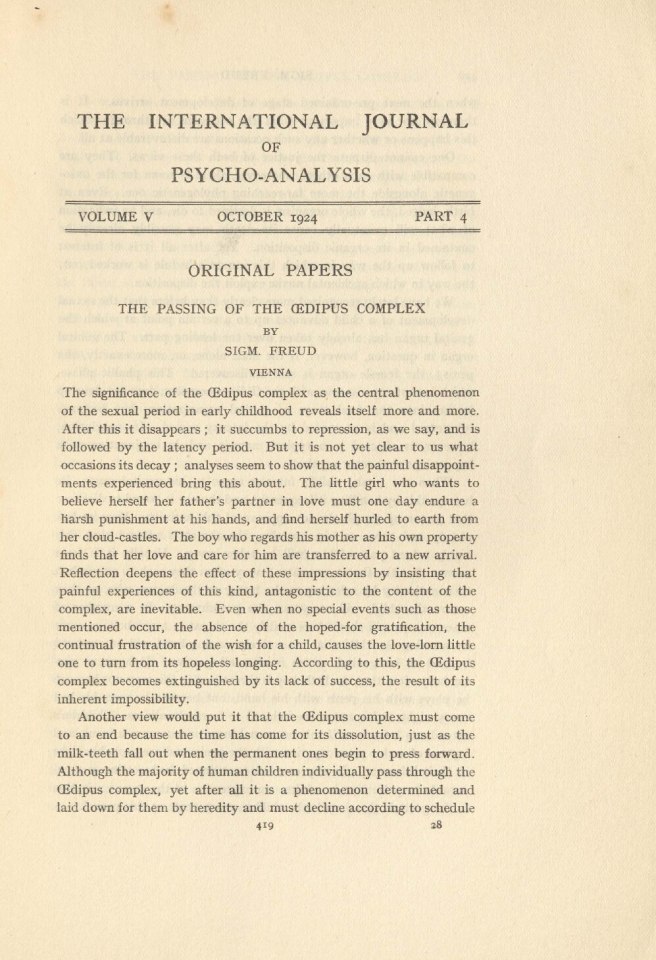
THE INTERNATIONAL JOURNAL
OF
PSYCHO-ANALYSIS
VOLUME V OCTOBER 1924 PART 4
ORIGINAL PAPERS
THE PASSING OF THE ŒDIPUS COMPLEX
BY
SIGM. FREUD
VIENNA
The significance of the Œdipus complex as the central phenomenon
of the sexual period in early childhood reveals itself more and more.
After this it disappears ; it succumbs to repression, as we say, and is
followed by the latency period. But it is not yet clear to us what
occasions its decay ; analyses seem to show that the painful disappoint-
ments experienced bring this about. The little girl who wants to
believe herself her father's partner in love must one day endure a
harsh punishment at his hands, and find herself hurled to earth from
her cloud-castles. The boy who regards his mother as his own property
finds that her love and care for him are transferred to a new arrival.
Reflection deepens the effect of these impressions by insisting that
painful experiences of this kind, antagonistic to the content of the
complex, are inevitable. Even when no special events such as those
mentioned occur, the absence of the hoped-for gratification, the
continual frustration of the wish for a child, causes the love-lorn little
one to turn from its hopeless longing. According to this, the Œdipus
complex becomes extinguished by its lack of success, the result of its
inherent impossibility.Another view would put it that the Œdipus complex must come
to an end because the time has come for its dissolution, just as the
milk-teeth fall out when the permanent ones begin to press forward.
Although the majority of human children individually pass through the
Œdipus complex, yet after all it is a phenomenon determined and
laid down for them by heredity and must decline according to scheduleS.
420
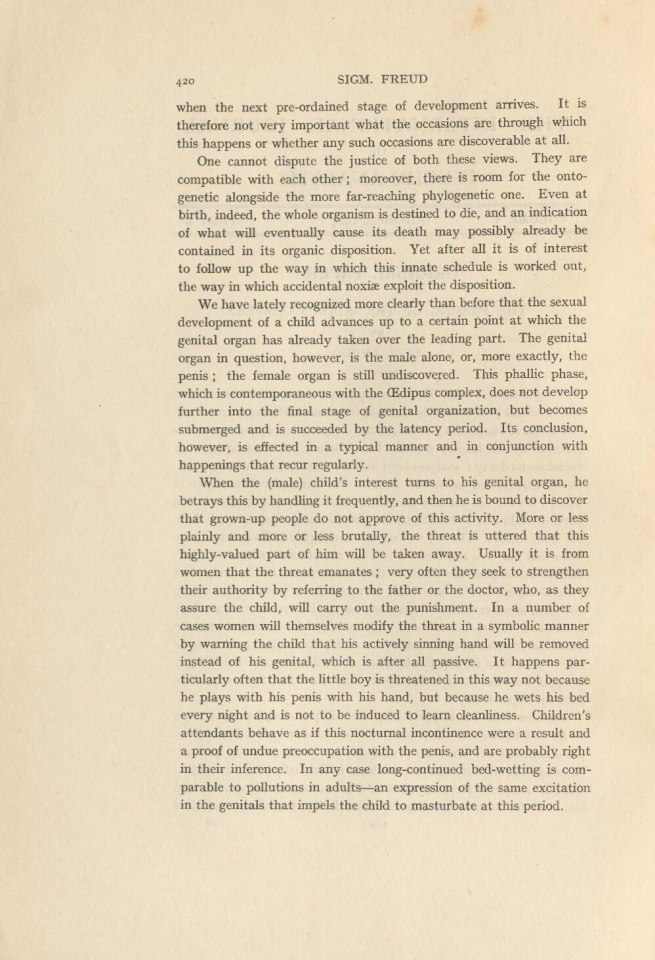
when the next pre-ordained stage of development arrives. It is
therefore not very important what the occasions are through which
this happens or whether any such occasions are discoverable at all.One cannot dispute the justice of both these views. They are
compatible with each other; moreover, there is room for the onto-
genetic alongside the more far-reaching phylogenetic one. Even at
birth, indeed, the whole organism is destined to die, and an indication
of what will eventually cause its death may possibly already be
contained in its organic disposition. Yet after all it is of interest
to follow up the way in which this innate schedule is worked out,
the way in which accidental noxiæ exploit the disposition.We have lately recognized more clearly than before that the sexual
development of a child advances up to a certain point at which the
genital organ has already taken over the leading part. The genital
organ in question, however, is the male alone, or, more exactly, the
penis; the female organ is still undiscovered. This phallic phase,
which is contemporaneous with the Œdipus complex, does not develop
further into the final stage of genital organization, but becomes
submerged and is succeeded by the latency period. Its conclusion,
however, is effected in a typical manner and in conjunction with
happenings that recur regularly.When the (male) child’s interest turns to his genital organ, he
betrays this by handling it frequently, and then he is bound to discover
that grown-up people do not approve of this activity. More or less
plainly and more or less brutally, the threat is uttered that this
highly-valued part of him will be taken away. Usually it is from
women that the threat emanates; very often they seek to strengthen
their authority by referring to the father or the doctor, who, as they
assure the child, will carry out the punishment. In a number of
cases women will themselves modify the threat in a symbolic manner
by warning the child that his actively sinning hand will be removed
instead of his genital, which is after all passive. It happens par-
ticularly often that the little boy is threatened in this way not because
he plays with his penis with his hand, but because he wets his bed
every night and is not to be induced to learn cleanliness. Children’s
attendants behave as if this nocturnal incontinence were a result and
a proof of undue preoccupation with the penis, and are probably right
in their inference. In any case long-continued bed-wetting is com-
parable to pollutions in adults—an expression of the same excitation
in the genitals that impels the child to masturbate at this period.S.
421
THE PASSING OF THE ŒDIPUS COMPLEX
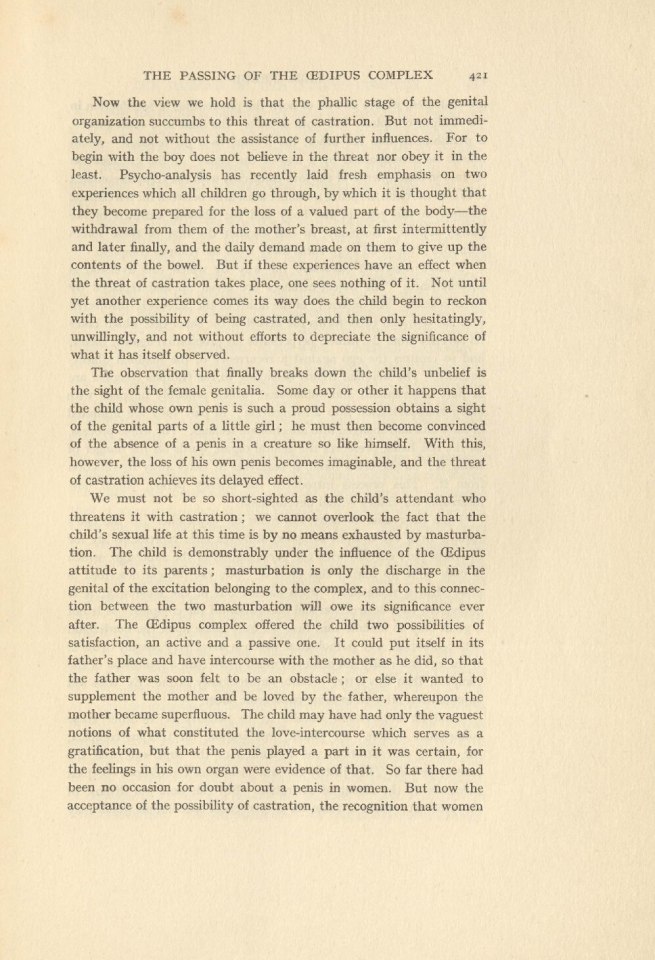
Now the view we hold is that the phallic stage of the genital
organization succumbs to this threat of castration. But not immedi-
ately, and not without the assistance of further influences. For to
begin with the boy does not believe in the threat nor obey it in the
least. Psycho-analysis has recently laid fresh emphasis on two
experiences which all children go through, by which it is thought that
they become prepared for the loss of a valued part of the body–the
withdrawal from them of the mother’s breast, at first intermittently
and later finally, and the daily demand made on them to give up the
contents of the bowel. But if these experiences have an effect when
the threat of castration takes place, one sees nothing of it. Not until
yet another experience comes its way does the child begin to reckon
with the possibility of being castrated, and then only hesitatingly,
unwillingly, and not without efforts to depreciate the significance of
what it has itself observed.The observation that finally breaks down the child’s unbelief is
the sight of the female genitalia. Some day or other it happens that
the child whose own penis is such a proud possession obtains a sight
of the genital parts of a little girl; he must then become convinced
of the absence of a penis in a creature so like himself. With this,
however, the loss of his own penis becomes imaginable, and the threat
of castration achieves its delayed effect.We must not be so short-sighted as the child’s attendant who
threatens it with castration; we cannot overlook the fact that the
child’s sexual life at this time is by no means exhausted by masturba-
tion. The child is demonstrably under the influence of the Œdipus
attitude to its parents; masturbation is only the discharge in the
genital of the excitation belonging to the complex, and to this connec-
tion between the two masturbation will owe its significance ever
after. The Œdipus complex offered the child two possibilities of
satisfaction, an active and a passive one. It could put itself in its
father’s place and have intercourse with the mother as he did, so that
the father was soon felt to be an obstacle; or else it wanted to
supplement the mother and be loved by the father, whereupon the
mother became superfluous. The child may have had only the vaguest
notions of what constituted the love-intercourse which serves as a
gratification, but that the penis played a part in it was certain, for
the feelings in his own organ were evidence of that. So far there had
been no occasion for doubt about a penis in women. But now the
acceptance of the possibility of castration, the recognition that womenS.
422
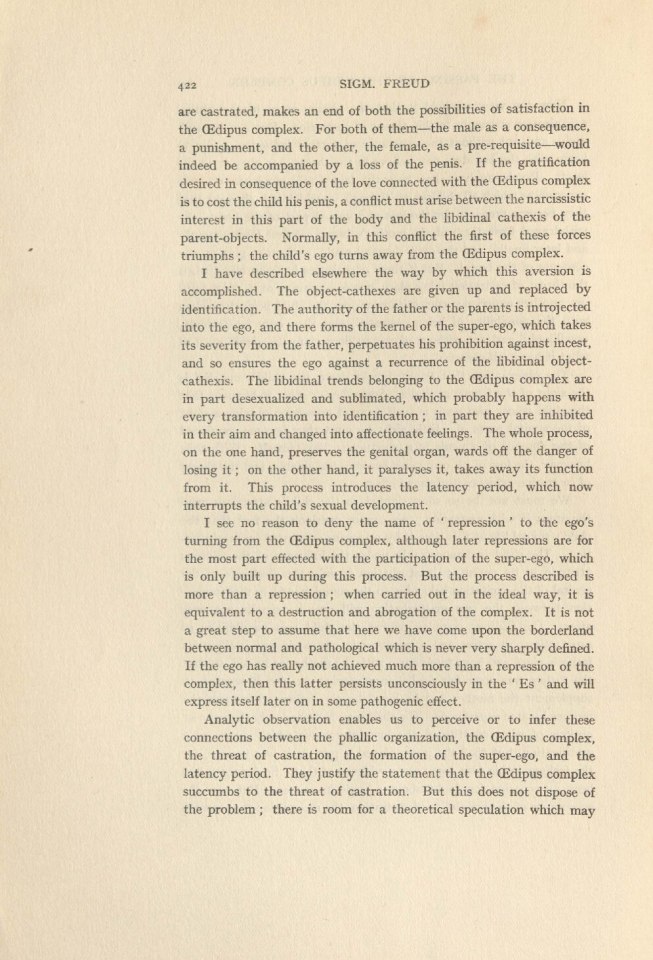
are castrated, makes an end of both the possibilities of satisfaction in
the Œdipus complex. For both of them–the male as a consequence,
a punishment, and the other, the female, as a pre-
requisite–would
indeed be accompanied by a loss of the penis. If the gratification
desired in consequence of the love connected with the Œdipus complex
is to cost the child his penis, a conflict must arise between the narcissistic
interest in this part of the body and the libidinal cathexis of the
parent-
objects. Normally, in this conflict the first of these forces
triumphs; the child’s ego turns away from the Œdipus complex.I have described elsewhere the way by which this aversion is
accomplished. The object-
cathexes are given up and replaced by
identification. The authority of the father or the parents is introjected
into the ego, and there forms the kernel of the super-
ego, which takes
its severity from the father, perpetuates his prohibition against incest,
and so ensures the ego against a recurrence of the libidinal object-
cathexis. The libidinal trends belonging to the Œdipus complex are
in part desexualized and sublimated, which probably happens with
every transformation into identification; in part they are inhibited
in their aim and changed into affectionate feelings. The whole process,
on the one hand, preserves the genital organ, wards off the danger of
losing it; on the other hand, it paralyses it, takes away its function
from it. This process introduces the latency period, which now
interrupts the child’s sexual development.I see no reason to deny the name of ‘repression’ to the ego’s
turning from the Œdipus complex, although later repressions are for
the most part effected with the participation of the super-
ego, which
is only built up during this process. But the process described is
more than a repression; when carried out in the ideal way, it is
equivalent to a destruction and abrogation of the complex. It is not
a great step to assume that here we have come upon the borderland
between normal and pathological which is never very sharply defined.
If the ego has really not achieved much more than a repression of the
complex, then this latter persists unconsciously in the ‘Es’ and will
express itself later on in some pathogenic effect.Analytic observation enables us to perceive or to infer these
connections between the phallic organization, the Œdipus complex,
the threat of castration, the formation of the super-
ego, and the
latency period. They justify the statement that the Œdipus complex
succumbs to the threat of castration. But this does not dispose of
the problem; there is room for a theoretical speculation which mayS.
423
THE PASSING OF THE ŒDIPUS COMPLEX
overthrow the results obtained or set them in a new light. Before we
traverse this path, however, we must attend to a question which was
already roused during this discussion and has long been left on one side.
The process described relates, as we expressly stated, only to the
male child. How is the corresponding development effected in a little
girl?Here our material—for some reason we do not understand—becomes
far more shadowy and incomplete. The female sex develops an
Œdipus complex too, a super-ego and a latency period. May one
ascribe to it also a phallic organization and a castration complex?
The answer is in the affirmative, but it cannot be the same as in the
boy. The feministic demand for equal rights between the sexes does
not carry far here; the morphological difference must express itself in
differences in the development of the mind. ‘Anatomy is Destiny’,
to vary a saying of Napoleon’s. The little girl’s clitoris behaves at
first just like a penis, but by comparing herself with a boy playfellow
the child perceives that she has ‘come off short’, and takes this fact
as ill-treatment and as a reason for feeling inferior. For a time she still
consoles herself with the expectation that later when she grows up
she will acquire just as big an appendage as a boy. Here the woman’s
‘masculine complex’ branches off. The female child does not under-
stand her actual loss as a sex characteristic, but explains it by assuming
that at some earlier date she had possessed a member which was just
as big and which had later been lost by castration. She does not seem
to extend this conclusion about herself on to other grown women, but
in complete accordance with the phallic phase she ascribes to them
large and complete, that is, male, genitalia. The result is an essential
difference between her and the boy, namely, that she accepts castration
as an established fact, an operation already performed, whereas the boy
dreads the possibility of its being performed.The castration-dread being thus excluded in her case, there falls
away a powerful motive towards forming the super-ego and breaking
up the infantile genital organization. These changes seem to be due
in the girl far more than in the boy to the results of educative influences,
of external intimidation threatening the loss of love. The Œdipus
complex in the girl is far simpler, less equivocal, than that of the little
possessor of a penis; in my experience it seldom goes beyond the wish
to take the mother’s place, the feminine attitude towards the father.
Acceptance of the loss of a penis is not endured without some attempt
at compensation. The girl passes over—by way of a symbolic analogy,S.
424
one may say—from the penis to a child ; her Œdipus complex culmi-
nates in the desire, which is long cherished, to be given a child by her
father as a present, to bear him a child. One has the impression that
the Œdipus complex is later gradually abandoned because this wish is
never fulfilled. The two desires, to possess a penis and to possess a
child, remain powerfully charged with libido in the unconscious and
help to prepare the woman’s nature for its subsequent sex rôle. The
comparative weakness of the sadistic component of the sexual instinct,
which may probably be related to the penis-deficiency, facilitates the
transformation of directly sexual trends into those inhibited in aim,
feelings of tenderness. It must be confessed, however, that on the
whole our insight into these processes of development in the girl is
unsatisfying, shadowy, and incomplete.I have no doubt that the temporal and causal relations described
between Œdipus complex, sexual intimidation (the threat of castration),
formation of the super-ego and advent of the latency period are of a
typical kind ; but I do not maintain that this type is the only possible
one. Variations in the sequence and the linking up of these processes
must be very significant in the development of the individual.Since the publication of Otto Rank’s interesting study on the trauma
of birth, the conclusion of the present modest communication—
that the boy’s Œdipus complex succumbs to the dread of castration—
cannot be accepted without further discussion. It seems to me
premature, however, to enter upon this discussion at the present time,
and perhaps also inadvisable to begin to criticize or to assess the value
of Rank’s view in the present connection.
The passing of the Œdipus complex
1924-003/1924.en
1924-003/1924.en
