-
S.
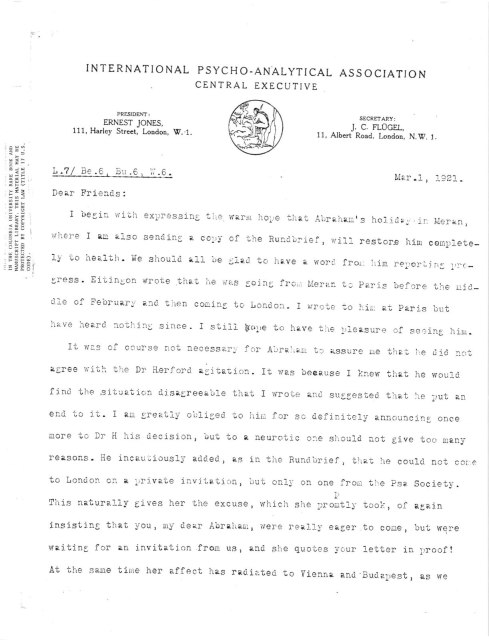
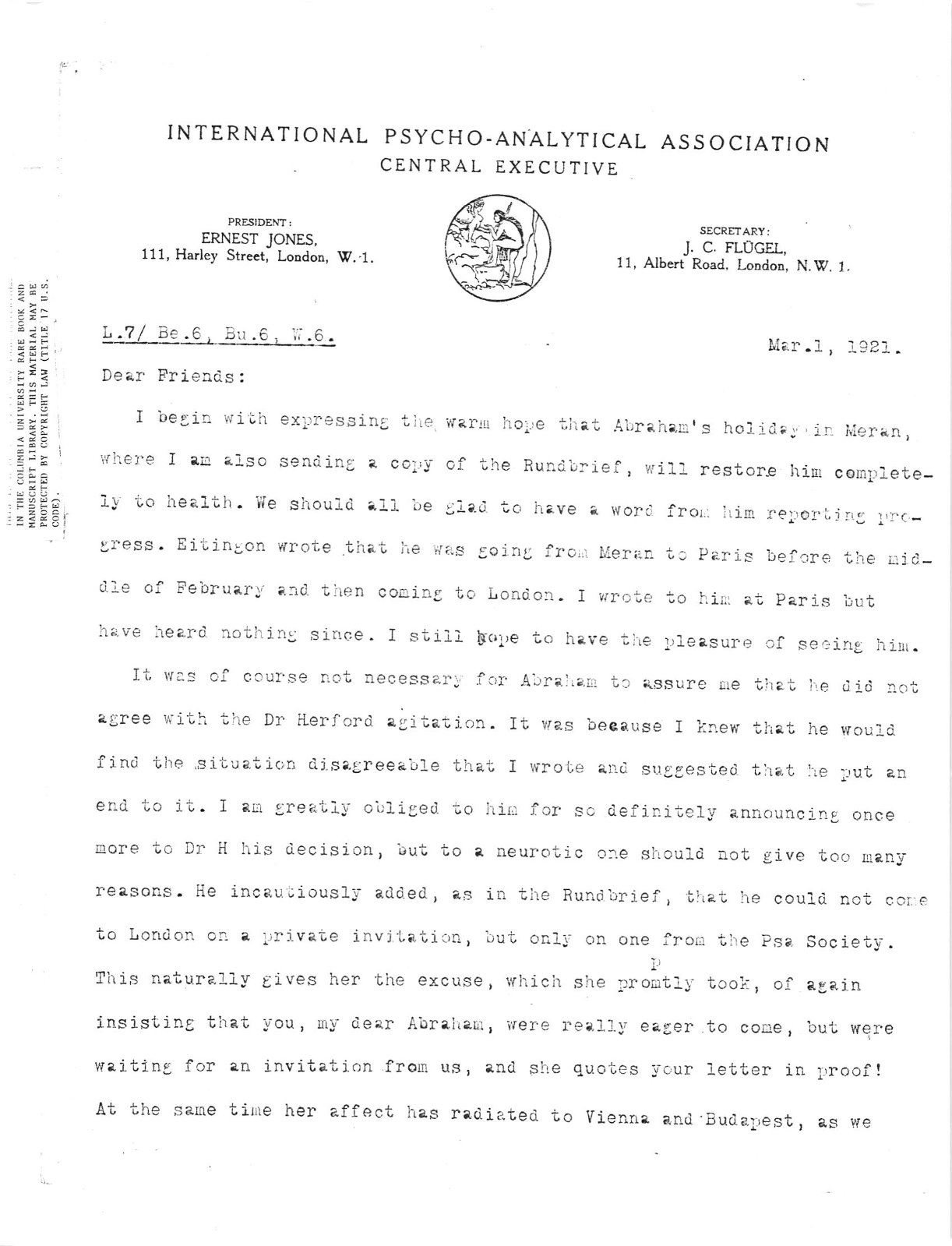
L.7 / Be.6, Bu.6, W.6.
Mar. 1, 1921.Dear Friends:
I begin with expressing the warm hope that Abraham's holiday in Meran,
where I am also sending a copy of the Rundbrief, will restore him complete-
ly to health. We should all be glad to have a word from him reporting pro-
gress. Eitingon wrote that he was going from Meran to Paris before the mid-
dle of February and then coming to London. I wrote to him at Paris but
have heard nothing since. I still hope to have the pleasure of seeing him.It was of course not necessary for Abraham to assure me that he did not
agree with the Dr Herford agitation. It was because I knew that he would
find the situation disagreeable that I wrote and suggested that he put an
end to it. I am greatly obliged to him for so definitely announcing once
more to Dr H his decision, but to a neurotic one should not give too many
reasons. He incautiously added, as in the Rundbrief, that he could not come
to London on a private invitation, but only on one from the Psa Society.
This naturally gives her the excuse, which she promptly took, of again
insisting that you, my dear Abraham, were really eager to come, but were
waiting for an invitation from us, and she quotes your letter in proof!At the same time her affect has radiated to Vienna and Budapest, as we
-
S.
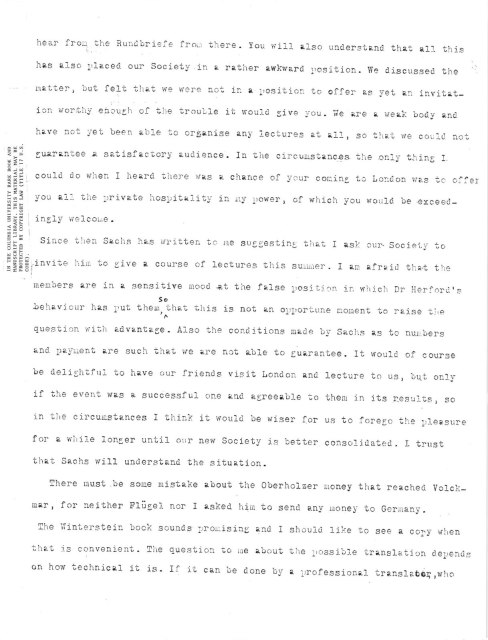
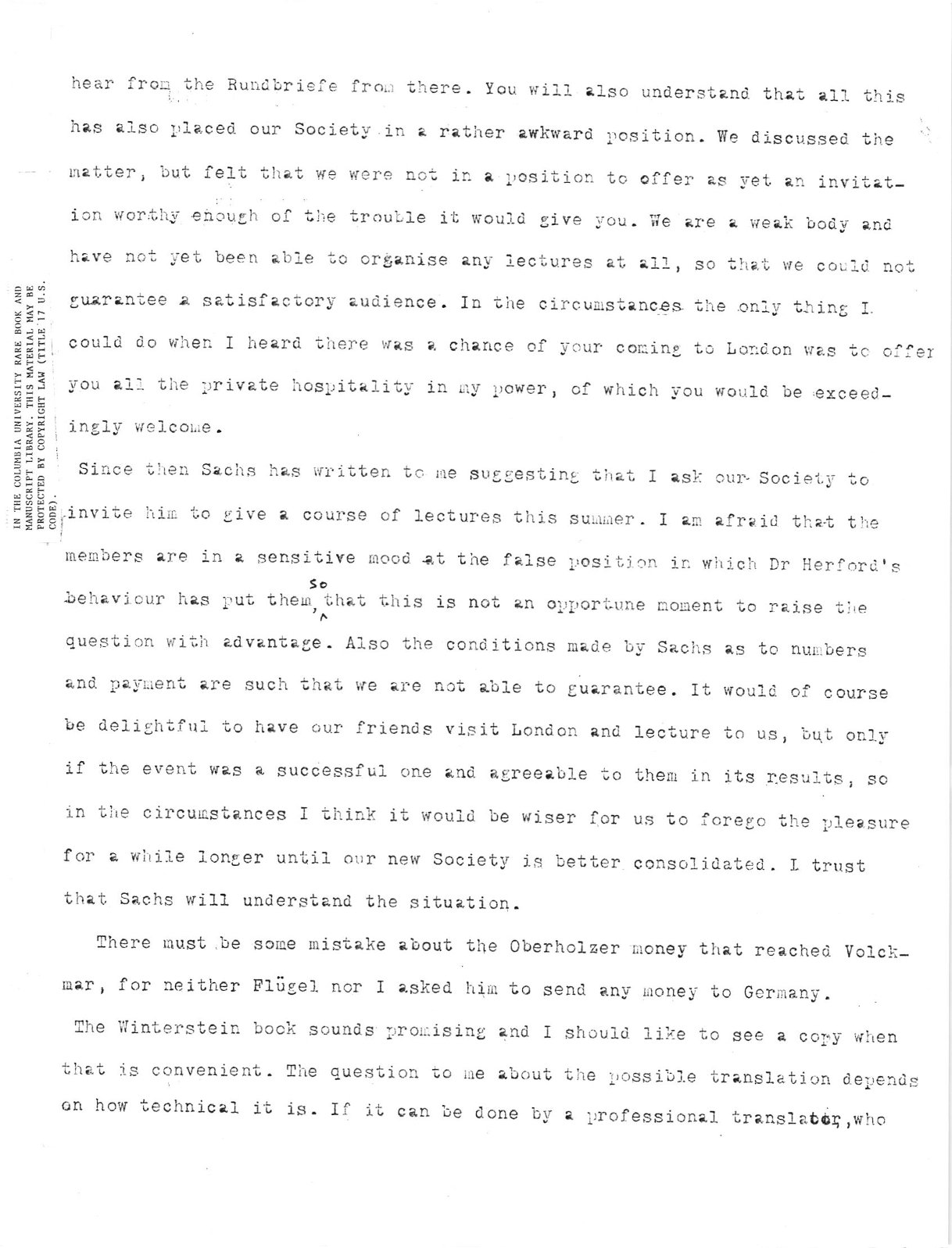
we hear from the Rundbriefe from there. You will understand that all this
has also placed our Society in a rather awkward position. We discussed the
matter, but felt that we were not in a position to offer as yet an invitat-
ion worthy enough of the trouble it would give you. We are a weak body and
have not yet been able to organise any lectures at all, so that we could not
guarantee a satisfactory audience. In the circumstances the only thing I
could do when I heard there was a chance of your coming to London was to offer
you all the private hospitality in my power, of which you would be exceed-
ingly welcome.Since then Sachs has written to me suggesting that I ask our Society to
invite him to give a course of lectures this summer. I am afraid that the
members are in a sensitive mood at the false position in which Dr Herford’s
behaviour has put them, so that this is not an opportune moment to raise the
question with advantage. Also the conditions made by Sachs as to numbers
and payment are such that we are not able to guarantee. It would of course
be delightful to have our friends visit London and lecture to us, but only
if the event was a successful one and agreeable to them in its results, so
in the circumstances I think it would be wise for us to forego the pleasure
for a while longer until our new Society is better consolidated. I trust
that Sachs will understand the situation.There must be some mistake about the Oberholzer money that reached Volck-
mar, for neither Flügel nor I asked him to send any money to Germany.The Winterstein book sounds promising and I should like to see a copy when
that is convenient. The question to me about the possible translation depends
on how technical it is. If it can be done by a professional translator, who -
S.
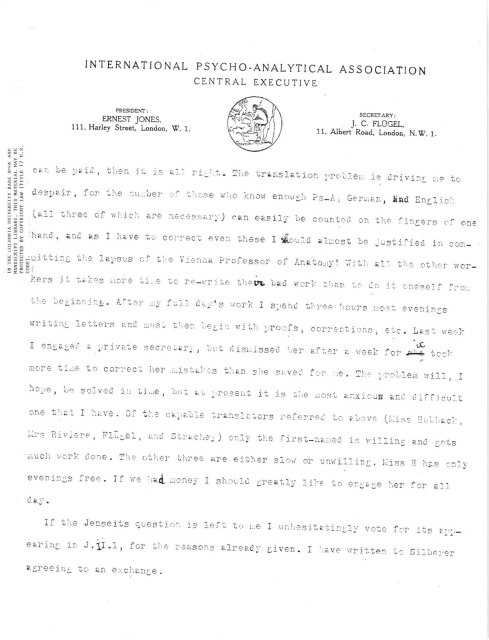
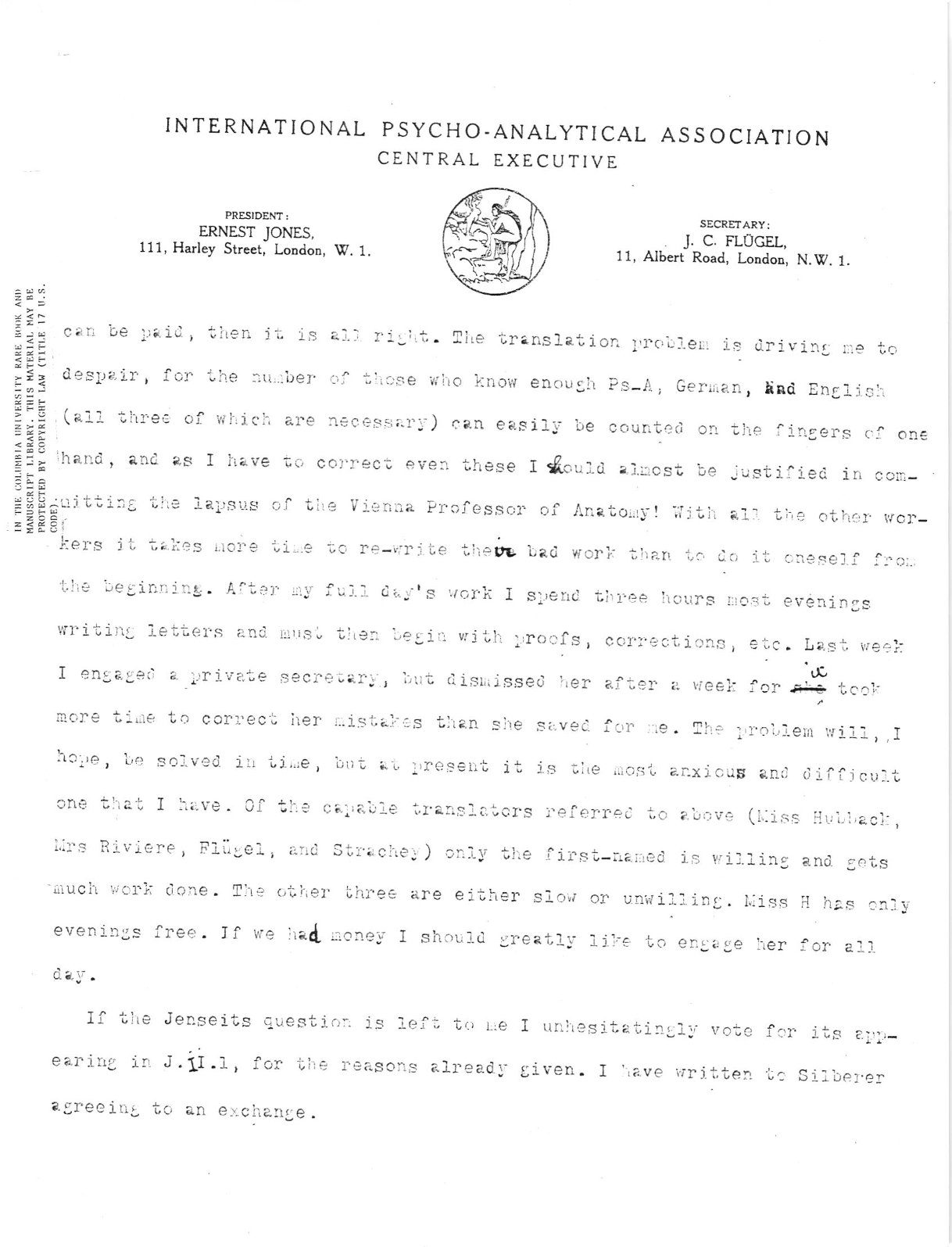
can be paid, then it is all right. The translation problem is driving me to
despair, for the number of those who know enough Ps-A, German, and English
(all three of which are necessary) can easily be counted on the fingers of one
hand, and as I have to correct even these I should almost be justified in com-
mitting the lapsus of the Vienna Professor of Anatomy! With all the other wor-
kers it takes more time to re-write the bad work than to do it oneself from
the beginning. After my full day’s work I spend three hours most evenings
writing letters and must then begin with proofs, corrections, etc. Last week
I engaged a private secretary, but dismissed her after a week for it took
more time to correct her mistakes than she saved for me. The problem will, I
hope, be solved in time, but at present it is the most anxious and difficult
one that I have. Of the capable translators referred to above (Miss Hubback,
Mrs Riviere, Flügel, and Strachey) only the first-named is willing and gets
much work done. The other three are either slow or unwilling. Miss H has only
evenings free. If we had money I should greatly like to engage her for all
day.If the Jenseits question is left to me I unhesitatingly vote for its app-
earing in J.ii, for the reasons already given. I have written to Silberer
agreeing to an exchange. -
S.
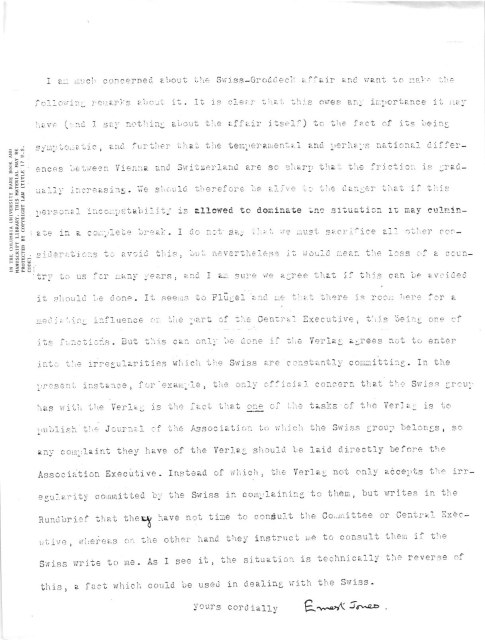
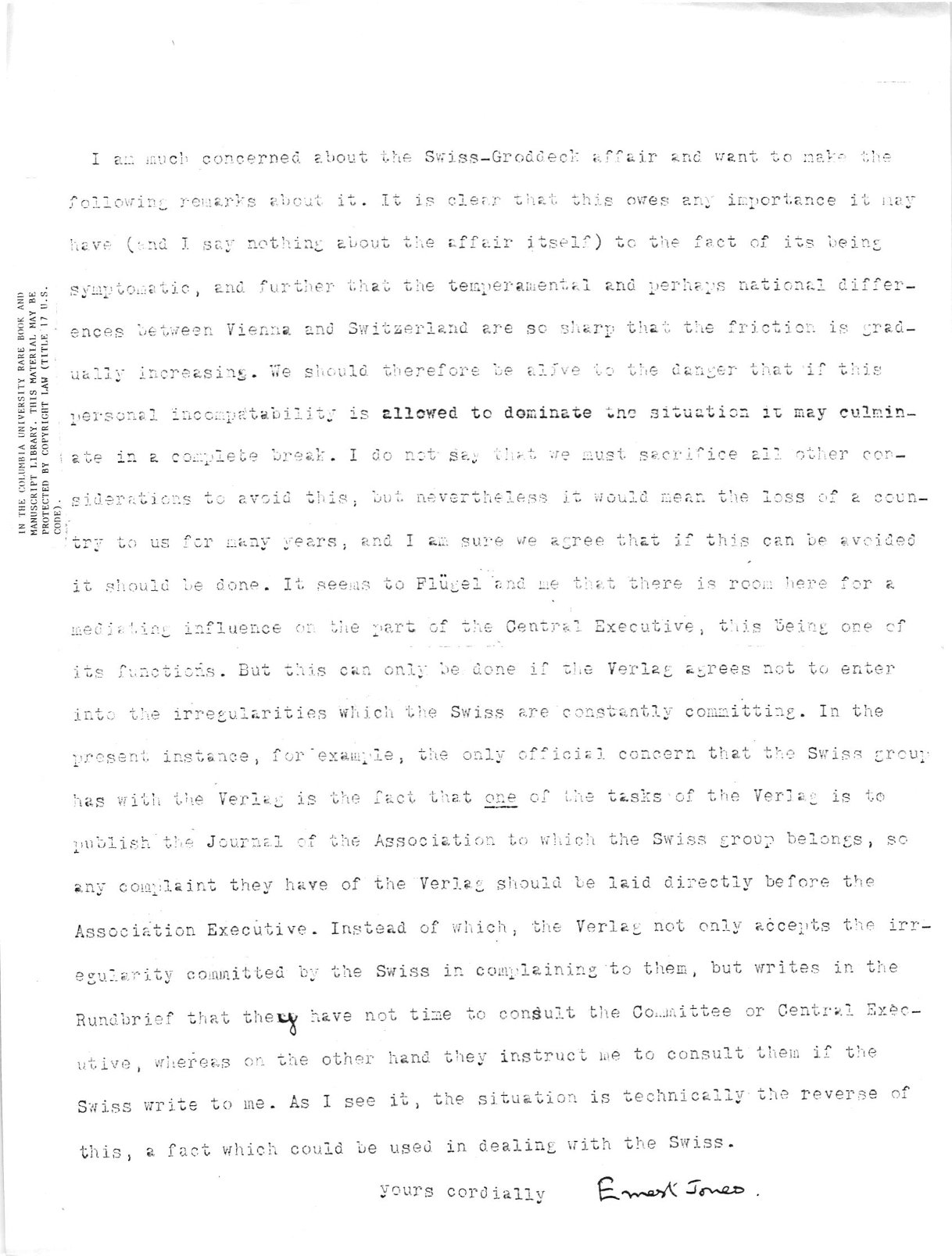
I am much concerned about the Swiss-Groddeck affair and want to make the
following remarks about it. It is clear that this owes any importance it may
have (and I say nothing about the affair itself) to the fact of its being
symptomatic, and further that the temperamental and perhaps national differ-
ences between Vienna and Switzerland are so sharp that the friction is grad-
ually increasing. We should therefore be alive to the danger that if this
personal incompatibility is allowed to dominate the situation it may culmin-
ate in a complete break. I do not say that we must sacrifice all other con-
siderations to avoid this, but nevertheless it would mean the loss of a coun-
try to us for many years, and I am sure we agree that if this can be avoided
it should be done. It seems to Flügel and me that there is room here for a
mediating influence on the part of the Central Executive, this being one of
its functions. But this can only be done if the Verlag agrees not to enter
into the irregularities which the Swiss are constantly committing. In the
present instance, for example, the only official concern that the Swiss group
has with the Verlag is the fact that one of the tasks of the Verlag is to
publish the Journal of the Association to which the Swiss group belongs, so
any complaint they have of the Verlag should be laid directly before the
Association Executive. Instead of which, the Verlag not only accepts the irr-
egularity committed by the Swiss in complaining to them, but writes in the
Rundbrief that they have not time to consult the Committee or Central Exec-
utive, whereas on the other hand they instruct me to consult them if the
Swiss write to me. As I see it, the situation is technically the reverse of
this, a fact which could be used in dealing with the Swiss.Yours cordially
Ernest Jones
- Geheimes Komitee
- Abraham, Karl
- Eitingon, Max
- Ferenczi, Sándor
- Freud, Sigmund
- Rank, Otto
- Sachs, Hanns
