S.
253
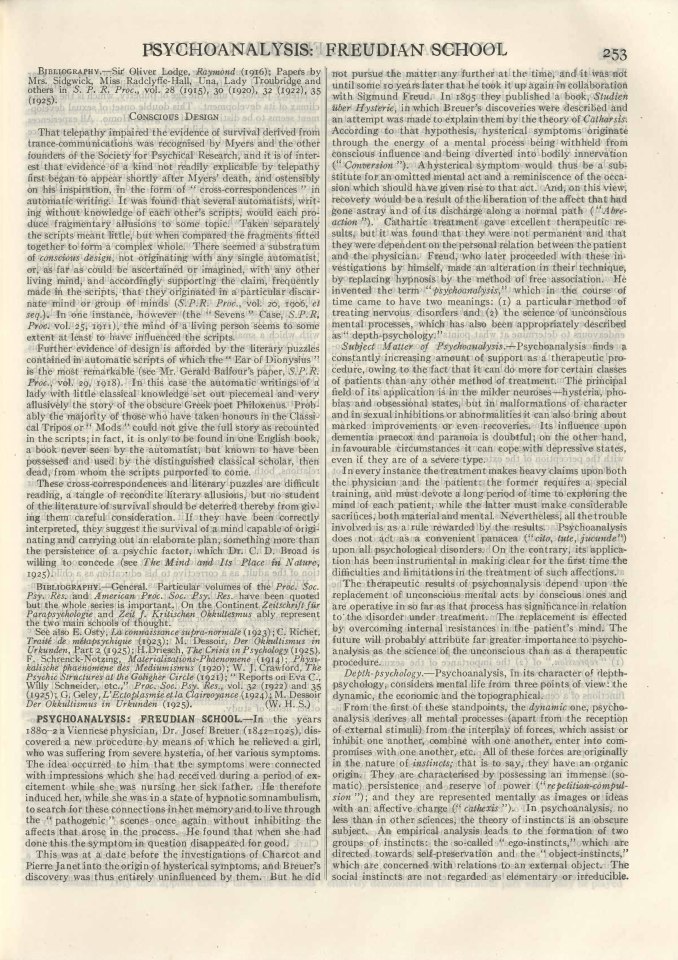
PSYCHOANALYSIS: FREUDIAN SCHOOL—In the years
1880–2 a Viennese physician, Dr. Josef Breuer (1842–1925), dis-
covered a new procedure by means of which he relieved a girl,
who was suffering from severe hysteria, of her various symptoms.
The idea occurred to him that the symptoms were connected
with impressions which she had received during a period of ex-
citement while she was nursing her sick father. He therefore
induced her, while she was in a state of hypnotic somnambulism,
to search for these connections in her memory and to live through
the “pathogenic” scenes once again without inhibiting the
affects that arose in the process. He found that when she had
done this the symptom in question disappeared for good. This
was at a date before the investigations of Charcot and
Pierre Janet into the origin of hysterical symptoms, and Breuer’s
discovery was thus entirely uninfluenced by them. But he didnot pursue the matter any further at the time, and it was not
until some 10 years later that he took it up again in collaboration
with Sigmund Freud. In 1895 they published a book, Studien
über Hysterie, in which Breuer’s discoveries were described and
an attempt was made to explain them by the theory of Catharsis.
According to that hypothesis, hysterical symptoms originate
through the energy of a mental process being withheld from
conscious influence and being diverted into bodily innervation
(“Conversion”). A hysterical symptom would thus be a sub-
stitute for an omitted mental act and a reminiscence of the occa-
sion which should have given rise to that act. And, on this view,
recovery would be a result of the liberation of the affect that had
been arrested and of its discharge along a normal path (“Abre-
action”). Cathartic treatment gave excellent therapeutic re-
sults, but it was found that they were not permanent and that
they were dependent on the personal relation between the patient
and the physician. Freud, who later proceeded with these in-
vestigations by himself, made an alteration in their technique,
by replacing hypnosis by the method of free association. He
invented the term “psychoanalysis,” which in the course of
time came to have two meanings: (1) a particular method of
treating nervous disorders and (2) the science of unconscious
mental processes, which has also been appropriately described
as “depth-psychology.”Subject Matter of Psychoanalysis—Psychoanalysis finds a
constantly increasing amount of support as a therapeutic pro-
cedure, owing to the fact that it can do more for certain classes
of patients than any other method of treatment. The principal
field of its application is in the milder neuroses—hysteria, pho-
bias and obsessional states, but in malformations of character
and in sexual inhibitions or abnormalities it can also bring about
marked improvements or even recoveries. Its influence upon
dementia praecox and paranoia is doubtful; on the other hand,
in favourable circumstances it can cope with depressive states,
even if they are of a severe type.In every instance the treatment makes heavy claims upon both
the physician and the patient; the former requires a special
training, and must devote a long period of time to exploring the
mind of each patient, while the latter must make considerable
sacrifices, both material and mental. Nevertheless, all the trouble
involved is as a rule rewarded by the results. Psychoanalysis
does not act as a convenient panacea (“cilo, tute, jucunde!”)
upon all psychological disorders. On the contrary, its applica-
tion has been instrumental in making clear for the first time the
difficulties and limitations in the treatment of such affections.The therapeutic results of psychoanalysis depend upon the
replacement of unconscious mental acts by conscious ones and
are operative in so far as that process has significance in relation
to the disorder under treatment. The replacement is effected
by overcoming internal resistances in the patient’s mind. The
future will probably attribute far greater importance to psycho-
analysis as the science of the unconscious than as a therapeutic
procedure.Depth-psychology—Psychoanalysis, in its character of depth
psychology, considers mental life from three points of view: the
dynamic, the economic and the topographical.From the first of these standpoints, the dynamic one, psycho-
analysis derives all mental processes (apart from the reception
of external stimuli) from the interplay of forces, which assist or
inhibit one another, combine with one another, enter into com-
promises with one another, etc. All of these forces are originally
in the nature of instincts; that is to say, they have an organic
origin. They are characterised by possessing an immense (so-
matic) persistence and a reserve of power (“repetition-compul-
sion”); and they are represented mentally as images or ideas
with an affective charge (“cathexis”). In psychoanalysis, no
less than in other sciences, the theory of instincts is an obscure
subject. An empirical analysis leads to the formation of two
groups of instincts: the so-called “ego-instincts,” which are
directed towards self-preservation and the “object-instincts,”
which are concerned with relations to an external object. The
social instincts are not regarded as elementary or irreducible.S.
254
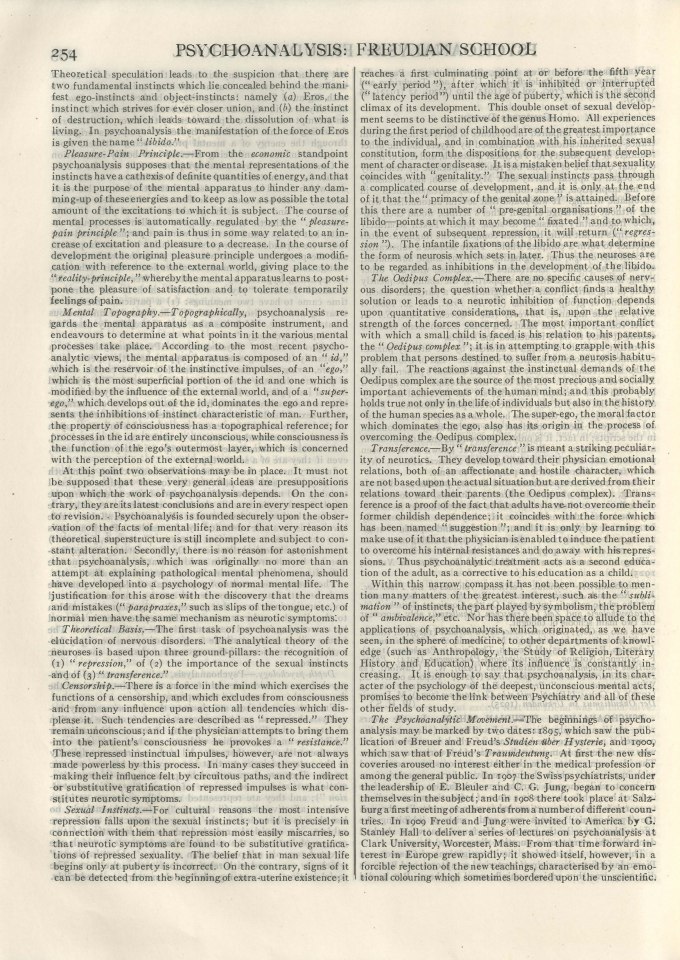
Theoretical speculation leads to the suspicion that there are
two fundamental instincts which lie concealed behind the mani-
fest ego-instincts and object-instincts: namely (a) Eros, the
instinct which strives for ever closer union, and (b) the instinct
of destruction, which leads toward the dissolution of what is
living. In psychoanalysis the manifestation of the force of Eros
is given the name “libido.” From the economic standpoint
psychoanalysis supposes that the mental representations of the
instincts have a cathexis of definite quantities of energy, and that
it is the purpose of the mental apparatus to hinder any dam-
ming-up of these energies and to keep as low as possible the total
amount of the excitations to which it is subject. The course of
mental processes is automatically regulated by the “pleasure-
pain principle”; and pain is thus in some way related to an in-
crease of excitation and pleasure to a decrease. In the course of
development the original pleasure principle undergoes a modifi-
cation with reference to the external world, giving place to the
“reality-principle,” whereby the mental apparatus learns to post-
pone the pleasure of satisfaction and to tolerate temporarily
feelings of pain.
Mental Topography.—Topographically, psychoanalysis re-
gards the mental apparatus as a composite instrument, and
endeavours to determine at what points in it the various mental
processes do take place. According to the most recent psycho-
analytic views, the mental apparatus is composed of an “id,”
which is the reservoir of the instinctive impulses, of an “ego,”
which is the most superficial portion of the id and one which is
modified by the influence of the external world, and of a “super-
ego,” which develops out of the id, dominates the ego and repre-
sents the inhibitions of instinct characteristic of man. Further,
the property of consciousness has a topographical reference; for
processes in the id are entirely unconscious, while consciousness is
the function of the ego’s outermost layer, which is concerned
with the perception of the external world.
At this point two observations may be in place. It must not
be supposed that these very general ideas are presuppositions
upon which the work of psychoanalysis depends. On the con-
trary, they are its latest conclusions and are in every respect open
to revision. Psychoanalysis is founded securely upon the obser-
vation of the facts of mental life; and for that very reason its
(theoretical superstructure is still incomplete and subject to con-
stant alteration. Secondly, there is no reason for astonishment
that psychoanalysis, which was originally no more than an
attempt at explaining pathological mental phenomena, should
have developed into a psychology of normal mental life. The
justification for this arose with the discovery that the dreams
and mistakes (“parapraxes,” such as slips of the tongue, etc.) of
normal men have the same mechanism as neurotic symptoms.
Theoretical Basis.—The first task of psychoanalysis was the
elucidation of nervous disorders. The analytical theory of the
neuroses is based upon three ground-pillars: the recognition of
(1) “repression,” of (2) the importance of the sexual instincts
and of (3) “transference.”
Censorship.—There is a force in the mind which exercises the
functions of a censorship, and which excludes from consciousness
and from any influence upon action all tendencies which dis-
please it. Such tendencies are described as “repressed.” They
remain unconscious; and if the physician attempts to bring them
into the patient’s consciousness he provokes a “resistance.”
These repressed instinctual impulses, however, are not always
made powerless by this process. In many cases they succeed in
making their influence felt by circuitous paths, and the indirect
or substitutive gratification of repressed impulses is what con-
stitutes neurotic symptoms.
Sexual Instincts.—For cultural reasons the most intensive
repression falls upon the sexual instincts; but it is precisely in
connection with them that repression most easily miscarries, so
that neurotic symptoms are found to be substitutive gratifica-
tions of repressed sexuality. The belief that in man sexual life
begins only at puberty is incorrect. On the contrary, signs of it
can be detected from the beginning of extra-uterine existence; it
reaches a first culminating point at or before the fifth year
(“early period”), after which it is inhibited or interrupted
(“latency period”) until the age of puberty, which is the second
climax of its development. This double onset of sexual develop-
ment seems to be distinctive of the genus Homo. All experiences
during the first period of childhood are of the greatest importance
to the individual, and in combination with his inherited sexual
constitution, form the dispositions for the subsequent develop-
ment of character or disease. It is a mistaken belief that sexuality
coincides with “genitality.” The sexual instincts pass through
a complicated course of development, and it is only at the end
of it that the “primacy of the genital zone” is attained. Before
this there are a number of “pre-genital organisations” of the
libido—points at which it may become “fixated,” and to which,
in the event of subsequent repression, it will return (“regres-
sion”). The infantile fixations of the libido are what determine
the form of neurosis which sets in later. Thus the neuroses are
to be regarded as inhibitions in the development of the libido.
The Oedipus Complex.—There are no specific causes of nerv-
ous disorders; the question whether a conflict finds a healthy
solution or leads to a neurotic inhibition of function depends
upon quantitative considerations, that is, upon the relative
strength of the forces concerned. The most important conflict
with which a small child is faced is his relation to his parents,
the “Oedipus complex”; it is in attempting to grapple with this
problem that persons destined to suffer from a neurosis habitu-
ally fail. The reactions against the instinctual demands of the
Oedipus complex are the source of the most precious and socially
important achievements of the human mind; and this probably
holds true not only in the life of individuals but also in the history
of the human species as a whole. The super-ego, the moral factor
which dominates the ego, also has its origin in the process of
overcoming the Oedipus complex.
Transference.—By “transference” is meant a striking peculiar-
ity of neurotics. They develop toward their physician emotional
relations, both of an affectionate and hostile character, which
are not based upon the actual situation but are derived from their
relations toward their parents (the Oedipus complex). Trans-
ference is a proof of the fact that adults have not overcome their
former childish dependence; it coincides with the force which
has been named “suggestion”; and it is only by learning to
make use of it that the physician is enabled to induce the patient
to overcome his internal resistances and do away with his repres-
sions. Thus psychoanalytic treatment acts as a second educa-
tion of the adult, as a corrective to his education as a child.
Within this narrow compass it has not been possible to men-
tion many matters of the greatest interest, such as the “subli-
mation” of instincts, the part played by symbolism, the problem
of “ambivalence,” etc. Nor has there been space to allude to the
applications of psychoanalysis, which originated, as we have
seen, in the sphere of medicine, to other departments of knowl-
edge (such as Anthropology, the Study of Religion, Literary
History and Education) where its influence is constantly in-
creasing. It is enough to say that psychoanalysis, in its char-
acter of the psychology of the deepest, unconscious mental acts,
promises to become the link between Psychiatry and all of these
other fields of study.
The Psychoanalytic Movement.—The beginnings of psycho-
analysis may be marked by two dates: 1895, which saw the pub-
lication of Breuer and Freud’s Studien über Hysterie, and 1900,
which saw that of Freud’s Traumdeutung. At first the new dis-
coveries aroused no interest either in the medical profession or
among the general public. In 1907 the Swiss psychiatrists, under
the leadership of E. Bleuler and C. G. Jung, began to concern
themselves in the subject; and in 1908 there took place at Salz-
burg a first meeting of adherents from a number of different coun-
tries. In 1909 Freud and Jung were invited to America by G.
Stanley Hall to deliver a series of lectures on psychoanalysis at
Clark University, Worcester, Mass. From that time forward in-
terest in Europe grew rapidly; it showed itself, however, in a
forcible rejection of the new teachings, characterised by an emo-
tional colouring which sometimes bordered upon the unscientific.S.
355
PSYCHOLOGY
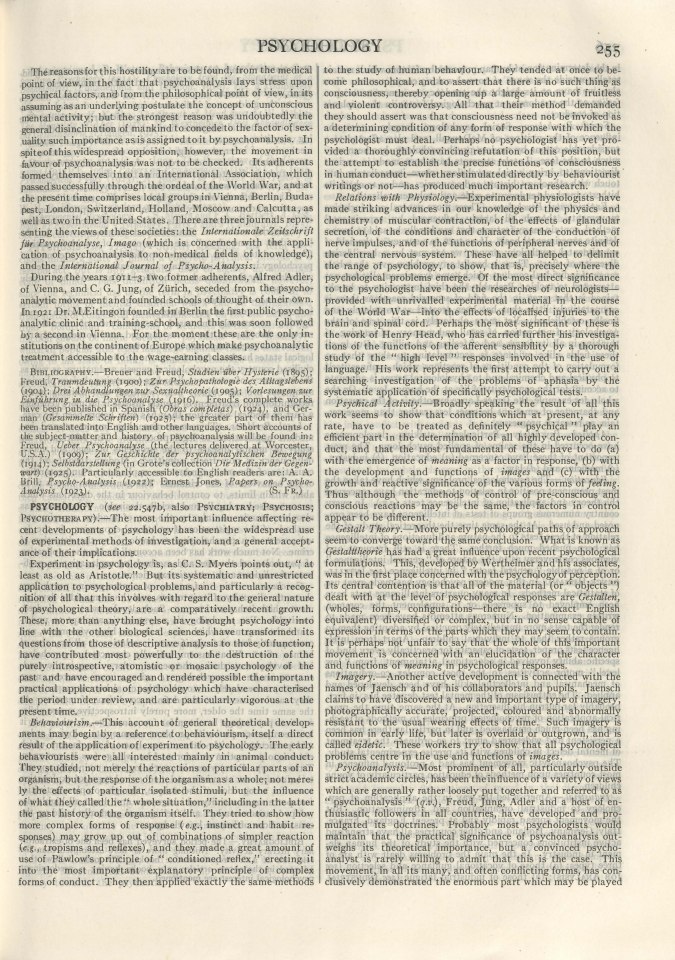
The reasons for this hostility are to be found, from the medical
point of view, in the fact that psychoanalysis lays stress upon
psychical factors, and from the philosophical point of view, in its
assuming as an underlying postulate the concept of unconscious
mental activity; but the strongest reason was undoubtedly the
general disinclination of mankind to concede to the factor of sex-
uality such importance as is assigned to it by psychoanalysis. In
spite of this widespread opposition, however, the movement in
favour of psychoanalysis was not to be checked. Its adherents
formed themselves into an International Association, which
passed successfully through the ordeal of the World War, and at
the present time comprises local groups in Vienna, Berlin, Buda-
pest, London, Switzerland, Holland, Moscow and Calcutta, as
well as two in the United States. There are three journals repre-
senting the views of these societies: the Internationale Zeitschrift
für Psychoanalyse, Imago (which is concerned with the appli-
cation of psychoanalysis to non-medical fields of knowledge),
and the International Journal of Psycho-Analysis.During the years 1911–3, two former adherents, Alfred Adler,
of Vienna, and C. G. Jung, of Zürich, seceded from the psycho-
analytic movement and founded schools of thought of their own.
In 1921 Dr. M. Eitingon founded in Berlin the first public psycho-
analytic clinic and training-school, and this was soon followed
by a second in Vienna. For the moment these are the only in-
stitutions on the continent of Europe which make psychoanalytic
treatment accessible to the wage-earning classes.BIBLIOGRAPHY.—Breuer and Freud, Studien über Hysterie (1895);
Freud, Traumdeutung (1900); Zur Psychopathologie des Alltagslebens
(1904); Drei Abhandlungen zur Sexualtheorie (1905); Vorlesungen zur
Einführung in die Psychoanalyse (1916). Freud’s complete works
have been published in Spanish (Obras completas) (1924), and Ger-
man (Gesammelte Schriften) (1925); the greater part of them has
been translated into English and other languages. Short accounts of
the subject-matter and history of psychoanalysis will be found in:
Freud, Ueber Psychoanalyse (the lectures delivered at Worcester,
U.S.A.) (1909); Zur Geschichte der Psychoanalytischen Bewegung
(1914); Selbstdarstellung (in Grote’s collection Die Medizin der Gegen-
wart) (1925). Particularly accessible to English readers are: A. A. Brill,
Psycho-Analysis (1922); Ernest Jones, Papers on Psycho-
Analysis (1923).S.
THE
ENCYCLOPÆDIA BRITANNICA
A DICTIONARY OF ARTS,
SCIENCES, LITERATURE
& GENERAL INFORMATIONThe Three New Supplementary Volumes
constituting with the Volumes of the
Latest Standard EditionTHE THIRTEENTH EDITION
VOLUME III
PACIFIC to ZUYDER ZEE
and INDEXLONDON
THE ENCYCLOPÆDIA BRITANNICA COMPANY, LTD.
NEW YORK
THE ENCYCLOPÆDIA BRITANNICA, INC.
Psychoanalysis: Freudian school
1926-021/1926
1926-021/1926
