Freud, Sigmund (1896-002/1912.en): Further Observations on the Defense-Neuropsychoses
S.
155
CHAPTER VII.
FURTHER OBSERVATIONS ON THE DEFENSE-NEUROPSYCHOSES.
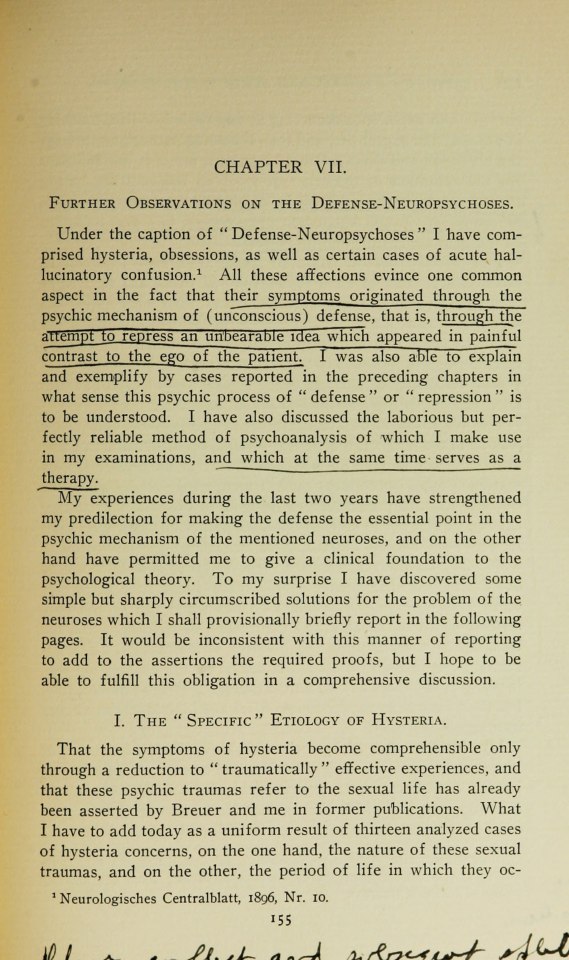
Under the caption of “Defense-Neuropsychoses” I have com-
prised hysteria, obsessions, as well as certain cases of acute hal-
lucinatory confusion.1 All these affections evince one common
aspect in the fact that their symptoms originated through the
psychic mechanism of (unconscious) defense, that is, through the
attempt to repress an unbearable idea which appeared in painful
contrast to the ego of the patient. I was also able to explain
and exemplify by cases reported in the preceding chapters in
what sense this psychic process of “defense” or “repression” is
to be understood. I have also discussed the laborious but per-
fectly reliable method of psychoanalysis of which I make use
in my examinations, and which at the same time serves as a
therapy.My experiences during the last two years have strengthened
my predilection for making the defense the essential point in the
psychic mechanism of the mentioned neuroses, and on the other
hand have permitted me to give a clinical foundation to the
psychological theory. To my surprise I have discovered some
simple but sharply circumscribed solutions for the problem of the
neuroses which I shall provisionally briefly report in the following
pages. It would be inconsistent with this manner of reporting
to add to the assertions the required proofs, but I hope to be
able to fulfill this obligation in a comprehensive discussion.I. THE “SPECIFIC” ETIOLOGY OF HYSTERIA.
That the symptoms of hysteria become comprehensible only
through a reduction to “traumatically” effective experiences, and
that these psychic traumas refer to the sexual life has already
been asserted by Breuer and me in former publications. What
I have to add today as a uniform result of thirteen analyzed cases
of hysteria concerns, on the one hand, the nature of these sexual
traumas, and on the other, the period of life in which they oc-
cur.1Neurologisches Centralblatt, 1896, Nr. 10.
S.
156
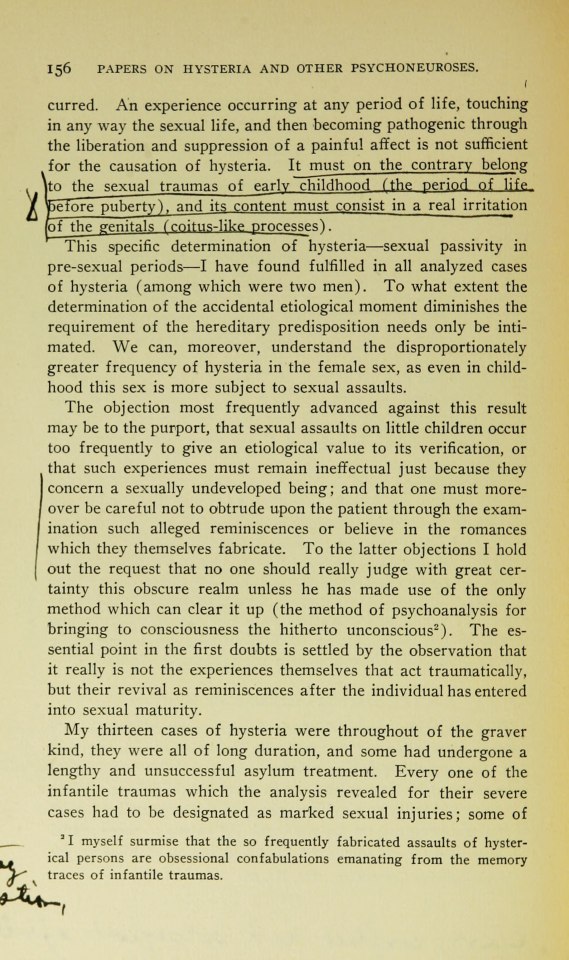
curred. An experience occurring at any period of life, touching
in any way the sexual life, and then becoming pathogenic through
the liberation and suppression of a painful affect is not sufficient
for the causation of hysteria. It must on the contrary belong
to the sexual traumas of early childhood (the period of life
before puberty), and its content must consist in a real irritation
of the genitals (coitus-
like processes).This specific determination of hysteria–sexual passivity in
pre-
sexual periods–I have found fulfilled in all analyzed cases
of hysteria (among which were two men). To what extent the
determination of the accidental etiological moment diminishes the
requirement of the hereditary predisposition needs only be inti-
mated. We can, moreover, understand the disproportionately
greater frequency of hysteria in the female sex, as even in child-
hood this sex is more subject to sexual assaults.The objection most frequently advanced against this result
may be to the purport, that sexual assaults on little children occur
too frequently to give an etiological value to its verification, or
that such experiences must remain ineffectual just because they
concern a sexually undeveloped being; and that one must more
over be careful not to obtrude upon the patient through the exam-
ination such alleged reminiscences or believe in the romances
which they themselves fabricate. To the latter objections I hold
out the request that no one should really judge with great cer-
tainty this obscure realm unless he has made use of the only
method which can clear it up (the method of psychoanalysis for
bringing to consciousness the hitherto unconscious2)). The es-
sential point in the first doubts is settled by the observation that
it really is not the experiences themselves that act traumatically,
but their revival as reminiscences after the individual has entered
into sexual maturity.My thirteen cases of hysteria were throughout of the graver
kind, they were all of long duration, and some had undergone a
lengthy and unsuccessful asylum treatment. Every one of the
infantile traumas which the analysis revealed for their severe
cases had to be designated as marked sexual injuries; some of2)I myself surmise that the so frequently fabricated assaults of hyster-
ical persons are obsessional confabulations emanating from the memory
traces of infantile traumas.S.
157
them were indeed abominable. Among the persons who were
guilty of such serious abuse we have in the first place nurses,
governesses, and other servants to whom children are left much
too carelessly, then in regrettable frequency come the teachers;
but in seven of the thirteen cases we dealt with innocent childish
offenders, mostly brothers who for years entertained sexual re-
lations with their younger sisters. The course of events always
resembled some of the cases which could with certainty be tracked,
namely, that the boy had been abused by a person of the feminine
sex, thus awakening in him prematurely the libido, and that after
a few years he repeated in sexual aggression on his sister the
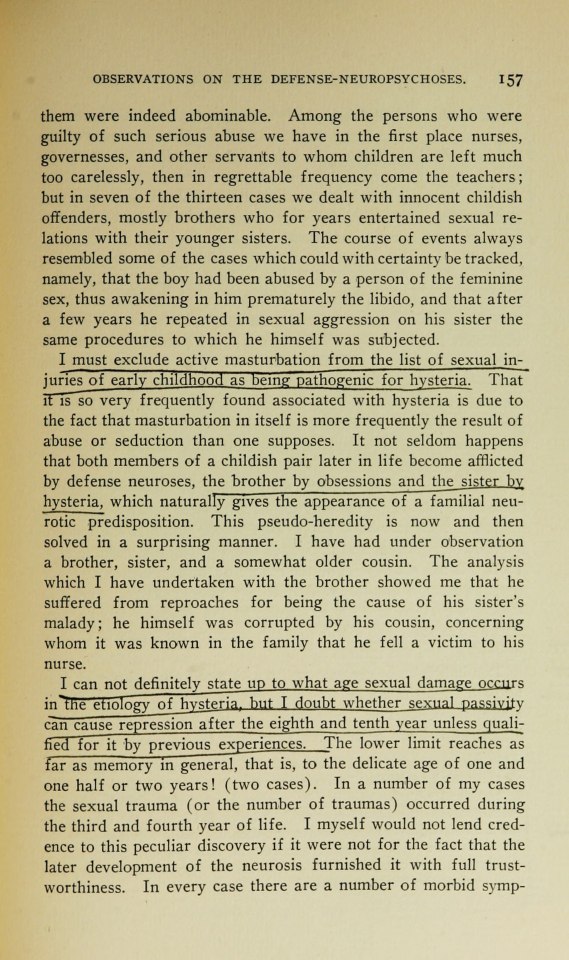
same procedures to which he himself was subjected.I must exclude active masturbation from the list of sexual in-
juries of early childhood as being pathogenic for hysteria. That
it is so very frequently found associated with hysteria is due to
the fact that masturbation in itself is more frequently the result of
abuse or seduction than one supposes. It not seldom happens
that both members of a childish pair later in life become afflicted
by defense neuroses, the brother by obsessions and the sister by
hysteria, which naturally gives the appearance of a familial neu-
rotic predisposition. This pseudo-heredity is now and then
solved in a surprising manner. I have had under observation
a brother, sister, and a somewhat older cousin. The analysis
which I have undertaken with the brother showed me that he
suffered from reproaches for being the cause of his sister’s
malady; he himself was corrupted by his cousin, concerning
whom it was known in the family that he fell a victim to his
nurse.I can not definitely state up to what age sexual damage occurs
in the etiology of hysteria, but I doubt whether sexual passivity
can cause repression after the eighth and tenth year unless quali-
fied for it by previous experiences. The lower limit reaches as
far as memory in general, that is, to the delicate age of one and
one half or two years! (two cases). In a number of my cases
the sexual trauma (or the number of traumas) occurred during
the third and fourth year of life. I myself would not lend cred-
ence to this peculiar discovery if it were not for the fact that the
later development of the neurosis furnished it with full trust-
worthiness. In every case there are a number of morbid symp-
tomsS.
158
toms, habits and phobias which are only explainable by return-
ing to those youthful experiences, and the logical structure of the
neurotic manifestation makes it impossible to reject the faithfully
retained memories of childhood. Except through psychoanalysis
it is of no avail to ask a hysterical patient about these infantile
traumas; their remains can only be found in the morbid symp-
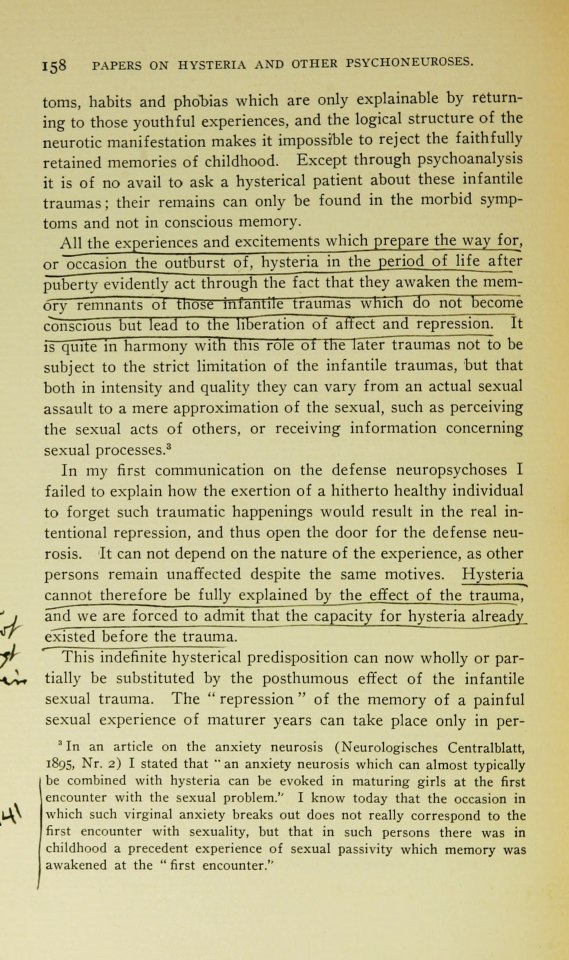
toms and not in conscious memory.All the experiences and excitements which prepare the way for,
or occasion the outburst of, hysteria in the period of life after
puberty evidently act through the fact that they awaken the mem-
ory remnants of those infantile traumas which do not become
conscious but lead to the liberation of affect and repression. It
is quite in harmony with this role of the later traumas not to be
subject to the strict limitation of the infantile traumas, but that
both in intensity and quality they can vary from an actual sexual
assault to a mere approximation of the sexual, such as perceiving
the sexual acts of others, or receiving information concerning
sexual processes.3In my first communication on the defense psychoneuroses I
failed to explain how the exertion of a hitherto healthy individual
to forget such traumatic happenings would result in the real in-
tentional repression, and thus open the door for the defense neu-
rosis. It can not depend on the nature of the experience, as other
persons remain unaffected despite the same motives. Hysteria
cannot therefore be fully explained by the effect of the trauma,
and we are forced to admit that the capacity for hysteria already
existed before the trauma.This indefinite hysterical predisposition can now wholly or par- tially be substituted by the posthumous effect of the infantile
sexual trauma. The “repression” of the memory of a painful
sexual experience of maturer years can take place only in per-3In an article on the anxiety neurosis (Neurologisches Centralblatt,
1895, Nr. 2) I stated that “an anxiety neurosis which can almost typically
be combined with hysteria can be evoked in maturing girls at the first
encounter with the sexual problem.” I know today that the occasion in
which such virginal anxiety breaks out does not really correspond to the
first encounter with sexuality, but that in such persons there was in
childhood a precedent experience of sexual passivity which memory was
awakened at the “first encounter.”S.
159
sons in whom this experience can bring into activity the memory
remnants of an infantile trauma.4)The prerequisite of obsessions is also a sexual infantile exper-
ience, but of a different nature than that of hysteria. The
etiology of both defense neuroses now shows the follow-
ing relation to the etiology of both simple neuroses, neurasthenia
and anxiety neurosis. As I have shown above, both the latter
neuroses are the direct results of the sexual noxas alone, while
both defense neuroses are the direct results of sexual noxas which
acted before the appearance of sexual maturity that is, they are
the results of the psychic memory remnants of these noxas. Theactual causes producing neurasthenia and anxiety neurosis simul-
taneously play the rôle of inciting causes of the defense neuroses,
and on the other hand, the specific causes of the defense neuroses,
the infantile traumas, may simultaneously prepare the soil for
the later developing neurasthenia. Finally it not seldom happens
that the existence of a neurasthenia or anxiety neurosis is only
preserved by continued recollection of an infantile trauma rather
than by actual sexual injuries.4)A psychological theory of the repression ought also to inform us why
only ideas of a sexual content can be repressed. It may be formulated
as follows: It is known that ideas of a sexual content produce exciting
processes in the genitals resembling the actual sexual experience. It may
be assumed that this somatic excitement becomes transformed into psychic.
As a rule the activity referred to is much stronger at the time of the
occurrence than at the recollection of the same. But if the sexual ex-
perience takes place during the time of sexual immaturity and the recol-
lection of the same is awakened during or after maturity, the recollection
then acts disproportionately more exciting than the previous experience,
for puberty has in the mean time incomparably increased the reactive
capacity of the sexual apparatus. But such an inverse proportion seems
to contain the psychological determination of repression. Through the
retardation of the pubescent maturity in comparison with the psychic
function, the sexual life offers the only existing possibility for that in-
version of the relative efficacy. The infantile traumas subsequently act
like fresh experiences, but they are then unconscious. Deeper psycho-
logical discussions I will have to postpone for another time. I moreover
call attention to the fact that the here considered time of “sexual ma-
turity” does not coincide with puberty, but occurs before the same (eight
to ten years).S.
160
II. THE ESSENCE AND MECHANISM OF COMPULSION NEUROSIS.
Sexual experiences of early childhood have the same signifi-
cance in the etiology of the compulsion neurosis as in hysteria,
still we no longer deal here with sexual passivity but with pleas-
urably accomplished aggressions, and with pleasurably exper-
ienced participation in sexual acts, that is, we deal here with
sexual activity. It is due to this difference in the etiological re-
lations that the masculine sex seems to be preferred in the com-
pulsion neurosis.In all my cases of compulsion neurosis I have found besides a
sub-soil of hysterical symptoms which could be traced to a pleas-
urable action of sexual passivity from a precedent scene. I pre-
sume that this coincidence is a lawful one and that premature
sexual aggression always presupposes an experience of seduction.
But I am unable to present as yet a complete description of the
etiology of the compulsion neurosis. I only believe that the final
determination as to whether a hysteria or compulsion neurosis
should originate on the basis of infantile traumas depends on the
temporal relation of the development of the libido.The essence of the compulsion neurosis may be expressed in
the following simple formula: Obsessions are always trans-
formed reproaches returning from the repression which always
refer to a pleasurably accomplished sexual action of childhood.
In order to elucidate this sentence it will be necessary to describe
the typical course of compulsion neurosis.In a first period—period of childish immorality—the events
containing the seeds of the later neurosis take place. In the ear-
liest childhood there appear at first the experiences of sexual se-
duction which later makes the repression possible, and this is fol-
lowed by the actions of sexual aggressions against the other sex
which later manifest themselves as actions of reproach.This period is brought to an end by the appearance of the—
often self ripened—sexual “maturity.” A reproach then attaches
itself to the memory of that pleasurable action, and the connection
with the initial experience of passivity makes it possible—often
only after conscious and recollected effort—to repress it and re-
place it by a primary symptom of defense. The third period, that
of apparent healthiness but really of successful defense, begins
with the symptoms of scrupulousness, shame and diffidence.


