S.
ALBERT EINSTEIN
S.

S.
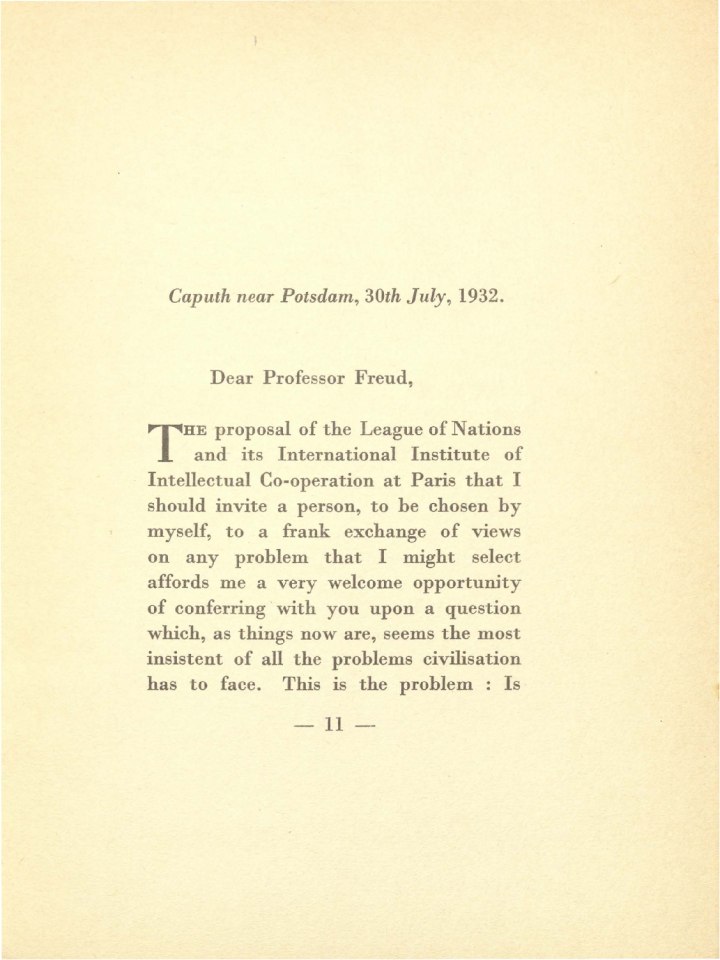
Caputh near Potsdam, 30th July, 1932.
Dear Professor Freud,
THE proposal of the League of Nations
and its International Institute of
Intellectual Co-operation at Paris that I
should invite a person, to be chosen by
myself, to a frank exchange of views
on any problem that I might select
affords me a very welcome opportunity
of conferring with you upon a question
which, as things now are, seems the most
insistent of all the problems civilisation
has to face. This is the problem : Is11
S.
12
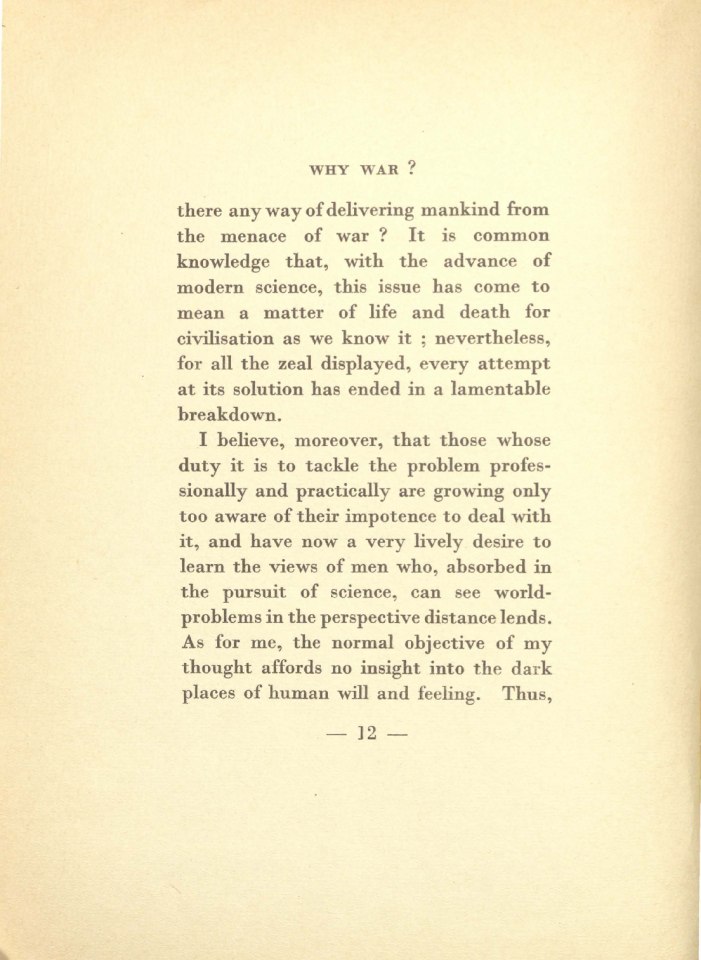
WHY WAR ?
there any way of delivering mankind from
the menace of war ? It is common
knowledge that, with the advance of
modern science, this issue has come to
mean a matter of life and death for
civilisation as we know it ; nevertheless,
for all the zeal displayed, every attempt
at its solution has ended in a lamentable
breakdown.I believe, moreover, that those whose
duty it is to tackle the problem profes-
sionally and practically are growing only
too aware of their impotence to deal with
it, and have now a very lively desire to
learn the views of men who, absorbed in
the pursuit of science, can see world-
problems in the perspective distance lends.
As for me, the normal objective of my
thought affords no insight into the dark
places of human will and feeling. Thus,S.
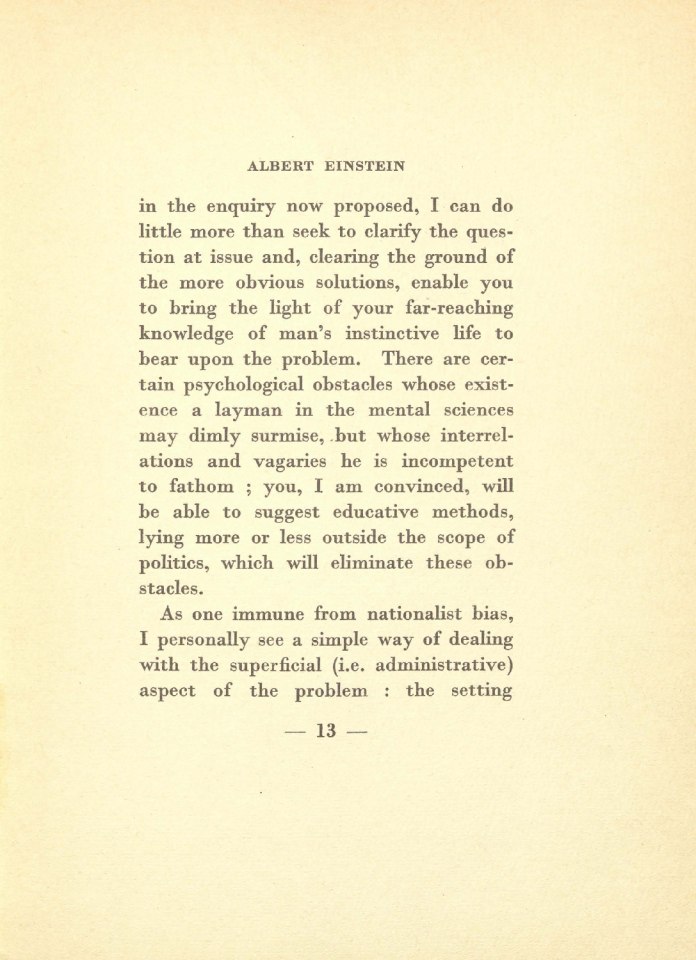
ALBERT EINSTEIN
in the enquiry now proposed, I can do
little more than seek to clarify the ques-
tion at issue and, clearing the ground of
the more obvious solutions, enable you
to bring the light of your far-reaching
knowledge of man’s instinctive life to
bear upon the problem. There are cer-
tain psychological obstacles whose exist-
ence a layman in the mental sciences
may dimly surmise, but whose interrel-
ations and vagaries he is incompetent
to fathom; you, I am convinced, will
be able to suggest educative methods,
lying more or less outside the scope of
politics, which will eliminate these ob-
stacles.As one immune from nationalist bias,
I personally see a simple way of dealing
with the superficial (i.e. administrative)
aspect of the problem: the setting— 13 —
S.
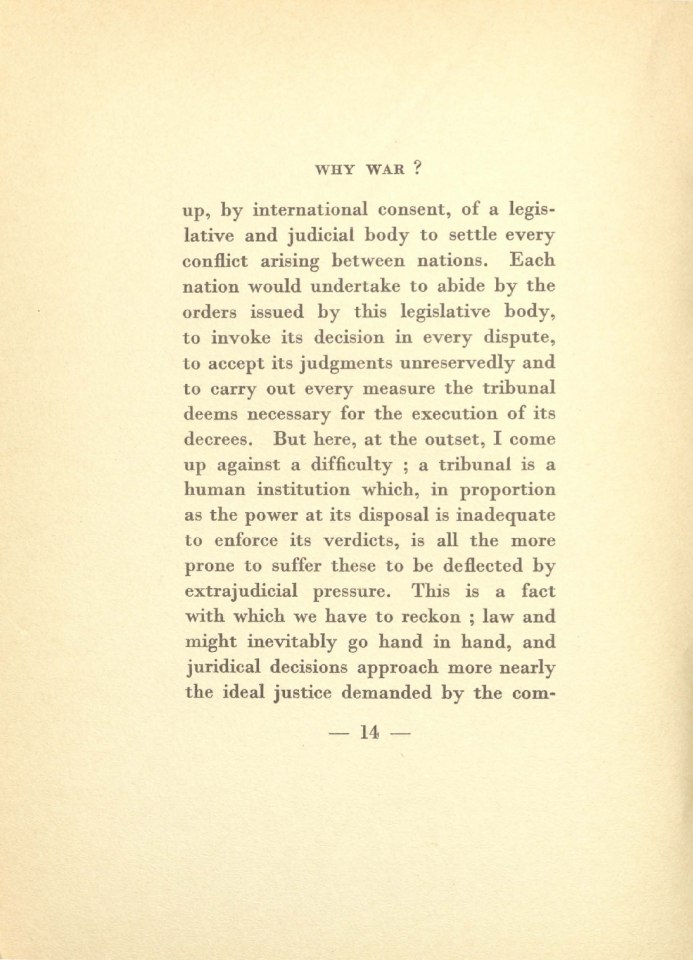
14
up, by international consent, of a legis-
lative and judicial body to settle every
conflict arising between nations. Each
nation would undertake to abide by the
orders issued by this legislative body,
to invoke its decision in every dispute,
to accept its judgments unreservedly and
to carry out every measure the tribunal
deems necessary for the execution of its
decrees. But here, at the outset, I come
up against a difficulty ; a tribunal is a
human institution which, in proportion
as the power at its disposal is inadequate
to enforce its verdicts, is all the more
prone to suffer these to be deflected by
extrajudicial pressure. This is a fact
with which we have to reckon ; law and
might inevitably go hand in hand, and
juridical decisions approach more nearly
the ideal justice demanded by the com-
S.
15
ALBERT EINSTEIN
munity (in whose name and interests
these verdicts are pronounced) in so
far as the community has effective power
to compel respect of its juridical ideal.
But at present we are far from possessing
any supranational organisation compet-
ent to render verdicts of incontestable
authority and enforce absolute submis-
sion to the execution of its verdicts.Thus I am led to my first axiom : the
quest of international security involves
the unconditional surrender by every
nation, in a certain measure, of its liberty
of action, its sovereignty that is to say,
and it is clear beyond all doubt that no
other road can lead to such security.The ill-success, despite their obvious
sincerity, of all the efforts made during
the last decade to reach this goal leaves
us no room to doubt that strong psycho-S.
16
WHY WAR ?
logical factors are at work, which para-
lyse these efforts. Some of these factors
are not far to seek. The craving for
power which characterises the govern-
ing class in every nation is hostile to any
limitation of the national sovereignty.
This political power-hunger is wont to
batten on the activities of another group,
whose aspirations are on purely mercen-
ary, economic lines. I have specially
in mind that small but determined group,
active in every nation, composed of indi
viduals who, indifferent to social consider-
ations and restraints, regard warfare, the
manufacture and sale of arms, simply as
an occasion to advance their personal
interests and enlarge their personal autho-
rity.But recognition of this obvious fact is
merely the first step towards an appre-
S.

17
ALBERT EINSTEIN
ciation of the actual state of affairs.
Another question follows hard upon it :
How is it possible for this small clique
to bend the will of the majority, who
stand to lose and suffer by a state of war,
to the service of their ambitions ? (In
speaking of the majority, I do not exclude
soldiers of every rank who have chosen
war as their profession, in the belief that
they are serving to defend the highest
interests of their race, and that attack
is often the best method of defence.)
An obvious answer to this question would
seem to be that the minority, the ruling
class at present, has the schools and press,
usually the Church as well, under its
thumb. This enables it to organise and
sway the emotions of the masses, and
make its tool of them.Yet even this answer does not provide
S.
WHY WAR ?
and extravagant form of conflict be-
tween man and man was deliberate, for
here we have the best occasion of discover-
ing ways and means to render all armed
conflicts impossible.I know that in your writings we may
find answers, explicit or implied, to all
the issues of this urgent and absorbing
problem. But it would be of the great-
est service to us all were you to present
the problem of world peace in the light
of your most recent discoveries, for such
a presentation well might blaze the trail
for new and fruitful modes of action.Yours very sincerely,
A. EINSTEIN.
Why War?1933-071/1933.en