S.

S.
1
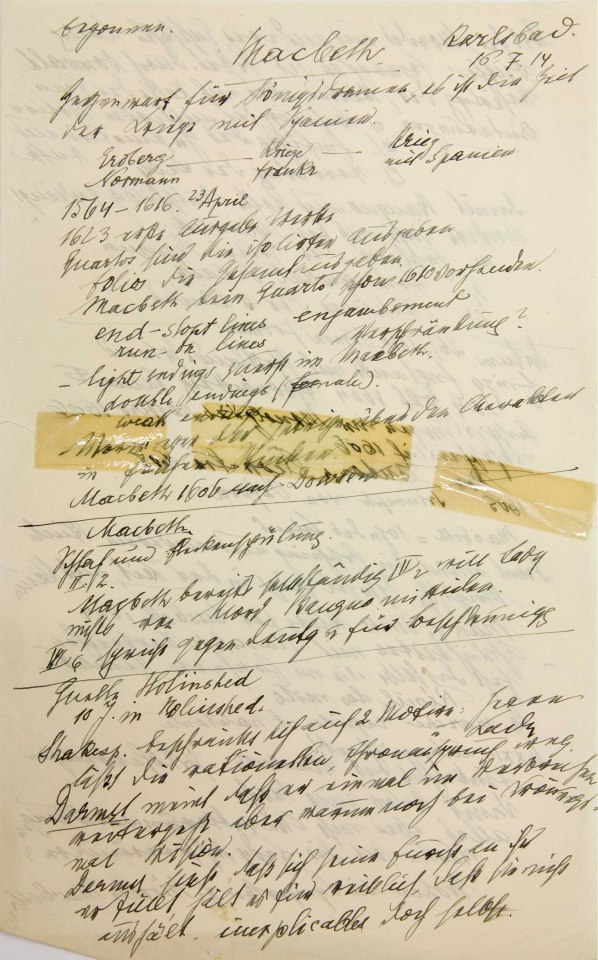
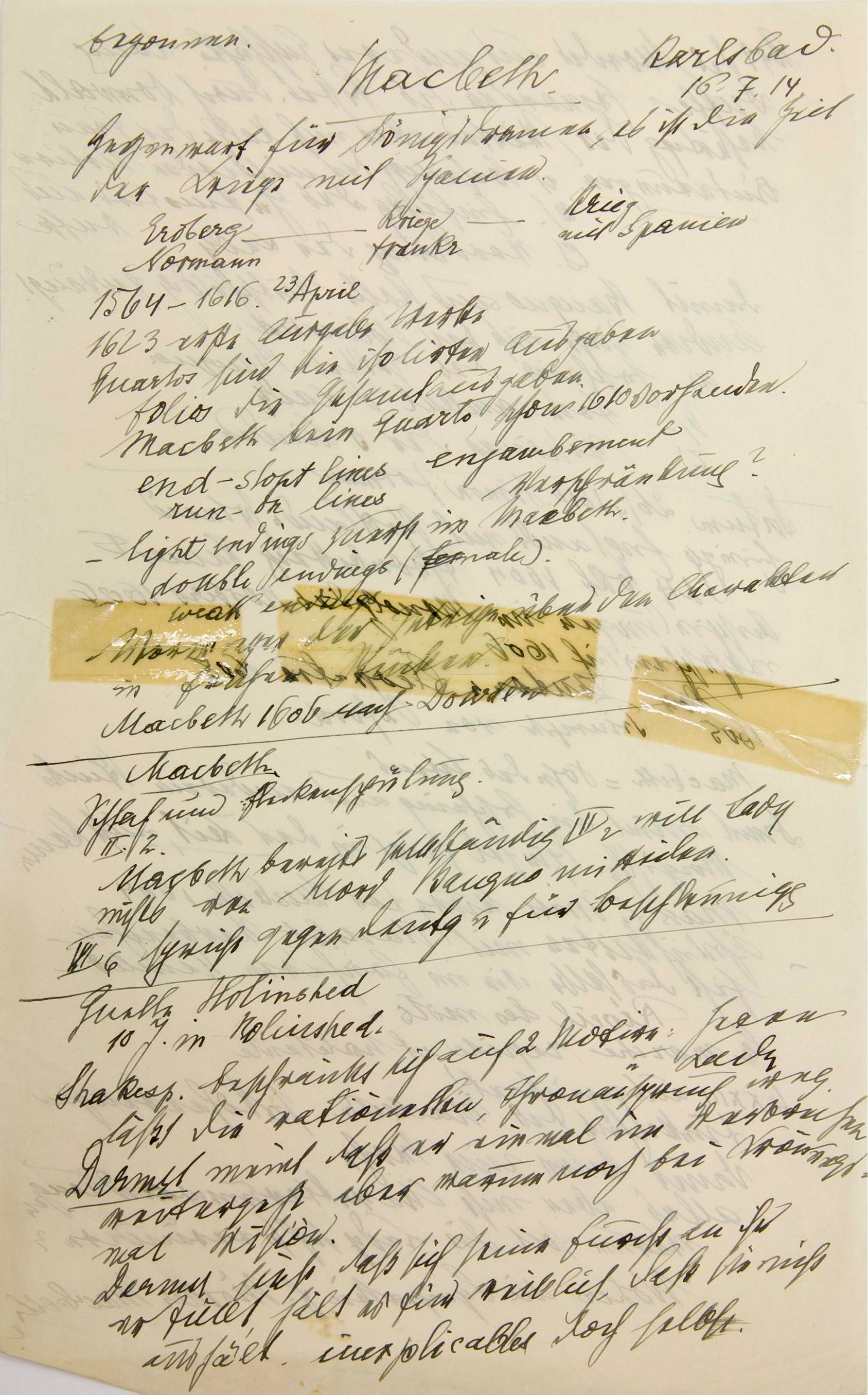
begonnen.
Karlsbad
16.7.14,Macbeth.
Gegenwart für Königsdramen ist die Zeit der
Kriege mit Spanien.Eroberg _____ Kriege ––––– Krieg
Normann Frankr mit Spanien1564-1616. 23April
1623 erste Ausgabe Werke
Quartos sind die isolirten Ausgaben
Folios die Gesamtausgaben.
Macbeth kein Quarto, schon 1610 vorhanden.end-stopt lines enjambement
run-on lines Verschränkung?
- Light endings zuerst im Macbeth
double endlings (fermale)
weak endingsVorwiegen der Intrigen über den Charakter
in frühen Stücken.Macbeth 1606 nach Dowden
___
Macbeth
Schlaf und Fleckenspülung.
II/2.
Macbeth bereits selbständig III2 will Lady
nichts von Mord Banguo mitteilen.
III6 spricht gegen Deutzg u für Beschleinigg——
Quelle Holinshed
18 J. in Holinshed.Shakesp. beschränkt sich auf 2 Motive: ¿¿¿¿
u Lady
läßt die rationellen, Thronanspruch weg.
Darmst meint, daß er einmal im Verbrechen
weitergeht, aber warum noch bei Krönungs-
mal Vision.Darmst sieht, daß sich seine Furcht an ihr
erfüllt, hält es hin vielleicht, daß sie nicht
aushält. Inexplicables doch selbst.Editorische Anmerkungen:
Quelle: https://study.com/academy/lesson/end-stopped-line-in-poetry-definition-examples.html
"What are end-stop and enjambment in poetry? An end-stopped line is identified by a phrase or complete thought that appears on a single line in a poem."Quelle: https://studyflix.de/deutsch/enjambement-3077
Enjambement: Zeilensprung in einem Gedicht.Quelle: https://en.wikipedia.org/wiki/End-stopping
An end-stopped line is a feature in poetry in which the syntactic unit (phrase, clause, or sentence) corresponds in length to the line. Its opposite is enjambment, where the sentence runs on into the next line. According to A. C. Bradley, "a line may be called 'end-stopped' when the sense, as well as the metre, would naturally make one pause at its close; 'run-on' when the mere sense would lead one to pass to the next line without any pause."Quelle: https://www.gutenberg.org/files/16966/16966-h/16966-h.htm
SHAKESPEAREAN TRAGEDY
LECTURES ON
HAMLET, OTHELLO, KING LEAR
MACBETH
BY
A.C. BRADLEY
LL.D. LITT.D., FORMERLY PROFESSOR OF POETRY IN THE UNIVERSITY OF OXFORDSECOND EDITION (THIRTEENTH IMPRESSION)
MACMILLAN AND CO., LIMITED ST. MARTIN'S STREET, LONDON
1919First Edition 1904.
Second Edition March 1905.
Reprinted August 1905, 1906, 1908, 1910, 1911, 1912, 1914, 1915, 1916, 1918, 1919.
GLASGOW: PRINTED AT THE UNIVERSITY PRESS BY ROBERT MACLEHOSE AND CO. LTD.Seite 475, Notes on Macbeth
"II. The Enjambement or Overflow test is also known as the End-stopped and Run-on line test. A line may be called ‘end-stopped’ when the sense, as well as the metre, would naturally make one pause at its close; ‘run on’ when the mere sense would lead one to pass to the next line without any pause." (Bradley, 475)_______________
Quelle: https://archive.org/details/shaksperecritica00dowd/page/n5/mode/2up
Third Edition, New York, London: Harper & Brothers Publishers, 1880.Edward Dowden, Edward (1875): Shakspere: A critical Study of his Mind and Art. Third Edition, New York, London: Harper & Brothers Publishers, 1880.
_____________-
Quelle: https://www.en.shakespeare-bibliothek.anglistik.uni-muenchen.de/miscell…’s Historie of Scotlande & William Shakespeare’s Macbeth
Holinshed’s Historie of Scotlande & William Shakespeare’s Macbeth
Quelle: https://de.wikipedia.org/wiki/Raphael_Holinshed
Raphael Holinshed (* um 1520; † um 1580 in Bramcote) war ein englischer Schriftsteller, dessen Werk – bekannt unter dem Titel Holinshed’s Chronicles – William Shakespeare als Quelle vieler seiner Dramen diente.- Holinshed’s Chronicles, 1577 bei der British Library
- Faksimile-Darstellung der Chronicles beim HathiTrust
- Text-Versionen der Chronicles Ausgaben beim Holinshed-Project
Titelblatt der Erstedition der Chronicles, 1577: https://de.wikipedia.org/wiki/Raphael_Holinshed#/media/Datei:1577_print…
S.

2
Art des Mordes aus anderer ¿¿¿. König
Duffe Ermorden des ¿¿¿ durch Donald,
Beseitigg des Wirtes, aber nicht ¿¿¿ der Frau.Änderungen. a) Beseitig der milderen Motive
b). Einführg des Gastmotivs aus
Duffe
c). Verdrängg der Lady.damit Bangua aus Rolle Mitschuldig gedrängt.
Andere Züge nicht bei Molinshed
a). Erscheing des Geistes Bangua
b). Somnambul d. Lady
c) ¿¿¿ der 3 Kinder——
Datum 26./., 1610. Simon Forman.
Einigg Englands mit Schottland u Irland14 Okt 1604 Thronbesteigg James I
Anspielungen in Monolog des Norbert 1606
wahrscheinlich 1606.____
Von Anton u Cleopatra 1608
1605 Triumph von OxfordMacbeth = Sohn des Lebens
Drmst meint die Erscheint aus anderem Stück
Magische Spiegel zeigt in der Zeit, nicht Raum
Mass f. Mass kurz vor Macbeth 1604_ Ähnlichkeiten mit Hamlet., Verbrechen –
fast dasselbe wie im früheren Hamlet –
Réveil des lots –
la marche rapide et haletanteLIXXIII ausgezeichnet!
Dunkelheit des Macbeth. Inkohaerenzen
dauert kaum eine Woche
alles, aber nicht Charakterumwandlungen
warum soll die Lady sich so verändern?
Woher die Sympathie für Mörder Macbeth?Editorische Anmerkungen:
Übersetzung von:
"la marche rapide et haletante": Schnelles, keuchendes Gehen
"Réveil des lots": Erwachen der ChargenS.
1
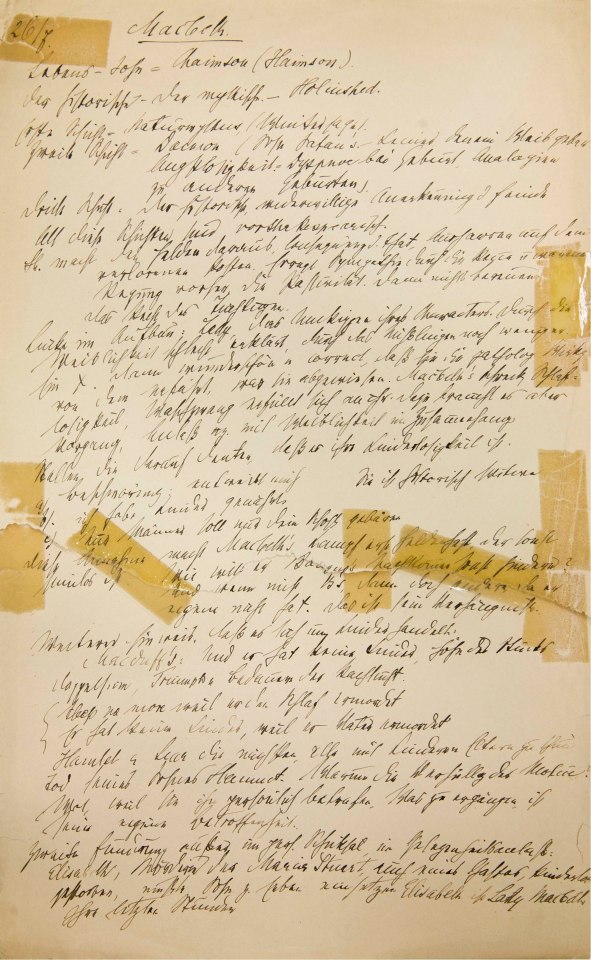
Macbeth.
Lebens - Sohn = Chaimson (Haimson).
Das Historische – der mythische. – Holinshed.Erste Schicht = Naturmythen (¿¿¿tersage)
Zweite Schicht = Daemon (Sohn Satans.– ¿¿¿¿, den ein Weib gebar
Angstlosigkeit.= Dyspnoe bei Geburt, Analogien
zu anderen Geburten).
Dritte Schicht = der hsitorische, widerwillige Anerkennung d Feinde
All diese Schichten sind vor¿¿¿¿¿¿¿Sh. Macht den Helden daraus, Consequenz d. That, ¿¿¿ auf dem
verlorenen Posten. ¿¿¿ Sympathie durch die ¿¿¿ u warum
Regung vorher. Die Passivität. Dann nicht ¿¿¿
. das Recht der Tüchtigen.Lücke in Aufbau: Lady, das ¿¿¿igen ihres Charakters. Durch die
Weiblichkeit schlecht erklärt. Durch das Mißlingen noch weniger.
Ein X. Dann wunderschön u correct, daß sie die patholog. Wirkg
von ihm erfährt, war sie abgewiesen. Macbeth‘s Schrekc Schlaf-
losigkeit, Waschzwang erfüllt sich an ihr. Dazu braucht es aber
Vorgang, Anlaßuz mit Weiblichkeit in Zusamenhang
Stellen die darauf deuten, daß es ihre Kinderlosigkeit ist.a) Beschwörung: entweibl. mich Sie ist historisch ¿¿¿¿
b). ich habe Kinder ¿¿¿
c). Nur Männer soll mir Dein Schoß gebärenDiese ¿¿¿ macht Macbeth’s Kampf erst heldenhaft, der sonst
sinnlos ist. Wie will er Banqug’s Nachkomen sonst hindern?
Und wenn nicht Bs, dann doch andere, da er
. eigene nicht aht. Das ist sein Verhängni?.Weiterer- sie weis, daß es sich um Kinder handelt:
(Macduff’s: Und er hat keine Kinder, Sohn des Stucks
Doppelsinn, Triumph u Bedauern der Rachsucht.¿¿¿ no more weil er den Schlaf ermordet
Er hat keine Kinder, weil er Vater ermordetHamlet u Lear die nächsten, alle mit Kindern, Eltern zu thun
Tod seines Sohnes Hamuet. Warum die Werfüllg der Motive?
Wol, weil sie ihre persönlich betrafen. Was zu ergänzen, ist
Seine eigene Betroffenheit.Zweite ¿¿ung außer im pers. Schicksal, in Gelegenheitsanlaß:
Elisabeth, Mörderin der Maria Stuart, auch eines Gastes, kinderlos
gestorben, mußte Sohn g. haben. einsetzen Elisabeth ist Lady Macbeth
Ihre letzten Stunden.S.
1
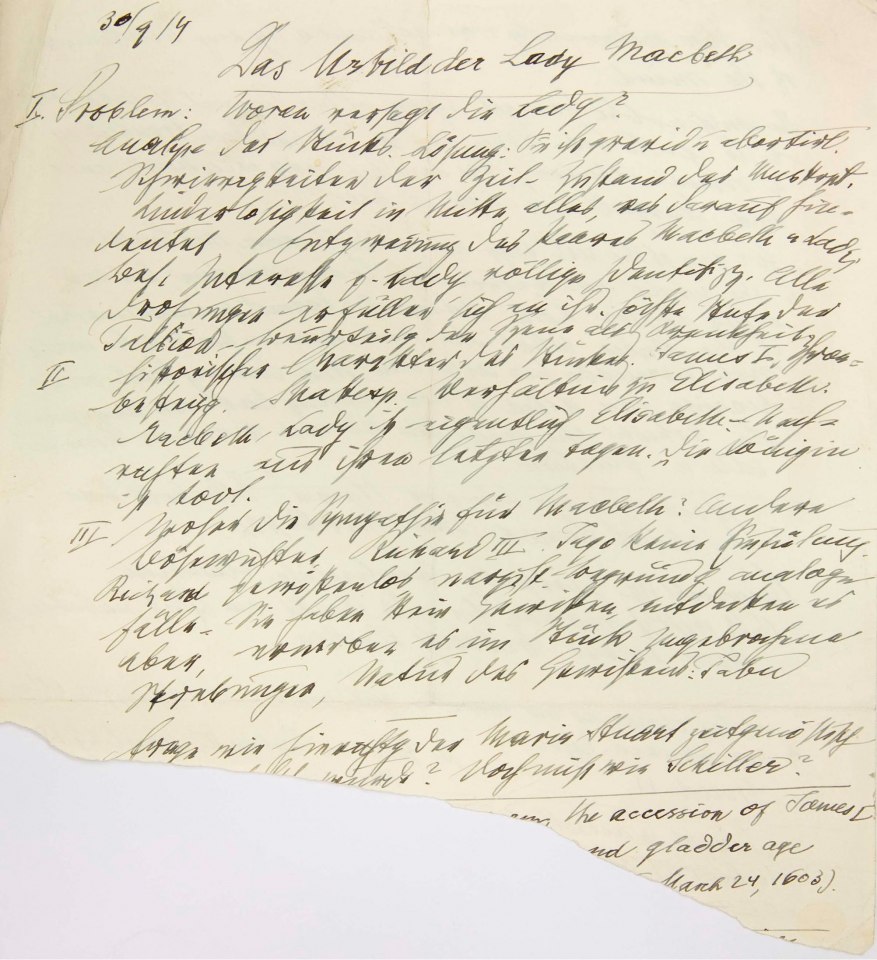
30/9/14
Das Urbild der Lady Macbeth
I. Problem: Woran versagt die Lady?
Analyse des Stücks. Lösung: Sie ist gravid u abortirt.
Schwierigkeiten der Zeit – Zustand des ¿¿¿
Kinderlosgkeit in Mitte alles, was darauf hin-
deuItet, Entzweiung des Paares Macbeth u Lady,
¿¿¿ Interesse f. Lady völloge ¿¿¿. Alle
Drohungen erfüllen sich an ihr. Höchste Stufe des
Tallion. – Beurteilg der Szene als ¿¿heit
II. Historischer Charakter des Stückes. James I, Thron-
besteigg. Shakesp. Verhätlnis zu Elisabeth.
Macbeth Lady ist eigentlich Elisabeth.– Nach-
richten aus ihren letzten Tagen. "Die Königin
ist todt.III, Woher die Sympathie für Macbeth? Andere
Bösewichter, Richard III. Jago keine Einflung.
Richer gewißenlosnarzist. Begründg analoge
Fälle – Sie haben kein Gewißen, entdecken es
aber, erwerben es im Stück. Ungebrochene
Strebungen, Natur des Gewißens: TabuFrage wie Hinrichtg der Maria Stuart zeitgenössisch
[…]? Doch nicht wie Schiller?____
[…] the accession of James I
[…] gladden age
[…] March 24, 1603).S.

1
[Literaturzitate]
p236. Her melancholy was not caused by any weakening
of the mind.She could not be brought by any of her Council to take food
or to go to bed. When in bed she hat been troubled by
a visual illusion; "she saw her body exceedingly lean
and fearful on a light of fire"."for any of the rest" says her maid of honour, Mrs. Southwell,
"she would not answer them to any question, but said
softly to my Lord Admiral’s earnest persuasions that
if he knew what she had seen in her bed he would
not persuade her as he did. And Secretary Cecil, over-
hearing her, asked if her majesty ha seen any spirits;
to which she said she scorned to answer him so
idle a question.___________
"Ich bin nur ein dürrer Stamm" Elisabeth bei
Geburt ¿¿¿. Erich Marells p32Heinrich VIII Zeit¿¿¿ Verherrlichg. Elisabeths.
1613 mehrfach nicht von ihm, nur Stück, am Schluß unbeteilgt
kann ¿¿¿ Betracht bleiben.__________
Si las espias no mi ¿¿¿, que no creo, entundo que ella
no trendra hijos, …Si las espias no mi mienten, que no creo, entiendo que ella
no tendra hijos, …
Froude ¿¿¿
De feria an Philipp II April 29 […]
MS Si[…]___
I ought to add […]
to be out […]
can […]- Quelle: https://www.gutenberg.org/cache/epub/50982/pg50982-images.html
Twelve English Statesman
Queen Elizabeth
by Edward Spencer Beesly (1892)
First Edition printed February 1892. Reprinted March 1892; 1895; 1897; 1900; 1903; 1906.
Diese Ausgabe: New York: The Macmillan Company (1906)
Chapter XI
Domestic Affairs: 1588-1601
Abschnitt 236/37:
In the same month Robert Carey, son of her cousin Lord Hunsdon, visited her, and professed to think her looking well. “No, Robin,” she said, “I am not well,” and then “discoursed of her indisposition, and that her heart had been sad and heavy for ten{236} or twelve days, and in her discourse she fetched not so few as forty or fifty great sighs.... Hereupon I wrote to the King of Scots.”[18] Her melancholy was not caused by any weakening of her mind. A long letter to James, dated January 5, 1603, though hardly legible, is very vigorous and characteristic.
"At the beginning of March 1603 she became much worse. There was some disease of the throat, attended with swelling and a distressing formation of phlegm, which made speaking difficult. The only relatives about her were Robert Carey and his sister Lady Scrope, watching keenly that they might be the first to inform James of her death. She could not be brought by any of her Council to take food or go to bed. When in bed she had been troubled by a visual illusion; “she saw her body exceedingly lean and fearful in a light of fire.” At last Nottingham, the Admiral, who was mourning the recent death of his wife, was sent for. He was a second cousin of Anne Boleyn, and was the one person to whom the dying Queen seemed to cling with some trust. He induced her to take some broth. “For any of the rest,” says her maid-of-honour, Mistress Southwell, “she would not answer them to any question, but said softly to my Lord Admiral’s earnest persuasions that if he knew what she had seen in her bed he would not persuade{237} her as he did. And Secretary Cecil, overhearing her, asked if her Majesty had seen any spirits; to which she said she scorned to answer him so idle a question. Then he told her how, to content the people, her Majesty must go to bed. To which she smiled, wonderfully contemning him, saying that the word must was not to be used to princes; and thereupon said, ‘Little man, little man, if your father had lived ye [he?] durst not have said so much: but thou knowest I must die, and that maketh thee so presumptuous.’ And presently commanding him and the rest to depart her chamber, willed my Lord Admiral to stay; to whom she shook her head, and with a pitiful voice said, ‘My Lord, I am tied with a chain of iron about my neck.’ He alleging her wonted courage to her, she replied, ‘I am tied, and the case is altered with me.’ ” At last, “what by fair means,” says Carey, “what by force, he got her to bed.”"
Auch zu finden in archive.org
History of England: From the Fall of Wolsey to the Death of ...
James Anthony Froude · 1866 · Great Britain
Anthony Froude, M.A. (): History of England. From The Fall of Wolsey to the Death of Elizabeth
Reign of Elizabeth. Volume 1. Fourth Edition. London: Longmans Green, And Co. 1866Zitat: : Chapt I, 1559, May
Seite 84:
FN 1:'Si las espias no mi mienten, que
no creo, entiendo que ella no tendra
hijos; pero si el Archiduque es hom-
bre , aunque ella se muera sin ellos ,
se podra qudar con el Reyno teniendo
las espaldas de V. Md.’– De Feria to
Philip II., April 29. MS. Simancas.Auch zu finden in archive.org
- Quelle: https://www.gutenberg.org/cache/epub/50982/pg50982-images.html
"Macbeth"
1914-112/1914.01



1914-112/1914.01

