S.
VI
THE DREAM-WORKALL other previous attempts to solve the problems of dreams
have concerned themselves directly with the manifest dream-
content as it is retained in the memory. They have sought
to obtain an interpretation of the dream from this content,
or, if they dispensed with an interpretation, to base their
conclusions concerning the dream on the evidence provided
by this content. We, however, are confronted by a different
set of data; for us a new psychic material interposes itself
between the dream-content and the results of our investigations :
the latent dream-content, or dream-thoughts, which are obtained
only by our method. We develop the solution of the dream from
this latent content, and not from the manifest dream-content.
We are thus confronted with a new problem, an entirely
novel task—that of examining and tracing the relations
between the latent dream-thoughts and the manifest dream-
content, and the processes by which the latter has grown out
of the former.The dream-thoughts and the dream-content present them-
selves as two descriptions of the same content in two different
languages ; or, to put it more clearly, the dream-content appears
to us as a translation of the dream-thoughts into another mode
of expression, whose symbols and laws of composition we must
learn by comparing the origin with the translation. The dream-
thoughts we can understand without further trouble the moment
we have ascertained them. The dream-content is, as it were,
presented in hieroglyphics, whose symbols must be translated,
one by one, into the language of the dream-thoughts. It would
of course, be incorrect to attempt to read these symbols in
accordance with their values as pictures, instead of in accord-
ance with their meaning as symbols. For instance, I have
before me a picture-puzzle (rebus)—a house, upon whose roof
there is a boat; then a single letter; then a running figure,
whose head has been omitted, and so on. As a critic I might
be tempted to judge this composition and its elements to be
nonsensical. A boat is out of place on the roof of a house,S.
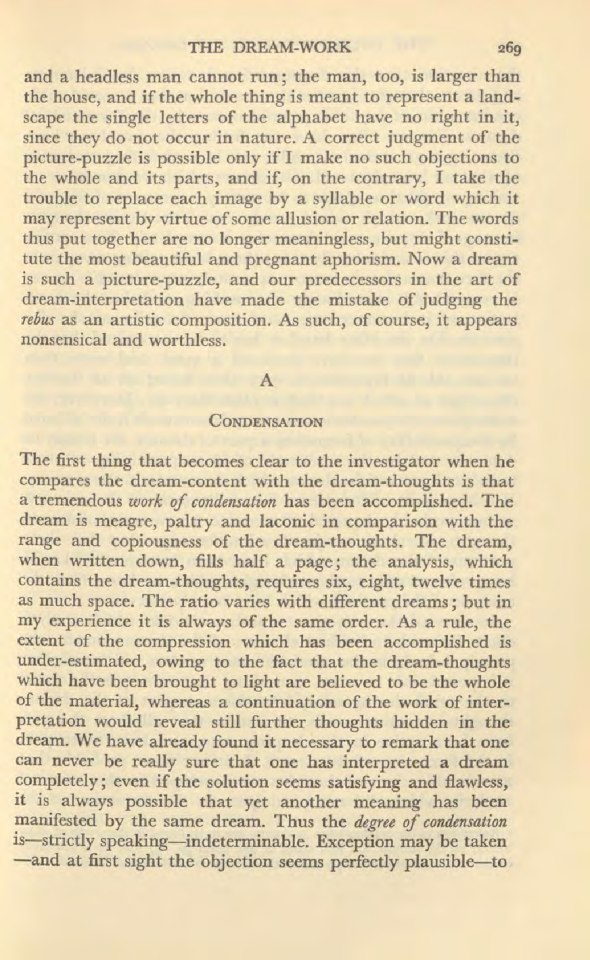
THE DREAM-WORK 269
and a headless man cannot run; the man, too, is larger than
the house, and if the whole thing is meant to represent a land-
scape the single letters of the alphabet have no right in it,
since they do not occur in nature. A correct judgment of the
picture-puzzle is possible only if I make no such objections to
the whole and its parts, and if, on the contrary, I take the
trouble to replace each image by a syllable or word which it
may represent by virtue of some allusion or relation. The words
thus put together are no longer meaningless, but might consti-
tute the most beautiful and pregnant aphorism. Now a dream
is such a picture-puzzle, and our predecessors in the art of
dream-interpretation have made the mistake of judging the
rebus as an artistic composition. As such, of course, it appears
nonsensical and worthless.A
CONDENSATIONThe first thing that becomes clear to the investigator when he
compares the dream-content with the drcam-thoughts is that
a tremendous work of condensation has been accomplished. The
dream is meagre, paltry and laconic in comparison with the
range and copiousness of the dream-thoughts. The dream,
when written down, fills half a page; the analysis, which
contains the dream-thoughts, requires six, eight, twelve times
as much space. The ratio varies with different dreams; but in
my experience it is always of the same order. As a rule, the
extent of the compression which has been accomplished is
under-estimated, owing to the fact that the dream-thoughts
which have been brought to light are believed to be the whole
of the material, whereas a continuation of the work of inter-
pretation would reveal still further thoughts hidden in the
dream. We have already found it necessary to remark that one
can never be really sure that one has interpreted a dream
completely; even if the solution seems satisfying and flawless,
it is always possible that yet another meaning has been
manifested by the same dream. Thus the degree of condensation
is—strictly speaking—indeterminable. Exception may be taken
—and at first sight the objection seems perfectly plausible—toS.
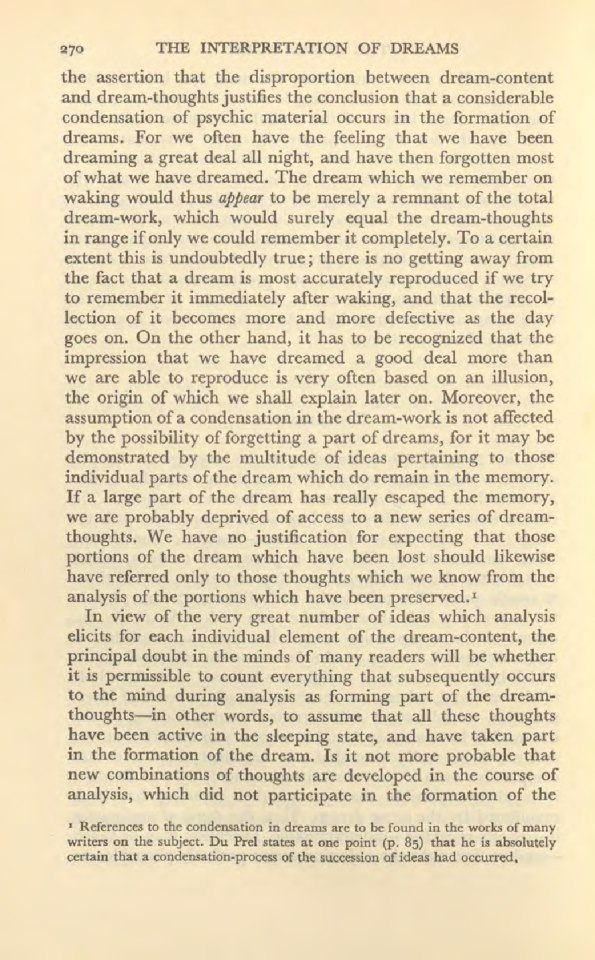
270 THE INTERPRETATION OF DREAMS
the assertion that the disproportion between dream-content
and dream-thoughts justifies the conclusion that a considerable
condensation of psychic material occurs in the formation of
dreams. For we often have the feeling that we have been
dreaming a great deal all night, and have then forgotten most
of what we have dreamed. The dream which we remember on
waking would thus appear to be merely a remnant of the total
dream-work, which would surely equal the dream-thoughts
in range if only we could remember it completely. To a certain
extent this is undoubtedly true; there is no getting away from
the fact that a dream is most accurately reproduced if we try
to remember it immediately after waking, and that the recol-
lection of it becomes more and more defective as the day
goes on. On the other hand, it has to be recognized that the
impression that we have dreamed a good deal more than
we are able to reproduce is very often based on an illusion,
the origin of which we shall explain later on. Moreover, the
assumption of a condensation in the dream-work is not affected
by the possibility of forgetting a part of dreams, for it may be
demonstrated by the multitude of ideas pertaining to those
individual parts of the dream which do remain in the memory.
If a large part of the dream has really escaped the memory,
we are probably deprived of access to a new series of dream-
thoughts. We have no justification for expecting that those
portions of the dream which have been lost should likewise
have referred only to those thoughts which we know from the
analysis of the portions which have been preserved.*In view of the very great number of ideas which analysis
elicits for each individual element of the dream-content, the
principal doubt in the minds of many readers will be whether
it is permissible to count everything that subsequently occurs
to the mind during analysis as forming part of the dream-
thoughts—in other words, to assume that all these thoughts
have been active in the sleeping state, and have taken part
in the formation of the dream. Is it not more probable that
new combinations of thoughts are developed in the course of
analysis, which did not participate in the formation of the1 References to the condensation in dreams are to be found in the works of many
writers on the subject. Du Prel states at one point (p. 85) that he is absolutely
certain that a condensation-process of the succession of ideas had occurred,S.
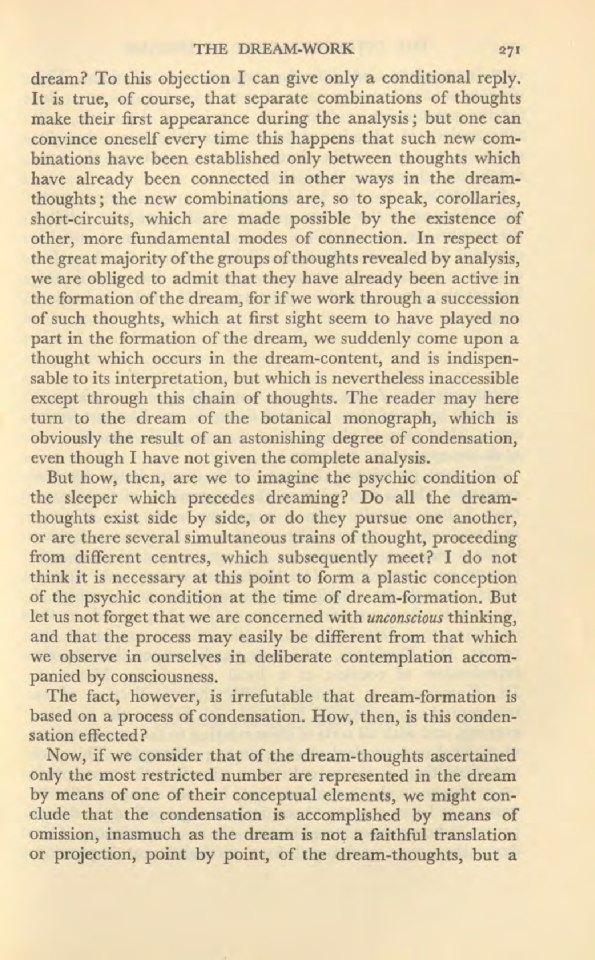
THE DREAM-WORK 271
dream? To this objection I can give only a conditional reply.
It is true, of course, that separate combinations of thoughts
make their first appearance during the analysis; but one can
convince oneself every time this happens that such new com-
binations have been established only between thoughts which
have already been connected in other ways in the dream-
thoughts; the new combinations are, so to speak, corollaries,
short-circuits, which are made possible by the existence of
other, more fundamental modes of connection. In respect of
the great majority of the groups of thoughts revealed by analysis,
we are obliged to admit that they have already been active in
the formation of the dream, for if we work through a succession
of such thoughts, which at first sight seem to have played no
part in the formation of the dream, we suddenly come upon a
thought which occurs in the dream-content, and is indispen-
sable to its interpretation, but which is nevertheless inaccessible
except through this chain of thoughts. The reader may here
turn to the dream of the botanical monograph, which is
obviously the result of an astonishing degree of condensation,
even though I have not given the complete analysis.But how, then, are we to imagine the psychic condition of
the sleeper which precedes dreaming? Do all the dream-
thoughts exist side by side, or do they pursue one another,
or are there several simultaneous trains of thought, proceeding
from different centres, which subsequently meet? I do not
think it is necessary at this point to form a plastic conception
of the psychic condition at the time of dream-formation, But
let us not forget that we are concerned with unconscious thinking,
and that the process may easily be different from that which
we observe in ourselves in deliberate contemplation accom-
panied by consciousness.The fact, however, is irrefutable that dream-formation is
based on a process of condensation. How, then, is this conden-
sation effected?Now, if we consider that of the dream-thoughts ascertained
only the most restricted number are represented in the dream
by means of one of their conceptual elements, we might con-
clude that the condensation is accomplished by means of
omission, inasmuch as the dream is not a faithful translation
or projection, point by point, of the dream-thoughts, but aS.
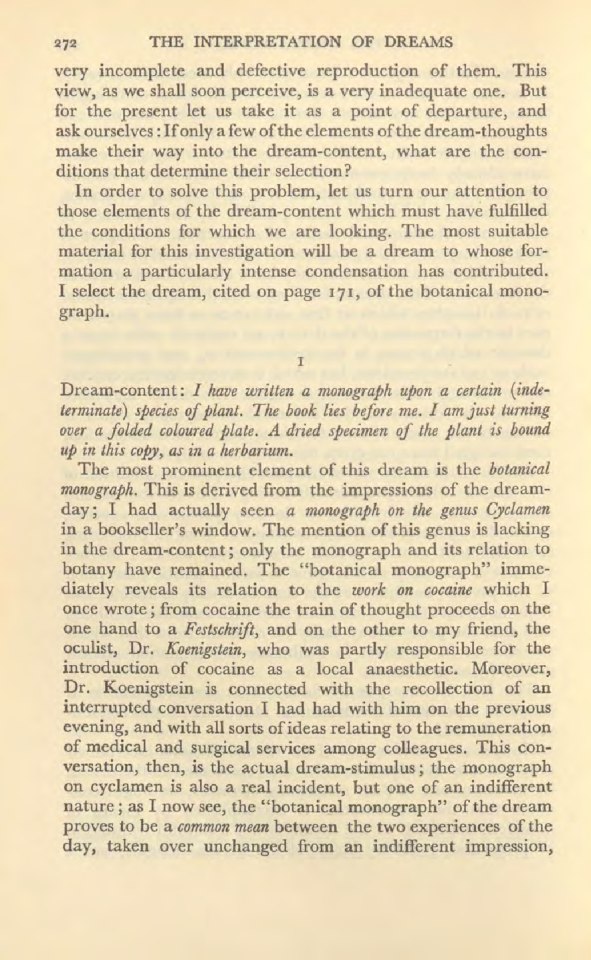
272 THE INTERPRETATION OF DREAMS
very incomplete and defective reproduction of them. This
view, as we shall soon perceive, is a very inadequate one, But
for the present let us take it as a point of departure, and
ask ourselves : If only a few of the elements of the dream-thoughts
make their way into the dream-content, what are the con-
ditions that determine their selection?In order to solve this problem, let us turn our attention to
those elements of the dream-content which must have fulfilled
the conditions for which we are looking. The most suitable
material for this investigation will be a dream to whose for-
mation a particularly intense condensation has contributed.
I select the dream, cited on page 171, of the botanical mono-
graph.I
Dream-content: I have written a monograph upon a certain (inde
terminate) species of plant. The book lies before me. I am just turning
over a folded coloured plate. A dried specimen of the plant is bound
up in this copy, as in a herbarium.The most prominent element of this dream is the botanical
monograph. This is derived from the impressions of the dream-
day; I had actually seen a monograph on the genus Cyclamen
in a bookseller’s window. The mention of this genus is lacking
in the dream-content; only the monograph and its relation to
botany have remained. The “botanical monograph” imme-
diately reveals its relation to the work on cocaine which I
once wrote ; from cocaine the train of thought proceeds on the
one hand to a Festschrift, and on the other to my friend, the
oculist, Dr. Koenigstein, who was partly responsible for the
introduction of cocaine as a local anaesthetic. Moreover,
Dr. Koenigstein is connected with the recollection of an
interrupted conversation I had had with him on the previous
evening, and with all sorts of ideas relating to the remuneration
of medical and surgical services among colleagues. This con-
versation, then, is the actual dream-stimulus ; the monograph
on cyclamen is also a real incident, but one of an indifferent
nature ; as I now see, the “botanical monograph” of the dream
proves to be a common mean between the two experiences of the
day, taken over unchanged from an indifferent impression,S.
THE DREAM-WORK 273
and bound up with the psychically significant experience by
means of the most copious associations.Not only the combined idea of the botanical monograph,
however, but also each of its separate elements, “Botanical”
and “monograph,” penetrates farther and farther, by manifold
associations, into the confused tangle of the dream-thoughts.
To botanical belong the recollections of the person of Professor
Gärtner (German: Gartner = gardener), of his blooming
wife, of my patient, whose name is Flora, and of a lady con-
cerning whom I told the story of the forgotten flowers. Gärtner,
again, leads me to the laboratory and the conversation with
Koenigstein; and the allusion to the two female patients belongs
to the same conversation. From the lady with the flowers a
train of thoughts branches off to the favourite flowers of my
wife, whose other branch leads to the title of the hastily seen
monograph. Further, botanical recalls an episode at the
“Gymnasium”, and a university examination; and a fresh
subject—that of my hobbies—which was broached in the
above-mentioned conversation, is linked up, by means of
what is humorously called my favourite flower, the artichoke,
with the train of thoughts proceeding from the forgotten
flowers; behind “artichoke” there lies, on the one hand, a
recollection of Italy, and on the other a reminiscence of a
scene of my childhood, in which I first formed an acquaintance
—which has since then grown so intimate—with books,
Botanical, then, is a veritable nucleus, and, for the dream, the
meeting-point of many trains of thought; which, I can testify,
had all really been brought into connection by the conversation
referred to. Here we find ourselves in a thought-factory, in
which, as in The Weaver's Masterpiece :—“The little shuttles to and fro
Fly, and the threads unnoted flow;
One throw links up a thousand threads.”Monograph in the dream, again, touches two themes: the one-
sided nature of my studies, and the costliness of my hobbies.
The impression derived from this first investigation is that
the elements “botanical” and “monograph” were taken up
into the dream-content because they were able to offer the
most numerous points of contact with the greatest number of
5S.
274 THE INTERPRETATION OF DREAMS
dream-thoughts, and thus represented nodal points at which a
great number of the dream-thoughts met together, and because
they were of manifold significance in respect of the meaning of
the dream. The fact upon which this explanation is based may
be expressed in another form: Every element of the dream-
content proves to be over-determined—that is, it appears several
times over in the dream-thoughts.We shall learn more if we examine the other components
of the dream in respect of their occurrence in the dream-
thoughts. The coloured plate refers (cf. the analysis on p. 173) to
a new subject, the criticism passed upon my work by colleagues,
and also to a subject already represented in the dream—my
hobbies—and, further, to a memory of my childhood, in which
I pull to pieces a book with coloured plates ; the dried specimen
of the plant relates to my experience with the herbarium at
the "Gymnasium”, and gives this memory particular emphasis.
Thus I perceive the nature of the relation between the dream-
content and dream-thoughts : Not only are the elements of the
dream determined several times over by the dream-thoughts,
but the individual dream-thoughts are represented in the
dream by several elements. Starting from an element of the
dream, the path of the association leads to a number of dream-
thoughts; and from a single dream-thought to several elements
of the dream. In the process of dream-formation, therefore,
it is not the case that a single dream-thought, or a group of
dream-thoughts, supplies the dream-content with an abbre-
viation of itself as its representative, and that the next dream-
thought supplies another abbreviation as its representative
(much as representatives are elected from among the popu-
lation) ; but rather that the whole mass of the dream-thoughts
is subjected to a certain elaboration, in the course of which
those elements that receive the strongest and completest
support stand out in relief; so that the process might perhaps
be likened to election by the scrutin du liste. Whatever dream
I may subject to such a dissection, I always find the same
fundamental principle confirmed—that the dream-elements
have been formed out of the whole mass of the dream-thoughts,
and that every one of them appears, in relation to the dream-
thoughts, to have a multiple determination.It is certainly not superfluous to demonstrate this relation
S.
THE DREAM-WORK 275
of the dream-content to the dream-thoughts by means of a
further example, which is distinguished by a particularly
artful intertwining of reciprocal relations. The dream is that
of a patient whom I am treating for claustrophobia (fear of
enclosed spaces). It will soon become evident why I feel myself
called upon to entitle this exceptionally clever piece of dream-
activity:п. “А BEAUTIFUL DREAM”
The dreamer is driving with a great number of companions in X-
street, where ihere is a modest hostelry (which is not the case). 4
theatrical performance is being given in one of the rooms of the inn.
He is first spectator, then actor. Finally the company are told to change
their clothes, in order to return lo the city. Some of the company are
shown into rooms on the ground floor, others to rooms on the first floor.
Then a dispute arises. The people upstairs are annoyed because those
downstairs have not yet finished changing, so that they cannot come down.
His brother is upstairs; he is downstairs; and he is angry with his
brother because they are so hurried. (This part obscure.) Besides,
it was already decided, upon their arrival, who was to go upstairs and
who down. Then he goes alone up the hill towards the city, and he
walks so heavily, and with such difficulty, that he cannot move from the
spot. An elderly gentleman joins him and talks angrily of the King of
Italy. Finally, towards the top of the hill, he is able to walk much
more eastly.The difficulty experienced in climbing the hill was so distinct
that for some time after waking he was in doubt whether the
experience was a dream or the reality.Judged by the manifest content, this dream can hardly be
eulogized. Contrary to the rules, I shall begin the interpretation
with that portion which the dreamer referred to as being the
most distinct.The difficulty dreamed of, and probably experienced during
the dream—difficulty in climbing, accompanied by dyspnoca 一
was one of the symptoms which the patient had actually
exhibited some years before, and which, in conjunction with
other symptoms, was at the time attributed to tuberculosis
(probably hysterically simulated). From our study of exhibition-
dreams we are already acquainted with this sensation of beingS.
276 THE INTERPRETATION OF DREAMS
inhibited in motion, peculiar to dreams, and here again we
find it utilized as material always available for the purposes of
any other kind of representation. The part of the dream-content
which represents climbing as difficult at first, and easier at the
top of the hill, made me think, while it was being related, of
the well-known masterly introduction to Daudet's Sappho.
Here a young man carries the woman he loves upstairs; she
is at first as light as a feather, but the higher he climbs the more
she weighs; and this scene is symbolic of the progress of their
relation, in describing which Daudet seeks to admonish young
men not to lavish an earnest affection upon girls of humble
origin and dubious antecedents.! Although I knew that my
patient had recently had a love-affair with an actress, and had
broken it off, I hardly expected to find that the interpretation
which had occurred to me was correct. The situation in Sappho
is actually the reverse of that in the dream; for in the dream
climbing was difficult at the first and easy later on; in the
novel the symbolism is pertinent only if what was at first
easily carried finally proves to be a heavy burden. To my
astonishment, the patient remarked that the interpretation
fitted in very well with the plot of a play which he had seen
the previous evening. The play was called Rund um Wien
(“Round about Vienna”), and treated of the career of a girl
who was at first respectable, but who subsequently lapsed
into the demi-monde, and formed relations with highly-placed
lovers, thereby climbing, but finally she went downhill faster and
faster. This play reminded him of another, entitled Vor Stufe
zu Stufe (“From Step to Step”), the poster advertising which
had depicted a flight of stairs.To continue the interpretation: The actress with whom he
had had his most recent and complicated affair had lived in
X-street. There is no inn in this street. However, while he was
spending part of the summer in Vienna for the sake of this lady,
he had lodged (German: abgestiegen = stopped, literally
stepped off) at a small hotel in the neighbourhood. When he
was leaving the hotel, he said to the cab-driver: “I am glad
at all events that I didn’t get any vermin here!” (Incidentally,
the dread of vermin is one of his phobias.) Whereupon the* In estimating the significance of this passage we may recall the meaning of
dreams of climbing stairs, as explained in the chapter on Symbolism,S.
THE DREAM-WORK 277
cab-driver answered: "How could anybody stop there!
That isn't a hotel at all, it's really nothing but a pub!”
The “pub” immediately reminded him of a quotation:“Of a wonderful host
I was lately a guest.”But the host in the poem by Uhland is an apple-tree. Now a
second quotation continues the train of thought:Faust: (dancing with the young witch).
“A lovely dream once came to me;
I then beheld an apple-tree,And there two fairest apples shone:
They lured me so, I climbed thereon.”Tue FAR ONE:
“Apples have been desired by you,
Since first in Paradise they grew;
And I am moved with joy to know
That such within my garden grow.”There is not the slightest doubt what is meant by the apple-
tree and the apples. A beautiful bosom stood high among the
charms by which the actress had bewitched our dreamer.Judging from the context of the analysis, we had every reason
to assume that the dream referred to an impression of the
dreamer’s childhood. If this is correct, it must have referred
to the wet-nurse of the dreamer, who is now a man of nearly
thirty years of age. The bosom of the nurse is in reality an inn
for the child. The nurse, as well as Daudet’s Sappho, appears
as an allusion to his recently abandoned mistress.The (elder) brother of the patient also appears in the dream-
content; he is upstairs, while the dreamer himself is downstairs.
This again is an inversion, for the brother, as I happen to know,
has lost his social position, while my patient has retained his.
In relating the dream-content, the dreamer avoided saying
that his brother was upstairs and that he himself was down-
stairs. This would have been too obvious an expression, for in
Austria we say that a man is on the ground floor when he has lost
his fortune and social position, just as we say that he has come
down. Now the fact that at this point in the dream something is+ Translated by Bayard Taylor.
S.
278 THE INTERPRETATION OF DREAMS
represented as inverted must have a meaning ; and the inversion
must apply to some other relation between the dream-thoughts
and the dream-content. There is an indication which suggests
how this inversion is to be understood. It obviously applies
to the end of the dream, where the circumstances of climbing
are the reverse of those described in Sappho. Now it is evident
what inversion is meant: In Sappho the man carries the woman
who stands in a sexual relation to him ; in the dream-thoughts,
conversely, there is a reference to a woman carrying a man;
and, as this could occur only in childhood, the reference is once
more to the nurse who carries the heavy child. Thus the final
portion of the dream succeeds in representing Sappho and the
nurse in the same allusion.Just as the name Sappho has not been selected by the poet
without reference to a Lesbian practice, so the portions of the
dream in which people are busy upstairs and downstairs, “above”
and “beneath,” point to fancies of a sexual content with which
the dreamer is occupied, and which, as suppressed cravings,
are not unconnected with his neurosis. Dream-interpretation
itself does not show that these are fancies and not memories
of actual happenings ; it only furnishes us with a set of thoughts
and leaves it to us to determine their actual value. In this case
real and imagined happenings appear at first as of equal value—
and not only here, but also in the creation of more important
psychic structures than dreams. A large company, as we
already know, signifies a secret. The brother is none other
than a representative, drawn into the scenes of childhood by
“fancying backwards,” of all of the subsequent rivals for
women’s favours. Through the medium of an experience
indifferent in itself, the episode of the gentleman who talks
angrily of the King of Italy refers to the intrusion of people of
low rank into aristocratic society. It is as though the warning
which Daudet gives to young men were to be supplemented
by a similar warning applicable to a suckling child."To provide a third example for the study of condensation
in dream-formation, I shall cite the partial analysis of another* The fantastic nature of the situation relating to the dreamer’s wet-nurse is
shown by the circumstance, objectively ascertained, that the nurse in this case
was his mother. Further, I may call attention to the regret of the young man in
the anecdote related on p. 203 (that he had not taken better advantage of his
opportunities with his wet-nurse) as the probable source of this dream.S.
THE DREAM-WORK 279
dream, for which I am indebted to an elderly lady who under-
went psychoanalytic treatment. Consistently with the condition
of severe anxiety from which the patient was suffering, her
dreams contained a great abundance of sexual thought-material,
the unearthing of which astonished her at first as much as
it alarmed her. Since I could not complete the interpretation
of the dream, the dream-material seems to fall into several
groups, without apparent connection.III. THE COCKCHAFER DREAM”
The dream-content: She remembers that she has two cockchafers
in a box, which she must set at liberty, for otherwise they will be
suffocated. She opens the box, and the cockchafers are quite exhausted;
one of them flies out of the window, but the other is crushed on the case-
ment while she is shutting the window, as someone or other requests
her to do (expressions of disgust).Analysis. —Her husband is away from home, and her fourteen-
year-old daughter is sleeping in the bed beside her. In the
evening, the child calls her attention to the fact that a moth has
fallen into her glass of water ; but she neglects to take it out, and
in the morning she feels sorry for the poor little creature. A
story which she had read during the evening told of some
boys throwing a cat into boiling water, and the convulsions of
the animal were described. These are the occasions for the
dream, both of which are indifferent in themselves. She is
further occupied with the subject of cruelty to animals. Years
before, while they were spending the summer in a certain
neighbourhood, her daughter had been very cruel to animals.
She began to make a collection of butterflies, and asked her
mother for arsenic with which to kill the specimens. Once it
happened that a moth flew about the room for a long while
with a pin thrust through its body; on another occasion she
found that some caterpillars which had been kept for meta-
morphosis had died of starvation. The same child, when even
younger, was in the habit of pulling off the wings of beetles
and butterflies; now she would shrink in horror from such
cruel actions ; she is now so good-natured.The mother’s mind is occupied with this contrast. It recalls
another contrast, the contrast between appearance and dis-S.
280 THE INTERPRETATION OF DREAMS
position, as described in Adam Bede, by George Eliot. There
a beautiful but vain and quite stupid girl is contrasted with an
ugly but high-minded young woman. The aristocrat who seduces
the little goose is contrasted with the working-man, who has a
noble character and behaves in accordance with it. It is impos-
sible to tell character from people’s looks. Who could tell from
her looks that she is tormented by sensual desires?In the same year in which the little girl started her collection
of butterflies, the district in which they were staying suffered
greatly from a pest of cockchafers. The children worked havoc
among the cockchafers, and crushed them cruelly. At that time
she saw a man who used to eat cockchafers after tearing
off their wings. She herself was born in May and married in
May (the German name for the cockchafer is Maikåfer = May-
beetle). Three days after the wedding she wrote a letter home,
saying how happy she was. But she was by no means happy.During the evening before the dream she had rummaged
among her old letters, and had read several, comical and
serious, to her family—an extremely ridiculous letter from a
piano-teacher who had paid her attentions when she was a
girl, as well as one from an aristocratic admirer."She blames herself because one of her daughters got hold of
a bad book by Maupassant.2 The arsenic which her little girl
asks for recalls the arsenic pills which restores the power of youth
to the Duc de Mora in Le Nabab.“Set at liberty” recalls to her a passage from The Magic Flute:
“I cannot constrain you to love,
But yet I will not set you free.”** Maikäfer” suggests the speech of Käthchen3: “Verliebt ja bist
du wie ein Käfer mir” (Yes, you are in love with me like a
beetle”). And on the top of this the dreamer remembers the
speech in Tannhåuser: “Because you are inspired by wicked
kast: 277She is living in fear and anxiety concerning her absent
+ This was the real dream-stimulus.
* By way of supplement: Such reading is poison to a young girl. She herself
in her youth had drawn much information from forbidden books.3 A further train of thought leads to Penthesilea by the same author; cruelty to
a lover,S.
THE DREAM-WORK 281
husband. The dread that he may meet with an accident during
his journey finds expression in a number of day-dreams. Shortly
before this, during the analysis, she had found in her uncon-
scious thoughts a complaint of his “senility.” The wish-thought
which this dream conceals may perhaps best be conjectured
if I say that some days before this dream she was suddenly
astounded, while she was busily occupied, by hearing herself
imperatively saying to her husband : “Go and hang yourself.”
It turned out that some hours earlier she had read somewhere
that a vigorous erection is induced when a man is hanged.
It was the wish for an erection which escaped from repression
in this veiled and terror-inspiring form. “Go and hang yourself”
was as much as to say: "Get an erection at any cost.” Dr.
Jenkin’s arsenic pills in Le Nabab also come in here; for it was
known to the patient that the strongest aphrodisiac, cantha-
rides, is prepared by crushing beetles (the so-called "Spanish
flies). This is the tendency of the principal component of
the dream-content.Opening and shutting the window is the subject of a standing
quarrel with her husband. She herself likes to sleep with plenty
of air, and her husband does not. Exhaustion is the chief symptom
of which she complains nowadays.In all three of the dreams here cited I have shown by italics
where one of the clements of the dream recurs in the dream-
thoughts, in order to make the multiple relations of the former
more obvious. Since, however, the analysis of none of these
dreams has been carried to completion, it will probably be
worth while to consider a dream with a full analysis, in order
to demonstrate the manifold determination of the dream-
content. For this purpose I shall select the dream of Irma’s
injection. From this example we shall readily see that the
condensation-work in the dream-formation has made use of
more means than one.The chief person in the dream-content is my patient Irma,
who is seen with the features which belong to her in waking
life, and who therefore, in the first instance, represents
herself. But her attitude, as I examine her at the window,
is taken from a recollection of another person, of the lady
for whom I should like to exchange my patient, as is shown
by the dream-thoughts. Inasmuch as Irma has a diphtheriticS.
282 THE INTERPRETATION OF DREAMS
membrane, which recalls my anxiety about my eldest daughter,
she comes to represent this child of mine, behind whom,
connected with her by the identity of their names, is concealed
the person of the patient who died from the effects of poison.
In the further course of the dream the significance of Irma’s
personality changes (without the alteration of her image
as it is seen in the dream): she becomes one of the children
whom we examine in the public dispensaries for children’s
diseases, where my friends display the differences in their
mental capacities. The transition was obviously effected by
the idea of my little daughter. Owing to her unwillingness to
open her mouth, the same Irma constitutes an allusion to
another lady who was once examined by me, and, also in the
same connection, to my wife. Further, in the morbid changes
which I discover in her throat I have summarized allusions to
quite a number of other persons.All these people whom I encounter as I follow up the asso-
ciations suggested by “Irma” do not appear personally in the
dream; they are concealed behind the dream-person “Irma,”
who is thus developed into a collective image, which, as might
be expected, has contradictory features. Irma comes to repre-
sent these other persons, who are discarded in the work of
condensation, inasmuch as I allow anything to happen to her
which reminds me of these persons, trait by trait.For the purposes of dream-condensation I may construct a
composite person in yet another fashion, by combining the actual
features of two or more persons in a single dream-image. It
is in this fashion that the Dr. M. of my dream was constructed ;
he bears the name of Dr. M., and he speaks and acts as Dr. M.
does, but his bodily characteristics and his malady belong to
another person, my cldest brother; a single feature, paleness,
is doubly determined, owing to the fact that it is common to
both persons. Dr. R., in my dream about my uncle, is a similar
composite person. But here the dream-image is constructed
in yet another fashion. I have not united features peculiar to
the one person with the features of the other, thereby abridging
by certain features the memory-picture of each; but I have
adopted the method employed by Galton in producing family
portraits; namely, I have superimposed the two images, so
that the common features stand out in stronger relief, whileS.
THE DREAM-WORK 283
those which do not coincide neutralize one another and become
indistinct. In the dream of my uncle the fair beard stands out
in relief, as an emphasized feature, from a physiognomy
which belongs to two persons, and which is consequently
blurred ; further, in its reference to growing grey the beard
contains an allusion to my father and to myself.The construction of collective and composite persons is one
of the principal methods of dream-condensation. We shall
presently have occasion to deal with this in another connection.The notion of dysentery in the dream of Irma's injection has
likewise a multiple determination; on the one hand, because
of its paraphasic assonance with diphtheria, and on the other
because of its reference to the patient whom I sent to the East,
and whose hysteria had been wrongly diagnosed.The mention of propyls in the dream proves again to be an
interesting case of condensation. Not propyls but amyls were
included in the dream-thoughts. One might think that here a
simple displacement had occurred in the course of dream-
formation. This is in fact the case, but the displacement serves
the purposes of the condensation, as is shown from the follow-
ing supplementary analysis: If I dwell for a moment upon the
word propylen (German) its assonance with the word propylaeum
suggests itself to me. But a propylaeum is to be found not only
in Athens, but also in Munich. In the latter city, a year before
my dream, I had visited a friend who was seriously ill, and the
reference to him in trimethylamin, which follows closely upon
Propyls, is unmistakable.I pass over the striking circumstance that here, as elsewhere
in the analysis of dreams, associations of the most widely
differing values are employed for making thought-connections
as though they were equivalent, and I yield to the temptation
to regard the procedure by which amyls in the dream-thoughts
are replaced in the dream-content by propyls as a sort of plastic
process.On the one hand, here is the group of ideas relating to my
friend Otto, who does not understand me, thinks I am in the
wrong, and gives me the liqueur that smells of amyls; on the
other hand, there is the group of ideas—connected with the
first by contrast—relating to my Berlin friend who does under-
stand me, who would always think that I was right, and toS.
284 THE INTERPRETATION OF DREAMS
whom I am indebted for so much valuable information
concerning the chemistry of sexual processes.What elements in the Otto group are to attract my particular
attention are determined by the recent circumstances which
are responsible for the dream ; amyls belong to the elements so
distinguished, which are predestined to find their way into the
dream-content. The large group of ideas centring upon William
is actually stimulated by the contrast between William and
Otto, and those elements in it are emphasized which are in
tune with those already stirred up in the "Otto” group, In
the whole of this dream I am continually recoiling from
somebody who excites my displeasure towards another person
with whom I can at will confront the first; trait by trait I
appeal to the friend as against the enemy. Thus “amyls” in
the Otto group awakes recollections in the other group, also
belonging to the region of chemistry : "trimethylamin,” which
receives support from several quarters, finds its way into the
dream-content. “Amyls,” too, might have got into the dream-
content unchanged, but it yields to the influence of the
“William” group, inasmuch as out of the whole range of
recollections covered by this name an element is sought out
which is able to furnish a double determination for “amyls.”
“Propyls” is closely associated with “amyls”; from the
“William” group comes Munich with its propylaeum. Both
groups are united in “propyls—propylaeum.”” As though by a
compromise, this intermediate element then makes its way into
the dream-content. Here a common mean which permits of a
multiple determination has been created. It thus becomes
palpable that a multiple determination must facilitate penetra-
tion into the dream-content. For the purpose of this mean-
formation a displacement of the attention has been unhesi-
tatingly effected from what is really intended to something
adjacent to it in the associations.The study of the dream of Irma's injection has now enabled
us to obtain some insight into the process of condensation
which occurs in the formation of dreams. We perceive, as
peculiarities of the condensing process, a selection of those
elements which occur several times over in the dream-content,
the formation of new unities (composite persons, mixed images),
and the production of common means. The purpose which isS.
THE DREAM-WORK 285
served by condensation, and the means by which it is brought
about, will be investigated when we come to study in all their
bearings the psychic processes at work in the formation of
dreams. Let us for the present be content with establishing the
fact of dream-condensation as a relation between the dream-
thoughts and the dream-content which deserves attention.The condensation-work of dreams becomes most palpable
when it takes words and names as its objects. Generally
speaking, words are often treated in dreams as things, and
therefore undergo the same combinations as the ideas of things.
The results of such dreams are comical and bizarre word-
formations.1. A colleague sent an essay of his, in which he had, in my
opinion, overestimated the value of a recent physiological
discovery, and had expressed himself, moreover, in extravagant
terms. On the following night I dreamed a sentence which
obviously referred to this essay : “That is a truly norekdal style.”
The solution of this word-formation at first gave me some
difficulty; it was unquestionably formed as a parody of the
superlatives “colossal,” “pyramidal” ; but it was not easy to say
where it came from. At last the monster fell apart into the two
names Nora and Ekdal, from two well-known plays by Ibsen.
I had previously read a newspaper article on Ibsen by the
writer whose latest work I was now criticizing in my dream.2. One of my female patients dreams that a man with a fair
beard and a peculiar glittering eye is pointing to a sign-board attached
to a tree which reads: uclamparia—wet.*Analysis—The man was rather authoritative-looking, and his
peculiar glittering eye at once recalled the church of San Paolo,
near Rome, where she had seen the mosaic portraits of the
Popes, One of the early Popes had a golden eye (this is really
an optical illusion, to which the guides usually call attention).
Further associations showed that the general physiognomy of
the man corresponded with her own clergyman (pope), and
the shape of the fair beard recalled her doctor (myself), while
the stature of the man in the dream recalled her father. All
these persons stand in the same relation to her; they are all
guiding and directing the course of her life. On further
questioning, the golden eye recalled gold—money—the rather+ Given by translator, as the author's example could not be translated,
S.
286 THE INTERPRETATION OF DREAMS
expensive psychoanalytic treatment, which gives her a great
deal of concern. Gold, moreover, recalls the gold cure for
alcoholism—Herr D., whom she would have married, if it had
not been for his clinging to the disgusting alcohol habit—she
does not object to anyone's taking an occasional drink; she
herself sometimes drinks beer and liqueurs. This again brings
her back to her visit to San Paolo (fuori la mura) and its
surroundings. She remembers that in the neighbouring monas-
tery of the Tre Fontane she drank a liqueur made of eucalyptus
by the Trappist monks of the monastery. She then relates how
the monks transformed this malarial and swampy region into
a dry and wholesome neighbourhood by planting numbers of
eucalyptus trees. The word “uclamparia” then resolves itself into
eucalyptus and malaria, and the word wet refers to the former
swampy nature of the locality. Wet also suggests dry. Dry is
actually the name of the man whom she would have married
but for his over-indulgence in alcohol. The peculiar name of
Dry is of Germanic origin (drei = three) and hence alludes to
the monastery of the Three (drez) Fountains. In talking of
Herr Dry’s habit she used the strong expression: “He could
drink a fountain.” Herr Dry jocosely refers to his habit by
saying: “You know I must drink because I am always dry”
(referring to his name). The eucalyptus refers also to her neurosis,
which was at first diagnosed as malaria. She went to Italy
because her attacks of anxiety, which were accompanied by
marked rigors and shivering, were thought to be of malarial
origin. She bought some eucalyptus oil from the monks, and
she maintains that it has done her much good.The condensation uclamparia—uwet is therefore the point of
junction for the dream as well as for the neurosis.3. In a rather long and confused dream of my own, the
apparent nucleus of which is a sea-voyage, it occurs to me that
the next port is Hearsing, and next after that Fliess. The latter
is the name of my friend in B., to which city I have often
journeyed. But Hearsing is put together from the names of the
places in the neighbourhood of Vienna, which so frequently
end in "ing": Hietzing, Liesing, Moedling (the old Medelitz,
“mee delicie," "my joy"; that is, my own name, the German
for “joy” being Freude), and the English hearsay, which points
to calumny, and establishes the relation to the indifferentS.
THE DREAM-WORK 287
dream-stimulus of the day—a poem in Fliegende Blätter about a
slanderous dwarf, “Sagter Hatergesagt” (Saidhe Hashesaid).
By the combination of the final syllable ing with the name Fliess,
Vlissingen is obtained, which is a real port through which my
brother passes when he comes to visit us from England. But
the English for Vlissingen is Flushing, which signifies blushing,
and recalls patients suffering from erythrophobia (fear of
blushing), whom I sometimes treat, and also a recent publica-
tion of Bechterew’s, relating to this neurosis, the reading of
which angered me.:4. Upon another occasion I had a dream which consisted of
two separate parts. The first was the vividly remembered word
** Autodidasker” : the second was a faithful reproduction in the
dream-content of a short and harmless fancy which had been
developed a few days earlier, and which was to the effect that
I must tell Professor N., when I next saw him: “The patient
about whose condition I last consulted you is really suffering
from a neurosis, just as you suspected.” So not only must the
newly-coined “Autodidasker” satisfy the requirement that it
should contain or represent a compressed meaning, but this
meaning must have a valid connection with my resolve—
repeated from waking life—to give Professor N. due credit for
his diagnosis.Now Autodidasker is easily separated into author (German,
Autor), autodidact, and Lasker, with whom is associated the name* The same analysis and synthesis of syllables—a veritable chemistry of syllables—
serves us for many a jest in waking life. "What is the cheapest method of obtaining
silver? You go to a field where silver-berries are growing and pick them; then the
berries are eliminated and the silver remains in a free state.” [Translator's example]
The first person who read and criticized this book made the objection—with
which other readers will probably agree—“that the dreamer often appears too
witty.” That is true, so long as it applies to the dreamer; it involves a condemna-
tion only when its application is extended to the interpreter of the dream. In
waking reality I can make very little claim to the predicate “witty”; if my dreams
appear witty, this is not the fault of my individuality, but of the peculiar psycho-
logical conditions under which the dream is fabricated, and is intimately connected
with the theory of wit and the comical. The dream becomes witty because the
shortest and most direct way to the expression of its thoughts is barred for it; the
dream is under constraint. My readers may convince themselves that the dreams
of my patients give the impression of being quite as witty (at least, in intention),
as my own, and even more so, Nevertheless, this reproach impelled me to com-
pare the technique of wit with the dream-work, which I have done in a book on
Wit and its Relation to the Unconscious, translated by A. A. Brill. Dodd, Mead &
Co., New York.S.
288 THE INTERPRETATION OF DREAMS
Lasalle. The first of these words leads to the occasion of the
dream—which this time is significant. I had brought home to
my wife several volumes by a well-known author who is a friend
of my brothers, and who, as I have learned, comes from the
same neighbourhood as myself (J. J. David). One evening she
told me how profoundly impressed she had been by the pathetic
sadness of a story in one of David's novels (a story of wasted
talents), and our conversation turned upon the signs of talent
which we perceive in our own children. Under the influence
of what she had just read, my wife expressed some concern
about our children, and I comforted her with the remark that
precisely such dangers as she feared can be averted by training.
During the night my thoughts proceeded farther, took up my
wife’s concern for the children, and interwove with it all sorts
of other things. Something which the novelist had said to my
brother on the subject of marriage showed my thoughts a
by-path which might lead to representation in the dream.
This path led to Breslau; a lady who was a very good friend
of ours had married and gone to live there. I found in Breslau
Lasker and Lasalle, two examples to justify the fear lest our
boys should be ruined by women, examples which enabled me
to represent simultaneously two ways of influencing a man to
his undoing.? The Cherchez la femme, by which these thoughts
may be summarized, leads me, if taken in another sense, to
my brother, who is still unmarried and whose name is Alexander.
Now I see that Alex, as we abbreviate the name, sounds almost
like an inversion of Lasker, and that this fact must have
contributed to send my thoughts on a détour by way of Breslau.But the playing with names and syllables in which I am here
engaged has yet another meaning. It represents the wish that
my brother may enjoy a happy family life, and this in the
following manner: In the novel of artistic life, L’Œuvre, which,
by virtue of its content, must have been in association with
my dream-thoughts, the author, as is well-known, has inci-
dentally given a description of his own person and his own
domestic happiness, and appears under the name of Sandoz.
In the metamorphosis of his name he probably went to work+ Lasker died of progressive paralysis; that is, of the consequences of an infection
caught from a woman (syphilis) ; Lasalle, also a syphilitic, was killed in a duel
which he fought on account of the lady whom he had been courting.S.
THE DREAM-WORK 289
as follows : Zola, when inverted (as children are fond of inverting
names) gives Aloz. But this was still too undisguised ; he there-
fore replaced the syllable AZ, which stands at the beginning of
the name Alexander, by the third syllable of the same name,
sand, and thus arrived at Sandoz. My autodidasker originated in
a similar fashion.My phantasy—that I am telling Professor N. that the patient
whom we have both seen is suffering from a neurosis—found
its way into the dream in the following manner : Shortly before
the close of my working year I had a patient in whose case
my powers of diagnosis failed me, A serious organic trouble—
possibly some alterative degeneration of the spinal cord—was
to be assumed, but could not be conclusively demonstrated.
It would have been tempting to diagnose the trouble as a
neurosis, and this would have put an end to all my difficulties,
but for the fact that the sexual anamnesis, failing which I am
unwilling to admit a neurosis, was so energetically denied by
the patient. In my embarrassment I called to my assistance
the physician whom I respect most of all men (as others do
also), and to whose authority I surrender most completely.
He listened to my doubts, told me he thought them justified,
and then said: “Keep on observing the man, it is probably a
neurosis.” Since I know that he does not share my opinions
concerning the etiology of the neuroses, I refrained from
contradicting him, but I did not conceal my scepticism. A few
days later I informed the patient that I did not know what to
do with him, and advised him to go to someone else. Thereupon,
to my great astonishment, he began to beg my pardon for
having lied to me ; he had felt so ashamed ; and now he revealed
to me just that piece of sexual etiology which I had expected,
and which I found necessary for assuming the existence of a
neurosis, This was a relief to me, but at the same time a
humiliation ; for I had to admit that my consultant, who was
not disconcerted by the absence of anamnesis, had judged the
case more correctly. I made up my mind to tell him, when
next I saw him, that he had been right and I had been wrong.This is just what I do in the dream. But what sort of a wish
is fulfilled if I acknowledge that I am mistaken? This is precisely
my wish ; I wish to be mistaken as regards my fears—that is to
say, I wish that my wife, whose fears I have appropriated inT
S.
290 THE INTERPRETATION OF DREAMS
my dream-thoughts, may prove to be mistaken. The subject to
which the fact of being right or wrong is related in the dream
is not far removed from that which is really of interest to the
dream-thoughts. We have the same pair of alternatives, of
either organic or functional impairment caused by a woman,
or actually by the sexual life—either tabetic paralysis or a
neurosis—with which latter the nature of Lasalle’s undoing is
indirectly connected.In this well-constructed (and on careful analysis quite
transparent) dream, Professor N. appears not merely on
account of this analogy, and my wish to be proved mistaken,
or the associated references to Breslau and to the family of
our married friend who lives there, but also on account of the
following little dialogue which followed our consultation : After
he had acquitted himself of his professional duties by making
the above-mentioned suggestion, Dr. N. proceeded to discuss
personal matters. "How many children have you now?” —“Six.?”
— A thoughtful and respectful gesture.— “Girls, boys?” —“ Three
of each. They are my pride and my riches.”— "Well, you must be
careful ; there is no difficulty about the girls, but the boys are
a difficulty later on as regards their upbringing.” I replied that
until now they had been very tractable ; obviously this prognosis
of my boys’ future pleased me as little as his diagnosis of my
patient, whom he believed to be suffering only from a neurosis.
These two impressions, then, are connected by their contiguity,
by their being successively received; and when I incorporate
the story of the neurosis into the dream, I substitute it for the
conversation on the subject of upbringing, which is even more
closely connected with the dream-thoughts, since it touches so
closely upon the anxiety subsequently expressed by my wife.
Thus, even my fear that N. may prove to be right in his remarks
on the difficulties to be met with in bringing up boys is admitted
into the dream-content, inasmuch as it is concealed behind
the representation of my wish that I may be wrong to harbour
such apprehensions. The same phantasy serves without
alteration to represent both the conflicting alternatives.Examination-dreams present the same difficulties to inter-
pretation that I have already described as characteristic of
most typical dreams. The associative material which the
dreamer supplies only rarely suffices for interpretation. AS.
THE DREAM-WORK 291
deeper understanding of such dreams has to be accumulated
from a considerable number of examples. Not long ago I
arrived at a conviction that reassurances like “But you already
are a doctor,” and so on, not only convey a consolation but
imply a reproach as well. This would have run: “You are
already so old, so far advanced in life, and yet you still commit
such follies, are guilty of such childish behaviour.” This mix-
ture of self-criticism and consolation would correspond with
the examination-dreams. After this it is no longer surprising
that the reproaches in the last analysed examples concerning
“follies” and “childish behaviour” should relate to repetitions
of reprehensible sexual acts.The verbal transformations in dreams are very similar to
those which are known to occur in paranoia, and which are
observed also in hysteria and obsessions. The linguistic tricks
of children, who at a certain age actually treat words as objects,
and even invent new languages and artificial syntaxes, are a
common source of such occurrences both in dreams and in
the psychoncuroses.The analysis of nonsensical word-formations in dreams is
particularly well suited to demonstrate the degree of condensa-
tion effected in the dream-work. From the small number of the
selected examples here considered it must not be concluded
that such material is seldom observed or is at all exceptional.
It is, on the contrary, very frequent, but owing to the
dependence of dream-interpretation on psychoanalytic treat-
ment very few examples are noted down and reported, and
most of the analyses which are reported are comprehensible only
to the specialist in neuropathology. An example of this kind
is a dream of Dr. von Karpinska (Internat. Zeitschr. fir Psych.-
analyse, it, 1914), which contains the nonsensical word-formation
"Svingnum elvi." Another case worth noting is that in which a
word appears in a dream which is not in itself devoid of
meaning, but has been estranged from its actual meaning, and
summarizes various other meanings, to which it has the
relation of a “nonsensical” word. This is the case in the dream
ofa boy of ten about the “category,” communicated by V.
Tausk (Zur Psychologie der Kindersexualitát, Internat. Zeitschr. für
Psych., i, 1913). Here “category” signifies the female genitals,
and “categorizing” means urinating.S.
292 THE INTERPRETATION OF DREAMS
When a spoken utterance, expressly distinguished as such
from a thought, occurs in a dream, it is an invariable rule
that the dream-speech has originated from a remembered
speech in the dream-material. The wording of the speech has
either been preserved in its entirety or has been slightly
altered in expression; frequently the dream-speech is pieced
together from different recollections of spoken remarks; the
wording has remained the same, but the sense has perhaps
become ambiguous, or differs from the wording. Not in-
frequently the dream-speech serves merely as an allusion to
an incident in connection with which the remembered speech
was made,B
Tue Work OF DISPLACEMENTAnother and probably no less significant relation must have
already forced itself upon our attention while we were collecting
examples of dream-condensation. We may have noticed that
those elements which obtrude themselves in the dream-content
as its essential components do not by any means play this same
part in the dream-thoughts. As a corollary to this, the converse
of this statement is also true. That which is obviously the
essential content of the dream-thoughts need not be represented
at all in the dream. The dream is, as it were, centred elsewhere;
its content is arranged about elements which do not constitute
the central point of the dream-thoughts. Thus, for example,
in the dream of the botanical monograph the central point of
the dream-content is evidently the element “botanical”; in
the dream-thoughts we are concerned with the complications
and conflicts resulting from services rendered between col-
leagues which place them under mutual obligations; later on
* In the case of a young man who was suffering from obsessions, but whose
intellectual functions were intact and highly developed, I recently found the
only exception to this rule. The speeches which occurred in his dreams did not
originate in speeches which he had heard or had made himself, but correspondedto the undistorted verbal expression of his obsessive thoughts, which came to his
waking consciousness only in an altered form,S.
THE DREAM-WORK 293
with the reproach that I am in the habit of sacrificing too
much time to my hobbies; and the element “botanical” finds
no place in this nucleus of the dream-thoughts, unless it is
loosely connected with it by antithesis, for botany was never
among my favourite subjects. In the Sappho-dream of my
patient, ascending and descending, being upstairs and down,
is made the central point; the dream, however, is concerned
with the danger of sexual relations with persons of “low” degree;
so that only one of the elements of the dream-thoughts seems
to have found its way into the dream-content, and this is unduly
expanded. Similarly, in the dream about cockchafers, the
subject of which is the relations between sexuality and cruelty,
the motive of cruelty does indeed reappear in the dream-
content, but in a different connection, and without mention
of sexual matters; that is to say, it has been torn from its
context and thereby transformed into something alien. Again,
in the dream of my uncle, the fair beard, which seems to be
its central point, appears to have no rational connection with
the desire for greatness which we have recognized as the nucleus
of the dream-thoughts. Such dreams very naturally give us an
impression of a “displacement.” In complete contrast to these
examples, the dream of Irma’s injection shows that individual
elements may claim the same place in dream-formation as that
which they occupy in the dream-thoughts. The recognition of
this new and utterly inconstant relation between the dream-
thoughts and the dream-content will probably astonish us at
first. If we find in a psychic process of normal life that one
idea has been selected from among a number of others, and
has acquired a particular emphasis in our consciousness, we
are wont to regard this as proof that a peculiar psychic value
(a certain degree of interest) attaches to the victorious idea.
We now discover that this value of the individual element in
the dream-thoughts is not retained in dream-formation, or is
not taken into account. For there is no doubt which of the
elements of the dream-thoughts are of the highest value; our
judgment informs us immediately. In dream-formation the
essential elements, those that are emphasized by intensive
interest, may be treated as though they were subordinate, while
they are replaced in the dream by other elements, which were
certainly subordinate in the dream-thoughts. It seems at firstS.
204 THE INTERPRETATION OF DREAMS
as though the psychic intensity? of individual ideas were of no
account in their selection for dream-formation, but only their
greater or lesser multiplicity of determination. One might be
inclined to think that what gets into the dream is not what is
important in the dream-thoughts, but what is contained in
them several times over; but our understanding of dream-
formation is not much advanced by this assumption ; to begin
with, we cannot believe that the two motives of multiple
determination and intrinsic value can influence the selection
of the dream otherwise than in the same direction. Those ideas
in the dream-thoughts which are most important are probably
also those which recur most frequently, since the individual
dream-thoughts radiate from them as centres. And yet the
dream may reject these intensively emphasized and extensively
reinforced elements, and may take up into its content other
elements which are only extensively reinforced.This difficulty may be solved if we follow up yet another
impression received during the investigation of the over-
determination of the dream-content. Many readers of this
investigation may already have decided, in their own minds,
that the discovery of the multiple determination of the dream-
elements is of no great importance, because it is inevitable,
Since in analysis we proceed from the dream-elements, and
register all the ideas which associate themselves with these
elements, is it any wonder that these elements should recur
with peculiar frequency in the thought-material obtained in
this manner? While I cannot admit the validity of this object-
tion, I am now going to say something that sounds rather like
it: Among the thoughts which analysis brings to light are
many which are far removed from the nucleus of the dream,
and which stand out like artificial interpolations made for a
definite purpose. Their purpose may readily be detected ; they
establish a connection, often a forced and far-fetched connec-
tion, between the dream-content and the dream-thoughts, and
in many cases, if these elements were weeded out of the analysis,
the components of the dream-content would not only not be
over-determined, but they would not be sufficiently determined.
We are thus led to the conclusion that multiple determination,+ The psychic intensity or value of an idea—the emphasis due to interest—is of
course to be distinguished from perceptual or conceptual intensity.S.
THE DREAM-WORK 295
decisive as regards the selection made by the dream, is perhaps
not always a primary factor in dream-formation, but is often
a secondary product of a psychic force which is as yet unknown
to us. Nevertheless, it must be of importance for the entrance of
the individual elements into the dream, for we may observe that
in cases where multiple determination does not proceed easily
from the dream-material it is brought about with a certain effort.It now becomes very probable that a psychic force expresses
itself in the dream-work which, on the one hand, strips the
elements of the high psychic value of their intensity and, on
the other hand, by means of over-determination, creates new
significant values from elements of slight value, which new
values then make their way into the dream-content. Now if
this is the method of procedure, there has occurred in the
process of dream-formation a transference and displacement of the
Psychic intensities of the individual elements, from which results
the textual difference between the dream-content and the
thought-content. The process which we here assume to be
operative is actually the most essential part of the dream-work :
it may fitly be called dream-displacement. Dream-displacement and
dream-condensation are the two craftsmen to whom we may
chiefly ascribe the structure of the dream.I think it will be easy also to recognize the psychic force
which expresses itself in dream-displacement. The result of this
displacement is that the dream-content no longer has any
likeness to the nucleus of the dream-thoughts, and the dream
reproduces only a distorted form of the dream-wish in the
unconscious. But we are already acquainted with dream-
distortion; we have traced it back to the censorship which
one psychic instance in the psychic life exercises over another.
Drcam-displacement is one of the chief means of achieving this
distortion, Js fecit, cui profui. We must assume that dream-
displacement is brought about by the influence of this
censorship, the endopsychic defence. *1 Since I regard the attribution of dream-distortion to the censorship as the central
point of my conception of the dream, I will here quote the closing passage of a
story, Träumen wie Wachen, from Phantasien eines Realisten, by Lynkeus (Vienna,
second edition, 1900), in which I find this chief feature of my doctrine reproduced :
“Concerning a man who possesses the remarkable faculty of never dreaming
nonsense. , . ,"
"Your marvellous faculty of dreaming as if you were awake is based uponS.
296 THE INTERPRETATION OF DREAMS
The manner in which the factors of displacement, condensa-
tion and over-determination interact with one another in
dream-formation—which is the ruling factor and which the
subordinate one—all this will be reserved as a subject for later
investigation. In the meantime, we may state, as a second
condition which the elements that find their way into the
dream must satisfy, that they must be withdrawn from the resistance
of the censorship. But henceforth, in the interpretation of dreams,
we shall reckon with dream-displacement as an unquestionable
fact.0
THE MEANS or REPRESENTATION IN DREAMSBesides the two factors of condensation and displacement in dreams,
which we have found to be at work in the transformation of
the latent dream-material into the manifest dream-content, we
shall, in the course of this investigation, come upon two further
conditions which exercise an unquestionable influence over the
selection of the material that eventually appears in the dream.
But first, even at the risk of seeming to interrupt our progress,your virtues, upon your goodness, your justice, and your love of truth; it is the
moral clarity of your nature which makes everything about you intelligible to me.”“But if I really give thought to the matter,” was the reply, "I almost believe
that all men are made as I am, and that no one ever dreams nonsense! A dream
which one remembers so distinctly that one can relate it afterwards, and which,
therefore, is no dream of delirium, always has a meaning; why, it cannot be other-
wise! For that which is in contradiction to itself can never be combined into a
whole. The fact that time and space are often thoroughly shaken up, detracts
not at all from the real content of the dream, because both are without any signi-
ficance whatever for its essential content. We often do the same thing in waking
life; think of fairy-tales, of so many bold and pregnant creations of fantasy, of
which only a foolish person would say: "That is nonsense! For it isn't possible.’ ”“If only it were always possible to interpret dreams correctly, as you have just
done with mine!” said the friend.""That is certainly not an easy task, but with a little attention it must always
be possible to the dreamer.—You ask why it is generally impossible? In your case
there seems to be something veiled in your dreams, something unchaste in a
special and exalted fashion, a certain secrecy in your nature, which it is difficult
to fathom; and that is why your dreams so often seem to be without meaning, or
even nonsensical. But in the profoundest sense, this is by no means the case;
indeed it cannot be, for a man is always the same person, whether he wakes or
dreams.”S.
THE DREAM-WORK 297
1 shall take a preliminary glance at the processes by which the
interpretation of dreams is accomplished. I do not deny that
the best way of explaining them, and of convincing the critic
of their reliability, would be to take a single dream as an
example, to detail its interpretation, as I did (in Chapter II)
in the case of the dream of Irma’s injection, but then to
assemble the dream-thoughts which I had discovered, and from
them to reconstruct the formation of the dream—that is to say,
to supplement dream-analysis by dream-synthesis. I have done
this with several specimens for my own instruction; but I
cannot undertake to do it here, as I am prevented by a number
of considerations (relating to the psychic material necessary for
such a demonstration) such as any right-thinking person would
approve. In the analysis of dreams these considerations present
less difficulty, for an analysis may be incomplete and still
retain its value, even if it leads only a little way into the
structure of the dream. I do not see how a synthesis, to be
convincing, could be anything short of complete. I could give
a complete synthesis only of the dreams of such persons as are
unknown to the reading public. Since, however, neurotic
patients are the only persons who furnish me with the means
of making such a synthesis, this part of the description of
dreams must be postponed until I can carry the psychological
explanation of the neuroses far enough to demonstrate their
relation to our subject. This will be done elsewhere.From my attempts to construct dreams synthetically from
their dream-thoughts, I know that the material which is
yielded by interpretation varies in value. Part of it consists of
the essential dream-thoughts, which would completely replace
the dream and would in themselves be a sufficient substitute
for it, were there no dream-censorship. To the other part one
is wont to ascribe slight importance, nor does one set any value
on the assertion that all these thoughts have participated in
the formation of the dream; on the contrary, they may include
notions which are associated with experiences that have
occurred subsequently to the dream, between the dream and1 I have since given the complete analysis and synthesis of two dreams in the
Bruchstiick einer Hysterieanalyse, 1905 (Ges. Schriften, Bd. viii). O. Rank's analysis,
Ein Traum der sich selbst deutet, deserves mention as the most complete interpretation
of a comparatively long dream.S.
208 THE INTERPRETATION OF DREAMS
the interpretation. This part comprises not only all the
connecting-paths which have led from the manifest to the
latent dream-content, but also the intermediate and approxi-
mating associations by means of which one has arrived at a
knowledge of these connecting-paths during the work of
interpretation.At this point we are interested exclusively in the essential
dream-thoughts. These commonly reveal themselves as a com-
plex of thoughts and memories of the most intricate possible
construction, with all the characteristics of the thought-
processes known to us in waking life. Not infrequently they are
trains of thought which proceed from more than one centre,
but which are not without points of contact; and almost
invariably we find, along with a train of thought, its contra-
dictory counterpart, connected with it by the association of
contrast.The individual parts of this complicated structure naturally
stand in the most manifold logical relations to one another.
They constitute foreground and background, digressions,
illustrations, conditions, lines of argument and objections.
When the whole mass of these dream-thoughts is subjected to
the pressure of the dream-work, during which the fragments
are turned about, broken up and compacted, somewhat like
drifting ice, the question arises, what becomes of the logical
ties which had hitherto provided the framework of the structure?
What representation do “if,” “because,” “as though,” “ај
though,” “either—or” and all the other conjunctions, without
which we cannot understand a phrase or a sentence, receive
in our dreams?To begin with, we must answer that the dream has at its
disposal no means of representing these logical relations
between the dream-thoughts. In most cases it disregards all
these conjunctions, and undertakes the elaboration only of
the material content of the dream-thoughts. It is left to the
interpretation of the dream to restore the coherence which the
dream-work has destroyed.If dreams lack the ability to express these relations, the
psychic material of which they are wrought must be responsible
for this defect. As a matter of fact, the representative arts—
painting and sculpture—are similarly restricted, as comparedS.
THE DREAM-WORK 299
with poetry, which is able to employ speech; and here again
the reason for this limitation lies in the material by the
elaboration of which the two plastic arts endeavour to express
something. Before the art of painting arrived at an under-
standing of the laws of expression by which it is bound, it
attempted to make up for this deficiency. In old paintings little
labels hung out of the mouths of the persons represented, giving
in writing the speech which the artist despaired of expressing
in the picture.Here perhaps an objection will be raised, challenging the
assertion that our dreams dispense with the representation of
logical relations. There are dreams in which the most com-
plicated intellectual operations take place; arguments for and
against are adduced, jokes and comparisons are made, just as
in our waking thoughts. But here again appearances are
deceptive; if the interpretation of such dreams is continued it
will be found that all these things are dream-material, not the
representation of intellectual activity in the dream. The content of the
dream-thoughts is reproduced by the apparent thinking in our
dreams, but not the relations of the dream-thoughts to one another,
in the determination of which relations thinking consists. I shall
give some examples of this. But the fact which is most easily
established is that all speeches which occur in dreams, and
which are expressly designated as such, are unchanged or only
slightly modified replicas of speeches which occur likewise
among the memories in the dream-material. Often the speech
is only an allusion to an event contained in the dream-thoughts ;
the meaning of the dream is quite different.However, I shall not dispute the fact that even critical
thought-activity, which does not simply repeat material from
the dream-thoughts, plays a part in dream-formation. I shall
have to explain the influence of this factor at the close of this
discussion. It will then become clear that this thought activity
is evoked not by the dream-thoughts, but by the dream itself,
after it is, in a certain sense, already completed.Provisionally, then, it is agreed that the logical relations
between the dream-thoughts do not obtain any particular
representation in the dream. For instance, where there is a
contradiction in the dream, this is either a contradiction
directed against the dream itself or a contradiction containedS.
300 THE INTERPRETATION OF DREAMS
in one of the dream-thoughts; a contradiction in the dream
corresponds with a contradiction between the dream-thoughts
only in the most indirect and intermediate fashion.But just as the art of painting finally succeeded in depicting,
in the persons represented, at least the intentions behind their
words—tenderness, menace, admonition, and the like—by
other means than by floating labels, so also the dream has
found it possible to render an account of certain of the logical
relations between its dream-thoughts by an appropriate
modification of the peculiar method of dream-representation.
It will be found by experience that different dreams go to
different lengths in this respect; while one dream will entirely
disregard the logical structure of its material, another attempts
to indicate it as completely as possible. In so doing the dream
departs more or less widely from the text which it has to
elaborate; and its attitude is equally variable in respect of the
temporal articulation of the dream-thoughts, if such has been
established in the unconscious (as, for example, in the dream
of Irma’s injection).But what are the means by which the dream-work is enabled
to indicate those relations in the dream-material which are
difficult to represent? I shall attempt to enumerate these, one
by one.In the first place, the dream renders an account of the
connection which is undeniably present between all the
portions of the dream-thoughts by combining this material
into a unity as a situation or a proceeding. It reproduces
logical connection in the form of simultaneity; in this case it behaves
rather like the painter who groups together all the philosophers
or poets in a picture of the School of Athens, or Parnassus.
They never were assembled in any hall or on any mountain-
top, although to the reflective mind they do constitute a
community.The dream carries out in detail this mode of representation.
Whenever it shows two elements close together, it vouches for
a particularly intimate connection between their corresponding
representatives in the dream-thoughts. It is as in our method
of writing : fo signifies that the two letters are to be pronounced
as one syllable ; while £ with o following a blank space indicates
that ¢ is the last letter of one word and 0 the first letter ofS.
THE DREAM-WORK 301
another. Consequently, dream-combinations are not made up
of arbitrary, completely incongruous elements of the dream-
material, but of elements that are pretty intimately related in
the dream-thoughts also.For representing causal relations our dreams employ two
methods, which are essentially reducible to one. The method
of representation more frequently employed—in cases, for
example, where the dream-thoughts are to the effect: “Because
this was thus and thus, this and that must happen”—consists
in making the subordinate clause a prefatory dream and
joining the principal clause on to it in the form of the main
dream. If my interpretation is correct, the sequence may
likewise be reversed. The principal clause always corresponds
to that part of the dream which is elaborated in the greatest
detail.An excellent example of such a representation of causality
was once provided by a female patient, whose dream I shall
subsequently give in full. The dream consisted of a short
prologue, and of a very circumstantial and very definitely
centred dream-composition. I might entitle it “Flowery
language.” The preliminary dream is as follows: She goes to the
two maids in the kitchen and scolds them for taking so long to prepare
“a little bite of food.” She also sees a very large number of heavy
kitchen utensils in the kitchen turned upside down in order to drain, even
heaped up in stacks. The two maids go to fetch water, and have, as it
were, to climb into a river, which reaches up to the house or into the
courtyard.Then follows the main dream, which begins as follows: She
is climbing down from a height over a curiously shaped trellis, and she
is glad that her dress doesn't get caught anywhere, etc. Now the
preliminary dream refers to the house of the lady’s parents.
The words which are spoken in the kitchen are words which
she has probably often heard spoken by her mother. The piles
of clumsy pots and pans are taken from an unpretentious
hardware shop located in the same house. The second part of
this dream contains an allusion to the dreamer’s father, who
was always pestering the maids, and who during a flood—for
the house stood close to the bank of a river—contracted a fatal
illness. The thought which is concealed behind the preliminary
dream is something like this: "Because I was born in this house,S.
302 THE INTERPRETATION OF DREAMS
in such sordid and unpleasant surroundings . . ." The main
dream takes up the same thought, and presents it in a form
that has been altered by a wish-fulfilment: “I am of exalted
origin.” Properly then: “Because I am of such humble origin,
the course of my life has been so and so.”As far as I can see, the division of a dream into two unequal
portions does not always signify a causal relation between the
thoughts of the two portions. It often seems as though in the
two dreams the same material were presented from different
points of view ; this is certainly the case when a series of dreams,
dreamed the same night, end in a seminal emission, the somatic
need enforcing a more and more definite expression. Or the
two dreams have proceeded from two separate centres in the
dream-material, and they overlap one another in the content,
so that the subject which in one dream constitutes the centre
co-operates in the other as an allusion, and vice versa. But in
a certain number of dreams the division into short preliminary
dreams and long subsequent dreams actually signifies a causal
relation between the two portions. The other method of
representing the causal relation is employed with less com-
prehensive material, and consists in the transformation of an
image in the dream into another image, whether it be of a
person or a thing. Only where this transformation is actually
seen occurring in the dream shall we seriously insist on the
causal relation ; not where we simply note that one thing has
taken the place of another. I said that both methods of
representing the causal relation are really reducible to the
same method; in both cases causation is represented by
succession, sometimes by the succession of dreams, sometimes
by the immediate transformation of one image into another.
In the great majority of cases, of course, the causal
relation is not represented at all, but is effaced amidst the
succession of elements that is unavoidable even in the dream-
process.Dreams are quite incapable of expressing the alternative
feither—or” ; it is their custom to take both members of this
alternative into the same context, as though they had an equal
right to be there. A classic example of this is contained in the
dream of Irma's injection, Its latent thoughts obviously mean:
I am not responsible for the persistence of Irma’s pains; theS.
THE DREAM-WORK 303
responsibility rests either with her resistance to accepting the
solution or with the fact that she is living under unfavourable
sexual conditions, which I am unable to change, or her pains
are not hysterical at all, but organic. The dream, however,
carries out all these possibilities, which are almost mutually
exclusive, and is quite ready to add a fourth solution derived
from the dream-wish. After interpreting the dream, I then
inserted the either—or in its context in the dream-thoughts.But when in narrating a dream the narrator is inclined to
employ the alternative either—or: “It was either a garden or a
living-room,” etc., there is not really an alternative in the
dream-thoughts, but an “and”—a simple addition. When we
use either—or we are as a rule describing a quality of vagueness
in some element of the dream, but a vagueness which may still
be cleared up. The rule to be applied in this case is as follows:
The individual members of the alternative are to be treated
as equal and connected by an “and.” For instance, after
waiting long and vainly for the address of a friend who is
travelling in Italy, I dream that I receive a telegram which
gives me the address, On the telegraph form I see printed in
blue letters: the first word is blurred—perhaps viaor villa; the second is distinctly Sezerno,
or even (Casa).The second word, which reminds me of Italian names, and
of our discussions on etymology, also expresses my annoyance
in respect of the fact that my friend has kept his address a
secret from me; but each of the possible first three words may
be recognized on analysis as an independent and equally
justifiable starting-point in the concatenation of ideas,During the night before the funeral of my father I dreamed
of a printed placard, a card or poster rather like the notices
in the waiting-rooms of railway stations which announce that
smoking is prohibited. The sign reads either :—You are requested to shut the eyes
orYou are requested to shut one eye
S.
304 THE INTERPRETATION OF DREAMS
an alternative which I am in the habit of representing in the
following form:—
the
You are requested to shut eye(s).
oneEach of the two versions has its special meaning, and leads
along particular paths in the dream-interpretation. I had made
the simplest possible funeral arrangements, for I knew what
the deceased thought about such matters. Other members
of the family, however, did not approve of such puritanical
simplicity ; they thought we should feel ashamed in the presence
of the other mourners. Hence one of the wordings of the dream
asks for the “shutting of one eye,” that is to say, it asks that
people should show consideration. The significance of the
vagueness, which is here represented by an either—or, is plainly
to be seen. The dream-work has not succeeded in concocting
a coherent and yet ambiguous wording for the dream-thoughts.
Thus the two principal trains of thought are separated from
each other, even in the dream-content.In some few cases the division of a dream into two equal
parts expresses the alternative which the dream finds it so
difficult to present.The attitude of dreams to the category of antithesis and
coniradiction is very striking. This category is simply ignored;
the word “No” does not seem to exist for a dream. Dreams
are particularly fond of reducing antitheses to uniformity, or
representing them as one and the same thing. Dreams likewise
take the liberty of representing any element whatever by its
desired opposite, so that it is at first impossible to tell, in
respect of any element which is capable of having an opposite,
whether it is contained in the dream-thoughts in the negative
or the positive sense.* In one of the recently cited dreams,+ From a work of K. Abel's, Der Gegensinn der Urworte 1884, (see my review of it
in the Bleuler-Freud Jahrbuch, ii, 1910 (Ges. Schriften, Bd. x). I learned the sur-
prising fact, which is confirmed by other philologists, that the oldest languages
behaved just as dreams do in this regard, They had originally only one word for
both extremes in a series of qualities or activities (strong—weak, old—young,
far—near, bind—separate), and formed separate designations for the two opposites
only secondarily, by slight modifications of the common primitive word. Abel
demonstrates a very large number of those relationships in ancent Egyptian,
and points to distinct remnants of the same development in the Semitic and
Indo-Germanic languages.S.
THE DREAM-WORK 305
whose introductory portion we have already interpreted
(“because my origin is so and so”), the dreamer climbs down
over a trellis, and holds a blossoming bough in her hands.
Since this picture suggests to her the angel in paintings of the
Annunciation (her own name is Mary) bearing a lily-stem in
his hand, and the white-robed girls walking in procession on
Corpus Christi Day, when the streets are decorated with green
boughs, the blossoming bough in the dream is quite clearly an
allusion to sexual innocence. But the bough is thickly studded
with red blossoms, each of which resembles a camellia. At the
end of her walk (so the dream continues) the blossoms are
already beginning to fall; then follow unmistakable allusions
to menstruation. But this very bough, which is carried like a
lily-stem and as though by an innocent girl, is also an allusion
to Camille, who, as we know, usually wore a white camellia,
but a red one during menstruation. The same blossoming bough
(“the flower of maidenhood” in Goethe's songs of the miller's
daughter) represents at once sexual innocence and its opposite.
Moreover, the same dream, which expresses the dreamer’s joy
at having succeeded in passing through life unsullied, hints in
several places (as in the falling of the blossom) at the opposite
train of thought, namely, that she had been guilty of various
sins against sexual purity (that is, in her childhood). In the
analysis of the dream we may clearly distinguish the two
trains of thought, of which the comforting one seems to be super-
ficial, and the reproachful one more profound. The two are
diametrically opposed to each other, and their similar yet
contrasting elements have been represented by identical dream-
elements.The mechanism of dream-formation is favourable in the
highest degree to only one of the logical relations. This relation
is that of similarity, agreement, contiguity, ‘just as” ; a relation
which may be represented in our dreams, as no other can be,
by the most varied expedients. The "screening? which occurs
in the dream-material, or the cases of ‘just as,” are the chief
points of support for dream-formation, and a not inconsiderable
part of the dream-work consists in creating new "screenings"
of this kind in cases where those that already exist are prevented* Cf. the remark of Aristotle concerning the qualifications of an interpreter of
dreams (see p. poça
(ob. せS.
306 THE INTERPRETATION OF DREAMS
by the resistance of the censorship from making their way into
the dream. The effort towards condensation evinced by the
dream-work facilitates the representation of a relation of
similarity.Similarity, agreement, community, are quite generally expressed
in dreams by contraction into a unity, which is either already
found in the dream-material or is newly created. The first case
may be referred to as identification, the second as composition.
Identification is used where the dream is concerned with
persons, composition where things constitute the material to
be unified; but compositions are also made of persons.
Localities are often treated as persons.Identification consists in giving representation in the dream-
content to only one of two or more persons who are related
by some common feature, while the second person or other
persons appear to be suppressed as far as the dream is con-
cerned. In the dream this one “screening” person enters into
all the relations and situations which derive from the persons
whom he screens. In cases of composition, however, when
persons are combined, there are already present in the dream-
image features which are characteristic of, but not common to,
the persons in question, so that a new unity, a composite
person, appears as the result of the union of these features.
The combination itself may be effected in various ways. Either
the dream-person bears the name of one of the persons to whom
he refers—and in this case we simply know, in a manner that
is quite analogous to knowledge in waking life, that this or that
person is intended—while the visual features belong to another
person; or the dream-image itself is compounded of visual
features which in reality are derived from the two. Also,
instead of by the visual features, the part played by the second
person may be represented by the attitudes and gestures which
are usually ascribed to him by the words he speaks, or by the
situations in which he is placed. In this latter method of
characterization the sharp distinction between the identification
and the combination of persons begins to disappear. But it
may also happen that the formation of such a composite person
is unsuccessful. The situations or actions of the dream are then
attributed to one person, and the other—as a rule the more
important—is introduced as an inactive spectator. Perhaps theS.
THE DREAM-WORK 307
dreamer will say: "My mother was there too” (Stekel). Such
an element of the dream-content is then comparable to a
determinative in hieroglyphic script which is not meant to be
expressed, but is intended only to explain another sign.The common feature which justifies the union of two persons
—that is to say, which enables it to be made—may either be
represented in the dream or it may be absent. As a rule
identification or composition of persons actually serves to avoid
the necessity of representing this common feature. Instead
of repeating: “A is ill-disposed towards me, and so is B,” I
make, in my dream, a composite person of A and B; or I
conceive A as doing something which is alien to his character,
but which is characteristic of B. The dream-person obtained in
this way appears in the dream in some new connection, and
the fact that he signifies both A and B justifies my inserting
that which is common to both persons—their hostility towards
me—at the proper place in the dream-interpretation. In this
manner I often achieve a quite extraordinary degree of con-
densation of the dream-content; I am able to dispense with
the direct representation of the very complicated relations
belonging to one person, if I can find a second person who has
an equal claim to some of these relations. It will be readily
understood how far this representation by means of identifica-
tion may circumvent the censoring resistance which sets up
such harsh conditions for the dream-work. The thing that
offends the censorship may reside in those very ideas which are
connected in the dream-material with the one person; I now
find a second person, who likewise stands in some relation to
the objectionable material, but only to a part of it. Contact at
that one point which offends the censorship now justifies my
formation of a composite person, who is characterized by the
indifferent features of each. This person, the result of com-
bination or identification, being free of the censorship, is now
suitable for incorporation in the dream-content. Thus, by the
application of dream-condensation, I have satisfied the demands
of the dream-censorship.When a common feature of two persons is represented in a
dream, this is usually a hint to look for another concealed
common feature, the representation of which is made impossible
by the censorship. Here a displacement of the common featureS.
308 THE INTERPRETATION OF DREAMS
has occurred, which in some degree facilitates representation.
From the circumstance that the composite person is shown to
me in the dream with an indifferent common feature, I must
infer that another common feature which is by no means
indifferent exists in the dream-thoughts.Accordingly, the identification or combination of persons
serves various purposes in our dreams; in the first place, that
of representing a feature common to two persons; secondly,
that of representing a displaced common feature; and thirdly,
that of expressing a community of features which is merely
wished for. As the wish for a community of features in two
persons often coincides with the interchanging of these persons,
this relation also is expressed in dreams by identification. In
the dream of Irma’s injection I wish to exchange one patient
for another—that is to say, I wish this other person to be my
patient, as the former person has been; the dream deals with
this wish by showing me a person who is called Irma, but who
is examined in a position such as I have had occasion to see
only the other person occupy. In the dream about my uncle
this substitution is made the centre of the dream; I identify
myself with the minister by judging and treating my colleagues
as shabbily as he does.It has been my experience—and to this I have found no
exception—that every dream treats of oneself. Dreams are
absolutely egoistic.* In cases where not my ego but only a
strange person occurs in the dream-content, I may safely
assume that by means of identification my ego is concealed
behind that person. I am permitted to supplement my ego.
On other occasions, when my ego appears in the dream, the
situation in which it is placed tells me that another person is
concealing himself, by means of identification, behind the ego.
In this case I must be prepared to find that in the interpretation
I should transfer something which is connected with this
person—the hidden common feature—to myself. There are
also dreams in which my ego appears together with other
persons who, when the identification is resolved, once more
show themselves to be my ego. Through these identifications
I shall then have to connect with my ego certain ideas to which
the censorship has objected. I may also give my ego multiple1 Cf. here the observations made on р. 263.
S.
THE DREAM-WORK 309
representation in my dream, either directly or by means of
identification with other people. By means of several such
identifications an extraordinary amount of thought material
may be condensed. That one's ego should appear in the same
dream several times or in different forms is fundamentally no
more surprising than that it should appear, in conscious
thinking, many times and in different places or in different
relations: as, for example, in the sentence: “When 7 think
what a healthy child 7 was.”Still easier than in the case of persons is the resolution of
identifications in the case of localities designated by their own
names, as here the disturbing influence of the all-powerful ego
is lacking. In one of my dreams of Rome (p. 194) the name of
the place in which I find myself is Rome; I am surprised,
however, by a large number of German placards at a street
corner. This last is a wish-fulfilment, which immediately
suggests Prague; the wish itself probably originated at a period
of my youth when I was imbued with a German nationalistic
spirit which to-day is quite subdued. At the time of my dream
I was looking forward to meeting a friend in Prague; the
identification of Rome with Prague is therefore explained by a
desired common feature; I would rather meet my friend in
Rome than in Prague; for the purpose of this meeting I should
like to exchange Prague for Rome.The possibility of creating composite formations is one of the
chief causes of the fantastic character so common in dreams, in
that it introduces into the dream-content elements which could
never have been objects of perception. The psychic process
which occurs in the creation of composite formations is obviously
the same as that which we employ in conceiving or figuring a
dragon or a centaur in our waking senses. The only difference
is that in the fantastic creations of waking life the impression
intended is itself the decisive factor, while the composite
formation in the dream is determined by a factor—the common
feature in the dream-thoughts—which is independent of its
form. Composite formations in dreams may be achieved in a* If I do not know behind which of the persons appearing in the dream I am to
look for my ego, I øbserve the following rule: That person in the dream who is
subject to an emotion which I am aware of while asleep is the one that conceals
my ego.S.
310 THE INTERPRETATION OF DREAMS
great many different ways. In the most artless of these methods
only the properties of the one thing are represented, and this
representation is accompanied by a knowledge that they refer
to another object also. A more careful technique combines
features of the one object with those of the other in a new
image, while it makes skilful use of any really existing resem-
blances between the two objects. The new creation may prove
to be wholly absurd, or even successful as a fantasy, according
as the material and the wit employed in constructing it may
permit. If the objects to be condensed into a unity are too
incongruous, the dream-work is content with creating a com-
posite formation with a comparatively distinct nucleus, to which
are attached more indefinite modifications. The unification
into one image has here been to some extent unsuccessful; the
two representations overlap one another, and give rise to
something like a contest between the visual images. Similar
representations might be obtained in a drawing if one were to
attempt to give form to a unified abstraction of disparate
perceptual images.Dreams naturally abound in such composite formations;
I have given several examples of these in the dreams already
analysed, and will now cite more such examples. In the dream
on p. 305, which describes the career of my patient “in flowery
language,” the dream-ego carries a spray of blossom in her
hand which, as we have seen, signifies at once sexual innocence
and sexual transgression. Moreover, from the manner in which
the blossoms are set on, they recall cherry-blossom ; the blossoms
themselves, considered singly, are camellias, and finally the
whole spray gives the dreamer the impression of an exotic plant.
The common feature in the elements of this composite formation
is revealed by the dream-thoughts. The blossoming spray is
made up of allusions to presents by which she was induced or
was to have been induced to behave in a manner agreeable to
the giver. So it was with cherries in her childhood, and with
a camellia-tree in her later years; the exotic character is an
allusion to a much-travelled naturalist, who sought to win her
favour by means of a drawing of a flower. Another female
patient contrives a composite mean out of bathing machines at
a seaside resort, country privies, and the aftics of our city
dwelling-houses. A reference to human nakedness and exposureS.
THE DREAM-WORK 311
is common to the first two elements; and we may infer from
their connection with the third element that (in her childhood)
the garret was likewise the scene of bodily exposure. A dreamer
of the male sex makes a composite locality out of two places
in which “treatment” is given—my office and the assembly
rooms in which he first became acquainted with his wife.
Another, a female patient, after her elder brother has promised
to regale her with caviare, dreams that his legs are covered all
over with black beads of caviare. The two elements, “faint” in a
moral sense and the recollection of a cutaneous eruption in
childhood which made her legs look as though studded over
with red instead of black spots, have here been combined with
the beads of caviare to form a new idea—the idea of “what she
gets from her brother.” In this dream parts of the human body
are treated as objects, as is usually the case in dreams. In one
of the dreams recorded by Ferenczi there occurs a composite
formation made up of the person of a physician and a horse, and
this composite being wears a mighishirt. The common feature
in these three components was revealed in the analysis, after
the nightshirt had been recognized as an allusion to the father
of the dreamer in a scene of childhood. In each of the three
cases there was some object of her sexual curiosity. As a child
she had often been taken by her nurse to the army stud, where
she had the amplest opportunity to satisfy her curiosity, at that
time still uninhibited.I have already stated that the dream has no means of
expressing the relation of contradiction, contrast, negation.
I shall now contradict this assertion for the first time. A certain
number of cases of what may be summed up under the word
“contrast” obtain representation, as we have seen, simply by
means of identification—that is, when an exchange, a sub-
stitution, can be bound up with the contrast. Of this we have
cited repeated examples. Certain other of the contrasts in the
dream-thoughts, which perhaps come under the category of
“inverted, turned into the opposite,” are represented in dreams in
the following remarkable manner, which may almost be
described as witty. The “inversion” does not itself make its
way into the dream-content, but manifests its presence in the
material by the fact that a part of the already formed dream-
content which is, for other reasons, closely connected in contextS.
312 THE INTERPRETATION OF DREAMS
is—as it were subsequently—inverted. It is easier to illustrate
this process than to describe it. In the beautiful “Up and
Down” dream (p. 275) the dream-representation of ascending
is an inversion of its prototype in the dream-thoughts: that is,
of the introductory scene of Daudet’s Sappho; in the dream
climbing is difficult at first and easy later on, whereas in the
novel it is easy at first, and later becomes more and more
difficult. Again, “above” and “below,” with reference to the
dreamer’s brother, are reversed in the dream. This points to a
relation of inversion or contrast between two parts of the
material in the dream-thoughts, which indeed we found in
them, for in the childish phantasy of the dreamer he is carried
by his nurse, while in the novel, on the contrary, the hero
carries his beloved. My dream of Goethe's attack on Herr M.
(to be cited later) likewise contains an inversion of this sort,
which must be set right before the dream can be interpreted.
In this dream Goethe attacks a young man, Herr M.; the
reality, as contained in the dream-thoughts, is that an eminent
man, a friend of mine, has been attacked by an unknown
young author. In the dream I reckon time from the date of
Goethe's death; in reality the reckoning was made from the
year in which the paralytic was born. The thought which
influences the dream-material reveals itself as my opposition to
the treatment of Goethe as though he were a lunatic. “It is
the other way about,” says the dream ; “if you don’t understand
the book it is you who are feeble-minded, not the author.”
All these dreams of inversion, moreover, seem to me to imply
an allusion to the contemptuous phrase, “to turn one’s back
upon a person” (German: einem die Kehrseite zeigen, lit. to show
a person one’s backside): cf. the inversion in respect of the
dreamer’s brother in the Sappho dream. It is further worth
noting how frequently inversion is employed in precisely those
dreams which are inspired by repressed homosexual impulses.Moreover, inversion, or transformation into the opposite, is
one of the most favoured and most versatile methods of
representation which the dream-work has at its disposal. It
serves, in the first place, to enable the wish-fulfilment to prevail
against a definite element of the dream-thoughts. “If only it
were the other way about!” is often the best expression for the
reaction of the ego against a disagreeable recollection. ButS.
THE DREAM-WORK 313
inversion becomes extraordinarily useful in the service of the
censorship, for it effects, in the material to be represented, a
degree of distortion which at first simply paralyses our under-
standing of the dream. It is therefore always permissible, if a
dream stubbornly refuses to surrender its meaning, to venture
on the experimental inversion of definite portions of its manifest
content. Then, not infrequently, everything becomes clear.Besides the inversion of content, the temporal inversion must
not be overlooked. A frequent device of dream-distortion
consists in presenting the final issue of the event or the con-
clusion of the train of thought at the beginning of the dream,
and appending at the end of the dream the premises of the
conclusion, or the causes of the event. Anyone who forgets this
technical device of dream-distortion stands helpless before the
problem of dream-interpretation.*In many cases, indeed, we discover the meaning of the dream
only when we have subjected the dream-content to a multiple
inversion, in accordance with different relations. For example,
in the dream of a young patient who is suffering from obsessional
neurosis, the memory of the childish death-wish directed against
a dreaded father concealed itself behind the following words:
His father scolds him because he comes home so late, but the context
of the psychoanalytic treatment and the impressions of the
dreamer show that the sentence must be read as follows: He is
angry with his father, and further, that his father always came
home too early (i.e. too soon). He would have preferred that his
father should not come home at all, which is identical with
the wish (see p. 251) that his father would die. As a little boy,
during the prolonged absence of his father, the dreamer was
guilty of a sexual aggression against another child, and was* The hysterical attack often employs the same device of temporal inversion in
order to conceal its meaning from the observer. The attack of a hysterical girl,
for example, consists in enacting a little romance, which she has imagined in the
unconscious in connection with an encounter in a tram. A man, attracted by the
beauty of her foot, addresses her while she is reading, whereupon she goes with
him and a passionate love-scene ensues, Her attack begins with the representation
of this scene by writhing movements of the body (accompanied by movements
of the lips and folding of the arms to signify kisses and embraces), whereupon she
hurries into the next room, sits down on a chair, lifts her skirt in order to show her
foot, acts as though she were about to read a book, and speaks to me (answers
me), Cf. the observation of Artemidorus: “In interpreting dream-stories one
must consider them the first time from the beginning to the end, and the second
time from the end to the beginning.”S.
314 THE INTERPRETATION OF DREAMS
punished by the threat: “Just you wait until your father comes
home!”If we should seek to trace the relations between the dream-
content and the dream-thoughts a little farther, we shall do
this best by making the dream itself our point of departure,
and asking ourselves: What do certain formal characteristics
of the dream-presentation signify in relation to the dream-
thoughts? First and foremost among the formal characteristics
which are bound to impress us in dreams are the differences
in the sensory intensity of the single dream-images, and in the
distinctness of various parts of the dream, or of whole dreams
as compared with one another. The differences in the intensity
of individual dream-images cover the whole gamut, from a
sharpness of definition which one is inclined—although without
warrant—to rate more highly than that of reality, to a provoking
indistinctness which we declare to be characteristic of dreams,
because it really is not wholly comparable to any of the degrees
of indistinctness which we occasionally perceive in real objects.
Moreover, we usually describe the impression which we receive
of an indistinct object in a dream as “fleeting,” while we think
of the more distinct dream-images as having been perceptible
also for a longer period of time. We must now ask ourselves by
what conditions in the dream-material these differences in the
distinctness of the individual portions of the dream-content are
brought about.Before proceeding farther, it is necessary to deal with certain
expectations which seem to be almost inevitable. Since actual
sensations experienced during sleep may constitute part of the
dream-material, it will probably be assumed that these sen-
sations, or the dream-elements resulting from them, are
emphasized by a special intensity, or conversely, that anything
which is particularly vivid in the dream can probably be traced
to such real sensations during sleep. My experience, however,
has never confirmed this. It is not true that those elements of
a dream which are derivatives of real impressions perceived in
sleep (nerve stimuli) are distinguished by their special vividness
from others which are based on memories. The factor of reality
is inoperative in determining the intensity of dream-images.Further, it might be expected that the sensory intensity
(vividness) of single dream-images is in proportion to theS.
THE DREAM-WORK 315
psychic intensity of the elements corresponding to them in the
dream-thoughts. In the latter, intensity is identical with psychic
value ; the most intense elements are in fact the most significant,
and these constitute the central point of the dream-thoughts.
We know, however, that it is precisely these elements which
are usually not admitted to the dream-content, owing to the
vigilance of the censorship. Still, it might be possible for their
mostimmediate derivatives, which represent them in the dream,
to reach a higher degree of intensity without, however, for that
reason constituting the central point of the dream-representa-
tion. This assumption also vanishes as soon as we compare the
dream and the dream-material. The intensity of the elements
in the one has nothing to do with the intensity of the elements
in the other; as a matter of fact, a complete “transvaluation of
all psychic values” takes place between the dream-material and
the dream, The very element of the dream which is transient
and hazy, and screened by more vigorous images, is often
discovered to be the one and only direct derivative of the topic
that completely dominates the dream-thoughts.The intensity of the dream-elements proves to be determined
in a different manner: that is, by two factors which are mutually
independent. It will readily be understood that those elements
by means of which the wish-fulfilment expresses itself are those
which are intensely represented. But analysis tells us that from
the most vivid elements of the dream the greatest number of
trains of thought proceed, and that those which are most vivid
are at the same time those which are best determined. No
change of meaning is involved if we express this latter empirical
proposition in the following formula: The greatest intensity is
shown by those elements of the dream for whose formation the
most extensive condensation-work was required. We may therefore
expect that it will be possible to express this condition, as well
as the other condition of the wish-fulfilment, in a single formula.I must utter a warning that the problem which I have just
been considering—the causes of the greater or lesser intensity
or distinctness of single elements in dreams—is not to be‚ confounded with the other problem—that of variations in the
distinctness of whole dreams or sections of dreams. In the
former case the opposite of distinctness is haziness ; in the latter,
confusion, It is, of course, undeniable that in both scales theS.
316 THE INTERPRETATION OF DREAMS
two kinds of intensities rise and fall in unison. A portion of
the dream which seems clear to us usually contains vivid
elements; an obscure dream, on the contrary, is composed ofless vivid elements. But the problem offered by the scale of
definition, which ranges from the apparently clear to the
indistinct or confused, is far more complicated than the problem
of the fluctuations in vividness of the dream-elements. For
reasons which will be given later, the former cannot at this
stage be further discussed. In isolated cases one observes, not
without surprise, that the impression of distinctness or in-
distinctness produced by a dream has nothing to do with the
dream-structure, but proceeds from the dream-material, as one
of its ingredients. Thus, for example, I remember a dream
which on waking seemed so particularly well-constructed,
flawless and clear that I made up my mind, while I was still
in a somnolent state, to admit a new category of dreams—those
which had not been subject to the mechanism of condensation
and distortion, and which might thus be described as
“phantasies during sleep.” A closer examination, however,
proved that this unusual dream suffered from the same
structural flaws and breaches as exist in all other dreams; so
I abandoned the idea of a category of “dream-phantasies.”!
The content of the dream, reduced to its lowest terms, was
that I was expounding to a friend a difficult and long-sought
theory of bisexuality, and the wish-fulfilling power of the dream
was responsible for the fact that this theory (which, by the way,
was not communicated in the dream) appeared to be so lucid
and flawless. Thus, what I believed to be a judgment as
regards the finished dream was a part, and indeed the most
essential part, of the dream-content. Here the dream-work
reached out, as it were, into my first waking thoughts, and
presented to me, in the form of a judgment of the dream, that
part of the dream-material which it had failed to represent
with precision in the dream. I was once confronted with the
exact counterpart of this case by a female patient who at first
absolutely declined to relate a dream which was necessary for
the analysis “because it was so hazy and confused,” and who
finally declared, after repeatedly protesting the inaccuracy of
her description, that it seemed to her that several persons—
+ I do not know to-day whether I was justified in doing so,S.
THE DREAM-WORK 317
herself, her husband, and her father—had occurred in the
dream, and that she had not known whether her husband was
her father, or who really was her father, or something of that
sort. Comparison of this dream with the ideas which occurred
to the dreamer in the course of the sitting showed beyond a
doubt that it dealt with the rather commonplace story of a
maidservant who has to confess that she is expecting a child,
and hears doubts expressed as to “who the father really is.”
The obscurity manifested by this dream, therefore, was once
more a portion of the dream-exciting material, A fragment of
this material was represented in the form of the dream. The
form of the dream or of dreaming is employed with astonishing frequency
to represent the concealed content.Glosses on the dream, and seemingly harmless comments on
it, often serve in the most subtle manner to conceal—although,
of course, they really betray—a part of what is dreamed. As,
for example, when the dreamer says: Here the dream was wiped
out, and the analysis gives an infantile reminiscence of listening
to someone cleaning himself after defaecation. Or another
example, which deserves to be recorded in detail: A young
man has a very distinct dream, reminding him of phantasies
of his boyhood which have remained conscious. He found
himself in a hotel at a seasonal resort; it was night; he mistook
the number of his room, and entered a room in which an
elderly lady and her two daughters were undressing to go to
bed. He continues : "Then there are some gaps in the dream; some-
thing is missing ; and at the end there was a man in the room,
who wanted to throw me out, and with whom I had to struggle.”
He tries in vain to recall the content and intention of the
boyish phantasy to which the dream obviously alluded. But
we finally become aware that the required content had already
been given in his remarks concerning the indistinct part of the
dream. The “gaps” аге the genital apertures of the women
who are going to bed: "Here something is missing” describes
the principal characteristic of the female genitals. In his young
days he burned with curiosity to see the female genitals, and
was still inclined to adhere to the infantile sexual theory which
attributes a male organ to women,r Accompanying hysterical symptoms; amenorrhoca and profound depression
were the chief troubles of this patientS.
318 THE INTERPRETATION OF DREAMS
A very similar form was assumed in an analogous reminis-
cence of another dreamer. He dreamed: I go with Fraulein К.
into the restaurant of the Volksgarten . . . then comes a dark place,
an interruption . . . then I find myself in the salon of a brothel,
where I see two or three women, one in a chemise and drawers.Analysis. —Fráulein K. is the daughter of his former employer :
as he himself admits, she was a sister-substitute, He rarely had
the opportunity of talking to her, but they once had a con-
versation in which “one recognized one’s sexuality, so to speak,
as though one were to say: I am a man and you are a woman.”
He had been only once to the above-mentioned restaurant,
when he was accompanied by the sister of his brother-in-law,
a girl to whom he was quite indifferent. On another occasion
he accompanied three ladies to the door of the restaurant.
The ladies were his sister, his sister-in-law, and the girl already
mentioned. He was perfectly indifferent to all three of them,
but they all belonged to the "sister category.” He had visited
a brothel but rarely, perhaps two or three times in his life.The interpretation is based on the "dark place,” the
“interruption” in the dream, and informs us that on occasion,
but in fact only rarely, obsessed by his boyish curiosity, he had
inspected the genitals of his sister, a few ycars his junior. A few
days later the misdemeanour indicated in the dream recurred
to his conscious memory.All dreams of the same night belong, in respect of their
content, to the same whole; their division into several parts,
their grouping and number, are all full of meaning and may
be regarded as pieces of information about the latent dream-
thoughts. In the interpretation of dreams consisting of several
main sections, or of dreams belonging to the same night, we
must not overlook the possibility that these different and
successive dreams mean the same thing, expressing the same
impulses in different material. That one of these homologous
dreams which comes first in time is usually the most distorted
and most bashful, while the next dream is bolder and more
distinct.Even Pharaoh’s dream of the ears and the kine, which
Joseph interpreted, was of this kind. It is given by Josephus
in greater detail than in the Bible. After relating the first dream,
the King said: “After I had seen this vision I awaked out ofS.
THE DREAM-WORK 319
my sleep, and, being in disorder, and considering with myself
what this appearance should be, I fell asleep again, and
saw another dream much more wonderful than the foregoing,
which still did more affright and disturb me.” After listening
to the relation of the dream, Joseph said: “This dream, O
King, although seen under two forms, signifies one and the
same event of things.”Jung, in his Beitrag zur Psychologie des Geriichtes, relates how a
veiled erotic dream of a schoolgirl was understood by her
friends without interpretation, and continued by them with
variations, and he remarks, with reference to one of these
narrated dreams, “that the concluding idea of a long series of
dream-images had precisely the same content as the first image
of the series had endeavoured to represent. The censorship
thrust the complex out of the way as long as possible by a
constant renewal of symbolic screenings, displacements, trans-
formations into something harmless, etc.” Scherner was well
acquainted with this peculiarity of dream-representation, and
describes it in terms of a special law in the Appendix to his
doctrine of organic stimulation (p. 166): “But finally, in all
symbolic dream-formations emanating from definite. nerve
stimuli, the phantasy observes the general law that at the
beginning of the dream it depicts the stimulating object only
by the remotest and freest allusions, but towards the end,
when the graphic impulse becomes exhausted, the stimulus
itself is nakedly represented by its appropriate organ or its
function; whereupon the dream, itself describing its organic
motive, achieves its end. . . .”A pretty confirmation of this law of Scherner’s has been
furnished by Otto Rank in his essay: Ein Traum, der sich selbst
deutet. This dream, related to him by a girl, consisted of two
dreams of the same night, separated by an interval of time, the
second of which ended with an orgasm. It was possible to
interpret this orgastic dream in detail in spite of the few ideas
contributed by the dreamer, and the wealth of relations
between the two dream-contents made it possible to recognize
that the first dream expressed in modest language the same
thing as the second, so that the latter—the orgastic dream—1 Josephus; Antiquities of the Jews, book ii, chap. v, trans. by Wm. Whiston,
David Mackay, Philadelphia.S.
320 THE INTERPRETATION OF DREAMS
facilitated a full explanation of the former. From this example,
Rank very justifiably argues the significance of orgastic dreams
for the theory of dreams in general.But in my experience it is only in rare cases that one is in a
position to translate the lucidity or confusion of a dream,
respectively, into a certainty or doubt in the dream-material.
Later on I shall have to disclose a hitherto unmentioned factor
in dream-formation, upon whose operation this qualitative
scale in dreams is essentially dependent.In many dreamsin which a certain situation and environment
are preserved for some time, there occur interruptions which
may be described in the following words: “But then it seemed
as though it were, at the same time, another place, and there
such and such a thing happened.” In these cases what interrupts
the main action of the dream, which after a while may be
continued again, reveals itself in the dream-material as a
subordinate clause, an interpolated thought. Conditionally in
the dream-thoughts is represented by simultaneity in the
dream-content (wenn or wann = if or when, while).We may now ask, What is the meaning of the sensation of
inhibited movement which so often occurs in dreams, and is
so closely allied to anxiety? One wants to move, and is unable
to stir from the spot; or wants to accomplish something, and
encounters obstacle after obstacle. The train is about to start,
and one cannot reach it; one's hand is raised to avenge an
insult, and its strength fails, etc. We have already met with
this sensation in exhibition-dreams, but have as yet made no
serious attempt to interpret it. It is convenient, but inadequate,
to answer that there is motor paralysis in sleep, which manifests
itself by means of the sensation alluded to. We may ask:
“Why is it, then, that we do not dream continually of such
inhibited movements?” And we may permissibly suspect that
this sensation, which may at any time occur during sleep,
serves some sort of purpose for representation, and is evoked
only when the need of this representation is present in the
dream-material.Inability to do a thing does not always appear in the dream
as a sensation; it may appear simply as part of the dream-
content. I think one case of this kind is especially fitted to
enlighten us as to the meaning of this peculiarity. I shall giveS.
THE DREAM-WORK 321
an abridged version of a dream in which I seem to be accused
of dishonesty. The scene is a mixture made up of a private sanatorium
and several other places. A manservant appears, lo summon me to an
inquiry. I know in the dream that something has been missed, and that
the inquiry is taking place because I am suspected of having appropriated
the lost article. Analysis shows that inquiry is lo be taken in two senses;
it includes the meaning of medical examination. Being conscious of my
innocence, and my position as consultant in this sanatorium, I calmly
follow the manservant. We are received at the door by another man-
servant, who says, pointing at me, "Have you brought him? Why, he is
a respectable man.” Thereupon, and unattended, I enter a great hall
where there are many machines, which reminds me of an inferno with
its hellish instruments of punishment. I see a colleague sirapped to an
appliance; he has every reason to be interested in my appearance, but he
takes no notice of me. I understand that I may now go. Then I cannot
find my hat, and cannot go after all.The wish that the dream fulfils is obviously the wish that
my honesty shall be acknowledged, and that I may be permitted
to go; there must therefore be all sorts of material in the
dream-thoughts which comprise a contradiction of this wish.
The fact that I may go is the sign of my absolution; if, then,
the dream provides at its close an event which prevents me
from going, we may readily conclude that the suppressed
material of the contradiction is asserting itself in this feature.
The fact that I cannot find my hat therefore means : "You are
not after all an honest man.” The inability to do something
in the dream is the expression of a contradiction, a “No”; so that
our earlier assertion, to the effect that the dream is not capable
of expressing a negation, must be revised accordingly.”In other dreams in which the inability to do something
occurs, not merely as a situation, but also as a sensation, the* A reference to an experience of childhood emerges, in the complete analysis,
through the following connecting-links : "The Moor has done his duty, the Moor
can go.” And then follows the waggish question: “How old is the Moor when he
has done his duty?”—“A year, then he can go (walk)." (It is said that I came
into the world with so much black curly hair that my young mother declared that
I was a little Moor.) The fact that I cannot find my hat is an experience of the
day which has been exploited in various senses. Our servant, who is a genius at
stowing things away, had hidden the hat. A rejection of melancholy thoughts of
death is concealed behind the conclusion of the dream: “I have not nearly done
my duty yet; I cannot go yet.” Birth and death together—as in the dream of
Goethe and the paralytic, which was a little earlier in date.
xS.
322 THE INTERPRETATION OF DREAMS
same contradiction is more emphatically expressed by the
sensation of inhibited movement, or a will to which a counter-
will is opposed. Thus the sensation of inhibited movement
represents a conflict of will. We shall see later on that this very
motor paralysis during sleep is one of the fundamental con-
ditions of the psychic process which functions during dreaming.
Now an impulse which is conveyed to the motor system is
none other than the will, and the fact that we are certain that
this impulse will be inhibited in sleep makes the whole process
extraordinarily well-adapted to the representation of a will
towards something and of a “No” which opposes itself thereto.
From my explanation of anxiety, it is easy to understand why
the sensation of the inhibited will is so closely allied to anxiety,
and why it is so often connected with it in dreams. Anxiety is
a libidinal impulse which emanates from the unconscious and
is inhibited by the preconscious.* Therefore, when a sensation
of inhibition in the dream is accompanied by anxiety, the
dream must be concerned with a volition which was at one
time capable of arousing libido; there must be a sexual impulse.As for the judgment which is often expressed during a
dream: “Of course, it is only a dream," and the psychic force
to which it may be ascribed, I shall discuss these questions
later on. For the present I will merely say that they are intended
to depreciate the importance of what is being dreamed. The
interesting problem allied to this, as to what is meant if a
certain content in the dream is characterized in the dream
itself as having been "dreamed”—the riddle of a "dream
within a dream"—has been solved in a similar sense by W.
Stekel, by the analysis of some convincing examples. Here
again the part of the dream "dreamed" is to be depreciated
in value and robbed of its reality; that which the dreamer
continues to dream after waking from the "dream within a
dream" is what the dream-wish desires to put in place of the
obliterated reality. It may therefore be assumed that the part
“dreamed” contains the representation of the reality, the real
memory, while, on the other hand, the continued dream
contains the representation of what the dreamer merely wishes.
The inclusion of a certain content in “a dream within a dream”
is therefore equivalent to the wish that what has beenx This theory is not in accordance with more recent views.
S.
THE DREAM-WORK 323
characterized as a dream had never occurred. In other words:
when a particular incident is represented by the dream-work
in a "dream," it signifies the strongest confirmation of the
reality of this incident, the most emphatic affirmation of it. The
dream-work utilizes the dream itself as a form of repudiation,
and thereby confirms the theory that a dream is a wish-
fulfilment.D
REGARD FOR REPRESENTABILITYWe have hitherto been concerned with investigating the manner
in which our dreams represent the relations between the
dream-thoughts, but we have often extended our inquiry to
the further question as to what alterations the dream-material
itself undergoes for the purposes of dream-formation. We now
know that the dream-material, after being stripped of a great
many of its relations, is subjected to compression, while at the
same time displacements of the intensity of its elements enforce
a psychic transvaluation of this material. The displacements
which we have considered were shown to be substitutions of
one particular idea for another, in some way related to the
original by its associations, and the displacements were made
to facilitate the condensation, inasmuch as in this manner,
instead of two elements, a common mean between them found
its way into the dream. So far no mention has been made of
any other kind of displacement. But we learn from the analyses
that displacement of another kind does occur, and that it
manifests itself in an exchange of the verbal expression for the
thought in question. In both cases we are dealing with a
displacement along a chain of associations, but the same process
takes place in different psychic spheres, and the result of this
displacement in the one case is that one element is replaced
by another, while in the other case an element exchanges its
verbal shape for another.This second kind of displacement occurring in dream-
formation is not only of great theoretical interest, but is also
peculiarly well-fitted to explain the appearance of phantastic
absurdity in which dreams disguise themselves. Displacement
usually occurs in such a way that a colourless and abstractS.
324 THE INTERPRETATION OF DREAMS
expression of the dream-thought is exchanged for one that is
pictorial and concrete. The advantage, and along with it the
purpose, of this substitution is obvious. Whatever is pictorial
is capable of representation in dreams and can be fitted into a
situation in which abstract expression would confront the
dream-representation with difficulties not unlike those which
would arise if a political leading article had to be represented
in an illustrated journal. Not only the possibility of representa-
tion, but also the interests of condensation and of the censorship,
may be furthered by this exchange. Once the abstractly
expressed and unserviceable dream-thought is translated into
pictorial language, those contacts and identities between this
new expression and the rest of the dream-material which are
required by the dream-work, and which it contrives whenever
they are not available, are more readily provided, since in
every language concrete terms, owing to their evolution, are
richer in associations than are abstract terms. It may be
imagined that a good part of the intermediate work in dream-
formation, which seeks to reduce the separate dream-thoughts
to the tersest and most unified expression in the dream, is
effected in this manner, by fitting paraphrases of the various
thoughts. The one thought whose mode of expression has
perhaps been determined by other factors will therewith exert
a distributive and selective influence on the expressions avail-
able for the others, and it may even do this from the very start,
just as it would in the creative activity of a poet. When a poem
is to be written in rhymed couplets, the second rhyming line
is bound by two conditions: it must express the meaning
allotted to it, and its expression must permit of a rhyme with
the first line. The best poems are, of course, those in which
one does not detect the effort to find a rhyme, and in which
both thoughts have as a matter of course, by mutual induction,
selected the verbal expression which, with a little subsequent
adjustment, will permit of the rhyme.In some cases the change of expression serves the purposes
of dream-condensation more directly, in that it provides an
arrangement of words which, being ambiguous, permits of the
expression of more than one of the dream-thoughts. The whole
range of verbal wit is thus made to serve the purpose of the
dream-work, The part played by words in dream-formationS.
THE DREAM-WORK 325
ought not to surprise us. A word, as the point of junction of a
number of ideas, possesses, as it were, a predestined ambiguity,
and the neuroses (obsessions, phobias) take advantage of the
opportunities for condensation and disguise afforded by words
quite as eagerly as do dreams.! That dream-distortion also
profits by this displacement of expression may be readily
demonstrated. It is indeed confusing if one ambiguous word
is substituted for two with single meanings, and the replace-
ment of sober, everyday language by a plastic mode of
expression baffles our understanding, especially since a dream
never tells us whether the elements presented by it are to be
interpreted literally or metaphorically, whether they refer to
the dream-material directly, or only by means of interpolated
expressions. Generally speaking, in the interpretation of any
element of a dream it is doubtful whether ita) is to be accepted in the negative or the positive sense
(contrast relation) ;(b) is to be interpreted historically (as a memory) :
(¢) is symbolic; or whether
d) its valuation is to be based upon its wording.
In spite of this versatility, we may say that the representation
effected by the dream-work, which was never even intended to be
understood, does not impose upon the translator any greater
difficulties than those that the ancient writers of hieroglyphics
imposed upon their readers.I have already given several examples of dream-
representations which are held together only by ambiguity of
expression ("her mouth opens without difficulty,” in the dream
of Irma’s injection; “I cannot go yet after all,” in the last
dream related, p. 321, etc.). I shall now cite a dream in the
analysis of which plastic representation of the abstract thoughts
plays a greater part. The difference between such dream-
interpretation and the interpretation by means of symbols may
nevertheless be clearly defined; in the symbolic interpretation
of dreams the key to the symbolism is selected arbitrarily by
the interpreter, while in our own cases of verbal disguise these
keys are universally known and are taken from established1 Cf. Wit and its Relation to the Unconscious (translated by A. A. Brill: Dodd,
Mead & Co., 1910), and the "word-bridges” in solutions of neurotic symptoms.S.
326 THE INTERPRETATION OF DREAMS
modes of speech, Provided one hits on the right idea on the
right occasion, one may solve dreams of this kind, either
completely or in part, independently of any statements made
by the dreamer,A lady, a friend of mine, dreams: She is at the opera. It is a
Wagnerian performance, which has lasted until 7.45 in the morning.
In the stalls and pit there are tables, at which people are eating and
drinking. Her cousin and his young wife, who have just returned from
their honeymoon, are sitting at one of these tables; beside them is a
member of the aristocracy. The young wife is said to have brought him
back with her from the honeymoon quite openly, just as she might have
brought back a hat. In the middle of the stalls there is a high tower,
on the top of which there is a platform surrounded by an iron railing.
There, high overhead, stands the conductor, with the features of Hans
Richter, continually running round behind the railing, perspiring
terribly; and from this position he is conducting the orchestra, which is
arranged round the base of the tower. She herself is sitting in a box
with a friend of her own sex (known to me). Her younger sister tries
to hand her up, from the stalls, a large lump of coal, alleging that she
had not known that it would be so long, and that she must by this time
be miserably cold. (As though the boxes ought to have been heated during
the long performance.)Although in other respects the dream gives a good picture
of the situation, it is, of course, nonsensical enough: the tower
in the middle of the stalls, from which the conductor leads the
orchestra, and above all the coal which her sister hands up
to her. I purposely asked for no analysis of this dream. With
some knowledge of the personal relations of the dreamer, I was
able to interpret parts of it independently of her, I knew that
she had felt intense sympathy for a musician whose career had
been prematurely brought to an end by insanity. I therefore
decided to take the tower in the stalls verbally. It then emerged
that the man whom she wished to see in the place of Hans
Richter lowered above all the other members of the orchestra.
This tower must be described as a composite formation by means
of apposition; by its substructure it represents the greatness of
the man, but by the railing at the top, behind which he runs
round like a prisoner or an animal in a cage (an allusion to
the name of the unfortunate man), it represents his later fate.* Hugo Wolf.
S.
THE DREAM-WORK 327
“Lunatic-tower” is perhaps the expression in which the two
thoughts might have met.Now that we have discovered the dream’s method of
representation, we may try, with the same key, to unlock the
meaning of the second apparent absurdity, that of the coal
which her sister hands up to the dreamer. “Coal” should mean
“secret love.”“No fire, no coal so hotly glows
As the secret love of which no one knows.”She and her friend remain seated* while her younger sister, who
still has a prospect of marrying, hands her up the coal “because
she did not know that it would be so long.” What would be so
long is not told in the dream. If it were an anecdote, we should
say "the performance”; but in the dream we may consider
the sentence as it is, declare it to be ambiguous, and add
“before she married.” The interpretation "secret love” is then
confirmed by the mention of the cousin who is sitting with his
wife in the stalls, and by the open love-affair attributed to the
latter. The contrasts between secret and open love, between
the dreamer's fire and the coldness of the young wife, dominate
the dream. Moreover, here once again there is a person “in a
high position” as a middle term between the aristocrat and the
musician who is justified in raising high hopes.In the above analysis we have at last brought to light a third
factor, whose part in the transformation of the dream-thoughts
into the dream-content is by no means trivial: namely, con-
sideration of the suitability of the dream-thoughts for representation
in the particular psychic material of which the dream makes use
—that is, for the most part in visual images. Among the
various subordinate ideas associated with the essential dream-
thoughts, those will be preferred which permit of visual
representation, and the dream-work does not hesitate to recast
the intractable thoughts into another verbal form, even
though this is a more unusual form, provided it makes
representation possible, and thus puts an end to the psycho-
logical distress caused by strangulated thinking. This pouring
of the thought-content into another mould may at the same3 [The German “sitzen geblieben" is often applied to women who have not
succeeded in getting married. —Trans.]S.
328 THE INTERPRETATION OF DREAMS
time serve the work of condensation, and may establish relations
with another thought which otherwise would not have been
established. It is even possible that this second thought may
itself have previously changed its original expression for the
purpose of meeting the first one half-way.Herbert Silberer* has described a good method of directly
observing the transformation of thoughts into images which
occurs in dream-formation, and has thus made it possible to
study in isolation this one factor of the dream-work, If while
in a state of fatigue and somnolence he imposed upon himself
a mental effort, it frequently happened that the thought
escaped him, and in its place there appeared a picture in which
he could recognize the substitute for the thought. Not quite
appropriately, Silberer described this substitution as “auto-
symbolic.” I shall cite here a few examples from Silberer’s
work, and on account of certain peculiarities of the phenomena
observed I shall recur to the subject later on.“Example 1.—1 remember that I have to correct a halting
passage in an essay.“Symbol. —I see myself planing a piece of wood.
“Example ⑤ 一 I endeavour to call to mind the aim of
certain metaphysical studies which I am proposing to
undertake.“This aim, I reflect, consists in working one’s way through,
while seeking for the basis of existence, to ever higher forms
of consciousness or levels of being.“Symbol.—I run a long knife under a cake as though to take
a slice out of it.“Interpretation—My movement with the knife signifies
‘working one's way through.” . . . The explanation of the
basis of the symbolism is as follows: At table it devolves upon
me now and again to cut and distribute a cake, a business
which I perform with a long, flexible knife, and which
necessitates a certain amount of care. In particular, the neat
extraction of the cut slices of cake presents a certain amount
of difficulty; the knife must be carefully pushed under the slices
in question (the slow ‘working one’s way through’ in order to
get to the bottom). But there is yet more symbolism in the1 Bleuler-Freud Jahrbuch, i, 1909.
S.
THE DREAM-WORK 329
picture. The cake of the symbol was really a ‘dobos-cake’—that
is, a cake in which the knife has to cut through several layers
(the levels of consciousness and thought).“Example 9.—1 lost the thread in a train of thought. I make
an effort to find it again, but I have to recognize that the point
of departure has completely escaped me.“Symbol.—Part of a forme of type, the last lines of which
have fallen out.”In view of the part played by witticisms, puns, quotations,
songs, and proverbs in the intellectual life of educated persons,
it would be entirely in accordance with our expectations to
find disguises of this sort used with extreme frequency in the
representation of the dream-thoughts, Only in the case of a
few types of material has a generally valid dream-symbolism
established itself on the basis of generally known allusions and
verbal equivalents. A good part of this symbolism, however, is
common to the psychoneuroses, legends, and popular usages
as well as to dreams.In fact, if we look more closely into the matter, we must
recognize that in employing this kind of substitution the
dream-work is doing nothing at all original. For the achieve-
ment of its purpose, which in this case is representation without
interference from the censorship, it simply follows the paths
which it finds already marked out in unconscious thinking, and
gives the preference to those transformations of the repressed
material which are permitted to become conscious also in the
form of witticisms and allusions, and with which all the
phantasies of neurotics are replete. Here we suddenly begin
to understand the dream-interpretations of Scherner, whose
essential correctness I have vindicated elsewhere. The pre-
occupation of the imagination with one’s own body is by no
means peculiar to or characteristic of the dream alone. My
analyses have shown me that it is constantly found in the
unconscious thinking of neurotics, and may be traced back to
sexual curiosity, whose object, in the adolescent youth or
maiden, is the genitals of the opposite sex, or even of the same
sex. But, as Scherner and Volkelt very truly insist, the house
does not constitute the only group of ideas which is employed
for the symbolization of the body, either in dreams or in theS.
330 THE INTERPRETATION OF DREAMS
unconscious phantasies of neurosis. To be sure, I know patients
who have steadily adhered to an architectural symbolism for
the body and the genitals (sexual interest, of course, extends
far beyond the region of the external genital organs)—patients
for whom posts and pillars signify legs (as in the Song of Songs),
to whom every door suggests a bodily aperture (“hole”), and
every water-pipe the urinary system, and so on. But the groups
of ideas appertaining to plant-life, or to the kitchen, are just
as often chosen to conceal sexual images"; in respect of the
former everyday language, the sediment of imaginative com-
parisons dating from the remotest times, has abundantly paved
the way (the “vineyard” of the Lord, the “seed” of Abraham,
the "garden" of the maiden in the Song of Songs). The ugliest
as well as the most intimate details of sexual life may be thought
or dreamed of in apparently innocent allusions to culinary
operations, and the symptoms of hysteria will become
absolutely unintelligible if we forget that sexual symbolism
may conceal itself behind the most commonplace and in-
conspicuous matters as its safest hiding-place. That some
neurotic children cannot look at blood and raw meat, that they
vomit at the sight of eggs and macaroni, and that the dread
of snakes, which is natural to mankind, is monstrously ex-
aggerated in neurotics—all this has a definite sexual meaning.
Wherever the neurosis employs a disguise of this sort, it treads
the paths once trodden by the whole of humanity in the early
stages of civilization—paths to whose thinly veiled existence
our idiomatic expressions, proverbs, superstitions, and customs
testify to this day.I here insert the promised "flower-dream” of a female
patient, in which I shall print in Roman type everything which
is to be sexually interpreted. This beautiful dream lost all its
charm for the dreamer once it had been interpreted.(a) Preliminary dream: She goes to the two maids in the kitchen
and scolds them for taking so long to prepare "a little bite of food.”
She also sees a very large number of heavy kitchen utensils in the kitchen,
heaped into piles and turned upside down in order to drain. Later
addition: The two maids go to fetch water, and have, as it were, to1 A mass of corroborative material may be found in the three supplementary
volumes of Edward Fuchs's /llustrierte Sittengeschichte; privately printed by A.
Lange, Munich.S.
THE DREAM-WORK 331
climb into a river which reaches up to the house or into the courtyard.
(8) Main dream: She is descending from a heights over curiously
constructed railings, or a fence which is composed of large square
trellis-work hurdles with small square apertures It is really not
adapted for climbing; she is constantly afraid that she cannot find a
place for her foot, and she is glad that her dress doesn't get caught
anywhere, and that she is able to climb down it so respectably.s As she
climbs she is carrying a big branch in her hand, really like a tree,
which is thickly studded with red flowers; a spreading branch, with
many twigs.’ With this is connected the idea of cherry-blossoms
(Blüten = flowers), but they look like fully opened camellias, which
of course do not grow on trees. As she is descending, she first has one,
then suddenly two, and then again only one.3 When she has reached the
ground the lower flowers have already begun to fall. Now that she has
reached the bottom she sees an "odd man” who is combing—as she
would like to put it—just such a tree, that is, with a piece of wood he
is scraping thick bunches of hair from it, which hang from it like
moss. Other men have chopped off such branches in a garden, and have
lung them into the road, where they are lying about, so that a number
of people take some of them. But she asks whether this is right, whether
she may take one, too.9 In the garden there stands a young man (he is
a foreigner, and known to her) toward whom she goes in order to ask
him how it is possible to transplant such branches in her own
garden. He embraces her, whereupon she struggles and asks him what
he is thinking of, whether it is permissible to embrace her in such a
manner. He says there is nothing wrong in it, that it is permitted."
* For the interpretation of this preliminary dream, which is to be regarded as
“causal,” see р. 301. 2 Her career.
3 Exalted origin, the wish-contrast to the preliminary dream.
4 A composite formation, which unites two localities, the so-called garret
(German: Boden = floor, garret) of her father’s house, in which she used to playwith her brother, the object of her later phantasies, and the farm of a malicious
uncle, who used to tease her.
5 Wish-contrast to an actual memory of her uncle’s farm, to the effect that she
used to expose herself while she was asleep.
$ Just as the angel bears a lily-stem in the Annunciation.
7 For the explanation of this composite formation, see p. 305; innocence, men-
struation, La Dame aux Camélias.
8 Referring to the plurality of the persons who serve her phantasies.
⑨ Whether it is permissible to masturbate. ["Sich einen herunterreissen” means “to
pull off” and colloquially “to masturbate.”—TrANs.]
* The branch (Ast) has long been used to represent the male organ, and,
moreover, contains a very distinct allusion to the family name of the dreamer.
Refers to matrimonial precautions, as does that which immediately follows.S.
832 THE INTERPRETATION OF DREAMS
He then declares himself willing to go with her into the other garden,
in order to show her how to put them in, and he says something to her
which she does not quite understand: "" Besides this I need three metres
(later she says: square metres) or three fathoms of ground.” It seems
as though he were asking her for something in return for his willingness,
as though he had the intention of indemnifying (reimbursing)
himself in her garden, as though he wanted to evade some law or
other, to derive some advantage from it without causing her an injury.
She does not know whether or not he really shows her anything.The above dream, which has been given prominence on
account of its symbolic elements, may be described as a “bio-
graphical” dream. Such dreams occur frequently in psycho-
analysis, but perhaps only rarely outside it.I have, of course, an abundance of such material, but to
reproduce it here would lead us too far into the consideration
of neurotic conditions. Everything points to the same con-
clusion, namely, that we need not assume that any special
symbolising activity of the psyche is operative in dream-
formation; that, on the contrary, the dream makes use of such
symbolizations as are to be found ready-made in unconscious
thinking, since these, by reason of their ease of representation,
and for the most part by reason of their being exempt from
the censorship, satisfy more effectively the requirements of
dream-formation.E
REPRESENTATION IN DREAMS BY SYMBOLS: SOME FURTHER
TYPICAL DREAMSThe analysis of the last biographical dream shows that I
recognized the symbolism in dreams from the very outset.
But it was only little by little that I arrived at a full appreciation
of its extent and significance, as the result of increasing
experience, and under the influence of the works of W. Stekel,
concerning which I may here fittingly say something.This author, who has perhaps injured psychoanalysis as
much as he has benefited it, produced a large number of novel* An analogous "biographical" dream is recorded on p. 344, among the examples
of dream symbolism ; a second example is the dream related in detail by Rank
under the title Ein Traum der sich selbst deutet; for another which must be read
in the inverse sense, see Stekel, p. 486.S.
THE DREAM-WORK 333
symbolic translations, to which no credence was given at first,
but most of which were later confirmed and had to be accepted.
Stekel's services are in no way belittled by the remark that the
sceptical reserve with which these symbols were received was
not unjustified. For the examples upon which he based his
interpretations were often unconvincing, and, moreover, he
employed a method which must be rejected as scientifically
unreliable. Stekel found his symbolic meanings by way of
intuition, by virtue of his individual faculty of immediately
understanding the symbols. But such an art cannot be generally
assumed ; its efficiency is immune from criticism, and its results
have therefore no claim to credibility. It is as though one were
to base one’s diagnosis of infectious diseases on the olfactory
impressions received beside the sick-bed, although of course
there have been clinicians to whom the sense of smell—atrophied
in most people—has been of greater service than to others, and
who really have been able to diagnose a case of abdominal
typhus by their sense of smell.The progressive experience of psychoanalysis has enabled
us to discover patients who have displayed in a surprising degree
this immediate understanding of dream-symbolism. Many of
these patients suffered from dementia praecox, so that for a
time there was an inclination to suspect that all dreamers with
such an understanding of symbols were suffering from that
disorder. But this did not prove to be the case; it is simply a
question of a personal gift or idiosyncracy without perceptible
pathological significance.When one has familiarized oneself with the extensive
employment of symbolism for the representation of sexual
material in dreams, one naturally asks oneself whether many
of these symbols have not a permanently established meaning,
like the signs in shorthand ; and one even thinks of attempting
to compile a new dream-book on the lines of the cipher method.
In this connection it should be noted that symbolism does not
appertain especially to dreams, but rather to the unconscious
imagination, and particularly to that of the people, and it is
to be found in a more developed condition in folklore, myths,
legends, idiomatic phrases, proverbs, and the current witticisms
of a people than in dreams. We should have, therefore, to go
far beyond the province of dream-interpretation in order fullyS.
334 THE INTERPRETATION OF DREAMS
to investigate the meaning of symbolism, and to discuss the
numerous problems—for the most part still unsolved—which
are associated with the concept of the symbol." We shall here
confine ourselves to saying that representation by a symbol
comes under the heading of the indirect representations, but
that we are warned by all sorts of signs against indiscriminately
classing symbolic representation with the other modes of
indirect representation before we have clearly conceived its
distinguishing characteristics. In a number of cases the common
quality shared by the symbol and the thing which it represents
is obvious, in others it is concealed; in these latter cases the
choice of the symbol appears to be enigmatic. And these are
the very cases that must be able to elucidate the ultimate
meaning of the symbolic relation; they point to the fact that
it is of a genetic nature. What is to-day symbolically connected
was probably united, in primitive times, by conceptual and
linguistic identity.? The symbolic relationship seems to be a
residue and reminder of a former identity. It may also be noted
that in many cases the symbolic identity extends beyond the
linguistic identity, as had already been asserted by Schubert
(1814).3Dreams employ this symbolism to give a disguised representa-
tion to their latent thoughts. Among the symbols thus employed
there are, of course, many which constantly, or all but
constantly, mean the same thing. But we must bear in mind* Cf. the works of Bleuler and his Zürich disciples, Maeder, Abraham, and others,
and of the non-medical authors (Kleinpaul and others) to whom they refer.
But the most pertinent things that have been said on the subject will be found
in the work of O. Rank and H. Sachs, Die Bedeutung der Psychoanalyse für die Geistes-
wissenschaft, 1913, chap. i; also E. Jones, Die Theorie der Symbolik Intern. Zeitschr,
får Psychoanalyse, v, 1919.3 This conception would seem to find an extraordinary confirmation in a theory
advanced by Hans Sperber (Uber den Einfluss sexueller momente auf Entstehung und
Entwicklung der Sprache, in Imago, i, 1912). Sperber believes that primitive words
denoted sexual things exclusively, and subsequently lost their sexual significance
and were applied to other things and activities, which were compared with the
sexual.3 For example, a ship sailing on the sea may appear in the urinary dreams of
Hungarian dreamers, despite the fact that the term of "to ship,” for "to urinate,”
is foreign to this language. (Ferenczi; cf. also p. 347). In the dreams of the French
and the other romance peoples “room” serves as a symbolic representation for
“woman,” although these peoples have nothing analogous to the German Frauen-
zimmer. Many symbols are as old as language itself, while others are continually
being coined (e.g. the aeroplane, the Zeppelin).S.
THE DREAM-WORK 335
the curious plasticity of psychic material. Often enough a
symbol in the dream-content may have to be interpreted not
symbolically but in accordance with its proper meaning; at
other times the dreamer, having to deal with special memory-
material, may take the law into his own hands and employ
anything whatever as a sexual symbol, though it is not generally
so employed. Wherever he has the choice of several symbols
for the representation of a dream-content, he will decide in
favour of that symbol which is in addition objectively related
to his other thought-material ; that is to say, he will employ an
individual motivation besides the typically valid one.
Although since Scherner’s time the more recent investigations
of dream-problems have definitely established the existence of
dream-symbolism—even Havelock Ellis acknowledges that our
dreams are indubitably full of symbols—it must yet be admitted
that the existence of symbols in dreams has not only facilitated
dream-interpretation, but has also made it more difficult. The
technique of interpretation in accordance with the dreamers
free associations more often than otherwise leaves us in the
lurch as far as the symbolic elements of the dream-content are
concerned. A return to the arbitrariness of dream-interpretation
as it was practised in antiquity, and is seemingly revived by
Stekel’s wild interpretations, is contrary to scientific method.
Consequently, those elements in the dream-content which are
to be symbolically regarded compel us to employ a combined
technique, which on the one hand is based on the dreamer’s
associations, while on the other hand the missing portions have
to be supplied by the interpreter’s understanding of the symbols.
Critical circumspection in the solution of the symbols must
coincide with careful study of the symbols in especially trans-
parent examples of dreams in order to silence the reproach of
arbitrariness in dream-interpretation. The uncertainties which
still adhere to our function as dream-interpreters are due partly
to our imperfect knowledge (which, however, can be pro-
gressively increased) and partly to certain peculiarities of the
dream-symbols themselves. These often possess many and
varied meanings, so that, as in Chinese script, only the context
can furnish the correct meaning. This multiple significance of
the symbol is allied to the dream’s faculty of admitting over-
interpretations, of representing, in the same content, variousS.
336 THE INTERPRETATION OF DREAMS
wish-impulses and thought-formations, often of a widely
divergent character.After these limitations and reservations I will proceed. The
Emperor and the Empress (King and Queen)! in most cases
really represent the dreamer’s parents; the dreamer himself or
herself is the prince or princess. But the high authority con-
ceded to the Emperor is also conceded to great men, so that in
some dreams, for example, Goethe appears as a father-symbol
(Hitschmann).—All elongated objects, sticks, trec-trunks,
umbrellas (on account of the opening, which might be likened
to an erection), all sharp and elongated weapons, knives,
daggers, and pikes, represent the male member. A frequent,
but not very intelligible symbol for the same is ה 6
(a reference to rubbing and scraping?).—Small boxes, chests,
cupboards, and ovens correspond to the female organ; also
cavities, ships, and all kinds of vessels. —A room in a dream
generally represents a woman; the description of its various
entrances and exits is scarcely calculated to make us doubt
this interpretation.? The interest as to whether the room is
“open” or “locked” will be readily understood in this con-
nection. (Cf. Dora's dream in Fragment of an analysis of Hysteria.)
There is no need to be explicit as to the sort of key that will
unlock the room; the symbolism of "lock and key” has been
gracefully if broadly employed by Uhland in his song of the
Graf Ebersiein.—The dream of walking through a suite of rooms
signifies a brothel or a harem. But, as H. Sachs has shown by
an admirable example, it is also employed to represent marriage
(contrast). An interesting relation to the sexual investigations
of childhood emerges when the dreamer dreams of two rooms
1 [In the U.S.A. the father is represented in dreams as “the President," and even
more often as “the Governor" —a title which is frequently applied to the parent
in everyday life. —T'rans.]2 “A patient living in а boarding-house dreams that he meets one of the
servants, and asks her what her number is; to his surprise she answers: 14. He
has in fact entered into relations with the girl in question, and has often had her
in his bedroom. She feared, as may be imagined, that the landlady suspected her,
and had proposed, on the day beføre the dream, that they should meet in one of
the unoccupied rooms. In reality this room had the number 14, while in the dream
the woman bore this number. A clearer proof of the identification of woman and
room could hardly be imagined.” (Ernest Jones, Intern. Zeitschr. f. Psychoanalyse, ii,
1914.) (СЁ. Artemidorus, The Symbolism of Dreams [German version by Е. S.Krauss, Vienna, 1881, p. 110]: “Thus, for example, the bedroom signifies the
wife, supposing one to be in the house.)S.
THE DREAM-WORK 337
which were previously one, or finds that a familiar room in a
house of which he dreams has been divided into two, or the
reverse. In childhood the female genitals and anus (the
“behind” 1) are conceived of as a single opening according to
the infantile cloaca theory, and only later is it discovered that
this region of the body contains two separate cavities and
openings. Steep inclines, ladders, and stairs, and going up or
down them, are symbolic representations of the sexual act.?
Smooth walls over which one climbs, fagades of houses, across
which one lets oneself down—often with a sense of great
anxiety—correspond to erect human bodies, and probably
repeat in our dreams childish memories of climbing up parents
or nurses. “Smooth” walls are men; in anxiety dreams one
often holds firmly to “projections” on houses. Tables, whether
bare or covered, and boards, are women, perhaps by virtue of
contrast, since they have no protruding contours. “Wood,”
generally speaking, seems, in accordance with its linguistic
relations, to represent feminine matter (Materie). The name of
the island Madeira means "wood" in Portuguese. Since "bed
and board” (mensa et thorus) constitute marriage, in dreams the
latter is often substituted for the former, and as far as practicable
the sexual representation-complex is transposed to the eating-
complex.—Of articles of dress, a woman's hat may very often
be interpreted with certainty as the male genitals. In the
dreams of men one often finds the necktie as a symbol for the1 Cf. "the cloaca theory” in Three Contributions to the Theory af Sex. Translated
by A. A. Brill. Monograph Series, Journal of Nervous and Mental Diseases
Publishing Co.> I may here repeat what I have said in another place (Die Zukünftigen Chancen
der psychoanalytischen Therapie, Zentralblatt für Psychoanalyse, i, No. 1 and 2, 1910,
and Ges. Schriften, Bd. vi) : “Some time ago I learned that a psychologist who is un-
familiar with our work remarked to one of my friends that we were surely over-
estimating the secret sexual significance of dreams. He stated that his most frequent
dream was that of climbing a flight of stairs, and that there was surely nothing
sexual behind this. Our attention having been called to this objection, we directed
our investigations to the occurrence in dreams of flights of stairs, ladders, and steps,
and we soon ascertained that stairs (or anything analogous to them) represent a
definite symbol of coitus. The basis for this comparison is not difficult to find;
with rhythmical intervals and increasing breathlessness one reaches a height, and
may then come down again in a few rapid jumps. Thus the rhythm of coitus is
reproduced in climbing stairs. Let us not forget to consider the colloquial usage.
"This tells us that ‘mounting’ is, without further addition, used as a substitutive
designation for the sexual act. In French, the step of a staircase is called la
marche; un vieux marcheur corresponds exactly to the German, ein alter Steiger.”>
S.
338 THE INTERPRETATION OF DREAMS
penis; this is not only because neckties hang down in front of
the body, and are characteristic of men, but also because one
can select them at pleasure, a freedom which nature prohibits
as regards the original of the symbol. Persons who make use
of this symbol in dreams are very extravagant in the matter
of ties, and possess whole collections of them.? All complicated
machines and appliances are very probably the genitals—as a
rule the male genitals—in the description of which the
symbolism of dreams is as indefatigable as human wit. It is
quite unmistakable that all weapons and tools are used as
symbols for the male organ: e.g. ploughshare, hammer, gun,
revolver, dagger, sword, etc. Again, many of the landscapes
seen in dreams, especially those that contain bridges or wooded
mountains, may be readily recognized as descriptions of the
genitals, Marcinowski collected a series of examples in which
the dreamer explained his dream by means of drawings, in
order to represent the landscapes and places appearing in it.
These drawings clearly showed the distinction between the
manifest and the latent meaning of the dream. Whereas,
naively regarded, they seemed to represent plans, maps, and
so forth, closer investigation showed that they were representa-
tions of the human body, of the genitals, etc., and only after
conceiving them thus could the dream be understood.? Finally,
where one finds incomprehensible neologisms one may suspect
combinations of components having a sexual significance.
— Children, too, often signify the genitals, since men and women
are in the habit of fondly referring to their genital organs
as "little man,” “little woman,” “little thing.” The “little
brother” was correctly recognized by Stekel as the penis. To
play with or to beat a little child is often the dream's
representation of masturbation. The dream-work represents* Of. in the Zentralblatt für Psychoanalyse, ii, 675, the drawing of a ninetcen-ycar-
old maniac patient: a man with a snake as a neck-tie, which is turning towards
a girl. Also the story Der Schamhaftige (Anthropophyteia, vi, 334) : A woman entered
a bathroom, and there came face to face with a man who hardly had time to
put on his shirt. He was greatly embarrassed, but at once covered his throat
with the front of his shirt, and said: “Please excuse me, I have no necktie.” [In
this country, where the word “necktie” is used almost exclusively, the translator
has found it to be also a symbol of a burdensome woman from whom the dreamer
longs to be freed—"necktie—something tied to my neck like a heavy weight—
my fiancée,” are the associations from the dream of a man who eventually broke
off his engagement. —TRANS.]= Cf. Pfister's works on cryptography and picture-puzzles.
S.
THE DREAM-WORK 339
castration by baldness, hair-cutting, the loss of teeth, and
beheading. As an insurance against castration, the dream uses
one of the common symbols of the penis in double or multiple
form; and the appearance in a dream of a lizard—an animal
whose tail, if pulled off, is regenerated by a new growth—has
the same meaning." Most of those animals which are utilized
as genital symbols in mythology and folklore play this part
also in dreams: the fish, the snail, the cat, the mouse (on
account of the hairiness of the genitals), but above all the
snake, which is the most important symbol of the male member.
Small animals and vermin are substitutes for little children,
e.g. undesired sisters or brothers. To be infected with vermin
is often the equivalent for pregnancy.—As a very recent symbol
of the male organ I may mention the airship, whose employ-
ment is justified by its relation to flying, and also, occasionally,
by its form.—Stekel has given a number of other symbols, not
yet sufficiently verified, which he has illustrated by examples.
The works of this author, and especially his book: Die Sprache
des Traumes, contain the richest collection of interpretations of
symbols, some of which were ingeniously guessed and were
proved to be correct upon investigation, as, for example, in the
section on the symbolism of death. The author lack of critical
reflection, and his tendency to generalize at all costs, make his
interpretations doubtful or inapplicable, so that in making use
of his works caution is urgently advised. I shall therefore
restrict myself to mentioning a few examples.Right and left, according to Stekel, are to be understood in
dreams in an ethical sense. “The right-hand path always
signifies the way to righteousness, the left-hand path the path
to crime. Thus the left may signify homosexuality, incest, and
perversion, while the right signifies marriage, relations with a
prostitute, etc. The meaning is always determined by the
individual moral standpoint of the dreamer’ (loc. cit., p. 466).
Relatives in dreams generally stand for the genitals (p. 473).
Here I can confirm this meaning only for the son, the daughter,
and the younger sister—that is, wherever “little thing” could
be employed. On the other hand, verified examples allow us
to recognize sisters as symbols of the breasts, and brothers as
symbols of the larger hemispheres. To be unable to overtake* Cf. the “lizard dream,” р. 28.
S.
340 THE INTERPRETATION OF DREAMS
a carriage is interpreted by Stekel as regret at being unable to
catch up with a difference in age (p. 479). The luggage of a
traveller is the burden of sin by which one is oppressed (ibid.).
But a traveller's luggage often proves to be an unmistakable
symbol of one’s own genitals. To numbers, which frequently
occur in dreams, Stekel has assigned a fixed symbolic meaning,
but these interpretations seem neither sufficiently verified nor
of universal validity, although in individual cases they can
usually be recognized as plausible. We have, at all events,
abundant confirmation that the figure three is a symbol of the
male genitals. One of Stekel’s generalizations refers to the
double meaning of the genital symbols. “Where is there a
symbol,” he asks, “which (if in any way permitted by the
imagination) may not be used simultaneously in the masculine
and the feminine sense?” To be sure, the clause in parenthesis
retracts much of the absolute character of this assertion, for this
double meaning is not always permitted by the imagination.
Still, I think it is not superfluous to state that in my experience
this general statement of Stekel's requires elaboration. Besides
those symbols which are just as frequently employed for the
male as for the female genitals, there are others which pre-
ponderantly, or almost exclusively, designate one of the sexes,
and there are yet others which, so far as we know, have only
the male or only the female signification. To use long, stiff
objects and weapons as symbols of the female genitals, or
hollow objects (chests, boxes, etc.) as symbols of the male
genitals, is certainly not permitted by the imagination.It is true that the tendency of dreams, and of the unconscious
phantasy, to employ the sexual symbols bisexually, reveals an
archaic trait, for in childhood the difference in the genitals
is unknown, and the same genitals are attributed to both
sexes. One may also be misled as regards the significance of a
bisexual sexual symbol if one forgets the fact that in some
dreams a general reversal of sexes takes place, so that the
male organ is represented by the female, and vice versa.
Such dreams express, for example, the wish of a woman to
be a man.The genitals may even be represented in dreams by other
parts of the body: the male member by the hand or the foot,
the female genital orifice by the mouth, the ear, or even the
eye. The secretions of the human body—mucus, tears, urine,S.
THE DREAM-WORK 341
semen, etc.—may be used in dreams interchangeably. This
statement of Stekel’s, correct in the main, has suffered a
justifiable critical restriction as the result of certain comments
of R. Reitler’s (Internat. Zeitschr. für Psych., i, 1913). The gist of the
matter is the replacement of an important secretion, such as
the semen, by an indifferent one.These very incomplete indications may suffice to stimulate
others to make a more painstaking collection. I have attempted
a much more detailed account of dream-symbolism in my
Introductory Lectures on Psychoanalysis (trans. by Joan Riviere.
Allen & Unwin, London).I shall now append a few instances of the use of such symbols,
which will show how impossible it is to arrive at the inter-
pretation of a dream if one excludes dream-symbolism, but also
how in many cases it is imperatively forced upon one. At the
same time, I must expressly warn the investigator against
overestimating the importance of symbols in the interpretation
of dreams, restricting the work of dream-translation to the
translation of symbols, and neglecting the technique of utilizing
the associations of the dreamer. The two techniques of dream-
interpretation must supplement one another; practically,
however, as well as theoretically, precedence is retained by the
latter process, which assigns the final significance to the
utterances of the dreamer, while the symbol-translation which
we undertake plays an auxiliary part.1. The hat as the symbol of a man (of the male
genitals) :* (A fragment from the dream of a young woman
who suffered from agoraphobia as the result of her fear of
temptation.)“I am walking in the street in summer; I am wearing a straw hat
of peculiar shape, the middle piece of which is bent upwards, while the
side pieces hang downwards (here the description hesitates), and in
such a fashion that one hangs lower than the other. I am cheerful and
in a confident mood, and as I pass a number of young officers I think
to myself: You can’t do anything to me.”As she could produce no associations to the hat, I said to her:
* In spite of all the differences between Scherner's conception of dream-symbolism
and the one developed here, I must still insist that Scherner should be recognized
as the true discoverer of symbolism in dreams, and that the experience of psycho-
analysis has brought his book (published in 1861) into posthumous repute.> From Nachträge zur Traumdeutung in Zentralblatt fir Psychoanalyse, i, Nos. 5
and 6, 1911.S.
342 THE INTERPRETATION OF DREAMS
“The hat is really a male genital organ, with its raised middle
piece and the two downward-hanging side pieces.” It is perhaps
peculiar that her hat should be supposed to be a man, but
after all one says: Unter die Haube kommen (to get under the cap)
when we mean: to get married. I intentionally refrained from
interpreting the details concerning the unequal dependence of
the two side pieces, although the determination of just such
details must point the way to the interpretation. I went on to
say that if, therefore, she had a husband with such splendid
genitals she would not have to fear the officers; that is, she
would have nothing to wish from them, for it was essentially
her temptation-phantasies which prevented her from going
about unprotected and unaccompanied. This last explanation
of her anxiety I had already been able to give her repeatedly
on the basis of other material.It is quite remarkable how the dreamer behaved after this
interpretation. She withdrew her description of the hat, and
would not admit that she had said that the two side pieces
were hanging down. I was, however, too sure of what I had
heard to allow myself to be misled, and so I insisted that she
did say it, She was quict for a while, and then found the
courage to ask why it was that one of her husband's testicles
was lower than the other, and whether it was the same with
all men. With this the peculiar detail of the hat was explained,
and the whole interpretation was accepted by her.The hat symbol was familiar to me long before the patient
related this dream. From other but less transparent cases I
believed that I might assume the hat could also stand for the
female genitals.2. The “little one” as the genital organ. Being run over as
a symbol of sexual intercourse.(Another dream of the same agoraphobic patient.)
"Her mother sends away her little daughter so that she has to go
alone. She then drives with her mother to the railway station, and sees
her little one walking right along the track, so that she is bound to be
run over. She hears the bones crack. (At this she experiences a feeling
of discomfort but no real horror.) She then looks out through the carriage+ Cf. Kirchgraber for a similar example (Zentralblatt für Psychoanalyse, iii, 1912,
P- 95). Stekel reported a dream in which the hat with an obliquely-standing
feather in the middle symbolized the (impotent) man.S.
THE DREAM-WORK 343
window, to see whether the parts cannot be seen behind. Then she
reproaches her mother for allowing the little one to go out alone.”Analysis. It is not an easy matter to give here a complete
interpretation of the dream. It forms part of a cycle of dreams,
and can be fully understood only in connection with the rest.
For it is not easy to obtain the material necessary to demonstrate
the symbolism in a sufficiently isolated condition. The patient
at first finds that the railway journey is to be interpreted
historically as an allusion to a departure from a sanatorium for
nervous diseases, with whose director she was of course in love,
Her mother fetched her away, and before her departure the
physician came to the railway station and gave her a bunch
of flowers; she felt uncomfortable because her mother witnessed
this attention. Here the mother, therefore, appears as the
disturber of her tender feelings, a réle actually played by this
strict woman during her daughter's girlhood. —The next associa-
tion referred to the sentence: "She then looks to see whether
the parts cannot be seen behind.” In the dream-fagade one
would naturally be compelled to think of the pieces of the little
daughter who had been run over and crushed. The association,
however, turns in quite a different direction. She recalls that
she once saw her father in the bath-room, naked, from behind ;
she then begins to talk about sex differences, and remarks that
in the man the genitals can be seen from behind, but in the
woman they cannot. In this connection she now herself offers
the interpretation that “the little one” is the genital organ,
and her little one (she has a four-year-old daughter) her own
organ, She reproaches her mother for wanting her to live as
though she had no genitals, and recognizes this reproach in
the introductory sentence of the dream: the mother sends her
little one away, so that she has to go alone. In her phantasy,
going alone through the streets means having no man, no
sexual relations (coire = to go together), and this she does not
like. According to all her statements, she really suffered as a
girl through her mother’s jealousy, because her father showed
a preference for her.The deeper interpretation of this dream depends upon
another dream of the same night, in which the dreamer
identifies herself with her brother. She was a “tomboy,” and
was always being told that she should have been born a boy.S.
344 THE INTERPRETATION OF DREAMS
This identification with the brother shows with especial
clearness that "the little one” signifies the genital organ. The
mother threatened him (her) with castration, which could only
be understood as a punishment for playing with the genital
parts, and the identification, therefore, shows that she herself
had masturbated as a child, though she had retained only a
memory of her brother’s having done so. An early knowledge
of the male genitals, which she lost later, must, according to
the assertions of this second dream, have been acquired at this
time. Moreover, the second dream points to the infantile sexual
theory that girls originate from boys as a result of castration.
After I had told her of this childish belief, she at once confirmed
it by an anecdote in which the boy asks the girl: “Was it cut
off?” to which the girl replies: “No, it's always been like that.”Consequently the sending away of "the little one,” of the
genital organ, in the first dream refers also to the threatened
castration. Finally, she blames her mother for not having
borne her as a boy.That “being run over” symbolizes sexual intercourse would
not be evident from this dream if we had not learned it from
many other sources,3. Representation of the genitals by buildings, stairs, and
shafts.(Dream of a young man inhibited by a father complex.)
“He is taking a walk with his father in a place which is certainly
the Prater, for one can see the Rotunda, in front of which there is a
small vestibule to which there is attached a captive balloon; the balloon,
however, seems rather limp. His father asks him what this is all for;
he is surprised at it, but he explains it to his father. They come into a
courtyard in which lies a large sheet of tin. His father wants to pull off
a big piece of this, but first looks round to see if anyone 15 watching.
He tells his father that all he needs to do is to speak to the overseer, and
then he can lake as much as he wants to without any more ado. From
this courtyard a flight of stairs leads down into a shaft, the walls of
which are softly upholstered, rather like a leather arm-chair. At the end
of this shaft there is a long platform, and then a new shaft begins . . >”Analysis. —T his dreamer belonged to a type of patient which is
not at all promising from a therapeutic point of view; up to
a certain point in the analysis such patients offer no resistance
whatever, but from that point onwards they prove to be almostS.
THE DREAM-WORK 345
inaccessible. This dream he analysed almost independently.
“The Rotunda,” he said, “is my genitals, the captive balloon
in front is my penis, about whose flaccidity I have been
worried.” We must, however, interpret it in greater detail:
the Rotunda is the buttocks, constantly associated by the child
with the genitals ; the smaller structure in front is the scrotum.
In the dream his father asks him what this is all for—that is,
he asks him about the purpose and arrangement of the genitals,
It is quite evident that this state of affairs should be reversed,
and that he ought to be the questioner. As such questioning
on the part of the father never occurred in reality, we must
conceive the dream-thought as a wish, or perhaps take it
conditionally, as follows: “If I had asked my father for sexual
enlightenment . . .“ The continuation of this thought we shall
presently find in another place.The courtyard in which the sheet of tin is spread out is not
to be conceived symbolically in the first instance, but originates
from his father’s place of business. For reasons of discretion I
have inserted the tin for another material in which the father
deals without, however, changing anything in the verbal
expression of the dream. The dreamer had entered his father’s
business, and had taken a terrible dislike to the somewhat
questionable practices upon which its profit mainly depended.
Hence the continuation of the above dream-thought (“if I had
asked him”) would be: “He would have deceived me just as
he does his customers,” For the “pulling off,” which serves to
represent commercial dishonesty, the dreamer himself gives a
second explanation, namely, masturbation. This is not only
quite familiar to us (see above, p. 331), but agrees very well
with the fact that the secrecy of masturbation is expressed by
its opposite (one can do it quite openly). Thus, it agrees entirely
with our expectations that the autoerotic activity should be
attributed to the father, just as was the questioning in the first
scene of the dream. The shaft he at once interprets as the
vagina, by referring to the soft upholstering of the walls. That
the act of coition in the vagina is described as a going down
instead of in the usual way as a going up agrees with what I
have found in other instances."The details—that at the end of the first shaft there is a long
+ Cf. comment in the Zentralblatt für Psychoanalyse, i; and see above, p. 331, note.S.
346 THE INTERPRETATION OF DREAMS
platform, and then a new shaft—he himself explains bio-
graphically. He had for some time had sexual intercourse with
women, but had given it up on account of inhibitions, and
now hopes to be able to begin it again with the aid of the
treatment. The dream, however, becomes indistinct towards
the end, and to the experienced interpreter it becomes evident
that in the second scene of the dream the influence of another
subject has already begun to assert itself; which is indicated
by his father’s business, his dishonest practices, and the vagina
represented by the first shaft, so that one may assume a reference
to his mother.4. The Male Organ symbolized by Persons and the Female
by a Landscape.(Dream of a woman of the lower class, whose husband is a
policeman, reported by B. Dattner.)“, . . Then someone broke into the house and she anxiously called
for a policeman. But he went peacefully with two tramps into a church,"
to which a great many steps led up; behind the church there was a
mountain3 on top of which there was a dense forest.4 The policeman
was provided wilh a helmet, a gorget, and a cloak.5 The two vagrants,
who went along with the policeman quite peaceably, had sack-like
aprons tied round their loins.É A road led from the church to the
mountain. This road was overgrown on each side with grass and
brushwood, which became thicker and thicker as it reached the top of
the mountain, where it spread out into quite a forest.5. Castration Dreams of children.
(a) “A boy aged three years and five months, for whom his
Jather s return from military service is clearly inconvenient, wakes one
morning in a disturbed and excited state, and constantly repeats the
question: Why did Daddy carry his head on a plate? Last night Daddy
carried his head on a plate.”(6) “A student who is now suffering from a severe obsessional
neurosis remembers that in his sixth year he repeatedly had the following
dream: He goes to the barber to have his hair cut. Then a large woman
with severe features comes up to him and cuts off his head. He recognizes
the woman as his mother.”1 Or chapel = vagina. + Symbol of coitus.
3 Mons Veneris. 4 Crines pubis.
s Demons in cloaks and hoods are, according to the explanation of a specialist,
of a phallic character, 6 The two halves of the scrotum.S.

S.
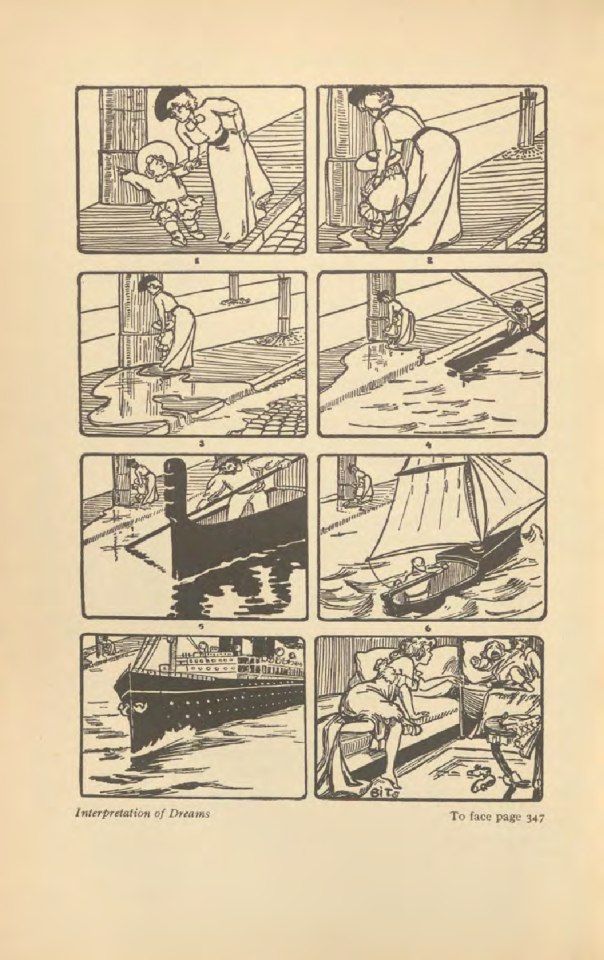
Interpretation of Dreams To face page 347
S.
THE DREAM-WORK 347
6. Urine Symbolism.
The drawings here reproduced belong to a series of pictures
discovered in a Hungarian comic periodical (Fidibusz) by
Ferenczi, who recognized that they constituted a useful illus-
tration of the theory of dreams. This material has already been
used by O. Rank under the title: Traum der franzøsichen Bonne,
in his work on Symbolschichtung im Wecktraum, etc.Not until we reach the last picture, which represents the
awakening of the nursemaid by the screaming of the child, does
it occur to us that the preceding seven pictures show the phases
of a dream. The first picture represents the stimulus which will
lead to the awakening. The little boy manifests a need, and
wants the help appropriate to it. The dream, however, changes
the situation in the bedroom to that of taking a walk. In the
second picture the nurse has already placed the boy at a street
corner; he urinates ; she can sleep on. But the waking stimulus
continues; indeed, it increases; the boy, finding that no
attention is paid to him, roars louder and louder. The more
urgently he demands the awakening and the help of the nurse,
the greater is the assurance in her dream that all is well, and
that there is no need of her waking. At the same time the dream
translates the growing intensity of the stimulus into the in-
creasing size of the symbol. The stream of water which the
urinating boy furnishes becomes increasingly bigger. In the
fourth picture it already bears a canoe, then a gondola, then
a sailing-ship, and finally a large steamer. The struggle between
the obstinate need for sleep and the unflagging waking stimulus
is here illustrated in an ingenious manner by the vivacious
artist,7. A Staircase Dream.
(Communicated and interpreted by Otto Rank.)
For the following transparent dream of nocturnal emission
I am indebted to the same colleague who furnished us with
the dream due to dental stimulus reported on p. 365.“I am running downstairs in the “stair-house* after a little girl,
whom I wish to punish because she has done something to me. At the
bottom of the stairs someone stops the child for me. (A grown-up* [The common staircase, surrounding a well עס shaft, which gives access to the
various floors of a block of flats.—TRANs.]S.
348 THE INTERPRETATION OF DREAMS
woman?) I catch hold of the child, but do not know whether I have
hit her, for I suddenly find myself in the middle of the staircase, where
1 effect coitus with the child (in the air, as it were). It is really no coitus,
I only rub my organ on her external genitals, and in doing this I see
them very distinctly, as distinctly as I see her head, which is lying
sideways. During the sexual act I see hanging to the left and above me
(also as if in the air) two small pictures, landscapes, representing a
house surrounded by vegetation. On the smaller one, instead of the
painter s signature, is my Christian name; it seems to be intended as a
birthday present to me. A small placard is hanging in front of the
pictures, to the effect that cheaper pictures could also be obtained. I then
see myself very indistinctly as though lying in bed on the landing,
and I am awakened by a feeling of welness which came from the
emission.“Interprelation. —The dreamer had been in a bookshop on the
evening of the dream-day where, while waiting, he had
examined some pictures which were exhibited there, and which
represented subjects similar to those of the dream-pictures. He
went up to one small picture which particularly took his fancy,
in order to ascertain the name of the artist, a name which,
however, proved quite unfamiliar to him.“Later in the same evening, in the company of some
acquaintances, he heard of a Bohemian servant-girl who
boasted that her illegitimate child ‘was made on the stairs.”
The dreamer inquired as to the details of this unusual
occurrence, and learned that the servant-girl went with her
lover to the home of her parents, where there was no oppor-
tunity for sexual relations, and that the excited man performed
the act on the stairs. In jesting allusion to the mischievous
expression applied to adulterated wine, the dreamer remarked :
"The child was really grown on the cellar steps.”“These experiences of the day, which are quite prominent
in the dream-content, were readily reproduced by the dreamer.
Just as readily he reproduced an old fragment of infantile
recollection which was likewise utilized by the dream. The
stairs were in the house in which he had spent the greater part
of his childhood, and in which he had first become consciously
acquainted with sexual problems. In this ‘stair-house’ he used,
among other things, to slide down the banisters astride, which
caused him to become sexually excited. In the dream, too, heS.
THE DREAM-WORK 349
comes down the stairs very rapidly, so rapidly that, according
to his own distinct assertion, he hardly touched the individual
steps, but rather ‘flew’ down or slid.” With the reference to
this infantile experience the beginning of the dream seems to
represent the factor of sexual excitement.—In the same `stair-
house,” and in the dwelling-house attached to it, the dreamer
used to have sexual scuffles with the neighbours’ children, in
which he satisfied himself in the same manner as he did in the
dream.“If we remember that, according to Freud's investigation of
sexual symbolism,? stairs and climbing stairs almost always
symbolize coitus, the dream becomes clear, Its motive force,
as well as its effect, the nocturnal emission, is of a purely
libidinal nature. Sexual excitement became aroused during the
sleeping state (in the dream this is represented by the rapid
running or sliding down the stairs), its sadistic quality, based
on the childish scuffles, being indicated by the pursuit and
overpowering of the child. The libidinal excitement becomes
enhanced, and presses on to the sexual act (represented in the
dream by grasping the child and conveying it to the middle
of the stairs). Up to this point the sexual character of the dream
seems to be represented in a purely symbolic manner and to
the unpractised dream-interpreter would be quite obscure.
But this symbolic gratification, which should have ensured
undisturbed sleep, was not sufficient for the powerful libidinal
excitement. The excitement leads to an orgasm, and thus the
whole staircase symbolism is unmasked as a substitute for coitus.
Freud lays stress on the rhythmical character of both actions
as one of the reasons for the sexual utilization of the staircase
symbolism, and the dream seems to confirm this most plainly,
for according to the express assertion of the dreamer the rhythm
of the sexual act, the rubbing up and down, was the most
pronounced feature of the whole dream.“There is still something to be said of the two pictures which,
apart from their real significance, have also the value of
“Weibsbilder, literally “woman-pictures', but idiomatically,
‘women’, This is in any case shown by the fact that the dream
deals with a big and a little picture, just as the dream-content+ See Zentralblatt für Psychoanalyse, i, p. 2 f.
S.
350 THE INTERPRETATION OF DREAMS
presents a big (grown-up) and a little girl. That cheaper
pictures could be obtained also points to the prostitution
complex, just as the dreamer’s name on the little picture, and
the thought that it was intended for his birthday, point to the
parent complex (to be born on the stairs = to be conceived in
coitus). ⑨“The indistinct final scene, in which the dreamer sees himself
lying in bed on the landing and feeling wet, seems to go back
into childhood, even beyond the infantile masturbation, and
presumably has its prototype in similarly pleasurable scenes of
bed-wetting.”8. A modified staircase dream.
To one of my patients, a sexual abstainer, who was very ill,
whose phantasy was fixated upon his mother, and who
repeatedly dreamed of climbing stairs while accompanied by
his mother, I once remarked that moderate masturbation would
probably have been less harmful to him than his enforced
abstinence. The influence of this remark provoked the following
dream:His piano teacher reproaches him for neglecting his piano-playing,
and for not practising the Études of Moscheles and Clementis Gradus
ad Parnassum. With reference to this he remarked that the
Gradus, too, is a stairway, and that the piano itself is a stairway,
as it has a scale.It may be said that there is no class of ideas which cannot
be enlisted in the representation of sexual facts and wishes.9. The Sensation of Reality and the Representation of
Repetition.A man, now thirty-five, relates a clearly remembered dream
which he claims to have had when he was four years of age:
The notary with whom his father's will was deposited—he had lost
his father at the age of three—brought two large Emperor-pears, of
which he was given one to eat. The other lay on the window-sill of the
living-room. He woke with the conviction of the reality of what
he had dreamt, and obstinately asked his mother to give him
the second pear; it was, he said, still lying on the window-sill.
His mother laughed at this.Analysis —The notary was a jovial old gentleman who, as he
seems to remember, really sometimes brought pears with him.
The window-sill was as he saw it in the dream. Nothing elseS.
THE DREAM-WORK 351
occurs to him in this connection, except, perhaps, that his
mother has recently told him a dream. She has two birds
sitting on her head ; she wonders when they will fly away, but
they do not fly away, and one of them flies to her mouth and
sucks at it.The dreamer’s inability to furnish associations justifies the
attempt to interpret it by the substitution of symbols. The two
pears—fommes ou poires—are the breasts of the mother who
nursed him; the window-sill is the projection of the bosom,
analogous to the balconies in the dream of houses (cf. p. 243).
His sensation of reality after waking is justified, for his mother
had actually suckled him for much longer than the customary
term, and her breast was still available. The dream is to be
translated : Mother, give (show) me the breast again at which
I once used to drink. The “once” is represented by the eating
of the one pear, the “again” by the desire for the other. The
temporal repetition of an act is habitually represented in dreams
by the numerical multiplication of an object.It is naturally a very striking phenomenon that symbolism
should already play a part in the dream of a child of four, but
this is the rule rather than the exception. One may say that the
dreamer has command of symbolism from the very first.The carly age at which people make use of symbolic
representation, even apart from the dream-life, may be shown
by the following uninfluenced memory of a lady who is now
twenty-seven: She is in her fourth year. The nursemaid is driving
her, with her brother, eleven months younger, and a cousin, who is
between the two in age, to the lavatory, so that they can do their little
business there before going for their walk. As the oldest, she sits on the
seat and the other two on chambers. She asks her ( female) cousin: Have
Jou a purse, too? Walter has a little sausage, I have a purse. The cousin
answers: Yes, I have a purse, too. The nursemaid listens, laughing,
and relates the conversation to the mother, whose reaction is a sharp
reprimand.Here a dream may be inserted whose excellent symbolism per-
mitted of interpretation with little assistance from the dreamer :10. The Question of Symbolism in the Dreams of Normal
Persons.* Alfred Robitsek in the Zentralblatt für Psychoanalyse, ii, 1911, p. 340.
ג The World of Dreams, London, 1911, p. 168.S.
352 THE INTERPRETATION OF DREAMS
An objection frequently raised by the opponents of psycho-
analysis—and recently also by Havelock Ellis—is that,
although dream-symbolism may perhaps be a product of the
neurotic psyche, it has no validity whatever in the case of
normal persons. But while psychoanalysis recognizes no
essential distinctions, but only quantitative differences, between
the psychic life of the normal person and that of the neurotic,
the analysis of those dreams in which, in sound and sick persons
alike, the repressed complexes display the same activity, reveals
the absolute identity of the mechanisms as well as of the
symbolism. Indeed, the natural dreams of healthy persons often
contain a much simpler, more transparent, and more charac-
teristic symbolism than those of neurotics, which, owing to the
greater strictness of the censorship and the more extensive
dream-distortion resulting therefrom, are frequently troubled
and obscured, and are therefore more difficult to translate.
The following dream serves to illustrate this fact. This dream
comes from a non-neurotic girl of a rather prudish and reserved
type. In the course of conversation I found that she was engaged
to be married, but that there were hindrances in the way of
the marriage which threatened to postpone it. She related
spontaneously the following dream:I arrange the centre of a table with flowers for a birthday. On
being questioned she states that in the dream she seemed to be
at home (she has no home at the time) and experienced a
feeling of happiness.The “popular” symbolism enables me to translate the dream
for myself. It is the expression of her wish to be married : the
table, with the flowers in the centre, is symbolic of herself and
her genitals. She represents her future wishes as fulfilled,
inasmuch as she is already occupied with thoughts of the birth
of a child ; so the wedding has taken place long ago.I call her attention to the fact that "the centre of a table” is
an unusual expression, which she admits; but here, of course,
I cannot question her more directly. I carefully refrain from
suggesting to her the meaning of the symbols, and ask her only
for the thoughts which occur to her mind in connection with
the individual parts of the dream. In the course of the analysis
her reserve gave way to a distinct interest in the interpretation,
and a frankness which was made possible by the serious toneS.
THE DREAM-WORK 353
of the conversation.—To my question as to what kind of flowers
they had been, her first answer is “expensive flowers; one has to pay
for them”; then she adds that they were lilies-of-the-valley, violets,
and pinks or carnations. I took the word lily in this dream in its
popular sense, as a symbol of chastity; she confirmed this, as
purity occurred to her in association with lily. Valley is a
common feminine dream-symbol. The chance juxtaposition of
the two symbols in the name of the flower is made into a piece
of dream-symbolism, and serves to emphasize the preciousness
of her virginity—expensive flowers; one has to pay for them—and
expresses the expectation that her husband will know how to
appreciate its value. The comment, expensive flowers, etc., has,
as will be shown, a different meaning in every one of the three
different flower-symbols.I thought of what seemed to me a venturesome explanation
of the hidden meaning of the apparently quite asexual word
violets by an unconscious relation to the French viol. But to my
surprise the dreamer’s association was the English word violate.
The accidental phonetic similarity of the two words violet and
violate is utilized by the dream to express in “the language of
flowers” the idea of the violence of defloration (another word
which makes use of flower-symbolism), and perhaps also to
give expression to a masochistic tendency on the part of the
girl.—An excellent example of the word bridges across which
run the paths to the unconscious. “One has to pay for them’ here
means life, with which she has to pay for becoming a wife and
a mother.In association with pinks, which she then calls carnations, I
think of carnal. But her association is colour, to which she adds
that carnations arc the flowers which her fiancé gives her
frequently and in large quantities. At the end of the conversation
she suddenly admits, spontaneously, that she has not told me
the truth; the word that occurred to her was not colour, but
incarnation, the very word I expected. Moreover, even the word
“colour” is not a remote association ; it was determined by the
meaning of carnation (i.e. flesh-colour)—that is, by the complex.
This lack of honesty shows that the resistance here is at its
greatest because the symbolism is here most transparent, and
the struggle between libido and repression is most intense in
connection with this phallic theme. The remark that thesez
S.
354 THE INTERPRETATION OF DREAMS
flowers were often given her by her fiancé is, together with the
double meaning of carnation, a still further indication of their
phallic significance in the dream. The occasion of the present
of flowers during the day is employed to express the thought
of a sexual present and a return present. She gives her virginity
and expects in return for it a rich love-life. But the words:
“expensive flowers, one has to pay for them” may have a real, financial
meaning.—The flower-symbolism in the dream thus comprises
the virginal female, the male symbol, and the reference to
violent defloration. It is to be noted that sexual flower-
symbolism, which, of course, is very widespread, symbolizes the
human sexual organs by flowers, the sexual organs of plants;
indeed, presents of flowers between lovers may perhaps have
this unconscious significance.The birthday for which she is making preparations in the
dream probably signifies the birth of a child. She identifies
herself with the bridegroom, and represents him preparing her
for a birth (having coitus with her). It is as though the latent
thoughts were to say: “If I were he, I would not wait, but I
would deflower the bride without asking her; I would use
violence.” Indeed, the word violate points to this. Thus even
the sadistic libidinal components find expression.In a deeper stratum of the dream the sentence 7 arrange,
etc., probably has an auto-erotic, that is, an infantile
significance.She also has a knowledge—possible only in the dream—of
her physical need ; she sees herself flat like a table, so that she
emphasizes all the more her virginity, the costliness of the centre
(another time she calls it a centre-piece of flowers). Even the
horizontal element of the table may contribute something to
the symbol.—The concentration of the dream is worthy of
remark ; nothing is superfluous, every word is a symbol.Later on she brings me a supplement to this dream:
“I decorate the flowers with green crinkled paper.” She adds that it
was fancy paper of the sort which is used to disguise ordinary
flower-pots. She says also: “To hide untidy things, whatever
was to be seen which was not pretty to the eye; there is a gap,
a little space in the flowers. The paper looks like velvet or moss.”
With decorate she associates decorum, as I expected. The green
colour is very prominent, and with this she associates hope,S.
THE DREAM-WORK 355
yet another reference to pregnancy.—In this part of the dream
the identification with the man is not the dominant feature,
but thoughts of shame and frankness express themselves. She
makes herself beautiful for him; she admits physical defects, of
which she is ashamed and which she wishes to correct. The
associations velvet and moss distinctly point to crines pubis.The dream is an expression of thoughts hardly known to
the waking state of the girl; thoughts which deal with the love
of the senses and its organs ; she is “prepared for a birth-day,”
i.e. she has coitus; the fear of defloration and perhaps the
pleasurably toned pain find expression ; she admits her physical
defects and over-compensates them by means of an over-
estimation of the value of her virginity Her shame excuses the
emerging sensuality by the fact that the aim of it all is the child.
Even material considerations, which are foreign to the lover,
find expression here. The affect of the simple dream—the
feeling of bliss—shows that here strong emotional complexes
have found satisfaction.Ferenczi has rightly called attention to the ease with which
the “dreams of the unsuspecting” allow one to divine the sense
of the symbols and the significance of the dreams (Int. Zeitschr.
SJ. Psych. iv. 1916-17).I include the following analysis of the dream of an historical
personage of our own time, because in it an object which even
otherwise would be well adapted to represent the male member
is, by an additional determinant, most distinctly characterized
as a phallic symbol. The “endless prolongation” of a riding-
whip can hardly signify anything else but an erection. Moreover.
this dream affords an excellent demonstration of the fact that
thoughts of a serious nature, and quite remote from the sexual,
may be represented by infantile sexual material.11. A dream of Bismarck’s (by Dr. Hanns Sachs).
“In his Gedanken und Erinerrungen Bismarck includes (vol. ii
of the Volksausgabe, p. 222) a letter which he wrote on December
18, 1881, to Kaiser Wilhelm. This letter contains the following
passage: ‘Your Majesty's communication encourages me to
relate a dream which I had in the spring of 1863, in the days
of the severest conflict, out of which no pathway seemed to
lead. I dreamed, and I told my dream the next morning to
my wife and other witnesses, that I was riding along a narrowS.
356 THE INTERPRETATION OF DREAMS
Alpine path, an abyss on the right, a wall of rocks on the left;
the path became narrower, so that the horse refused to proceed,
and turning about or dismounting was impossible because of
the lack of space; then I beat with the riding-whip in my left
hand against the smooth wall of rock, and called upon God;
the whip became endlessly long, the precipice fell like a piece
of scenery, and disclosed a broad road with a view of hills and
forest-land as in Bohemia, and Prussian troops with flags, and
even in the dream the thought occurred to me of how I could
report this quickly to Your Majesty. This dream fulfilled itself,
and I awoke from it happy and refreshed.’“The action of the dream falls into two parts: in the first
part the dreamer is involved in a distressing situation, from
which in the second part he is miraculously delivered. The
difficult position in which horse and rider find themselves is an
easily recognizable dream-representation of the critical situation
of the statesman, a situation which he may have felt with
especial acuteness on the evening before his dream while
thinking over his problems and policies. Bismarck himself, in
the above-quoted passage, makes use of this figure of speech
in order to describe the wretchedness of his situation at the
time; it was thus quite familiar and obvious to his mind. And
here, moreover, we have a good example of Silberer's functional
phenomenon.” The processes in the mind of the dreamer who,
in each of the solutions attempted in thought, comes upon an
insurmountable difficulty, but who none the less cannot and
must not wrest his mind from preoccupation with the problems
that beset him, are most aptly represented by the rider who
can go neither forwards nor backwards. The pride which
forbids him to think of yielding or retiring finds expression in
the dream in the words ‘turning about or dismounting was
impossible.” In his capacity of a man of incessant and strenuous
activity, toiling for the welfare of others, it was quite natural
for Bismarck to compare himself to a horse, and actually he
did so on various occasions; for example, in his famous
utterance: ‘A good horse dies in harness.” Interpreted thus,
the words ‘the horse refused’ mean simply that the over-tired
man felt the need of turning away from the cares of the present
or, to express it differently, that he was on the point of freeing
himself from the shackles of reality by means of sleep andS.
THE DREAM-WORK 357
dreams. The wish-fulfilment which finds such intense expression
in the second part has its prelude here in the words ‘Alpine
path.” Bismarck probably knew already that he would spend
his next vacation in the Alps, namely, in Gastein ; so the dream,
which transported him thither, freed him at a stroke from all
burdensome preoccupation with affairs of state.“In the second part, the wishes of the dreamer are represented
in a twofold manner as fulfilled—in an undisguised and palpable
fashion, and at the same time symbolically. Symbolically, by
the disappearance of the inhibiting rock, in place of which
there appears a broad road—the desired way of escape in its
most convenient form—plainly visible, despite the advancing
Prussian troops. For the explanation of this prophetic vision
one need not construct a mystic hypothesis ; the Freudian theory
of wish-fulfilment suffices completely. Bismarck was already
wishing for a successful war with Austria as the best way out
of the inner conflicts of Prussia. If he sees the Prussian troops,
with their colours, in Bohemia, i.e. in enemy country, then the
dream shows him his wish fulfilled, as postulated by Freud. It
is not of general but of individual significance that the dreamer
in this case was not satisfied with the dream-fulfilment, but was
able also to attain the actual goal. One feature which must
strike everyone who is acquainted with the psychoanalytical
interpretative technique is the riding-whip, which grows
‘endlessly long.” Whip, stick, lance, and similar objects are
familiar to us as phallic symbols; but if this whip has the most
striking characteristic of the phallus, namely, its extensibility,
there can be no doubt as to its meaning. The exaggeration of
this phenomenon by making the extension ‘endlessly long’
seems to show the influence of an infantile attitude. The taking
of the whip in the hand is a clear allusion to masturbation,
which refers, of course, not to the present-day life of the
dreamer, but to his far-distant childish impulses. Here Dr.
Stekel's interpretation is very valuable. According to this left
in the dream signifies what is wrong, forbidden, sinful, which
might very well be applicable to childish masturbation prac-
tised in defiance of prohibition. Between this lowest infantile
stratum and the uppermost, which is concerned with the daily
plans of the statesman, a middle stratum may be indicated
which has a relation to the other two. The whole incident ofS.
358 THE INTERPRETATION OF DREAMS
the miraculous rescue from an emergency by striking the rock
and calling upon God for help reminds one vividly of a Biblical
scene, namely, that in which Moses strikes water from the rock
for the thirsting children of Israel. A precise acquaintance with
this passage may be safely assumed in the case of Bismarck,
who came from a Protestant Bible-reading home. Bismarck, in
the time of conflict, might easily enough compare himself to
the leader Moses, whom the very people whom he wished to
set free rewarded with rebellion, hatred, and ingratitude. And
this would provide a point of contact with his present wishes.
On the other hand, the Biblical passage contains many details
which can very well be applied to phantasies of masturbation.
Moses grasps his rod against the prohibition of the Lord, and
for this transgression the Lord punishes him by announcing to
him that he must die without entering the promised land. The
prohibited grasping of the rod—unmistakably phallic in
dreams—the production of fluid by striking with it, and the
threat of death—here we have summarized all the main factors
of childish masturbation. Interesting, too, is the elaboration
which has welded together, by means of the Biblical passage,
the two heterogeneous pictures, of which one comes from the
psyche of the inspired statesman, the other from the impulses
of the primitive psyche of the child, in the course of which
elaboration all disagreeable elements have been eliminated.
That the seizing of the whip is a forbidden, rebellious action
is symbolically indicated only by the use of the left hand. In
the manifest dream-content, however, God is called upon as
the whip is seized, as though ostentatiously to reject any
thought of prohibition or secfecy. Of the two promises that
God made to Moses—that he should see the Promised Land,
but that he should not enter it—the one is very plainly
represented (view of hills and forest-land), whereas the other,
a most disagreeable one, is not mentioned at all. The water
has probably been sacrificed to the necessities of secondary
elaboration, which successfully sought to bring about the
unification of this scene with the previous one, and in place
of the water the rock itself falls.“The conclusion of an infantile masturbation-phantasy, in
which the theme of prohibition is represented, ought to be
expected in such a form that the child wishes that the personsS.
THE DREAM-WORK 359
of authority about him may not hear anything of what has
happened. In the dream this wish is displaced by the opposite,
the wish to tell the king immediately of what has occurred.
This reversal joins itself, however, very admirably, and quite
unostentatiously, to the victory-phantasy contained in the
uppermost stratum of the dream-thoughts and in part of the
manifest dream-content. Such a dream of victory and conquest
is often a cloak for the longing for erotic conquests ; individual
features of the dream, as, for example, the fact that resistance
is offered to the man advancing, but that after the application
of the lengthening whip a broad road appears, might point in
that direction, but they would not be sufficient to enable us
to construct from them a definite thread of wish and thought
running through the whole dream. We see here a typical
example of a completely successful dream-distortion, What is
offensive has been worked over, so that it nowhere protrudes
through the fabric which has been spread over it like a
protective covering. The consequence is that any release of
anxiety could be prevented. This is an ideal case of successful
wish-fulfilment, without violence to the censorship, so that we
can readily understand that the dreamer awoke from such a
dream happy and refreshed.”I close with the
12. Dream of a Chemist.
(A young man who has been trying to give up his
habit of masturbation by substituting intercourse with a
woman.)Preliminary statement: On the day before the dream he had
been instructing a student as to Grignard’s reaction, in which
magnesium is dissolved in absolutely pure ether under the
catalytic influence of iodine. Two days earlier there had been
an explosion in the course of the same reaction, in which
someone had burned his hand.Dream I. He is going to make phenylmagnesiumbromide; he sees
the apparatus with particular distinciness, bul he has substituted himself
Sor the magnesium. He is now in a curious, wavering attitude. He keeps
on repeating to himself: "This is the right thing, it is working, my feet
are beginning to dissolve, and my knees are getting soft.” Then he reaches
down and feels for his feet, and meanwhile (he does not know how) he
takes his legs out of the carboy, and then again he says to himself:S.
360 THE INTERPRETATION OF DREAMS
“That can’t be . . . Yes, it has been done correctly.” Then he
partially wakes, and repeals the dream to himself, because he wants to
tell it to me. He is positively afraid of the analysis df the dream. He is
much excited during this state of semi sleep, and repeats continually:
“Phenyl, phenyl.”II. He is in . . . with his whole family. He is supposed to be at
the Schottentor at half-past eleven in order to keep an appointment with
the lady in question, but he does not wake until half-past eleven. He
says to himself: “It is too late now; when you get there it will be
half-past twelve.” The next moment he sees the whole family gathered
about the table—his mother and the parlourmaid with the soup-tureen
with peculiar distinctness. Then he says to himself: “Well, if we are
sitting down to eat already I certainly can't get away.”Analysis. —He feels sure that even the first dream contains a
reference to the lady whom he is to meet at the place of
rendezvous (the dream was dreamed during the night before
the expected meeting). The student whom he was instructing
is a particularly unpleasant fellow; the chemist had said to
him: “That isn’t right, because the magnesium was still
unaffected,” and the student had answered, as though he were
quite unconcerned: “Nor it is.” He himself must be this
student; he is as indifferent to his analysis as the student is to
his synthesis; the he in the dream, however, who performs the
operation, is myself. How unpleasant he must seem to me with
his indifference to the result!Again, he is the material with which the analysis (synthesis)
is made. For the question is the success of the treatment. The
legs in the dream recall an impression of the previous evening.
He met a lady at a dancing class of whom he wished to make
a conquest; he pressed her to him so closely that she once
cried out. As he ceased to press her legs he felt her firm,
responding pressure against his lower thighs as far as just above
the knees, the spot mentioned in the dream. In this situation,
then, the woman is the magnesium in the retort, which is at
last working. He is feminine towards me, as he is virile towards
the woman. If he succeeds with the woman, the treatment
will also succeed. Feeling himself and becoming aware of his
knees refers to masturbation, and corresponds to his fatigue of
the previous day . . . The rendezvous had actually been made
for half-past eleven, His wish to oversleep himself and to keepS.
THE DREAM-WORK 361
to his sexual object at home (that is, masturbation) corresponds
to his resistance.He says, in respect of the repetition of the name phenyl, that
all these radicals ending in yl have always been pleasing to
him; they are very convenient to use: benzyl, acetyl, etc.
That, however, explained nothing. But when I proposed the
root Schlemihl: he laughed heartily, and told me that during
the summer he had read a book by Prévost which contained
a chapter: Les exclus de l’amour, and in this there was some
mention of Schlemiliés; and in reading of these outcasts he said
to himself: "That is my case.” He would have played the
Schlemihl if he had missed the appointment.It seems that the sexual symbolism of dreams has already
been directly confirmed by experiment. In 1912 Dr. K.
Schrôtter, at the instance of H. Swoboda, produced dreams in
deeply hypnotized persons by suggestions which determined a
large part of the dream-content. If the suggestion proposed
that the subject should dream of normal or abnormal sexual
relations, the dream carried out these orders by replacing
sexual material by the symbols with which psychoanalytic
dream-interpretation has made us familiar. Thus, following the
suggestion that the dreamer should dream of homosexual
relations with a lady friend, this friend appeared in the dream
carrying a shabby travelling-bag, upon which there was a label
with the printed words: "For ladies only.” The dreamer was
believed never to have heard of dream-symbolization or of
dream-interpretation. Unfortunately, the value of this im-
portant investigation was diminished by the fact that Dr.
Schrôtter shortly afterwards committed suicide. Of his dream-
experiments he gave us only a preliminary report in the
Zentralblatt für Psychoanalyse.Similar results were reported in 1923 by G. Roffenstein.
Especially interesting were the experiments performed by
Betlheim and Hartmann, because they eliminated hypnosis.
"These authors told stories of a crude sexual content to confused
patients suffering from Korsakoff's psychosis, and observed the
distortions which appeared when the material related was? [This Hebrew word is well incon in German-speaking countries, even among
Gentiles, and signifies an unlucky, awkward person.—TRANs.]S.
362 THE INTERPRETATION OF DREAMS
reproduced.' It was shown that the reproduced material con-
tained symbols made familiar by the interpretation of dreams
(climbing stairs, stabbing and shooting as symbols of coitus,
knives and cigarettes as symbols of the penis). Special value
was attached to the appearance of the symbol of climbing stairs,
for, as the authors justly observed, “a symbolization of this sort
could not be effected by a conscious wish to distort.”Only when we have formed a due estimate of the importance
of symbolism in dreams can we continue the study of the
typical dreams which was interrupted in an earlier chapter
(p. 260). I feel justified in dividing these dreams roughly into
two classes; first, those which always really have the same
meaning, and second, those which despite the same or a similar
content must nevertheless be given the most varied inter-
pretations. Of the typical dreams belonging to the first class
I have already dealt fairly fully with the examination-
dream.On account of their similar affective character, the dreams
of missing a train deserve to be ranked with the examination-
dreams ; moreover, their interpretation justifies this approxima-
tion. They are consolation-dreams, directed against another
anxiety perceived in dreams—the fear of death. “To depart”
is one of the most frequent and one of the most readily
established of the death-symbols. The dream therefore says
consolingly: “Reassure yourself, you are not going to die
(to depart),” just as the examination-dream calms us by
saying: "Don't be afraid; this time, too, nothing will happen
to you.” The difficulty in understanding both kinds of dreams
is due to the fact that the anxiety is attached precisely to the
expression of consolation.The meaning of the “dreams due to dental stimulus” which
I have often enough had to analyse in my patients escaped me
for a long time because, much to my astonishment, they
habitually offered too great a resistance to interpretation.
But finally an overwhelming mass of evidence convinced me
that in the case of men nothing other than the masturbatory
desires of puberty furnish the motive power of these dreams.
I shall analyse two such dreams, one of which is also a “flying
dream.” The two dreams were dreamed by the same person—
* Uber Fehlreaktionen bei der Korsakoffschen Psychose, Arch. f. Psychiatrie, Bd. bexii, 1924.S.
THE DREAM-WORK 363
a young man of pronounced homosexuality which, however,
has been inhibited in life.He is witnessing a performance of Fidelio from the stalls of the
opera-house; he is sitting next to L., whose personality is congenial to
him, and whose friendship he would like to have. Suddenly he flies,
diagonally, right across the stalls; he then puts his hand in his mouth
and draws out two of his teeth.He himself describes the flight by saying that it was as
though he were thrown into the air. As the opera performed
was Fidelio he recalls the words: —“He who a charming wife acquires. ..."”
But the acquisition of even the most charming wife is not
among the wishes of the dreamer. Two other lines would be
more appropriate :—“He who succeeds in the lucky (big) throw
The friend of a friend to be. .The dream thus contains the "lucky (big) throw,” which is
not, however, a wish-fulfilment only. For it conceals also the
painful reflection that in his striving after friendship he has
often had the misfortune to be “thrown out,” and the fear lest
this fate may be repeated in the case of the young man by
whose side he has enjoyed the performance of Fidelio. This is
now followed by a confession, shameful to a man of his
refinement, to the effect that once, after such a rejection on
the part of a friend, his profound sexual longing caused him
to masturbate twice in succession.The other dream is as follows: Two university professors of his
acquaintance are treating him in my place. One of them does something
to his penis; he is afraid of an operation. The other thrusts an iron bar
against his mouth, so that he loses one or two teeth. He is bound with
Jour silk handkerchiefs.The sexual significance of this dream can hardly be doubted.
The silk handkerchiefs allude to an identification with a
homosexual of his acquaintance. The dreamer, who has never
achieved coition (nor has he ever actually sought sexual
intercourse) with men, conceives the sexual act on the lines of
the masturbation with which he was familiar during puberty.I believe that the frequent modifications of the typical dream
S.
364 THE INTERPRETATION OF DREAMS
due to dental stimulus—that, for example, in which another
person draws the tooth from the dreamer’s mouth—will be
made intelligible by the same explanation. It may, however,
be difficult to understand how “dental stimulus” can have
come to have this significance. But here I may draw attention
to the frequent “displacement from below to above” which is
at the service of sexual repression, and by means of which all
kinds of sensations and intentions occurring in hysteria, which
ought to be localized in the genitals, may at all events be
realized in other, unobjectionable parts of the body. We have
a case of such displacement when the genitals are replaced by
the face in the symbolism of unconscious thought. This is
corroborated by the fact that verbal usage relates the buttocks
to the checks,? and the labia minora to the lips which enclose
the orifice of the mouth. The nose is compared to the penis in
numerous allusions, and in cach case the presence of hair
completes the resemblance. Only onc feature—the teeth—is
beyond all possibility of being compared in this way; but it is
just this coincidence of agreement and disagreement which
makes the teeth suitable for purposes of representation under
the pressure of sexual repression.I will not assert that the interpretation of dreams due to
dental stimulus as dreams of masturbation (the correctness of
which I cannot doubt) has been freed of all obscurity.3 I carry
the explanation as far as I am able, and must leave the rest
unsolved. But I must refer to yet another relation indicated by
a colloquial expression. In Austria there is in use an indelicate
designation for the act of masturbation, namely: “To pull one
out,” or “to pull one off.”4 I am unable to say whence these
colloquialisms originate, or on what symbolisms they are based;+ The extraction of a tooth by another is usually to be interpreted as castration
(cf. hair-cutting; Stekel). One must distinguish between dreams due to dental
stimulus and dreams referring to the dentist, such as have been recorded, for
example, by Coriat (Zentralblatt für Psychoanalyse, iii, 440).+ [In German ‘‘Backen” = cheeks and “Hinterbacken” (lit, “hind-cheeks”) =
buttocks. —TRANs.]3 According to C. G. Jung, dreams due to dental stimulus in the case of women
have the significance of parturition dreams. E. Jones has given valuable confirma-
tion of this. The common element of this interpretation with that represented
above may be found in the fact that in both cases (castration-birth) there is a
question of removing a part from the whole body.+ Cf. the “biographical” dream on p. 331.
S.
THE DREAM-WORK 365
but the teeth would very well fit in with the first of the two.
As dreams of pulling teeth, and of teeth falling out, are
interpreted in popular belief to mean the death of a connection,
and as psychoanalysis can admit of such a meaning only at
the most as a joking allusion to the sense already indicated, I
insert here a dream due to dental stimulus placed at my
disposal by Otto Rank.“As regards the subject of dreams due to dental stimulus,
I have received the following report from a colleague who has
for some time taken a lively interest in the problems of
dream-interpretation :—“I recently dreamed that I went to the dentist, who drilled at one
of my back teeth in the lower jaw. He worked so long at it that the
tooth became useless. He then grasped it with the forceps and pulled it
out with such perfect ease that it astonished me. He said that I must
not worry about it as this was not really the tooth that had been treated;
and he put it on the table where the tooth (as it seemed to me now, an
upper incisor) fell apart into several layers. I rose from the operating
chair, drew inquisitively nearer and, full of interest, put a medical
question. As the dentist was separating the individual pieces of the
conspicuously white tooth, and crushing them (pulverizing them) with
an instrument, he explained to me that this had some connection with
puberty, and that only before puberly did the teeth come out so easily;
that in women the decisive factor in this respect is the birth of a child.“ Ч then noticed (I believe while half awake) that this dream
was accompanied by an emission, which I cannot, however,
definitely place at a particular point in the dream; I am
inclined to think that it began with the pulling out of the tooth.“I then continued to dream something which I can no longer
remember, but which concluded with the fact that I had left my hat
and coat somewhere (perhaps at the dentists), hoping that they would
be brought after me, and that, dressed only in my overcoat, I hastened
to catch a departing train. I managed at the last moment to jump on
to the last carriage, where somebody already was. I could not, however,
succeed in making my way into the carriage, but was compelled to make
the journey in an uncomfortable position, from which I allempled to
escape, eventually with success. We passed through a long tunnel, in
which two trains from the opposite direction passed through our own
train as though it were the tunnel. I looked in as from the outside
through a carriage window.S.
366 THE INTERPRETATION OF DREAMS
“ ‘As material for the interpretation of this dream we
obtained the following experiences and thoughts of the dream-
day :—“ “I, For a short time I had actually been under dental
treatment, and at the time of the dream I was suffering from
continual pain in the lower jaw tooth, which was drilled at in
the dream, and on which the dentist had in fact worked longer
than I liked. On the morning of the day of the dream I had
again gone to the dentist's on account of the pain, and he had
suggested that I should allow him to extract a tooth, other
than the one treated, in the same jaw, from which the pain
probably came. It was a “wisdom tooth” which was just
breaking through. On this occasion, and in this connection, I
had put a question to his professional conscience.“ TI. On the afternoon of the same day I was obliged to
apologize to a lady for being bad-tempered and explain that
it was due to toothache; whereupon she told me that she was
afraid to have one of her roots extracted, although the crown
was almost completely gone. She thought that the extraction
of eye-teeth was especially painful and dangerous, although an
acquaintance had told her that it was much easier when a
tooth of the upper jaw was in question. It was such a tooth in
her case. The same acquaintance also told her that, while
under an anacsthetic, a wrong tooth had been pulled out, a
statement which increased her fear of the necessary operation.
She then asked me whether by eye-teeth one was to understand
molars or canines, and what was known about them. I then
called her attention to the vein of superstition in all these
opinions, without, however, emphasizing the kernel of truth at
the heart of many popular beliefs. She then related what in
her experience was a very old and general popular belief,
according to which, if a pregnant woman has toothache, she will give
birth to a boy.“ “III, This saying interested me, in connection with the
typical significance of dreams due to dental stimulus as a
substitute for masturbation (as stated by Freud, in his
Interpretation of Dreams), since in it the teeth and the male
genitals are brought into a certain relation. On the evening of
the same day I therefore read the passage in question in
The Interpretation of Dreams, and there found, amongst otherS.
THE DREAM-WORK 367
things, the statements which I am going to quote, whose
influence on my dream is as plainly recognizable as the influence
of the two experiences I have just recorded. Freud says of
dreams due to dental stimulus that “in the case of men, nothing
other than the masturbatory desires of puberty furnish the
motive power of these dreams” (p. 362). Further: “I believe
that the frequent modifications of the typical dream due to
dental stimulus—that, for example, in which another person
draws the tooth from the dreamer’s mouth—will be made
intelligible by the same explanation. It may, however, be
difficult to understand how ‘dental stimulus’ can have come
to have this significance. But here I may draw attention to
the frequent “displacement from below to above’ “ (in the
dream in question from the lower to the upper jaw) “which is
at the service of sexual repression, and by means of which all
kinds of sensations and intentions occurring in hysteria, which
ought to be localized in the genitals, may at all events be
realized in other, unobjectionable parts of the body” (p. 364).
“But I must refer to yet another relation indicated by colloquial
expression. In Austria there is in use an indelicate designation
for the act of masturbation, namely: “To pull one out, or
‘to pull one off” ” (р. 364). This expression had been familiar
to me in carly youth as a designation for masturbation, and
from this point it will not be difficult for the experienced
dream-interpreter to obtain access to the infantile material
which may lie at the root of this dream. I wish only to add
that the ease with which the tooth in the dream came out, and
the fact that it became transformed, after coming out, into an
upper incisor, recalls to me an experience of childhood, in
which I myself easily and painlessly pulled out one of my
wobbling front teeth. This episode, which to this day I
remember in all its details, happened at the same early period
at which my first conscious attempts at masturbation began
(Screen-memory).“ Freud's reference to an assertion of С. G. Jung's that
women’s dreams due to dental stimulus signify parturition
(p. 364), together with the popular belief in the significance
of toothache in pregnant women, occasioned the contrast, in
the dream, between the feminine significance and the masculine
(puberty). In this connection I recall an earlier dream whichS.
368 THE INTERPRETATION OF DREAMS
I dreamed soon after I had been discharged from the care of
a dentist, to the effect that the gold crowns which had just
been put in fell out, whereupon I was greatly chagrined, in
the dream, on account of the considerable expense involved,
which I had not yet got over. In view of a certain experience,
this dream is now comprehensible to me as a commendation
of the material advantages of masturbation as against the
economically altogether less advantageous object-love (gold
crowns), and I believe that these thoughts were again awakened
in me by the lady’s statement as to the meaning of toothache
in pregnant women,”“Thus far my colleague's illuminating and, I believe,
incontestable interpretation, to which I have nothing to add,
unless indeed I point to the probable meaning of the second
part of the dream, which by way of the word-bridges—Zahn
ziehen (to pull a tooth)—Zug (from ziehen, to pull = a train), and
Zahn reissen (to pull a tooth)—reisen (to travel)— represents the
dreamer”s transition, apparently effected under difficulty, from
masturbation to sexual intercourse (tunnel, through which
trains go in and out in opposite directions), as well as the
dangers of the latter (pregnancy; overcoat?).“Theoretically this case seems to be interesting in two ways.
First, it confirms the connection discovered by Freud, inasmuch
as the ejaculation in the dream occurs during the act of tooth-
drawing. For no matter in what form nocturnal ejaculation
may appear, we are obliged to regard it as a masturbatory
gratification which takes place without the help of mechanical
excitation, Moreover, the gratification of emission in this case
does not take place, as usual, through the medium of an object,
even though this is only imagined, but is objectless, purely
auto-erotic, if one may say so, or at most it perhaps reveals
a slight homosexual tendency (the dentist)."The second point which seems worth mention is the
following. An obvious objection could be made that we have
here a wholly superfluous attempt to drag in the Freudian
conception, since the events of the dream-day alone are quite
sufficient to make the content of the dream intelligible to us.
The visit to the dentist, the conversation with the lady, and
the reading of The Interpretation of Dreams are enough to explain* [German Überzieher, lit, something pulled over.—TRANs.]
S.
THE DREAM-WORK 369
why the sleeper, who was disturbed during the night by
toothache, should have dreamed this dream—even supposing,
the objector may add, that the dream was produced in order
to get rid of the sleep-disturbing pain (by representing the
extraction of the painful tooth, with a simultaneous drowning
of the dreaded sensation of pain by the libido). But, however
anxious we may be to give weight to this objection, we cannot
take seriously the assertion that the reading of Freud's explana-
tions could have established in the dreamer’s mind the
connection between tooth-extraction and masturbation, or that
it could have been made operative, had not the association
(‘to pull one off’), as the dreamer himself admitted, been
formed already years before. What may have still further
stimulated this association, besides the conversation with the
lady, is shown by a later assertion of the dreamer, to the effect
that while reading the Interpretation of Dreams he could not, for
intelligible reasons, quite believe in this typical meaning of
dreams due to dental stimulus, and conceived the desire to
know whether it held true for all dreams of this kind. The
dream now confirms the theory, at least for his own person,
and shows him why he had been obliged to doubt it. The
dream is therefore, in this respect also, the fulfilment of a wish;
namely, the wish to be convinced of the comprehensiveness
and reliability of this conception of Freud's."To the second group of typical dreams belong those in which
one is flying or hovering, falling, swimming, etc. What do these
dreams signify? Here we cannot generalize. They mean, as we
shall learn, something different in each case ; only, the sensory
material which they contain always comes from the same
source.We must conclude from the information obtained in psycho-
analysis that these dreams also repeat impressions of our
childhood—that is, that they refer to the games involving
movement which have such an extraordinary attraction for
children. Where is the uncle who has never made a child fly
by running with it across the room, with outstretched arms, or
has never played at falling with it by rocking it on his knee
and then suddenly straightening his leg, or by lifting it above
his head and suddenly pretending to withdraw his supporting
hand? At such moments children shout with joy and insatiablyAA
S.
370 THE INTERPRETATION OF DREAMS
demand a repetition of the performance, especially if a little
fright and dizziness are involved in it. In after years they
repeat their sensations in dreams, but in dreams they omit the
hands that held them, so that now they are free to float or fall.
We know that all small children have a fondness for such
games as rocking and see-sawing ; and when they see gymnastic
performances at the circus their recollection of such games is
refreshed. In some boys the hysterical attack consists simply in
the reproduction of such performances, which they accomplish
with great dexterity. Not infrequently sexual sensations are
excited by these games of movement, innocent though they
are in themselves. To express the matter in a few words: it is
these romping games of childhood which are being repeated
in dreams of flying, falling, vertigo, and the like, but the
pleasurable sensations are now transformed into anxiety. But,
as every mother knows, the romping of children often enough
ends in quarrelling and tears.I have therefore good reason for rejecting the explanation
that it is the condition of our cutaneous sensations during
sleep, the sensation of the movements of the lungs, etc., that
evoke dreams of flying and falling. As I see it, these sensations
have themselves been reproduced from the memory to which
the dream refers—that they are therefore dream-content, and
not dream-sources."This material, consisting of sensations of motion, similar in
character, and originating from the same sources, is now used
for the representation of the most manifold dream-thoughts.
Dreams of flying or hovering, for the most part pleasurably
toned, will call for the most widely differing interpretations
—interpretations of a quite special nature in the case of some
dreamers, and interpretations of a typical nature in that of
others. One of my patients was in the habit of dreaming very
frequently that she was hovering a little way above the street
without touching the ground. She was very short of stature,
and she shunned every sort of contamination involved by
intercourse with human beings. Her dream of suspension—
which raised her feet above the ground and allowed her head
to tower into the air, fulfilled both of her wishes, In the case1 This passage, dealing with dreams of motion, is repeated on account of the
context. Cf. р. 264,S.
THE DREAM-WORK 1
of other dreamers of the same sex, the dream of flying had
the significance of the longing: “If only I were a little bird P*
Similarly, others become angels at night, because no one has
ever called them angels by day. The intimate connection
between flying and the idea of a bird makes it comprehensible
that the dream of flying, in the case of male dreamers, should
usually have a coarsely sensual significance’; and we should
not be surprised to hear that this or that dreamer is always
very proud of his ability to fly.Dr. Paul Federn (Vienna) has propounded the fascinating
theory that a great many flying dreams are erection dreams,
since the remarkable phenomenon of erection, which con-
stantly occupies the human phantasy, cannot fail to be
impressive as an apparent suspension of the laws of gravity
(cf. the winged phalli of the ancients).It is a noteworthy fact that a prudent experimenter like
Mourly Vold, who is really averse to any kind of interpretation,
nevertheless defends the erotic interpretation of the dreams of
flying and hovering,? He describes the erotic element as “the
most important motive factor of the hovering dream,” and
refers to the strong sense of bodily vibration which accompanies
this type of dream, and the frequent connection of such dreams
with erections and emissions.Dreams of falling are more frequently characterized by
anxiety. Their interpretation, when they occur in women,
offers no difficulty, because they nearly always accept the
symbolic meaning of falling, which is a circumlocution for
giving way to an erotic temptation. We have not yet exhausted
the infantile sources of the dream of falling : nearly all children
have fallen occasionally, and then been picked up and fondled ;
if they fell out of bed at night they were picked up by the
nurse and taken into her bed.People who dream often, and with great enjoyment, of
swimming, cleaving the waves, etc., have usually been bed-
wetters, and they now repeat in the dream a pleasure which
they have long since learned to forgo. We shall soon learn,
from one example or another, to what representations dreams
of swimming easily lend themselves.* [A reference to the German slang word “vögeln” (to copulate) from “Vogel”
(a bird).—Tnaws.] a Über den Traum, Ges. Schriften, Bd. iii.S.
372 THE INTERPRETATION OF DREAMS
The interpretation of dreams of fire justifies a prohibition of
the nursery, which forbids children to “play with fire” so that
they may not wet the bed at night. These dreams also are
based on reminiscences of the enuresis nocturna of childhood.
In my Fragmnt of an Analysis of Hysteriax I have given the
complete analysis and synthesis of such a dream of fire in
connection with the infantile history of the dreamer, and have
shown for the representation of what maturer impulses this
infantile material has been utilized.It would be possible to cite quite a number of other “typical”
dreams, if by such one understands dreams in which there is
a frequent recurrence, in the dreams of different persons, of
the same manifest dream-content. For example: dreams of
passing through narrow alleys, or a whole suite of rooms;
dreams of burglars, in respect of whom nervous people take
measures of precaution before going to bed; dreams of being
chased by wild animals (bulls, horses) ; or of being threatened
with knives, daggers, and lances. The last two themes are
characteristic of the manifest dream-content of persons suffering
from anxiety, etc. A special investigation of this class of material
would be well worth while. In lieu of this I shall offer two
observations, which do not, however, apply exclusively to
typical dreams.The more one is occupied with the solution of dreams, the
readier one becomes to acknowledge that the majority of the
dreams of adults deal with sexual material and give expression
to erotic wishes. Only those who really analyse dreams, that is,
those who penetrate from their manifest content to the latent
dream-thoughts, can form an opinion on this subject: but
never those who are satisfied with registering merely the
manifest content (as, for example, Nåcke in his writings on
sexual dreams). Let us recognize at once that there is nothing
astonishing in this fact, which is entirely consistent with the
principles of dream-interpretation. No other instinct has had
to undergo so much suppression, from the time of childhood
onwards, asthesexualinstinctin all its numerous components :*—* Collected Papers, vol. iii, trans. by Alex. and James Strachey. Hogarth Press,
London.2 Cf. the author's Three Contributions to the Theory of Sex, 1930, translated by AL,
A. Brill. Monograph Series, Journal of Nervous and Mental Diseases Publishing;
Co., New York.S.
THE DREAM-WORK 373
from no other instinct are so many and such intense unconscious
wishes left over, which now, in the sleeping state, generate
dreams. In dream-interpretation this importance of the sexual
complexes must never be forgotten, though one must not, of
course, exaggerate it to the exclusion of all other factors.Of many dreams it may be ascertained, by careful inter-
pretation, that they may even be understood bisexually,
inasmuch as they yield an indisputable over-interpretation, in
which they realize homosexual impulses—that is, impulses
which are contrary to the normal sexual activity of the dreamer.
But that all dreams are to be interpreted bisexually, as Stekel:
maintains, and Adler,? seems to me to be a generalization as
insusceptible of proof as it is improbable, and one which,
therefore, I should be loth to defend; for I should, above all,
be at a loss to know how to dispose of the obvious fact that
there are many dreams which satisfy other than erotic needs
(taking the word in the widest sense), as, for example, dreams
of hunger, thirst, comfort, etc. And other similar assertions, to
the effect that “behind every dream one finds a reference to
death” (Stekel), or that every dream shows “an advance from
the feminine to the masculine line” (Adler), seem to me to go
far beyond the admissible in the interpretation of dreams.
The assertion that all dreams call for a sexual interpretation, against
which there is such an untiring polemic in the literature of
the subject, is quite foreign to my Interpretation of Dreams. It
will not be found in any of the eight editions of this book, and
is in palpable contradiction to the rest of its contents.We have stated elsewhere that dreams which are con-
spicuously innocent commonly embody crude erotic wishes, and
this we might confirm by numerous further examples. But
many dreams which appear indifferent, in which we should
never suspect a tendency in any particular direction, may be
traced, according to the analysis, to unmistakably sexual
wish-impulses, often of an unsuspected nature. For example,
who, before it had been interpreted, would have suspected a
sexual wish in the following dream? The dreamer relates:1 W. Stekel, Die Sprache des Traumes, 1911.
+ Alf. Adler, Der Psychische Hermaphroditismus im Leben und in der Neurose, in
Fortschritte der Medizin, 1910, No, 16, and later papers in the Zentralblatt für Psy-
choanalyse, i, 1910-11.S.
374 THE INTERPRETATION OF DREAMS
Between two stately palaces there stands, a little way back, a small
house, whose doors are closed. My wife leads me along the little bit of
road leading to the house and pushes the door open, and then I slip
quickly and easily into the interior of a courtyard that slopes steeply
upwards.Anyone who has had experience in the translating of dreams
will, of course, at once be reminded that penetration into
narrow spaces and the opening of locked doors are among the
commonest of sexual symbols, and will readily see in this dream
a representation of attempted coition from behind (between
the two stately buttocks of the female body). The narrow,
steep passage is, of course, the vagina : the assistance attributed
to the wife of the dreamer requires the interpretation that in
reality it is only consideration for the wife which is responsible
for abstention from such an attempt. Moreover, inquiry shows
that on the previous day a young girl had entered the household
of the dreamer; she had pleased him, and had given him the
impression that she would not be altogether averse to an
approach of this sort. The little house between the two palaces
is taken from a reminiscence of the Hradschin in Prague, and
once more points to the girl, who is a native of that city.If, in conversation with my patients, I emphasize the
frequency of the Oedipus dream—the dream of having sexual
intercourse with one’s mother—I elicit the answer: “I cannot
remember such a dream.” Immediately afterwards, however,
there arises the recollection of another, an unrecognizable,
indifferent dream, which the patient has dreamed repeatedly,
and which on analysis proves to be a dream with this very
content—that is, yet another Oedipus dream. I can assure the
reader that disguised dreams of sexual intercourse with the
dreamer’s mother are far more frequent than undisguised
dreams to the same effect. +
* I have published a typical example of such a disguised Oedipus dream in No. 1
of the Zentralblatt fiir Psychoanalyse (sce below) ; another, with a detailed analysis,
was published in No. 4 of the same journal by Otto Rank. For other disguised
Oedipus dreams in which the eye appears as a symbol, see Rank (Int. Zeitschr,
für Ps.A., i, 1913). Papers upon eye dreams and eye symbolism by Eder, Ferenczi,
and Reitler will be found in the same issue. The blinding in the Oedipus legend
and elsewhere is a substitute for castration. The ancients, by the way, were not
unfamiliar with the symbolic interpretation of the undisguised Oedipus dream(see O. Rank, Jakrb. ii, p. 534): “Thus, a dream of Julius Caesar's of sexual
relations with his mother has been handed down to us, which the oneiroscopistsS.
THE DREAM-WORK 375
There are dreams of landscapes and localities in which
emphasis is always laid upon the assurance: “I have been here
before.” But this “Déjà vu” has a special significance in dreams.
In this case the locality is always the genitals of the mother;
of no other place can it be asserted with such certainty that
one "has been here before.” I was once puzzled by the account
of a dream given by a patient afflicted with obsessional neurosis.
He dreamed that he called at a house where he had been twice
before. But this very patient had long ago told me of an episode
of his sixth year. At that time he shared his mother’s bed, and
had abused the occasion by inserting his finger into his mother’s
genitals while she was asleep.A large number of dreams, which are frequently full of
interpreted as a favourable omen signifying his taking possession of the earth
(Mother Earth). Equally well known is the oracle delivered to the Tarquinii,
to the effect that that one of them would become the ruler of Rome who should
be the first to kiss his mother (osculum matri tulerit), which Brutus conceived as
referring to Mother Earth (terram osculo contigit, scilicet quod ea communis mater
omnium mortalium esset, Livy, I, Ixi). CE. here the dream of Hippias in Heredotus,VI,
107: "But Hippias led the barbarians to Marathon after he had had the following
dream-vision the previous night. It had seemed to Hippias that he was sleeping
with his own mother. He concluded from this dream that he would return home
to Athens, and would regain power, and that he would dic in his fatherland in
his old age.” These myths and interpretations point to a correct psychological
insight. I have found that those persons who consider themselves preferred or
favoured by their mothers manifest in life that confidence in themselves, and that
unshakable optimism, which often scem heroic, and not infrequently compel
actual success.Typical example of a disguised Oedipus dream: —
A man dreams: He has a secret affair with a woman whom another man wishes to
marry. He is concerned lest the other should discover this relation and abandon the marriage;
he therefore behaves very affectionately to the man; he nestles up to him and kisses him.—The
facts of the dreamer’s life touch the dream-content only at one point. He has a
secret affair with a married woman, and an equivocal expression of her husband,
with whom he is on friendly terms, aroused in him the suspicion that he might
have noticed something of this relationship. There is, however, in reality, yet
another factor, the mention of which was avoided in the dream, and which alone
gives the key to it. The life of the husband is threatened by an organic malady.
His wife is prepared for the possibility of his sudden death, and our dreamer
consciously harbours the intention of marrying the young widow after her husband’s
decease. It is through this objective situation that the dreamer finds himself
transferred into the constellation of the Oedipus dream; his wish is enabled to
kill the man, so that he may win the woman for his wife; his dream gives expression
to the wish in a hypocritical distortion. Instead of representing her as already
married to the other man, it represents the other man only as wishing to marry
her, which indeed corresponds with his own secret intention, and the hostile
wishes directed against the man are concealed under demonstrations of affection,
which are reminiscences of his childish relations to his father.S.
376 THE INTERPRETATION OF DREAMS
anxiety, and often have for content the traversing of narrow
spaces, or staying long in the water, are based upon phantasies
concerning the intra-uterine life, the sojourn in the mother's
womb, and the act of birth. I here insert the dream of a young
man who, in his phantasy, has even profited by the intra-uterine
opportunity of spying upon an act of coition between his
parents.“He is in a deep shaft, in which there is a window, as in the
Semmering tunnel. Through this he sees at first an empty landscape,
and then he composes a picture in it, which is there all at once and fills
up the emply space. The picture represents a field which is being deeply
tilled by an implement, and the wholesome air, the associated idea of
hard work, and the bluish-black clods of earth make a pleasant im-
pression on him. He then goes on and sees a work on education lying
open . . . and is surprised that so much attention is devoted in it to
the sexual feelings (of children), which makes him think of me.”Here is a pretty water-dream of a female patient, which was
turned to special account in the course of treatment.At her usual holiday resort on the . . . Lake, she flings herself into
the dark water at a place where the pale moon is reflected in the water.Dreams of this sort are parturition dreams; their inter-
pretation is effected by reversing the fact recorded in the
manifest dream-content ; thus, instead of “flinging oneself into
the water," read "coming out of the water”—that is, "being
born.": The place from which one is born may be recognized
if one thinks of the humorous sense of the French “la lune."
The pale moon thus becomes the white “bottom,” which the
child soon guesses to be the place from which it came. Now
what can be the meaning of the patient's wishing to be born
at a holiday resort? I asked the dreamer this, and she replied
without hesitation: "Hasn't the treatment made me as though
I were born again?” Thus the dream becomes an invitation to
continue the treatment at this summer resort—that is, to visit
her there; perhaps it also contains a very bashful allusion to
the wish to become a mother herself.1 For the mythological meaning of water-birth, see Rank: Der Mythus von der
Geburt des Helden, 1909.* It was not for a long time that I learned to appreciate the significance of the
phantasies and unconscious thoughts relating to life in the womb. They containthe explanation of the curious dread, felt by so many people, of being buried alive,
as well as the profoundest unconscious reason for the belief in a life after death,S.
THE DREAM-WORK 377
Another dream of parturition, with its interpretation, I take
from a paper by E. Jones. "She stood at the seashore waiching a
small boy, who seemed to be hers, wading into the water. This he did
till the water covered him and she could only see his head bobbing up
and down near the surface. The scene then changed to the crowded hall
of an hotel. Her husband left her, and she ‘entered into conversation with’
a stranger.“The second half of the dream was discovered in the analysis
to represent flight from her husband, and the entering into
intimate relations with a third person, behind whom was
plainly indicated Mr. X.’s brother, mentioned in a former
dream. The first part of the dream was a fairly evident birth-
phantasy. In dreams, as in mythology, the delivery of a child
from the uterine waters is commonly represented, by way of
distortion, as the entry of the child into water; among many
other instances, the births of Adonis, Osiris, Moses, and Bacchus
are well-known illustrations of this. The bobbing up and down
of the head in the water at once recalled to the patient the
sensation of quickening which she had experienced in her only
pregnancy. Thinking of the boy going into the water induced
a reverie in which she saw herself taking him out of the water,
carrying him into the nursery, washing and dressing him, and
installing him in her household.“The second half of the dream, therefore, represents thoughts
concerning the elopement, which belonged to the first half of
the underlying latent content; the first half of the dream
corresponded with the second half of the latent content, the
birth phantasy. Besides this inversion in the order, further
inversions took place in each half of the dream. In the first
half the child entered the water, and then his head bobbed;
in the underlying dream-thoughts the quickening occurred
first, and then the child left the water (a double inversion).
In the second half her husband left her; in the dream-thoughts
she left her husband.”Another parturition dream is related by Abraham—the
dream of a young woman expecting her first confinement:
From one point of the floor of the room a subterranean channel leadswhich represents only the projection into the future of this mysterious life before
birth, The act of birth, moreover, is the first experience attended by anxiety, and is thus the
source and model of the affect of anxiety.S.
378 THE INTERPRETATION OF DREAMS
directly into the water (path of parturition—amniotic fluid). She lifts up
a trap in the floor, and there immediately appears a creature dressed in
brownish fur, which almost resembles a seal. This creature changes into
the dreamers younger brother, to whom her relation has always been
maternal in character.Rank has shown from a number of dreams that parturition-
dreams employ the same symbols as micturition-dreams. The
erotic stimulus expresses itself in these dreams as an urethral
stimulus. The stratification of meaning in these dreams corre-
sponds with a change in the significance of the symbol since
childhood.We may here turn back to the interrupted theme (see p. 132)
of the part played by organic, sleep-disturbing stimuli in
dream-formation. Dreams which have come into existence
under these influences not only reveal quite frankly the wish-
fulfilling tendency, and the character of convenience-dreams,
but they very often display a quite transparent symbolism as
well, since waking not infrequently follows a stimulus whose
satisfaction in symbolic disguise has already been vainly
attempted in the dream. This is true of emission dreams as well
as those evoked by the need to urinate or defaecate. The
peculiar character of emission dreams permits us directly to
unmask certain sexual symbols already recognized as typical,
but nevertheless violently disputed, and it also convinces us
that many an apparently innocent dream-situation is merely
the symbolic prelude to a crudely sexual scene. This, however,
finds direct representation, as a rule, only in the comparatively
infrequent emission dreams, while it often enough turns into
an anxiety-dream, which likewise leads to waking.The symbolism of dreams due to urethral stimulus is especially
obvious, and has always been divined. Hippocrates had
already advanced the theory that a disturbance of the bladder
was indicated if one dreamt of fountains and springs (Havelock
Ellis). Scherner, who has studied the manifold symbolism of
the urethral stimulus, agrees that “the powerful urethral
stimulus always turns into the stimulation of the sexual sphere
and its symbolic imagery . . . The dream due to urethral
stimulus is often at the same time the representative of the
sexual dream.”O. Rank, whose conclusions (in his paper on Die Symbol
S.
THE DREAM-WORK 379
schichtung im Weckiraum) I have here followed, argues very
plausibly that a large number of "dreams due to urethral
stimulus” are really caused by sexual stimuli, which at first
seek to gratify themselves by way of regression to the infantile
form of urethral erotism. Those cases are especially instructive
in which the urethral stimulus thus produced leads to waking
and the emptying of the bladder, whereupon, in spite of this
relief, the dream is continued, and expresses its need in
undisguisedly erotic images."In a quite analogous manner dreams due to intestinal stimulus
disclose the pertinent symbolism, and thus confirm the relation,
which is also amply verified by ethno-psychology, of gold and
faeces.? “Thus, for example, a woman, at a time when she is
under the care of a physician on account of an intestinal disorder,
dreams of a digger for hidden treasure who is burying a treasure
in the vicinity of a little wooden shed which looks like a rural
privy. A second part of the dream has as its content how she
wipes the posterior of her child, a little girl, who has soiled
herself.”Dreams of “rescue” are connected with parturition dreams.
To rescue, especially to rescue from the water, is, when dreamed
by a woman, equivalent to giving birth; this sense is, however,
modified when the dreamer is a man,3Robbers, burglars, and ghosts, of which we are afraid before
going to bed, and which sometimes even disturb our sleep,
originate in one and the same childish reminiscence. They are
the nightly visitors who have waked the child in order to set it+ "The same symbolic representations which in the infantile sense constitute the
basis of the vesical dream appear in the ‘recent’ sense in purely sexual significance :
water = urine = semen = amniotic fluid; ship = ‘to pump ship’ (urinate) =
seed-capsule; getting wet = enuresis = coitus = pregnancy; swimming = full
bladder = dwelling-place of the unborn; rain = urination = symbol of fertili-zation; travelling ( journeying —alighting) = getting out of bed = having sexual
intercourse (honeymoon journey) ; urinating = sexual ejaculation” (Rank, I, c.).3 Freud, Charakter und Analerotik; Rank, Die Symbolschichtung, etc. ; Dattner, Intern.
Zeitschr. f. Psych. i, 1913; Reik, Intern. Zeitschr., iii, 1915.
3 For such a dream see Pfister, Ein Fall von psychanalytischer Seelensorge und Seelen-
heilung, in Evangelische Freiheit, 1909. Concerning the symbol of “rescuing,” see my
paper, Die Zukiinftigen Chancender psychoanalytischen Therapie, in Zentralblatt für Psycho-
analyse, No. I, 1910. Also Beitrage zur Psychologie des Liebeslebens, i. Uber einen
besonderen Typus der objektwahl beim Manne, in Jahrbuch für Ps.A., Bd. ii, 1910
(Ges. Schriften, Bd. v). Also Rank, Beilege zur Reitungs-phantasie in the Zentralblatt
Jūr Psychoanalyse, i, 1910, p. 331; Reik, Zur Rettungssymbolic; ibid, p. 299.S.
380 THE INTERPRETATION OF DREAMS
on the chamber, so that it may not wet the bed, or have lifted
the coverlet in order to see clearly how the child is holding
its hands while sleeping. I have been able to induce an exact
recollection of the nocturnal visitor in the analysis of some of
these anxiety-dreams. The robbers were always the father; the
ghosts more probably corresponded to female persons in white
night-gowns.F
EXAMPLES —ARITHMETIC AND SPEECH IN DREAMSBefore I proceed to assign to its proper place the fourth of the
factors which control the formation of dreams, I shall cite a
few examples from my collection of dreams, partly for the
purpose of illustrating the co-operation of the three factors
with which we are already acquainted, and partly for the
purpose of adducing evidence for certain unsupported assertions
which have been made, or of bringing out what necessarily
follows from them. It has, of course, been difficult in the
foregoing account of the dream-work to demonstrate my
conclusions by means of examples. Examples in support of
isolated statements are convincing only when considered in the
context of an interpretation of a dream as a whole; when they
are wrested from their context, they lose their value; on the
other hand, a dream-interpretation, even when it is by no
means profound, soon becomes so extensive that it obscures the
thread of the discussion which it is intended to illustrate. This
technical consideration must be my excuse if I now proceed
to mix together all sorts of things which have nothing in
common except their reference to the text of the foregoing
chapter.We shall first consider a few examples of very peculiar or
unusual methods of representation in dreams. A lady dreamed
as follows: A servant-girl is standing on a ladder as though to clean
the windows, and has with her a chimpanzee and a gorilla cat (later
corrected, angora cat). She throws the animals on to the dreamer;
the chimpanzee nestles up to her, and this is very disgusting. This
dream has accomplished its purpose by a very simple means,
namely, by taking a mere figure of speech literally, andS.
THE DREAM-WORK 381
representing it in accordance with the literal meaning of its
words. “Monkey,” like the names of animals in general, is an
opprobrious epithet, and the situation of the dream means
merely “to hurl invectives.? This same collection will soon
furnish us with further examples of the employment of this
simple artifice in the dream-work.Another dream proceeds in a very similar manner: À woman
with a child which has a conspicuously deformed cranium; the dreamer
has heard that the child acquired this deformity owing to its position in
its mother's womb. The doctor says that the cranium might be given a
better shape by means of compression, but that this would injure the
brain. She thinks that because it is a boy it won't suffer so much from
deformity. This dream contains a plastic representation of the
abstract concept: “Childish impressions,” with which the
dreamer has become familiar in the course of the treatment.In the following example the dream-work follows rather a
different course. The dream contains a recollection of an
excursion to the Hilmteich, near Graz: There is a terrible storm
outside; a miserable hotel—the water is dripping from the walls, and
the beds are damp. (The latter part of the content was less directly
expressed than I give it.) The dream signifies “superfluous.”
The abstract idea occurring in the dream-thoughts is first made
equivocal by a certain abuse of language; it has perhaps been
replaced by “overflowing,” or by “fluid” and "super-fluid
(-fluous),” and has then been brought to representation by an
accumulation of like impressions. Water within, water without,
water in the beds in the form of dampness—everything fluid
and "super” fluid. That for the purposes of dream-representa-
tion the spelling is much less considered than the sound of
words ought not to surprise us when we remember that rhyme
exercises a similar privilege.The fact that language has at its disposal a great number
of words which were originally used in a pictorial and concrete
sense, but are at present used in a colourless and abstract
fashion, has, in certain other cases, made it very easy for the
dream to represent its thoughts. The dream has only to restore
to these words their full significance, or to follow their change
of meaning a little way back. For example, a man dreams
that his friend, who is struggling to get out of a very tight
place, calls upon him for help. The analysis shows that theS.
382 THE INTERPRETATION OF DREAMS
tight place is a hole, and that the dreamer symbolically uses
these very words to his friend: “Be careful, or you'll get
yourself into a hole.” Another dreamer climbs a mountain
from which he obtains an extraordinarily extensive view. He
identifies himself with his brother, who is editing a “review”
dealing with the Far East.In a dream in Der Grüne Heinrich a spirited horse is plunging
about in a field of the finest oats, every grain of which is really
“a sweet almond, a raisin and a new penny" wrapped in red
silk and tied with a bit of pig's bristle.” The poet (or the
dreamer) immediately furnishes the meaning of this dream,
for the horse felt himself pleasantly tickled, so that he exclaimed :
“The oats are pricking me” (“I feel my oats”).In the old Norse Sagas (according to Henzen) prolific use
is made in dreams of colloquialisms and witty expressions; one
scarcely finds a dream without a double meaning or a play
upon words.It would be a special undertaking to collect such methods
of representation and to arrange them in accordance with the
principles upon which they are based. Some of the representa-
tions are almost witty. They give one the impression that one
would have never guessed their meaning if the dreamer himself
had not succeeded in explaining it.1. A man dreams that he is asked for a name, which, however, he
cannot recall. He himself explains that this means: “I shouldn’t
dream of it.”2. A female patient relates a dream in which all the persons
concerned were singularly large. “That means,” she adds, “that it
must deal with an episode of my early childhood, for at that
time all grown-up people naturally seemed to me immensely
large.” She herself did not appear in the dream.The transposition into childhood is expressed differently in
other dreams—by the translation of time into space. One sees
persons and scenes as though at a great distance, at the end
of a long road, or as though one were looking at them through
the wrong end of a pair of opera-glasses.3. A man who in waking life shows an inclination to employ
abstract and indefinite expressions, but who otherwise has his
wits about him, dreams, in a certain connection, that he reaches* [Given by translator, as the author's example could not be translated.]
S.
THE DREAM-WORK 383
a railway station just as a train is coming in. But then the platform
moves towards the train, which stands still; an absurd inversion of
the real state of affairs. This detail, again, is nothing more
than an indication to the effect that something else in the
dream must be inverted. The analysis of the same dream leads
to recollections of picture-books in which men were represented
standing on their heads and walking on their hands.4. The same dreamer, on another occasion, relates a short
dream which almost recalls the technique of a rebus. His uncle
gives him .a kiss in an automobile, He immediately adds the
interpretation, which would never have occurred to me: it
means auto-erotism. In the waking state this might have been
said in jest.5. At a New Year's Eve dinner the host, the patriarch of
the family, ushered in the New Year with a speech. One of
his sons-in-law, a lawyer, was not inclined to take the old man
seriously, especially when in the course of his speech he
expressed himself as follows: “When I open the ledger for the
Old Year and glance at its pages I see everything on the asset
side and nothing, thank the Lord, on the side of liability; all
you children have been a great asset, none of you a liability.”
On hearing this the young lawyer thought of X., his wife's
brother, who was a cheat and a liar, and whom he had recently
extricated from the entanglements of the law. That night, in
a dream, he saw the New Year's celebration once more, and
heard the speech, or rather saw it. Instead of speaking, the
old man actually opened the ledger, and on the side marked
"assets" he saw his name amongst others, but on the other
side, marked “liability,” there was the name of his brother-in-
law, X. However, the word “Liability” was changed into
“Lie-Ability,” which he regarded as X.’s main characteristic."6. A dreamer treats another person for a broken bone. The analysis
shows that the fracture represents a brøken marriage vow, elc.7. In the dream-content the time of day often represents a
certain period of the dreamer's childhood. Thus, for example,
5.15 a.m. means to one dreamer the age of five years and
three months; when he was that age a younger brother was
born.8. Another representation of age in a dream: 4 woman is
* Reported by Brill in his Fundamental Conceptions of Psychoanalysis.
S.
384 THE INTERPRETATION OF DREAMS
walking with two little girls; there is a difference of fifteen months in
their ages. The dreamer cannot think of any family of her
acquaintance in which this is the case. She herself interprets it
to mean that the two children represent her own person, and
that the dream reminds her that the two traumatic events of
her childhood were separated by this period of time (34 and
41 years).9. It is not astonishing that persons who are undergoing
psychoanalytic treatment frequently dream of it, and are
compelled to give expression in their dreams to all the thoughts
and expectations aroused by it. The image chosen for the
treatment is as a rule that of a journey, usually in a motor-car,
this being a modern and complicated vehicle ; in the reference
to the speed of the car the patient’s ironical humour is given
free play. If the “unconscious,” as an element of waking thought,
is to be represented in the dream, it is replaced, appropriately
enough, by subterranean localities, which at other times, when
there is no reference to analytic treatment, have represented
the female body or the womb. Below in the dream very often
refers to the genitals, and its opposite, above, to the face, mouth
or breast. By wild beasts the dream-work usually symbolizes
passionate impulses; those of the dreamer, and also those of
other persons of whom the dreamer is afraid ; or thus, by means
of a very slight displacement, the persons who experience these
passions. From this it is not very far to the totemistic
representation of the dreaded father by means of vicious
animals, dogs, wild horses, etc. One might say that wild beasts
serve to represent the libido, feared by the ego, and combated
by repression. Even the neurosis itself, the sick person, is often
separated from the dreamer and exhibited in the dream as an
independent person.One may go so far as to say that the dream-work makes use
of all the means accessible to it for the visual representation of
the dream-thoughts, whether these appear admissible or in-
admissible to waking criticism, and thus exposes itself to the
doubt as well as the derision of all those who have only hearsay
knowledge of dream-interpretation, but have never themselves
practised it. Stekel’s book, Die Sprache des Traumes, is especially
rich in such examples, but I avoid citing illustrations from this
work as the author's lack of critical judgment and his arbitraryS.
THE DREAM-WORK 385
technique would make even the unprejudiced observed feel
doubtful.10. From an essay by V. Tausk (Kleider und Farben im
Dienste der Traumdarstellung, in Interna. Zeitschr. für Ps.A., ii,
1914) —(a) A. dreams that he sees his former governess wearing a dress
of black lustre, which fits closely over her buttocks.— That means he
declares this woman to be lustful.(6) C. in a dream sees a girl on the road to X, bathed in a white
light and wearing a white blouse.The dreamer began an affair with a Miss White on this road.
11. In an analysis which I carried out in the French language
I had to interpret a dream in which I appeared as an elephant.
I naturally had to ask why I was thus represented. “Vous me
trompez,” answered the dreamer (Trompe = trunk).The dream-work often succeeds in representing very
refractory material, such as proper names, by means of the
forced exploitation of very remote relations. In one of my
dreams old Briicke has set me a task. I make a preparation, and pick
something out of it which looks like crumpled tinfoil. (I shall return
to this dream later.) The corresponding association, which is
not easy to find, is stanniol, and now I know that I have in mind
the name of the author Stannius, which appeared on the title-
page of a treatise on the nervous system of fishes, which in my
youth I regarded with reverence. The first scientific problem
which my teacher set me did actually relate to the nervous
system of a fish—the Ammocoetes. Obviously, this name could
not be utilized in the picture-puzzle.Here I must not fail to include a dream with a curious
content, which is worth noting also as the dream of a child,
and which is readily explained by analysis. A lady tells me:
“I can remember that when I was a child I repeatedly dreamed
that God wore a conical paper hat on His head. They often used to
make me wear such a hat at table, so that I shouldn't be able
to look at the plates of the other children and see how much
they had received of any particular dish. Since I had heard
that God was omniscient, the dream signified that I knew
everything in spite of the hat which I was made to wear.”What the dream-work consists in, and its unceremonious
handling ofits material, the dream-thoughts, may be shown inBB
S.
386 THE INTERPRETATION OF DREAMS
an instructive manner by the numbers and calculations which
occur in dreams. Superstition, by the way, regards numbers as
having a special significance in dreams. I shall therefore give
a few examples of this kind from my collection.1. From the dream of a lady, shortly before the end of her
treatment :—She wants to pay for something or other; her daughter takes 3 florins
65 kreuzer from her purse; but the mother says: “What are you doing?
lt costs only 2r kreuzer.' This fragment of the dream was
intelligible without further explanation owing to my knowledge
of the dreamer's circumstances. The lady was a foreigner, who
had placed her daughter at school in Vienna, and was able
to continue my treatment as long as her daughter remained
in the city. In three weeks the daughter’s scholastic year would
end, and the treatment would then stop. On the day before
the dream the principal of the school had asked her whether
she could not decide to leave the child at school for another
year. She had then obviously reflected that in this case she
would be able to continue the treatment for another year.
Now, this is what the dream refers to, for a year is equal to
365 days; the three weeks remaining before the end of the
scholastic year, and of the treatment, are equivalent to 27 days
(though not to so many hours of treatment). The numerals,
which in the dream-thoughts refer to periods of time, are given
money values in the dream, and simultaneously a deeper
meaning finds expression—for “time is money.” 365 kreuzer, of
course, are 3 florins 65 kreuzer. The smallness of the sums which
appear in the dream is a self-evident wish-fulfilment; the wish
has reduced both the cost of the treatment and the year's
school fees.2. In another dream the numerals are involved in even more
complex relations. A young lady, who has been married for
some years, learns that an acquaintance of hers, of about the
same age, Elise L., has just become engaged. Thereupon she
dreams: She is sitting in the theatre with her husband, and one side
of the stalls is quite emply. Her husband tells her thai Elise L. and
her fiancé had also wished to come to the theatre, but that they could
have obtained only poor seats; three for 1 florin 50 kreuzer, and of
course they could not take those. She thinks they didn’t lose much, either.What is the origin of the 1 florin 50 kreuzer? A really indifferent
S.
THE DREAM-WORK 387
incident of the previous day. The dreamer’s sister-in-law had
received 750 florins as a present from her husband, and hastened
to get rid of them by buying some jewellery. Let us note that
150 florins is roo times 1 florin 50 kreuzer. But whence the 3
in connection with the seats in the theatre? There is only one
association for this, namely, that the fiancé is three months
younger than herself. When we have ascertained the significance
of the fact that one side of the stalls is empty we have the
solution of the dream. This feature is an undisguised allusion
to a little incident which had given her husband a good excuse
for teasing her. She had decided to go to the theatre that week;
she had been careful to obtain tickets a few days beforehand,
and had had to pay the advance booking-fee. When they got
to the theatre they found that one side of the house was almost
empty; so that she certainly need not have been in such a hurry.I shall now substitute the dream-thoughts for the dream:
“It surely was nonsense to marry so early; there was no need
for my being in such a hurry. From Elise L.’s example I see
that I should have got a husband just the same—and one a
hundred times better—if I had only waited (antithesis to the
haste of her sister-in-law). I could have bought three such men
for the money (the dowry) !”—Our attention is drawn to the
fact that the numerals in this dream have changed their
meanings and their relations to a much greater extent than in
the one previously considered. The transforming and distorting
activity of the dream has in this case been greater—a fact
which we interpret as meaning that these dream-thoughts had
to overcome an unusual degree of endo-psychic resistance
before they attained to representation. And we must not
overlook the fact that the dream contains an absurd element,
namely, that fwo persons are expected to take three seats. It
will throw some light on the question of the interpretation of
absurdity in dreams if I remark that this absurd detail of the
dream-content is intended to represent the most strongly
emphasized of the dream-thoughts: “It was nonsense to marry
so early.” The figure 3, which occurs in a quite subordinate
relation between the two persons compared (three months’
difference in their ages), has thus been adroitly utilized to
produce the idea of nonsense required by the dream. The
reduction of the actual 150 florins to 1 florin 50 kreuzerS.
388 THE INTERPRETATION OF DREAMS
corresponds to the dreamer’s disparagement of her husband in
her suppressed thoughts.3. Another example displays the arithmetical powers of
dreams, which have brought them into such disrepute. A man
dreams: He is sitting in the Bs house (the B.'s are a family with
which he was formerly acquainted), and he says: “It was nonsense
that you didn't give me Amy for my wife.” Thereupon he asks the girl:
“How old are you?” Answer: “I was born in 1882.” “Ah, then you
are 28 years old.”Since the dream was dreamed in the year 1898, this is
obviously bad arithmetic, and the inability of the dreamer to
calculate may, if it cannot be otherwise explained, be likened
to that of a general paralytic. My patient was one of those men
who cannot help thinking about every woman they see. The
patient who for some months came next after him in my
consulting-room was a young lady; he met this lady after he
had constantly asked about her, and he was very anxious to
make a good impression on her. This was the lady whose age
he estimated at 28. So much for explaining the result of his
apparent calculation. But 7882 was the year in which he had
married, He had been unable to refrain from entering into
conversation with the two other women whom he met at my
house—the two by no means youthful maids who alternately
opened the door to him—and as he did not find them very
responsive, he had told himself that they probably regarded
him as elderly and “serious.”4. For another numerical dream and its interpretation—a
dream distinguished by its obvious determination, or rather
over-determination—I am indebted to B. Dattner :—"My landlord, a municipal policeman, dreamed that he was standing
at his post in the street—a wish-fulfilment. An inspector then came up
to him, having on his gorget the numbers 22 and 62 or 26—at all events,
there were several two's on it. The division of the number 2262 in the
narrative of ihe dream permits one to conclude that the components have
a separate significance. It occurs to him that the day before, while on
duty, they were discussing the duration of their service. The discussion
was occasioned by the fact that an inspector had been pensioned at 62.
The dreamer had completed only 22 years of service, and still needed 2years and 2 months to make him eligible for a go per cent. pension.
S.
THE DREAM-WORK 389
The dream shows him, in the first place, the fulfilment of a long-
cherished wish—the rank of inspector. The superior officer with 2262
on his collar is himself: he is on duly in the street, which is another
cherished wish; he has served his 2 years and 2 months, and he can now,
like the 62-year-old inspector, retire from the service on full pension." xBearing in mind these examples, and others of a similar
nature (to follow), we may say: The dream-work does not
calculate at all, whether correctly or incorrectly; it only strings
together, in the form of a sum, numerals which occur in the
dream-thoughts, and which may serve as allusions to material
which is insusceptible of representation. It thus deals with
figures, as material for expressing its intentions, just as it deals
with all other concepts, and with names and speeches which
are only verbal images.For the dream-work cannot compose a new speech. No
matter how many speeches and answers, which may in them-
selves be sensible or absurd, may occur in dreams, analysis
always shows us that the dream has merely taken from the
dream-thoughts fragments of speeches which have really been
delivered or heard, and has dealt with them in the most
arbitrary fashion. It has not only torn them from their context
and mutilated them, accepting one fragment and rejecting
another, but it has often fitted them together in a novel manner,
so that the speech which seems coherent in a dream is dissolved
by analysis into three or four components. In this new
application of the words the dream has often ignored the
meaning which they had in the dream-thoughts, and has
drawn an entirely new meaning from them.” Upon closer* Analyses of other numerical dreams have been given by Jung, Marcinowski
and others. Such dreams often involve very complicated arithmetical operations,
which are none the less solved by the dreamer with astonishing confidence, Cf.
also Ernest Jones, Uber unbewusste Zahlenbehandlung Zentralb. für Psychoanalyse, 4. ii,
1912, p. 241).3 Neurosis behaves in the same fashion. I know a patient who—involuntarily
and unwillingly—hears (hallucinates) songs or fragments of songs without being
able to understand their significance for her psychic life. She is certainly not a
paranoiac. Analysis shows that by exercising a certain license she gave the text
of these songs a false application. “Oh, thou blissful one! Oh, thou happy one!”
is the first line of a Christmas carol; but by not continuing it to the word
Christmastide she turns it into a bridal song, etc. The same mechanism of
of distortion may operate, without hallucination, merely in association.S.
390 THE INTERPRETATION OF DREAMS
inspection the more distinct and compact ingredients of the
dream-speech may be distinguished from others, which serve
as connectives, and have probably been supplied, just as we
supply omitted letters and syllables in. reading. The dream-
speech thus has the structure of breccia, in which the larger
picces of various material are held together by a solidified
cohesive medium.Strictly speaking, of course, this description is correct only
for those dream-speeches which have something of the sen-
sory character of a speech, and are described as “speeches.”
The others, which have not, as it were, been perceived as
heard or spoken (which have no accompanying acoustic
or motor emphasis in the dream) are simply thoughts,
such as occur in our waking life, and find their way un-
changed into many of our dreams. Our reading, too, seems
to provide an abundant and not easily traceable source
for the indifferent speech-material of dreams. But anything
that is at all conspicuous as a speech in a dream can be
referred to actual speeches which have been made or heard
by the dreamer.We have already found examples of the derivation of such
dream-speeches in the analyses of dreams which have been
cited for other purposes. Thus, in the "innocent market-dream”
(p- 185) where the speech: That is no longer to be had serves to
identify me with the butcher, while a fragment of the other
speech: I don’t know that, I don’t take that, precisely fulfils the
task of rendering the dream innocent. On the previous day
the dreamer, replying to some unreasonable demand on the
part of her cook, had waved her aside with the words: I don’t
know that, behave yourself properly, and she afterwards took into
the dream the first, indifferent-sounding part of the speech in
order to allude to the latter part, which fitted well into the
phantasy underlying the dream, but which might also have
betrayed it.Here is one of many examples which all lead to the same
conclusion :— įA large courtyard in which dead bodies are being burned. The
dreamer says, I'm going, I can’t stand the sight of it.” (Not a distinct
speech.) Then he meets two butcher boys and asks, “Well, did it lasteS.
THE DREAM-WORK 391
good?” And one of them answers, “No, it wasn't good.” As though it
had been human flesh.The innocent occasion of this dream is as follows: After
taking supper with his wife, the dreamer pays a visit to his
worthy but by no means appetizing neighbour. The hospitable
old lady is just sitting down to her own supper, and presses him
(among men a composite, sexually significant word is used
jocosely in the place of this word) to taste it. He declines,
saying that he has no appetite. She replies: “Go on with you,
Jou can manage it all right? or something of the kind. The
dreamer is thus forced to taste and praise what is offered him.
“But that’s good!” When he is alone again with his wife he
complains of his neighbour's importunity, and of the quality
of the food which he has tasted. “I can’t stand the sight of it,”
a phrase that in the dream, too, does not emerge as an actual
speech, is a thought relating to the physical charms of the lady
who invites him, which may be translated by the statement
that he has no desire to look at her.The analysis of another dream—which I will cite at this
stage for the sake of a very distinct speech, which constitutes
its nucleus, but which will be explained only when we come
to evaluate the affects in dreams—is more instructive. I dream
very vividly: 7 have gone to Brücke’s laboratory at night, and on
hearing a gentle knocking at the door I open it to (the deceased) Professor
Fleischl, who enters in the company of several strangers, and after
saying a few words sits down at his table. Then follows a second
dream: My friend Fl. has come to Vienna, unobtrusively, in July;
I meet him in the street, in conversation with my (deceased) friend P.,
and I go with them somewhere, and they sit down facing each other as
though at a small table, while I sit facing them at the narrow end of
the table. Fl. speaks of his sister, and says: “In three-quarters of an
hour she was dead,” and then something like * That is the threshold.”
As P. does not understand him, Fl. turns to me, and asks me how much
I have told P. of his affairs. At this, overcome by strange emotions,
I try to tell Fl. that P. (cannot possibly know anything, of course,
because he) is not alive. But noticing the mistake myself, I say: "Non
vixit"? Then I look searchingly at P., and under my gaze he becomes
pale and blurred, and his eyes turn a sickly blue—and at last he dissolves.
I rejoice greatly at this; I now understand that Ernst Fleischl, too, isS.
392 THE INTERPRETATION OF DREAMS
only an apparition, a revenant, and I find that it is quite possible that
such a person should exist only so long as one wishes him to, and that
he can be made to disappear by the wish of another person.This very pretty dream unites so many of the enigmatical
characteristics of the dream-content—the criticism made in the
dream itself, inasmuch as I myself notice my mistake in saying
Non vixit instead of Non vivit, the unconstrained intercourse
with deceased persons, whom the dream itself declares to be
dead, the absurdity of my conclusion, and the intense satis-
faction which it gives me—that “I would give my life” to
expound the complete solution of the problem. But in reality
I am incapable of doing what I do in the dream, i.e. of
sacrificing such intimate friends to my ambition. And if I
attempted to disguise the facts, the true meaning of the dream,
with which I am perfectly familiar, would be spoiled. I must
therefore be content to select a few of the elements of the dream
for interpretation, some here, and some at a later stage.The scene in which I annihilate P. with a glance forms the
centre of the dream. His eyes become strange and weirdly blue,
and then he dissolves. This scene is an unmistakable imitation
of a scene that was actually experienced. I was a demonstrator
at the Physiological Institute; I was on duty in the morning,
and Briicke learned that on several occasions I had been
unpunctual in my attendance at the students’ laboratory.
One morning, therefore, he arrived at the hour of opening,
and waited for me. What he said to me was brief and to the
point; but it was not what he said that mattered. What over-
whelmed me was the terrible gaze of his blue eyes, before
which I melted away—as P. does in the dream, for P. has
exchanged rôles with me, much to my relief. Anyone who
remembers the eyes of the great master, which were wonderfully
beautiful even in his old age, and has ever seen him angered,
will readily imagine the emotions of the young transgressor
on that occasion.But for a long while I was unable to account for the Non
vixit with which I pass sentence in the dream. Finally, I
remembered that the reason why these two words were so
distinct in the dream was not because they were heard or
spoken, but because they were seen. Then I knew at onceS.
THE DREAM-WORK 393
where they came from. On the pedestal of the statue of the
Emperor Joseph in the Vienna Hofburg are inscribed the
following beautiful words: —Saluti patrios vix it
non diu sed tolus.
From this inscription I had taken what fitted one inimical
train of thought in my dream-thoughts, and which was intended
to mean: “That fellow has nothing to say in the matter, he is
not really alive." And I now recalled that the dream was
dreamed a few days after the unveiling of the memorial to
Fleischl, in the cloisters of the University, upon which occasion
I had once more seen the memorial to Brücke, and must have
thought with regret (in the unconscious) how my gifted friend
P. with all his devotion to science, had by his premature
death forfeited his just claim to a memorial in these halls. So
I set up this memorial to him in the dream; Josef is my friend
Ps baptismal name.According to the rules of dream-interpretation, I should still
not be justified in replacing non vivit, which I need, by non vixit,
which is placed at my disposal by the recollection of the Kaiser
Josef memorial. Some other element of the dream-thoughts
must have contributed to make this possible. Something now
calls my attention to the fact that in the dream scene two
trains of thought relating to my friend P. meet, one hostile,
the other affectionate—the former on the surface, the latter
covered up—and both are given representation in the same
words: nor vixit. As my friend P. has deserved well of science,
I erect a memorial to him; as he has been guilty of a malicious
wish (expressed at the end of the dream) I annihilate him.
I have here constructed a sentence with a special cadence, and
in doing so I must have been influenced by some existingThe inscription in fact reads :—
Saluti pu b licae vixit
non diu sed totus."The motive of the mistake: patriae for publicae, has probably been correctly divined
by Wittels,* As an example of over-determination: My excuse for coming late was that
after working late into the night I had in the morning to make the long journey
from Kaiser-Josef-Strasse to Währinger Strasse,S.
394 THE INTERPRETATION OF DREAMS
model. But where can I find a similar antithesis, a similar
parallel between two opposite reactions to the same person,
both of which can claim to be wholly justified, and which
nevertheless do not attempt to affect one another? Only in
one passage which, however, makes a profound impression
upon the reader—Brutus’s speech of justification in
Shakespeare’s Julius Caesar: “As Caesar loved me, I weep for
him; as he was fortunate, I rejoice at it; as he was valiant, I
honour him; but as he was ambitious, I slew him.” Have we
not here the same verbal structure, and the same antithesis of
thought, as in the dream-thoughts? So I am playing Brutus in
my dream. If only I could find in my dream-thoughts another
collateral connection to confirm this! I think it might be the
following: “My friend Fl. comes to Vienna in July.” This
detail is not the case in reality. To my knowledge, my friend
has never been in Vienna in July. But the month of July is
named after Julius Caesar, and might therefore very well
furnish the required allusion to the intermediate thought—that
I am playing the part of Brutus."Strangely enough, I once did actually play the part of
Brutus. When I was a boy of fourteen I presented the scene
between Brutus and Caesar in Schiller's poem to an audience
of children: with the assistance of my nephew, who was a
year older than me, and who had come to us from England—
and was thus a revenani—for in him I recognized the playmate
of my early childhood. Until the end of my third year we had
been inseparable; we had loved each other and fought each
other and, as I have already hinted, this childish relation has
determined all my later feelings in my intercourse with persons
of my own age. My nephew John has since then had many
incarnations, which have revivified first one and then another
aspect of a character that is ineradicably fixed in my
unconscious memory. At times he must have treated me very
badly, and I must have opposed my tyrant courageously, for
in later years I was often told of a short speech in which I
defended myself when my father—his grandfather—called me
to account: “Why did you hit John?” “7 hit him because he hit
me.” It must be this childish scene which causes non vivit to
become non vixit, for in the language of later childhood striking+ And also, Caesar = Kaiser,
S.
THE DREAM-WORK 395
is known as wichsen (German : wichsen = to polish, to wax, i.e. to
thrash) ; and the dream-work does not disdain to take advan-
tage of such associations. My hostility towards my friend P.,
which has so little foundation in reality—he was greatly my
superior, and might therefore have been a new edition of my
old playmate—may certainly be traced to my complicated
relations with John during our childhood. I shall, as I have
said, return to this dream later on.G
ABSURD DREAMS—INTELLECTUAL PERFORMANCES IN DREAMSI
Hitherto, in our interpretation of dreams, we have come upon
the element of absurdity in the dream-content so frequently that
we must no longer postpone the investigation of its cause and
its meaning. We remember, of course, that the absurdity of
dreams has furnished the opponents of dream-interpretation
with their chief argument for regarding the dream as merely
the meaningless product of an attenuated and fragmentary
activity of the psyche.I will begin with a few examples in which the absurdity of
the dream-content is apparent only, disappearing when the
dream is more thoroughly examined. These are certain dreams
which—accidentally, one begins by thinking—are concerned
with the dreamer’s dead father.1. Here is the dream of a patient who had lost his father
six years before the date of the dream: —His father had been involved in a terrible accident. He was travelling
by the night express when the train was derailed, the seals were
telescoped, and his head was crushed from side to side. The dreamer
sees him lying on his bed; from his left eyebrow a wound runs vertically
upwards. The dreamer is surprised that his father should have met with
an accident (since he is dead already, as the dreamer adds in relating
his dream). His father’s eyes are so clear.According to the prevailing standards of dream-criticism,
this dream-content would be explained as follows: At first,S.
396 THE INTERPRETATION OF DREAMS
while the dreamer is picturing his father’s accident, he has
forgotten that his father has already been many years in his
grave; in the course of the dream this memory awakens, so that
he is surprised at his own dream even while he is dreaming it.
Analysis, however, tells us that it is quite superfluous to seek
for such explanations. The dreamer had commissioned a
sculptor to make a bust of his father, and he had inspected the
bust two days before the dream. It is this which seems to him
to have come to grief (the German word means “gone wrong”
or “met with an accident”). The sculptor has never seen his
father, and has had to work from photographs. On the very
day before the dream the son had sent an old family servant
to the studio in order to see whether he, too, would pass the
same judgment upon the marble bust—namely, that it was
too narrow between the temples. And now follows the memory-
material which has contributed to the formation of the dream:
The dreamer’s father had a habit, whenever he was harassed
by business cares or domestic difficulties, of pressing his temples
between his hands, as though his head was growing too large
and he was trying to compress it. When the dreamer was four
years old he was present when a pistol was accidentally dis-
charged, and his father’s eyes were blackened (his eyes are 0
clear). When his father was thoughtful or depressed he had a
deep furrow in his forehead just where the dream shows his
wound. The fact that in the dream this wrinkle is replaced by
a wound points to the second occasion for the dream. The
dreamer had taken a photograph of his little daughter; the
plate had fallen from his hand, and when he picked it up it
revealed a crack which ran like a vertical furrow across the
child’s forehead, extending as far as the eyebrow. He could
not help feeling a superstitious foreboding, for on the day
before his mother’s death the negative of her portrait had been
cracked.Thus the absurdity of this dream is simply the result of a
carelessness of verbal expression, which does not distinguish
between the bust or the photograph and the original. We are
all accustomed to making remarks like: “Don’t you think
it’s exactly your father?” The appearance of absurdity in
this dream might, of course, have been easily avoided. If it
were permissible to form an opinion on the strength of a singleS.
THE DREAM-WORK 397
case, one might be tempted to say that this semblance of
absurdity is admitted or even desired.II
Here is another example of the same kind from my own dreams
(I lost my father in the year 1896) : 一After his death my father has played a part in the political life of
the Magyars, and has united them into a political whole; and here
I see, indistinctly, a little picture: a number of men, as though in
the Reichstag; a man is standing on one or two chairs; there are others
round about him. I remember that on his death-bed he looked so like
Garibaldi, and I am glad that this promise has really come true.Certainly this is absurd enough. It was dreamed at the time
when the Hungarians were in a state of anarchy, owing to
Parliamentary obstruction, and were passing through the crisis
from which Koloman Széll subsequently delivered them. The
trivial circumstance that the scenes beheld in dreams consist
of such little pictures is not without significance for the
elucidation of this element. The customary visual dream-
representations of our thoughts present images that impress us
as being life-size ; my dream-picture, however, is the repro-
duction of a wood-cut inserted in the text of an illustrated
history of Austria, representing Maria Theresa in the Reichstag
of Pressburg—the famous scene of Moriamur pro rege nostro.
Like Maria Theresa, my father, in my dream, is surrounded
by the multitude; but he is standing on one or two chairs
(Stühlen), and is thus like a Stuhlrichter (presiding judge). (He has
united them; here the intermediary is the phrase: “We shall
need no judge.”) Those of us who stood about my father’s
death-bed did actually notice that he looked very like Garibaldi.
He had a post-mortem rise of temperature; his cheeks shone
redder and redder . . . involuntarily we continue: “And
behind him, in unsubstantial (radiance), lay that which
subdues us all—the common fate.”1 I have forgotten in what author I found a reference to a dream which was
overrun with unusually small figures, the source of which proved to be one of the
engravings of Jacques Callot, which the dreamer had examined during the day.
These engravings contain an enormous number of very small figures; a whole
series of them deals with the horrors of the Thirty Years War.S.
398 THE INTERPRETATION OF DREAMS
This uplifting of our thoughts prepares us for the fact that
we shall have to deal with this “common fate.” The post-mortem
rise in temperature corresponds to the words "after his death”
in the dream-content. The most agonizing of his afflictions had
been a complete paralysis of the intestines (obstruction) during
the last few weeks of his life. All sorts of disrespectful thoughts
associate themselves with this. One of my contemporaries, who
lost his father while still at the “gymnasium”—upon which
occasion I was profoundly moved, and tendered him my
friendship—once told me, derisively, of the distress of a relative
whose father had died in the street, and had been brought
home, when it appeared, upon undressing the corpse, that at
the moment of death, or post-mortem, an evacuation of the bowels
(Stuhlentleerung) had taken place. The daughter was deeply
distressed by this circumstance, because this ugly detail would
inevitably spoil her memory of her father. We have now
penetrated to the wish that is embodied in this dream. To
stand after one’s death before one’s children great and
undefiled : who would not wish that? What now has become
of the absurdity of this dream? The appearance of absurdity
was due only to the fact that a perfectly permissible figure of
speech, in which we are accustomed to ignore any absurdity
that may exist as between its components, has been faithfully
represented in the dream. Here again we can hardly deny that
the appearance of absurdity is desired and has been purposely
produced,The frequency with which dead persons appear in our
dreams as living and active and associating with us has evoked
undue astonishment, and some curious explanations, which
afford conspicuous proof of our misunderstanding of dreams.
And yet the explanation of these dreams is close at hand. How
often it happens that we say to ourselves: "If my father were
still alive, what would he say to this?” The dream can express
this if in no other way than by his presence in a definite
situation. Thus, for instance, a young man whose grandfather
has left him a great inheritance dreams that the old man is
alive, and calls his grandson to account, reproaching him for
his lavish expenditure, What we regard as an objection to the
dream on account of our better knowledge that the man is
already dead is in reality the consoling thought that the deadS.
THE DREAM-WORK 399
man does not need to learn the truth, or satisfaction over the
fact that he can no longer have a say in the matter.Another form of absurdity found in dreams of deceased
relatives does not express scorn and derision; it serves to
express the extremest repudiation, the representation of a
suppressed thought which one would like to believe the very last
thing one would think of. Dreams of this kind appear to be
capable of solution only if we remember that a dream makes
no distinction between desire and reality. For example, a man
who nursed his father during his last illness, and who felt his
death very keenly, dreamed some time afterwards the following
senseless dream: His father was again living, and conversing with
him as usual, but (and this was the remarkable thing) he had
nevertheless died, though he did not know if. This dream is intelligible
if, after "he had nevertheless died,” we insert in consequence of
the dreamer’s wish, and if after “but he did not know it,” we add
that the dreamer had entertained this wish. While nursing him, the
son had often wished that his father was dead; that is, he had
had the really compassionate thought that it would be a good
thing if death would at last put an end to his sufferings. While
he was mourning his father’s death, even this compassionate
wish became an unconscious reproach, as though it had really
contributed to shorten the sick man’s life. By the awakening
of the earliest infantile feelings against his father, it became
possible to express this reproach as a dream ; and it was precisely
because of the extreme antithesis between the dream-instigator
and the day-thoughts that this dream had to assume so absurd
a form."As a general thing, the dreams of a deceased person of whom
the dreamer has been fond confront the interpreter with
difficult problems, the solution of which is not always satisfying.
The reason for this may be sought in the especially pronounced
ambivalence of feeling which controls the relation of the
dreamer to the dead person. In such dreams it is quite usual
for the deceased person to be treated at first as living; then it
suddenly appears that he is dead; and in the continuation of
the dream he is once more living. This has a confusing effect.
I at last divined that this alternation of death and life is* Of. Formulierungen über die zwei Prinzipien des seelischen Geschehens, in Jahrbuch た
Ps.A., iii, 1, 1911 (Ges, Schriften, Bd. v).S.
400 THE INTERPRETATION OF DREAMS
intended to represent the indifference of the dreamer (“It is all
one to me whether he is alive or dead”). This indifference, of
course, is not real, but wished; its purpose is to help the
dreamer to deny his very intense and often contradictory
emotional attitudes, and so it becomes the dream-representation
of his ambivalence. For other dreams in which one meets with
deceased persons the following rule will often be a guide: Ifin
the dream the dreamer is not reminded that the dead person
is dead, he sets himself on a par with the dead; he dreams of
his own death. The sudden realization or astonishment in the
dream (“but he has long been dead!”) is a protest against
this identification, and rejects the meaning that the dreamer
is dead. But I will admit that I feel that dream-interpretation
is far from having elicited all the secrets of dreams having this
content.III
In the example which I shall now cite I can detect the
dream-work in the act of purposely manufacturing an absurdity
for which there is no occasion whatever in the dream-material.
It is taken from the dream which I had as a result of meeting
Count Thun just before going away on a holiday. “I am driving
in a cab, and I tell the driver to drive to a railway station. ‘Of course,
I can’t drive with you on the railway track itself,” I say, after the driver
has reproached me, as though I had worn him out; at the same time, it
seems as though I had already made with him a journey that one usually
makes by train.” Of this confused and senseless story analysis
gives the following explanation: During the day I had hired
a cab to take me to a remote street in Dornbach. The driver,
however, did not know the way, and simply kept on driving,
in the manner of such worthy people, until I became aware of
the fact and showed him the way, indulging in a few derisive
remarks. From this driver a train of thought led to the
aristocratic personage whom I was to meet later on. For the
present, I will only remark that one thing that strikes us
middle-class plebeians about the aristocracy is that they like
to put themselves in the driver's seat. Does not Count Thun
guide the Austrian "car of State”? The next sentence in the
dream, however, refers to my brother, whom I thus alsoS.
THE DREAM-WORK 401
identify with the cab-driver. I had refused to go to Italy with
him this year ("Of course, I can't drive with you on the railway
track itself”), and this refusal was a sort of punishment for his
accustomed complaint that I usually wear him out on this tour
(this finds its way into the dream unchanged) by rushing him
too quickly from place to place, and making him see too many
beautiful things in a single day. That evening my brother had
accompanied me to the railway station, but shortly before the
carriage had reached the Western station of the Metropolitan
Railway he had jumped out in order to take the train to
Purkersdorf. I suggested to him that he might remain with me
a little longer, as he did not travel to Purkersdorf by the
Metropolitan but by the Western Railway. This is why, in my
dream, I made in the cab a journey which one usually makes
by train. In reality, however, it was the other way about:
what I told my brother was: “The distance which you travel
on the Metropolitan Railway you could travel in my company
on the Western Railway.” The whole confusion of the dream
is therefore due to the fact that in my dream I replace
“Metropolitan Railway” by “cab,” which, to be sure, does
good service in bringing the driver and my brother into
conjunction. I then elicit from the dream some nonsense which
is hardly disentangled by elucidation, and which almost con-
stitutes a contradiction of my earlier speech (“Of course, I
cannot drive with you on the railway track itself”). But as I
have no excuse whatever for confounding the Metropolitan
Railway with the cab, I must intentionally have given the
whole enigmatical story this peculiar form in my dream.But with what intention? We shall now learn what the
absurdity in the dream signifies, and the motives which
admitted it or created it. In this case the solution of the mystery
is as follows : In the dream I need an absurdity, and something
incomprehensible, in connection with “driving” (Fahren =
riding, driving) because in the dream-thoughts I have a certain
opinion that demands representation. One evening, at the
house of the witty and hospitable lady who appears, in another
scene of the same dream, as the “housekeeper,” I heard two
riddles which I could not solve. As they were known to the
other members of the party, I presented a somewhat ludicrous
figure in my unsuccessful attempts to find the solutions. Theyca
S.
402 THE INTERPRETATION OF DREAMS
were two puns turning on the words Nachkommen (to obey
orders—offspring) and Vorfahren (to drive—forefathers, ances-
try). They ran, I believe, as follows :--“The coachman does it
At the master’s behests ;
Everyone has it;
In the grave it rests.”
(Vorfahren)
A confusing detail was that the first halves of the two riddles
were identical:
“The coachman does it
At the master’s behests:
Not everyone has it,
In the cradle it rests.”
(Nachkommen)When I saw Count Thun drive up (zorfahren) in state, and fell
into the Figaro-like mood in which one finds that the sole
merit of such aristocratic gentlemen is that they have taken
the trouble to be born (to become Nachkommen), these two
riddles became intermediary thoughts for the dream-work, As
aristocrats may readily be replaced by coachmen, and since it
was once the custom to call a coachman "Herr Schwáger”
(brother-in-law), the work of condensation could involve my
brother in the same representation. But the dream-thought at
work in the background is as follows: It is nonsense to be
proud of one’s ancestors (Vorfahren). I would rather be an
ancestor (Vorfahr) myself. On account of this opinion, “it is
nonsense,” we have the nonsense in the dream. And now the
last riddle in this obscure passage of the dream is solved
—namely, that I have driven before (vorher gefahren, vorge-
Jahren) with this driver.Thus, a dream is made absurd if there occurs in the dream-
thoughts, as one of the elements of the contents, the opinion:
“That is nonsense” ; and, in general, if criticism and derision
are the motives of one of the dreamer’s unconscious trains of
thought. Hence absurdity is one of the means by which the
dream-work represents contradiction; another means is the
inversion of material relation between the dream-thoughts and
the dream-content; another is the employment of the feeling
of motor inhibition. But the absurdity of a dream is not to beS.
THE DREAM-WORK 403
translated by a simple “no”; it is intended to reproduce the
tendency of the dream-thoughts to express laughter or derision
simultaneously with the contradiction. Only with this intention
does the dream-work produce anything ridiculous. Here again
it transforms a part of the latent content into a manifest form."As a matter of fact, we have already cited a convincing
example of this significance of an absurd dream. The dream
(interpreted without analysis) of the Wagnerian performance
which lasted until 7.45 a.m., and in which the orchestra is
conducted from a tower, etc. (see p. 326), is obviously saying:
It is a crazy world and an insane society. He who deserves a
thing doesn't get it, and he who doesn't care for it does get it.
In this way the dreamer compares her fate with that of her
cousin. The fact that dreams of a dead father were the first to
furnish us with examples of absurdity in dreams is by no means
accidental. The conditions for the creation of absurd dreams
are here grouped together in a typical fashion. The authority
proper to the father has at an early age evoked the criticism
of the child, and the strict demands which he has made have
caused the child, in self-defence, to pay particularly close
attention to every weakness of his father's; but the piety with
which the father's personality is surrounded in our thoughts,
especially after his death, intensifies the censorship which
prevents the expression of this criticism from becoming
conscious.IV
Here is another absurd dream of a deceased father:—
I receive a communication from the town council of my native city
concerning the cost of accommodation in the hospital in the year 1851.
This was necessitated by a seizure from which I was suffering. I make
fun of the matter for, in the first place, I was not yet born in 1851, and? Here the dream-work parodies the thought which it qualifies as ridiculous,
in that it creates something ridiculous in relation to it. Heine does the same
thing when he wishes to deride the bad rhymes of the King of Bavaria. He does
it by using even worse rhymes :—
“Herr Ludwig ist ein grosser PoetUnd singt er, so stürzt Apollo
Vor ihm auf die Knie und bittet und fleht,
Halt ein, ich werde sonst toll, oh!"
S.
404 THE INTERPRETATION OF DREAMS
in the second place, my father, to whom the communication might refer,
is already dead. I go to him in the adjoining room, where he is lying
in bed, and tell him about it. To my surprise he remembers that in the
year 1851 he was once drunk and had to be locked up or confined. It
was when he was working for the firm of T. "Then you, too, used io
drink?” I ask. "You married soon after?” I reckon that I was born in
1856, which seems to me to be immediately afterwards.In the light of the foregoing exposition, we shall translate
the insistence with which this dream exhibits its absurdities as
a sure sign of a particularly embittered and passionate polemic
in the dream-thoughts. All the greater, then, is our astonish-
ment when we perceive that in this dream the polemic is
waged openly, and that my father is denoted as the person
who is made a laughing-stock. Such frankness scems to
contradict our assumption of a censorship controlling the
dream-work, The explanation is that here the father is only an
interposed figure, while the quarrel is really with another
person, who appears in the dream only in a single allusion.
Whereas a dream usually treats of revolt against other persons,
behind whom the father is concealed, here it is the other way
about: the father serves as the man of straw to represent
another, and hence the dream dares to concern itself openly
with a person who is usually hallowed, because there is present
the certain knowledge that he is not in reality intended. We
learn of this condition of affairs by considering the occasion
of the dream. It was dreamed after I had heard that an older
colleague, whose judgment was considered infallible, had
expressed disapproval and astonishment on hearing that one
of my patients had already been undergoing psychoanalytic
treatment at my hands for five years. The introductory sen-
tences of the dream allude in a transparently disguised manner
to the fact that this colleague had for a time taken over the
duties which my father could no longer perform (statement of
expenses, accommodation in the hospital); and when our
friendly relations began to alter for the worse I was thrown
into the same emotional conflict as that which arises in the
case of a misunderstanding between father and son (by reason
of the part played by the father, and his earlier functions).
The dream-thoughts now bitterly resent the reproach that I
am not making better progress, which extends itself from theS.
THE DREAM-WORK 405
treatment of this patient to other things. Does my colleague
know anyone who can get on any faster? Does he not know
that conditions of this sort are usually incurable and last for
life? What are four or five years in comparison to a whole
lifetime, especially when life has been made so much easier for
the patient during the treatment?The impression of absurdity in this dream is brought about
largely by the fact that sentences from different divisions of
the dream-thoughts are strung together without any reconciling
transition. Thus the sentence, I go to him in the adjoining room,
etc., leaves the subject from which the preceding sentences are
taken, and faithfully reproduces the circumstances under which
I told my father that I was engaged to be married. Thus the
dream is trying to remind me of the noble disinterestedness
which the old man showed at that time, and to contrast this
with the conduct of another newly-introduced person. I now
perceive that the dream is allowed to make fun of my father
because in the dream-thoughts, in the full recognition of his
merits, he is held up as an example to others. It is in the nature
of every censorship that one is permitted to tell untruths about
forbidden things rather than the truth. The next sentence, to
the effect that my father remembers that he was once drunk,
and was locked up in consequence, contains nothing that really
relates to my father any more. The person who is screened by
him is here a no less important personage than the great
Meynert, in whose footsteps I followed with such veneration,
and whose attitude towards me, after a short period of
favouritism, changed into one of undisguised hostility. The
dream recalls to me his own statement that in his youth he
had at one time formed the habit of intoxicating himself with
chloroform, with the result that he had to enter a sanatorium; and
also my second experience with him, shortly before his death.
I had an embittered literary controversy with him in reference
to masculine hysteria, the existence of which he denied, and
when I visited him during his last illness, and asked him how
he felt, he described his condition at some length, and con-
cluded with the words: “You know, I have always been one
of the prettiest cases of masculine hysteria.” Thus, to my
satisfaction, and to my astonishment, he admitted what he so
long and so stubbornly denied. But the fact that in this sceneS.
406 THE INTERPRETATION OF DREAMS
of my dream I can use my father to screen Meynert is explained
not by any discovered analogy between the two persons, but
by the fact that it is the brief yet perfectly adequate
representation of a conditional sentence in the dream-thoughts
which, if fully expanded, would read as follows: “Of course,
if I belonged to the second generation, if I were the son of a
professor or a privy councillor, I should have progressed more
rapidly.” In my dream I make my father a professor and a
privy councillor. The most obvious and most annoying
absurdity of the dream lies in the treatment of the date 1851,
which seems to me to be indistinguishable from 1856, as though
a difference of five years meant nothing whatever. But it is just this
one of the dream-thoughts that requires expression, Four or
five years—that is precisely the length of time during which
I enjoyed the support of the colleague mentioned at the
outset; but it is also the duration of time I kept my fiancée
waiting before I married her; and by a coincidence that is
eagerly exploited by the dream-thoughts, it is also the time I
have kept my oldest patient waiting for a complete cure.
“What are five years? ask the dream-thoughts. “That is no
time at all to me, that isn’t worth consideration. I have time enough
ahead of me, and just as what you wouldn't believe came true
at last, so I shall accomplish this also.” Moreover, the number
51, when considered apart from the number of the century, is
determined in yet another manner and in an opposite sense;
for which reason it occurs several times over in the dream. It
is the age at which man seems particularly exposed to danger;
the age at which I have seen colleagues die suddenly, among
them one who had been appointed a few days earlier to a
professorship for which he had long been waiting.V
Another absurd dream which plays with figures :—
An acquaintance of mine, Herr M., has been attacked in an essay
by no less a person than Goethe and, as we all think, with unjustifiable
vehemence. Herr M. is, of course, crushed by this attack. He complains
of it bitterly at a dinner-party; but his veneration for Goethe has not
suffered as a result of this personal experience. I try to elucidate the
temporal relations a little, as they seem improbable to me. Goethe diedS.
THE DREAM-WORK 407
in 1832; since his attack upon M. must, of course, have taken place
earlier, M. was at the time quite a young man. It seems plausible to
me that he was 18 years old. But I do not know exactly what the date
of the present year is, and so the whole calculation lapses into obscurity.
The attack, by the way, is contained in Goethe's well-known essay on
“Nature.”We shall soon find the means of justifying the nonsense of
this dream. Herr M., with whom I became acquainted at a
dinner-party, had recently asked me to examine his brother, who
showed signs of general paralysis. The conjecture was right; the
painful thing about this visit was that the patient gave his
brother away by alluding to his youthful pranks, though our
conversation gave him no occasion to do so. I had asked the
patient to tell me the year of his birth, and had repeatedly got
him to make trifling calculations in order to show the weakness
of his memory—which tests, by the way, he passed quite well.
Now I can see that I behave like a paralytic in the dream )7 do
not know exacily what the date of the present year is). Other material
of the dream is drawn from another recent source. The editor
of a medical periodical, a friend of mine, had accepted for his
paper a very unfavourable “crushing” review of the last book
of my Berlin friend, Fl., the critic being a very youthful reviewer,
who was not very competent to pass judgment. I thought I
had a right to interfere, and called the editor to account; he
greatly regretted his acceptance of the review, but he would
not promise any redress, I thereupon broke off my relations
with the periodical, and in my letter of resignation I expressed
the hope that our personal relations would not suffer as a result of
the incident. The third source of this dream is an account
given by a female patient—it was fresh in my memory at the
time—of the psychosis of her brother who had fallen into a
frenzy, crying “Nature, Nature.” The physicians in attendance
thought that the cry was derived from a reading of Goethe’s
beautiful essay, and that it pointed to the patients’ overwork in
the study of natural philosophy. I thought, rather, of the
sexual meaning in which even our less cultured people use the
word “Nature,” and the fact that the unfortunate man after-
wards mutilated his genitals seems to show that I was not far
wrong. Eighteen years was the age of this patient at the time
of this access of frenzy.S.
408 THE INTERPRETATION OF DREAMS
If T add, further, that the book of my so severely criticized
friend (“One asks oneself whether the author or oneself is
crazy” had been the opinion of another critic) treats of the
temporal conditions of life, and refers the duration of Goethe life
to the multiple of a number significant from the biological
point of view, it will readily be admitted that in my dream I
am putting myself in my friend’s place. (I try to elucidate the
temporal relations a little.) But I behave like a paretic, and the
dream revels in absurdity. This means that the dream-thoughts
say, ironically : “Naturally, he is the fool, the lunatic, and you
are the clever people who know better. Perhaps, however, it is
the other way about?” Now, “the other way about” is abundantly
represented in my dream, inasmuch as Goethe has attacked
the young man, which is absurd, while it is perfectly possible
even to-day for a young fellow to attack the immortal Gocthe ;
and inasmuch as I reckon from the year of Goethe's death, while
I made the paretic reckon from the year of his birth.But I have further promised to show that no dream is
inspired by other than egoistical motives. Accordingly, I must
account for the fact that in this dream I make my friend’s cause
my own, and put myself in his place. My critical conviction in
waking life would not justify my doing so. Now, the story of
the eighteen-year-old patient, and the divergent interpretations
of his cry, “Nature,” allude to the fact that I have put myself
into opposition to the majority of physicians by claiming a
sexual etiology for the psychoneuroses. I may say to myself:
“You will meet with the same kind of criticism as your friend,
indeed you have already done so to some extent" ; so that I
may now replace the “he” in the dream-thoughts by “we.”
“Yes, you are right; we two are the fools.” That mea res agitur
is clearly shown by the mention of the short, incomparably
beautiful essay of Goethe’s, for it was a popular lecture on this
essay which induced me to study the natural sciences when I
left the gymnasium, and was still undecided as to my future.VI
I have to show that yet another dream in which my ego does
not appear is none the less egoistic. On p. 261 I referred to a
short dream in which Professor M. says: “My som, theS.
THE DREAM-WORK 409
”.myopic . . .”; and I stated that this was only a preliminary
dream, preceding another in which I play a part. Here is the
main dream, previously omitted, which challenges us to explain
its absurd and unintelligible word-formation.On account of something or other that is happening in Rome it is
necessary for the children to flee, and this they do. The scene is then laid
before a gate, a double gate in the ancient style (the Porta Romana in
Siena, as I realize while I am dreaming). I am sitting on the edge of
a well, and I am greatly depressed; I am almost weeping. A woman—
a nurse, a nun—brings out the two boys and hands them over to their
father, who is not myself. The elder is distinctly my eldest son, but I
do not see the face of the other boy. The woman asks the eldest boy for
a parting kiss. She is remarkable for a red nose. The boy refuses her
the kiss, but says to her, extending her his hand in parting, "Auf
Geseres,” and to both of us (or to one of us) "Auf Ungeseres.”
I have the idea that this indicates a preference.This dream is built upon a tangle of thoughts induced by a
play I saw at the theatre, called Das neue Ghetto (“The New
Ghetto”). The Jewish question, anxiety as to the future of my
children, who cannot be given a fatherland, anxiety as to
educating them so that they may enjoy the privileges of
citizens—all these features may easily be recognized in the
accompanying dream-thoughts.“By the waters of Babylon we sat down and wept.” Siena,
like Rome, is famous for its beautiful fountains. In the dream
I have to find some sort of substitute for Rome (cf. p. 194)
from among localities which are known to me. Near the Porta
Romana of Siena we saw a large, brightly-lit building, which
we learned was the Manicomio, the insane asylum. Shortly
before the dream I had heard that a co-religionist had been
forced to resign a position, which he had secured with great
effort, in a State asylum.Our interest is aroused by the speech: “Auf Geseres,” where
one might expect, from the situation continued throughout the
dream, “Auf Wiedersehen” (Au revoir), and by its quite meaning-
less antithesis: "Auf Ungeseres.” (“Un is a prefix meaning *not.")According to information received from Hebrew scholars,
Geseres is a genuine Hebrew word, derived from the verb goiser,
and may best be rendered by “ordained sufferings, fated
disaster.” From its employment in the Jewish jargon oneS.
410 THE INTERPRETATION OF DREAMS
would take it to mean “wailing and lamentation.” Ungeseres is
a coinage of my own, and is the first to attract my attention,
but for the present it baffles me. The little observation at the
end of the dream—that Ungeseres indicates an advantage over
Geseres—opens the way to the associations, and therewith to
understanding. This relation holds good in the case of caviare;
the unsalted kind" is more highly prized than the salted. “Caviare
to the general” — “noble passions.” Herein lies concealed a
jesting allusion to a member of my household, of whom I
hope—for she is younger than I—that she will watch over the
future of my children; this, too, agrees with the fact that
another member of my household, our worthy nurse, is clearly
indicated by the nurse (or nun) of the dream. But a connecting-
link is wanting between the pair, salted—unsalted and Geseres—
Ungeseres. This is to be found in gesåuert and ungesåuert (leavened
and unleavened). In their flight or exodus from Egypt the
children of Israel had not time to allow their dough to become
leavened, and in commemoration of this event they eat leavened
bread at Passover to this day. Here, too, I can find room for
the sudden association which occurred to me in this part of
the analysis. I remembered how we, my friend from Berlin
and myself, had strolled about the streets of Breslau, a city
which was strange to us, during the last days of Easter. A little
girl asked me the way to a certain street; I had to tell her
that I did not know it; I then remarked to my friend, “I hope
that later on in life the child will show more perspicacity in
selecting the persons whom she allows to direct her.” Shortly
afterwards a sign caught my eye: “Dr. Herod, consulting
hours . . .” I said to myself: “I hope this colleague does not
happen to be a children’s specialist.” Meanwhile my friend had
been developing his views on the biological significance of
bilateral symmetry, and had begun a sentence with the words:
“If we had only one eye in the middle of the forehead, like
Cyclops . . ." This leads us to the speech of the professor in
the preliminary dream: “My son, the myopic.” And now I have
been led to the chief source for Geseres. Many years ago, when
this son of Professor M.’s, who is to-day an independent thinker,
was still sitting on his school-bench, he contracted an affection
* [Note the resemblance of Geseres and Ungeseres to the German words for saltedand unsalted—gesalzen and ungesalzen; also to the words gesauert and ungesauert,
learned and unlearned.—TRrans.]S.
THE DREAM-WORK 411
of the eye which, according to the doctor, gave some cause for
anxiety. He expressed the opinion that so long as it was confined
to one eye it was of no great significance, but that if it should
extend to the other eye it would be serious. The affection
subsided in the one eye without leaving any ill effects; shortly
afterwards, however, the same symptoms did actually appear
in the other eye. The boy's terrified mother immediately
summoned the physician to her distant home in the country.
But the doctor was now of a different opinion (took the other
side). "What sort of “Geseres” is this you are making?’ he asked the
mother, impatiently. “If one side got well, the other will, too.”
And so it turned out.And now as to the connection between this and myself and
my family. The school-bench upon which Professor Ms son
learned his first lessons has become the property of my eldest
son; it was given to him by the boy's mother, and it is into
his mouth that I put the words of farewell in the dream. One
of the wishes that may be connected with this transference
may now be readily guessed. This school-bench is intended by
its construction to guard the child from becoming shortsighted
and ønesided. Hence myopia (and behind it the Cyclops), and
the discussion about bilateralism. The fear of one-sidedness has
a twofold significance; it might mean not only physical one-
sidedness, but intellectual one-sidedness also. Does it not seem
as though the scene in the dream, with all its craziness, were
contradicting precisely this anxiety? When on the one hand
the boy has spoken his words of farewell, on the other hand
he calls out the very opposite, as though to establish an
equilibrium. He is acting, as it were, in obedience to bilateral
symmetry !Thus a dream frequently has the profoundest meaning in
the places where it seems most absurd. In all ages those who
have had something to say and have been unable to say it
without danger to themselves have gladly donned the cap and
bells. He for whom the forbidden saying was intended was
more likely to tolerate it if he was able to laugh at it, and to
flatter himself with the comment that what he disliked was
obviously absurd. Dreams behave in real life as does the prince
in the play who is obliged to pretend to be a madman, and
hence we may say of dreams what Hamlet said of himself,
substituting an unintelligible jest for the actual truth: “I amS.
412 THE INTERPRETATION OF DREAMS
but mad north-north-west ; when the wind is southerly I know
a hawk from a handsaw” (Act II, Sc. II).:Thus my solution of the problem of absurdity in dreams is
that the dream-thoughts are never absurd—at least, not those
of the dreams of sane persons—and that the dream-work
produces absurd dreams, and dreams with individually absurd
elements, when the dream-thoughts contain criticism, ridicule,
and derision, which have to be given expression. My next
concern is to show that the dream-work is exhausted by the
co-operation of the three factors enumerated—and of a fourth
which has still to be mentioned—that it does no more than
translate the dream-thoughts, observing the four conditions
prescribed, and that the question whether the mind goes to
work in dreams with all its intellectual faculties, or with only
part of them, is wrongly stated, and does not meet the actual
state of affairs. But since there are plenty of dreams in which
judgments are passed, criticisms made, and facts recognized
in which astonishment at some individual element of the dream
appears, and explanations are attempted, and arguments
adduced, I must meet the objections deriving from these
occurrences by the citation of selected examples.My answer is as follows: Everything in dreams which occurs as
the apparent functioning of the critical faculty is to be regarded, not as
the intellectual performance of the dream-work, but as belonging to the
substance of the dream-thoughts, and it has found its way from these,
as a completed structure, into the manifest dream-content. I may go
ever farther than this! I may even say that the judgments
which are passed upon the dream as it is remembered after
waking, and the feelings which are aroused by the reproduction
of the dream, belong largely to the latent dream-content, and
must be fitted into place in the interpretation of the dream.1. One striking example of this has already been given. A
female patient does not wish to relate her dream because it was
too vague. She saw a person in the dream, and does not know+ This dream furnishes a good example in support of the universally valid doctrine
that dreams of the same night, even though they are separated in the memory,
spring from the same thought-material. The dream-situation in which I am
rescuing my children from the city of Rome, moreover, is distorted by a reference
back to an episode of my childhood. The meaning is that I envy certain relatives
who years ago had occasion to transplant their children to the soil of another
country.S.
THE DREAM-WORK 413
whether it was her husband or her father. Then follows a second
dream-fragment, in which there occurs a “manure-pail,” with
which the following reminiscence is associated. As a young
housewife she once declared jestingly, in the presence of a young
male relative who frequented the house, that her next business
would be to procure a new manure-pail. Next morning one
was sent to her, but it was filled with lilies of the valley. This
part of the dream served to represent the phrase, “Not grown
on my own manure.” 1 If we complete the analysis, we find in
the dream-thoughts the after-effect of a story heard in youth;
namely, that a girl had given birth to a child, and that it was
not clear who was the father. The dream-representation here
overlaps into the waking thought, and allows one of the
elements of the dream-thoughts to be represented by a
judgment, formed in the waking state, of the whole dream.2. A similar case: One of my patients has a dream which
strikes him as being an interesting one, for he says to himself,
immediately after waking: "I must tell that to the doctor.” The
dream is analysed, and shows the most distinct allusion to an
affair in which he had become involved during the treatment,
and of which he had decided to tell me nothing.3. Here is a third example from my own experience :—
I go to the hospital with P., through a neighbourhood in which there
are houses and gardens. Thereupon I have an idea that I have already
seen this locality several times in my dreams. I do not know my way
very well; P. shows me a way which leads round a corner to a restaurant
(indoor); here I ask for Frau Doni, and I hear that she is living at
the back of the house, in a small room, with three children. I go there,
and on the way I meet an undefined person with my two little girls.
After I have been with them for a while, I take them with me. A sort
of reproach against my wife for having left them there.On waking I am conscious of a great satisfaction, whose
motive seems to be the fact that I shall now learn from the
analysis what is meant by “I have already dreamed of this."s
" [This German expression is equivalent to our saying: "I am not responsible
for that,” “That's not my funeral,” or "That's not due to my own efforts."—TRans.]
2 The injunction or resolve already contained in the dream: "7 must tell that to
the doctor,” when it occurs in dreams during psychoanalytic treatment, is con-
stantly accompanied by a great resistance to confessing the dream, and is not
infrequently followed by the forgetting of the dream.3 A subject which has been extensively discussed in recent volumes of the Revue
Philosophique (paramnesia in dreams).S.
414 THE INTERPRETATION OF DREAMS
But the analysis of the dream tells me nothing about this; it
shows me only that the satisfaction belongs to the latent dream-
content, and not to a judgment of the dream. It is satisfaction
concerning the fact that I have had children by my marriage. Ps path
through life and my own ran parallel for a time; now he has
outstripped me both socially and financially, but his marriage
has remained childless. Of this the two occasions of the dream
give proof on complete analysis. On the previous day I had read
in the newspaper the obituary notice of a certain Frau Dona
A——y (which I turn into Doni), who had died in childbirth ;
I was told by my wife that the dead woman had been nursed
by the same midwife whom she herself had employed at the
birth of our two youngest boys. The name Dona had caught
my attention, for I had recently met with it for the first time
in an English novel. The other occasion for the dream may be
found in the date on which it was dreamed ; this was the night
before the birthday of my eldest boy, who, it seems, is poetically
gifted.4. The same satisfaction remained with me after waking
from the absurd dream that my father, after his death, had
played a political rôle among the Magyars. It is motivated by
the persistence of the feeling which accompanied the last
sentence of the dream: “7 remember that on his deathbed he looked
so like Garibaldi, and I am glad that it has really come true. . . .
(Followed by a forgotten continuation.) I can now supply from the
analysis what should fill this gap. It is the mention of my
second boy, to whom I have given the baptismal name of an
eminent historical personage who attracted me greatly during
my boyhood, especially during my stay in England. I had to
wait for a year before I could fulfil my intention of using
this name if the next child should be a son, and with great
satisfaction I greeted him by this name as soon as he was born.
It is easy to see how the father’s suppressed desire for greatness
is, in his thoughts, transferred to his children; one is inclined
to believe that this is one of the ways by which the suppression
of this desire (which becomes necessary in the course of life) is
effected. The little fellow won his right to inclusion in the text
of this dream by virtue of the fact that the same accident—that
of soiling his clothes (quite pardonable in either a child or in
a dying person)—had occurred to him. Compare with this theS.
THE DREAM-WORK 415
allusion Stuhlrichter (presiding judge) and the wish of the dream:
to stand before one’s children great and undefiled.5. If I should now have to look for examples of judgments
or expressions of opinion which remain in the dream itself, and
are not continued in, or transferred to, our waking thoughts,
my task would be greatly facilitated were I to take my examples
from dreams which have already been cited for other purposes.
The dream of Goethe’s attack on Herr M. appears to contain
quite a number of acts of judgment. I try to elucidate the temporal
relations a little, as they seem improbable to me. Does not this look
like a critical impulse directed against the nonsensical idea
that Goethe should have made a literary attack upon a young
man of my acquaintance? “It seems plausible to me that he was
18 years old.” That sounds quite like the result of a calculation,
though a silly one; and the “7 do not know exactly what is the date
of the present year” would be an example of uncertainty or doubt
in dreams.But I know from analysis that these acts of judgment, which
seem to have been performed in the dream for the first time,
admit of a different construction, in the light of which they
become indispensable for interpreting the dream, while at the
same time all absurdity is avoided. With the sentence “I try to
elucidate the temporal relations a little,” I put myself in the place
of my friend, who is actually trying to elucidate the temporal
relations of life. The sentence then loses its significance as a
judgment which objects to the nonsense of the previous
sentences. The interposition, “which seems improbable to me”
belongs to the following : “It seems plausible to me.” With almost
these identical words I replied to the lady who told me of her
brother” illness : “It seems improbable to me” that the cry of
“Nature, Nature,” was in any way connected with Goethe;
it seems much more plausible to me that it has the sexual
significance which is known to you. In this case, it is true, a
judgment was expressed, but in reality, not in a dream, and on
an occasion which is remembered and utilized by the dream-
thoughts. The dream-content appropriates this judgment like
any other fragment of the dream-thoughts.The number 18 with which the judgment in the dream is
meaninglessly connected still retains a trace of the context from
which the real judgment was taken. Lastly, the "I do not knowS.
416 THE INTERPRETATION OF DREAMS
exactly what is the date of the present year” is intended for no other
purpose than that of my identification with the paralytic, in
examining whom this particular fact was established.In the solution of these apparent acts of judgment in dreams,
it will be well to keep in mind the above-mentioned rule of
interpretation, which tells us that we must disregard the
coherence which is established in the dream between its con-
stituent parts as an unessential phenomenon, and that every
dream-clement must be taken separately and traced back to its
source. The dream is a compound, which for the purposes of
investigation must be broken up into its elements. On the other
hand, we become alive to the fact that there is a psychic force
which expresses itself in our dreams and establishes this
apparent coherence; that is, the material obtained by the
dream-work undergoes a secondary elaboration. Here we have
the manifestations of that psychic force which we shall presently
take into consideration as the fourth of the factors which
co-operate in dream-formation.6. Let us now look for other examples of acts of judgment
in the dreams which have already been cited. In the absurd
dream about the communication from the town council, I ask
the question, “You married soon after?” I reckon that I was born in
1856, which seems to me to be directly afterwards. This certainly
takes the form of an inference. My father married shortly after
his attack, in the year 1851. I am the eldest son, born in 1856;
so this is correct. We know that this inference has in fact been
falsified by the wish-fulfilment, and that the sentence which
dominates the dream-thoughts is as follows : Four or five years—
that is no time at all—that need not be counted. But every part of
this chain of reasoning may be scen to be otherwise determined
from the dream-thoughts, as regards both its content and its
form. It is the patient of whose patience my colleague complains
who intends to marry immediately the treatment is ended.
The manner in which I converse with my father in this dream
reminds me of an examination or cross-examination, and thus of a
university professor who was in the habit of compiling a
complete docket of personal data when entering his pupils’
names: You were born when?—In 1856.—Patre?—Then the
applicant gave the Latin form of the baptismal name of the
father, and we students assumed that the Hofrat drew inferencesS.
THE DREAM-WORK 417
from the father’s name which the baptismal name of the
candidate would not always have justified. Hence the drawing
of inferences in the dream would be merely the repetition of the
drawing of inferences which appears as a scrap of material in the
dream-thoughts. From this we learn something new. If an
inference occurs in the dream-content, it assuredly comes from
the dream-thoughts; but it may be contained in these as a
fragment of remembered material, or it may serve as the logical
connective of a series of dream-thoughts. In any case, an
inference in the dream represents an inference taken from the
dream-thoughts.*It will be well to continue the analysis of this dream at this
point. With the inquisition of the professor is associated the
recollection of an index (in my time published in Latin) of the
university students ; and further, the recollection of my own
course of study. The five years allowed for the study of medicine
were, as usual, too little for me. I worked unconcernedly for
some years longer; my acquaintances regarded me as a loafer,
and doubted whether I should "get through.” Then, suddenly,
I decided to take my examinations, and I “got through” in
spite of the postponement. A fresh confirmation of the dream-
thoughts with which I defiantly meet my critics: “Even though
you won't believe it, because I am taking my time, I shall reach
the conclusion (German, Schluss=end, conclusion, inference). It
has often happened like that.”In its introductory portion this dream contains several
sentences which, we can hardly deny, are of the nature of an
argument. And this argument is not at all absurd; it might
Just as well occur in my waking thoughts. In my dream I make fun
of the communication from the town council, for in the first place I was
not yet born in 1851, and in the second place my father, to whom it
might refer, is already dead. Not only is each of these statements
perfectly correct in itself, but they are the very arguments that
I should employ if I received such a communication. We know
from the foregoing analysis (p. 404) that this dream has sprung
from the soil of deeply embittered and scornful dream-thoughts ;* These results correct at several points my earlier statements concerning the
representation of logical relations (p. 299). These described the general
procedure of the dream-work, but overlooked its most delicate and most careful
operations.DD
S.
418 THE INTERPRETATION OF DREAMS
and if we may also assume that the motive of the censorship
is a very powerful one, we shall understand that the dream-
thought has every occasion to create a flawless refutation of an
unreasonable demand, in accordance with the pattern contained
in the dream-thoughts. But the analysis shows that in this case
the dream-work has not been required to make a free imitation,
but that material taken from the dream-thoughts had to be
employed for the purpose. It is as though in an algebraic
equation there should occur, besides the figures, plus and minus
signs, and symbols of powers and of roots, and as though
someone, in copying this equation, without understanding it,
should copy both the symbols and the figures, and mix them
all up together. The two arguments may be traced to the
following material: It is painful to me to think that many of
the hypotheses upon which I base my psychological solution
of the psychoneuroses will arouse scepticism and ridicule when
they first become known. For instance, I shall have to assert
that impressions of the second year of life, and even the first,
leave an enduring trace upon the emotional life of subsequent
neuropaths, and that these impressions—although greatly dis-
torted and exaggerated by the memory—may furnish the
earliest and profoundest basis of a hysterical symptom. Patients
to whom I explain this at a suitable moment are wont to
parody my explanation by offering to search for reminiscences
of the period when they were not yet born. My disclosure of the
unsuspected part played by the father in the earliest sexual
impulses of female patients may well have a similar reception.
(Cf. the discussion on p. 251.) Nevertheless, it is my well-
founded conviction that both doctrines are true. In con-
firmation of this I recall certain examples in which the death
of the father occurred when the child was very young, and
subsequent incidents, otherwise inexplicable, proved that the
child had unconsciously preserved recollections of the person
who had so early gone out of its life. I know that both my
assertions are based upon inferences whose validity will be
attacked. It is the doing of the wish-fulfilment that precisely
the material of those inferences which I fear will be contested
should be utilized by the dream-work for establishing
incontestable conclusions.7. In one dream, which I have hitherto only touched
S.
THE DREAM-WORK 419
upon, astonishment at the subject emerging is distinctly
expressed at the outset.“The elder Brücke must have set me some task or other; strangely
enough, it relates to the preparation of the lower part of my own body,
the pelvis and legs, which I see before me as though in the dissecting-
room, but without feeling the absence of part of my body, and without
a trace of horror. Louise N. is standing beside me, and helps me in the
work. The pelvis is eviscerated; now the upper, now the lower aspect
is visible, and the two aspects are commingled. Large fleshy red tubercles
are visible (which, even in the dream, make me think of haemorrhoids).
Also something lying over them had to be carefully picked off; it looked
like crumpled tinfoil.* Then I was once more in possession of my legs,
and I made a journey through the cily, but I took a cab (as I was tired).
To my astonishment, the cab drove into the front door of a house, which
opened and allowed it to pass into a corridor, which was broken off at
the end, and eventually led on into the open? Finally I wandered
through changing landscapes, with an Alpine guide, who carried my
things. He carried me for some distance, out of consideration for my
tired legs. The ground was swampy; we went along the edge; people
were sitting on the ground, like Red Indians or gypsies; among them a
girl. Until then I had made my way along on the slippery ground, in
constant astonishment that I was so well able to do so after making
the preparation. At last we came to a small wooden house with an open
window at one end. Here the guide set me down, and laid two planks,
which stood in readiness, on the window-sill so as to bridge the chasm
which had to be crossed from the window. Now I grew really alarmed
about my legs. Instead of the expected crossing, I saw two grown-up
men lying upon wooden benches which were fixed on the walls of the
hut, and something like two sleeping children next to them; as though
not the planks but the children were intended to make the crossing
possible. I awoke with terrified thoughts.Anyone who has been duly impressed by the extensive
nature of dream-condensation will readily imagine what a
number of pages the exhaustive analysis of this dream would
fill. Fortunately for the context, I shall make this dream only
the one example of astonishment in dreams, which makes its
appearance in the parenthetical remark, “sirangely enough.”1 Stanniol, allusion to Stannius; the nervous system of fishes; cf. p. 385.
* The place in the corridor of my apartment-house where the perambulators of
the other tenants stand; it is also otherwise hyper-determined several times over.S.
420 THE INTERPRETATION OF DREAMS
Let us consider the occasion of the dream. It is a visit of this
lady, Louise N., who helps me with my work in the dream.
She says: "Lend me something to read.” I offer her She, by
Rider Haggard. “А strange book, but full of hidden meaning,”
I try to explain; “the eternal feminine, the immortality of our
emotions—” Here she interrupts me: "I know that book
already. Haven't you something of your own?” “No, my own
immortal works are still unwritten.” “Well, when are you
going to publish your so-called ‘latest revelations,” which, you
promised us, even we should be able to read?” she asks, rather
sarcastically. I now perceive that she is a mouthpiece for
someone else, and I am silent. I think of the effort it cost me
to make public even my work on dreams, in which I had to
surrender so much of my own intimate nature. (“The best that
you know you can't tell the boys.”) The preparation of my
own body which I am ordered to make in my dream is thus
the self-analysis involved in the communication of my dreams.
The elder Briicke very properly finds a place here; in the first
years of my scientific work it so happened that I neglected the
publication of a certain discovery until his insistence forced
me to publish it. But the further trains of thought, proceeding
from my conversation with Louise N., go too deep to become
conscious ; they are side-tracked by way of the material which
has been incidentally awakened in me by the mention of Rider
Haggard's She. The comment “strangely enough” applies to this
book, and to another by the same author, The Heart of the
World; and numerous elements of the dream are taken from
these two fantastic romances. The swampy ground over which
the dreamer is carried, the chasm which has to be crossed by
means of planks, come from Ske; the Red Indians, the girl,
and the wooden house, from The Heart of the World. In both
novels a woman is the leader, and both treat of perilous
wanderings ; She has to do with an adventurous journey to an
undiscovered country, a place almost untrodden by the foot
of man. According to a note which I find in my record of the
dream, the fatigue in my legs was a real sensation from those
days. Probably a weary mood corresponded with this fatigue,
and the doubting question: “How much farther will my legs
carry me?” In Ske the end of the adventure is that the heroine
meets her death in the mysterious central fire, instead ofS.
THE DREAM-WORK 421
winning immortality for herself and for others. Some related
anxiety has mistakably arisen in the dream-thoughts. The
“wooden house” is assuredly also a cøfin—that is, the grave.
But in representing this most unwished-for of all thoughts by
means of a wish-fulfilment, the dream-work has achieved its
masterpiece. I was once in a grave, but it was an empty
Etruscan grave near Orvieto—a narrow chamber with two
stone benches on the walls, upon which were lying the skeletons
of two adults, The interior of the wooden house in the dream
looks exactly like this grave, except that stone has been replaced
by wood. The dream seems to say: “If you must already
sojourn in your grave, let it be this Etruscan grave,” and by
means of this interpolation it transforms the most mournful
expectation into one that is really to be desired. Unfortunately,
as we shall learn, the dream is able to change into its opposite
only the idea accompanying an affect, but not always the
affect itself. Hence I awake with “thoughts of terror,” even
after the idea that perhaps my children will achieve what has
been denied to their father has forced its way to representation:
a fresh allusion to the strange romance in which the identity
of a character is preserved through a series of generations
covering two thousand years.8. In the context of another dream there is a similar
expression of astonishment at what is experienced in the dream.
This, however, is connected with such a striking, far-fetched,
and almost intellectual attempt at explanation that if only on
this account I should have to subject the whole dream to
analysis, even if it did not possess two other interesting features.
On the night of the eighteenth of July I was travelling on the
Southern Railway, and in my sleep I heard someone call out:
“Hollthurn, ro minutes.” I immediately think of Holothuria—of a
natural history museum—that here is a place where valiant men have
vainly resisted the domination of their overlord.— Yes, the counter-
reformation in Austria! — Ду though it were a place in Styria or the
Tyrol. Now I see indistinctly a small museum, in which the relics or
the acquisitions of these men are preserved. I should like to leave the
train, but I hesitate to do so. There are women with fruit on the platform;
they squat on the ground, and in that position invitingly hold up their
baskets.—I hesitated, in doubt as to whether we have time, but here we
are still stationary.—I am suddenly in another compariment, in whichS.
422 THE INTERPRETATION OF DREAMS
the leather and the seals are so narrow that one’s spine directly touches
the back.“ I am surprised at this, but I may have changed carriages
while asleep. Several people, among them an English brother and
sister; a row of books plainly on a shelf on the wall —I see “The
Wealih of Nations,” and "Matter and Motion” (by Maxwell), thick
books bound in brown linen. The man asks his sister about a book
of Schiller's, whether she has forgotten it. These books seem to belong
now to me, now to them. At this point I wish to join in the conversation
in order to confirm or support what is being said. . . . I wake
sweating all over, because all the windows are shut. The
train stops at Marburg.While writing down the dream, a part of it occurs to me
which my memory wished to pass over. I tell the brother and
sister (in English), referring to a certain book: “It is from . . .” but
I correct myself : “It is by . . . The man remarks to his sister:
“He said it correctly.”The dream begins with the name of a station, which seems
to have almost waked me, For this name, which was Marburg,
I substitute Hollthurn. The fact that I heard Marburg the first,
or perhaps the second time it was called out, is proved by the
mention of Schiller in the dream; he was born in Marburg,
though not the Styrian Marburg? Now on this occasion,
although I was travelling first class, I was doing so under very
disagreeable circumstances. The train was overcrowded; in
my compartment I had come upon a lady and gentleman who
seemed very fine people, and had not the good breeding, or
did not think it worth while, to conceal their displeasure at
my intrusion. My polite greeting was not returned, and
although they were sitting side by side (with their backs to
the engine) the woman, before my eyes, hastened to pre-empt
the seat opposite her, and next to the window, with her
umbrella; the door was immediately closed, and pointed
remarks about the opening of windows were exchanged.+ This description is not intelligible even to myself, but I follow the principle
of reproducing the dream in those words which occur to me while I am writing
it down. The wording itself is a part of the dream-representation.ぇ Schiller was not born in one of the Marburgs, but in Marbach, as every German
schoolboy knows, and as I myself knew. This again is one of those errors (cf. p. 196)
which creep in as substitutes for an intentional falsification in another place
and which I have endeavoured to explain in The Psychopathology of Everyday Life
(translated by A. A. Brill).S.
THE DREAM-WORK 423
Probably I was quickly recognized as a person hungry for
fresh air. It was a hot night, and the atmosphere of the com-
partment, closed on both sides, was almost suffocating. My
experience as a traveller leads me to believe that such
inconsiderate and overbearing conduct marks people who have
paid for their tickets only partly, or not at all. When the
conductor came round, and I presented my dearly bought
ticket, the lady exclaimed haughtily and almost threateningly :
“My husband has a pass.” She was an imposing-looking person,
> with a discontented expression, in age not far removed from
the autumn of feminine beauty ; the man had no chance to say
anything ; he sat there motionless. I tried to sleep. In my dream
I take a terrible revenge on my disagreeable travelling com-
panions; no one would suspect what insults and humiliations
are concealed behind the disjointed fragments of the first half
of the dream. After this need has been satisfied, the second
wish, to exchange my compartment for another, makes itself
felt. The dream changes its scene so often, and without making
the slightest objection to such changes, that it would not have
seemed at all remarkable had I at once, from my memories,
replaced my travelling companions by more agreeable persons.
But here was a case where something or other opposes the
change of scene, and finds it necessary to explain it. How did
Isuddenly get into another compartment? I could not positively
remember having changed carriages. So there was only one
explanation: I must have left the carriage while asleep—an unusual
occurrence, examples of which, however, are known to
neuropathologists. We know of persons who undertake railway
journeys in a crepuscular state, without betraying their
abnormal condition by any sign whatever, until at some stage
of their journey they come to themselves, and are surprised by
the gap in their memory. Thus, while I am still dreaming, I
declare my own case to be such a case of automatisme ambulatoire.Analysis permits of another solution. The attempt at ex-
planation, which so surprises me if I am to attribute it to
the dream-work, is not original, but is copied from the neurosis
of one of my patients. I have already spoken in another chapter
of a highly cultured and kindly man who began, shortly after
the death of his parents, to accuse himself of murderous
tendencies, and who was distressed by the precautionaryS.
424 THE INTERPRETATION OF DREAMS
measures which he had to take to secure himself against these
tendencies. His was a case of severe obsessional ideas with full
insight. To begin with, it was painful to him to walk through
the streets, as he was obsessed by the necessity of accounting
for all the persons he met; he had to know whither they had
disappeared; if one of them suddenly eluded his pursuing
glance, he was left with a feeling of distress and the idea that
he might possibly have made away with the man. Behind this
obsessive idea was concealed, among other things, a Cain-
phantasy, for “all men are brothers.” Owing to the im-
possibility of accomplishing this task, he gave up going for
walks, and spent his life imprisoned within his four walls. But
reports of murders which had been committed in the world
outside were constantly reaching his room by way of the
newspapers, and his conscience tormented him with the doubt
that he might be the murderer for whom the police were
looking. The certainty that he had not left the house for weeks
protected him for a time against these accusations, until one
day there dawned upon him the possibility that he might have
left his house while in an unconscious state, and might thus have
committed murder without knowing anything about it. From
that time onwards he locked his front door, and gave the key
to his old housekeeper, strictly forbidding her to give it into
his hands, even if he demanded it.This, then, is the origin of the attempted explanation that I
may have changed carriages while in an unconscious state ; it
has been taken into the dream ready-made, from the material
of the dream-thoughts, and is evidently intended to identify
me with the person of my patient. My memory of this patient
was awakened by natural association, My last night journey
had been made a few weeks earlier in his company. He was
cured, and we were going into the country together to his
relatives, who had sent for me; as we had a compartment to
ourselves, we left all the windows open throughout the night,
and for as long as I remained awake we had a most interesting
conversation. I knew that hostile impulses towards his father
in childhood, in a sexual connection, had been at the root of
his illness. By identifying myself with him I wanted to make
an analogous confession to myself. The second scene of the
dream really resolves itself into a wanton phantasy to the effectS.
THE DREAM-WORK 425
that my two elderly travelling companions had acted so
uncivilly towards me because my arrival on the scene had
prevented them from exchanging kisses and embraces during
the night, as they had intended. This phantasy, however, goes
back to an early incident of my childhood when, probably
impelled by sexual curiosity, I had intruded into my parents’
bedroom, and was driven thence by my father’s emphatic
command.I think it would be superfluous to multiply such examples.
They would all confirm what we have learned from those
already cited : namely, that an act of judgment in a dream is
merely the repetition of an original act of judgment in the
dream-thoughts. In most cases it is an unsuitable repetition,
fitted into an inappropriate context; occasionally, however, as
in our last example, it is so artfully applied that it may almost
give one the impression of independent intellectual activity in
the dream. At this point we might turn our attention to that
psychic activity which, though it does not appear to co-operate
constantly in the formation of dreams, yet endeavours to fuse
the dream-elements of different origin into a flawless and
significant whole. We consider it necessary, however, first of all
to consider the expressions of affect which appear in dreams,
and to compare these with the affects which analysis discovers
in the dream-thoughts.H
THE ArrEcTs IN DREAMSA shrewd remark of Stricker's called our attention to the fact
that the expressions of affects in dreams cannot be disposed of
in the contemptuous fashion in which we are wont to shake off
the dream-content after we have waked. “If I am afraid of
robbers in my dreams, the robbers, to be sure, are imaginary,
but the fear of them is real”; and the same thing is true if I
rejoice in my dream. According to the testimony of our feelings,
an affect experienced in a dream is in no way inferior to one
of like intensity experienced in waking life, and the dream
presses its claim to be accepted as part of our real psychic
experiences, by virtue of its affective rather than its ideationalS.
426 THE INTERPRETATION OF DREAMS
content. In the waking state we do not put the one before the
other, since we do not know how to evaluate an affect
psychically except in connection with an ideational content.
If an affect and an idea are ill-matched as regards their
nature or their intensity, our waking judgment becomes
confused.The fact that in dreams the ideational content does not
always produce the affective result which in our waking
thoughts we should expect as its necessary consequence has
always been a cause of astonishment. Striimpell declared that
ideas in dreams are stripped of their psychic values. But there
is no lack of instances in which the reverse is true; when an
intensive manifestation of affect appears in a content which
seems to offer no occasion for it. In my dream I may be in a
horrible, dangerous, or disgusting situation, and yet I may feel
no fear or aversion ; on the other hand, I am sometimes terrified
by harmless things, and sometimes delighted by childish
things.This enigma disappeared more suddenly and more completely
than perhaps any other dream-problem if we pass from the
manifest to the latent content. We shall then no longer have
to explain it, for it will no longer exist. Analysis tells us
that the ideational contents have undergone displacements and sub-
stitutions, while the affects have remained unchanged. No wonder,
then, that the ideational content which has been altered
by dream-distortion no longer fits the affect which has re-
mained intact; and no cause for wonder when analysis has
put the correct content into its original place."In a psychic complex which has been subjected to the influ-
ence of the resisting censorship, the affects are the unyielding
constituent, which alone can guide us to the correct completion.1 If I am not greatly mistaken, the first dream which I was able to elicit from
my grandson (aged 20 months) points to the fact that the dream-work had suc-
ceeded in transforming its material into a wish-fulfilment, while the affect which
belonged to it remained unchanged even in the sleeping state. The night before
its father was to return to the front the child cried out, sobbing violently : "Papa,
Papa—Baby.” That may mean: Let Papa and Baby still be together; while the
weeping takes cognizance of the imminent departure. The child was at the time
very well able to express the concept of separation, “Fort” (= away, replaced
by a peculiarly accented, long-drawn-out 00004) had been his first word, and for
many months before this first dream he had played at “away” with all his toys;
which went back to his early self-conquest in allowing his mother to go away,S.
THE DREAM-WORK 427
This state of affairs is revealed in the psychoneuroses even more
distinctly than in dreams, Here the affect is always in the right,
at least as regards its quality; its intensity may, of course, be
increased by displacement of the neurotic attention. When the
hysterical patient wonders that he should be so afraid of a
trifle, or when the sufferer from obsessions is astonished that
he should reproach himself so bitterly for a mere nothing, they
are both in error, inasmuch as they regard the conceptual
content—the trifle, the mere nothing—as the essential thing,
and they defend themselves in vain, because they make this
conceptual content the starting-point of their thought-work.
Psychoanalysis, however, puts them on the right path,
inasmuch as it recognizes that, on the contrary, it is the affect
that is justified, and looks for the concept which pertains to it,
and which has been repressed by a substitution. All that we
need assume is that the liberation of affect and the conceptual
content do not constitute the indissoluble organic unity as
which we are wont to regard them, but that the two parts
may be welded together, so that analysis will separate them.
Dream-interpretation shows that this is actually the case.I will first of all give an example in which analysis explains
the apparent absence of affect in a conceptual content which
ought to compel a liberation of affect.I
The dreamer sees three lions in a desert, one of which is laughing, but
she is not afraid of them. Then, however, she must have fled from them,
for she is trying to climb a tree. But she finds that her cousin, the French
teacher, is already up in the tree, etc.The analysis yields the following material: The indifferent
occasion of the dream was a sentence in the dreamer’s English
exercise: “The lions greatest adornment is his mane.” Her
father used to wear a beard which encircled his face like a mane.
The name of her English teacher is Miss Lyons. An acquaintance
of hers had sent her the ballads of Loewe (Loewe = lion). These,
then, are the three lions; why should she be afraid of them?
She has read a story in which a negro who has incited his
fellows to revolt is hunted with bloodhounds, and climbs a tree
to save himself. Then follow fragmentary recollections in theS.
428 THE INTERPRETATION OF DREAMS
merriest mood, such as the following directions for catching
lions (from Die Fliegende Blätter): “Take a desert and put it
through a sieve; the lions will be left behind.” Also a very
amusing, but not very proper anecdote about an official who
is asked why he does not take greater pains to win the favour
of his chief, and who replies that he has been trying to creep
into favour, but that his immediate superior was already up
there. The whole matter becomes intelligible as soon as one
learns that on the dream-day the lady had received a visit
from her husband’s superior. He was very polite to her, and
kissed her hand, and she was not at all afraid of him, although
he is a “big bug” (Grosses Tier = big animal) and plays the part
of a “social lion” in the capital of her country. This lion is,
therefore, like the lion in ④ Midsummer Night's Dream, who is
unmasked as Snug the joiner; and of such stuff are all the
dream-lions of which one is not afraid.Ii
As my second example I will cite the dream of the girl who
saw her sister's little son lying as a corpse in his coffin, but
who, it may be added, was conscious of no pain or sorrow.
Why she was unmoved we know from the analysis. The dream
only disguised her wish to see once more the man she loved ;
the affect had to be attuned to the wish, and not to its
disguisement. There was thus no occasion for sorrow.In a number of dreams the affect does at least remain
connected with the conceptual content which has replaced the
content really belonging to it. In others, the dissolution of the
complex is carried farther. 'The affect is entirely separated from
the idea belonging to it, and finds itself accommodated else-
where in the dream, where it fits into the new arrangement of
the dream-elements. We have seen that the same thing happens
to acts of judgment in dreams. If an important inference occurs
in the dream-thoughts, there is one in the dream also; but the
inference in the dream may be displaced to entirely different
material. Not infrequently this displacement is effected in
accordance with the principle of antithesis.I will illustrate the latter possibility by the following dream,
which I have subjected to the most exhaustive analysis.S.
THE DREAM-WORK 429
III
À castle by the sea; afterwards it lies not directly on the coast, but on
a narrow canal leading to the sea. À certain Herr P. is the governor of
the casile. I stand with him in a large salon with three windows, in
front of which rise the projections of a wall, like battlements of a fortress.
I belong to the garrison, perhaps as a volunteer naval officer. We fear
the arrival of enemy warships, for we are in a state of war. Herr P.
intends to leave the castle; he gives me instructions as to what must be
done if what we fear should come to pass. His sick wife and his children
are in the threatened castle. As soon as the bombardment begins, the
large hall is to be cleared. He breathes heavily, and tries to get away;
I detain him, and ask him how I am to send him news in case of need.
He says something further, and immediately afterwards he sinks to the
floor dead. I have probably taxed him unnecessarily with my questions.
After his death, which makes no further impression upon me, I consider
whether the widow is to remain in the castle, whether I should give
notice of the death to the higher command, whether I should take over
the control of the castle as the next in command. I now stand at the
window, and scrutinize the ships as they pass by; they are cargo steamers,
and they rush by over the dark water; several with more than one funnel,
others with bulging decks (these are very like the railway stations
in the preliminary dream, which has not been related). Then
my brother is standing beside me, and we both look out of the window
on to the canal. At the sight of one ship we are alarmed, and call out:
“Here comes the warship!” It turns out, however, that they are only
the ships which I have already seen, returning. Now comes a small ship,
comically truncated, so that it ends amidships; on the deck one sees
curious things like cups or little boxes. We call out as with one voice:
“That is the breakfast ship.”The rapid motion of the ships, the deep blue of the water,
the brown smoke of the funnels—all these together produce an
intense and gloomy impression.The localities in this dream are compiled from several
journeys to the Adriatic (Miramare, Duino, Venice, Aquileia).
A short but enjoyable Easter trip to Aquileia with my brother,
a few weeks before the dream, was still fresh in my memory;
also the naval war between America and Spain, and, associated
with this my anxiety as to the fate of my relatives in America,S.
430 THE INTERPRETATION OF DREAMS
play a part in the dream. Manifestations of affect appear at
two places in this dream. In one place an affect that would be
expected is lacking: it is expressly emphasized that the death
of the governor makes no impression upon me; at another
point, when I see the warships, I am frightened, and experience
all the sensations of fright in my sleep. The distribution of
affects in this well-constructed dream has been effected in such
a way that any obvious contradiction is avoided. For there is
no reason why I should be frightened at the governor’s death,
and it is fitting that, as the commander of the castle, I should
be alarmed by the sight of the warship. Now analysis shows
that Herr P. is nothing but a substitute for my own ego (in
the dream I am his substitute). I am the governor who suddenly
dies. The dream-thoughts deal with the future of my family
after my premature death. No other disagreeable thought is to
be found among the dream-thoughts. The alarm which goes
with the sight of the warship must be transferred from it to
this disagreeable thought. Inversely, the analysis shows that
the region of the dream-thoughts from which the warship
comes is laden with most cheerful reminiscences. In Venice, a
year before the dream, one magically beautiful day, we stood
at the windows of our room on the Riva Schiavoni and looked
out over the blue lagoon, on which there was more traffic to
be seen than usual. Some English ships were expected; they
were to be given a festive reception; and suddenly my wife
cried, happy as a child: “Here comes the English warship! In
the dream I am frightened by the very same words ; once more
we see that speeches in dreams have their origin in speeches in
real life. I shall presently show that even the element “English”
in this speech has not been lost for the dream-work. Here, then,
between the dream-thoughts and the dream-content, I turn
joy into fright, and I need only point to the fact that by means
of this transformation I give expression to part of the latent
dream-content. The example shows, however, that the dream-
work is at liberty to detach the occasion of an affect from its
connections in the dream-thoughts, and to insert it at any other
place it chooses in the dream-content.I will take the opportunity which is here incidentally offered
of subjecting to a closer analysis the “breakfast ship,” whose
appearance in the dream so absurdly concludes a situationS.
THE DREAM-WORK 431
that has been rationally adhered to. If I look more closely at
this dream-object I am impressed, after the event, by the fact
that it was black, and that by reason of its truncation at its
widest beam it achieved, at the truncated end, a considerable
resemblance to an object which had aroused our interest in
the museums of the Etruscan cities. This object was a rect-
angular cup of black clay, with two handles, upon which stood
things like coffee-cups or tea-cups, very similar to our modern
service for the breakfast table. Upon inquiry we learned that
this was the toilet set of an Etruscan lady, with little boxes for
rouge and powder; and we told one another jestingly that it
would not be a bad idea to take a thing like that home to the
lady of the house. The dream-object, therefore, signifies a
“black toilet” (toilette==dress), or mourning, and refers directly
to a death. The other end of the dream-object reminds us of
the “boat” (German, Nachen, from the Greek root, vexus, as
a philological friend informs me), upon which corpses were
laid in prehistoric times, and were left to be buried by the sea.
This is associated with the return of the ships in the dream.“Silently on his rescued boat the old man drifts into harbour.”
It is the return voyage after the shipwreck (German: schiff-
bruch = ship-breaking); the breakfast ship looks as though itwere
broken off amidships. But whence comes the name "breakfast”
ship? This is where “English” comes in, which we have left
over from the warships. Breakfast, a breaking of the fast. Breaking
again belongs to shipwreck (Schif-bruch), and fasting is associated
with the black (mourning).But the only thing about this breakfast ship which has been
newly created by the dream is its name. The thing existed in
reality, and recalls to me one of the merriest moments of my
last journey. As we distrusted the fare in Aquileia, we took
some food with us from Goerz, and bought a bottle of the
excellent Istrian wine in Aquileia; and while the little mail-
steamer slowly travelled through the canale delle Mee and into
the lonely expanse of lagoon in the direction of Grado, we had
breakfast on deck in the highest spirits—we were the only
passengers—and it tasted to us as few breakfasts have ever
tasted. This, then, was the "breakfast ship,” and it is behind this
very recollection of the gayest joie de vivre that the dream hides
the saddest thoughts of an unknown and mysterious future,S.
432 THE INTERPRETATION OF DREAMS
The detachment of affects from the groups of ideas which
have occasioned their liberation is the most striking thing that
happens to them in dream-formation, but it is neither the only
nor even the most essential change which they undergo on
the way from the dream-thoughts to the manifest dream, Ifthe
affects in the dream-thoughts are compared with those in the
dream, one thing at once becomes clear: Wherever there is an
affect in the dream it is to be found also in the dream-thoughts ;
the converse, however, is not true, In general, a dream is less
rich in affects than the psychic material from which it is
elaborated. When I have reconstructed the dream-thoughts, I
see that the most intense psychic impulses are constantly
striving in them for self-assertion, usually in conflict with
others which are sharply opposed to them. Now, if I turn back
to the dream, I often find it colourless and devoid of any very
intensive affective tone. Not only the content, but also the
affective tone of my thoughts is often reduced by the dream-
work to the level of the indifferent. I might say that a suppression
of the affects has been accomplished by the dream-work. Take,
for example, the dream of the botanical monograph. It
corresponds to a passionate plea for my freedom to act as I am
acting, to arrange my life as seems right to me, and to me
alone. The dream which results from this sounds indifferent;
I have written a monograph; it is lying before me; it is pro-
vided with coloured plates, and dried plants are to be found
in each copy. It is like the peace of a deserted battlefield ; no
trace is left of the tumult of battle.But things may turn out quite differently ; vivid expressions
of affect may enter into the dream itself; but we will first of
all consider the unquestioned fact that so many dreams
appear indifferent, whereas it is never possible to go deeply
into the dream-thoughts without deep emotion.The complete theoretical explanation of this suppression of
affects during the dream-work cannot be given here ; it would
require a most careful investigation of the theory of the affects
and of the mechanism of repression. Here I can put forward
only two suggestions. I am forced—for other reasons—to
conceive the liberation of affects as a centrifugal process
directed towards the interior of the body, analogous to the
processes of motor and secretory innervation. Just as in theS.
THE DREAM-WORK 483
sleeping state the emission of motor impulses towards the outer
world seems to be suspended, so the centrifugal awakening of
affects by unconscious thinking during sleep may be rendered
more difficult. The affective impulses which occur during the
course of the dream-thoughts may thus in themselves be feeble,
so that those that find their way into the dream are no stronger,
According to this line of thought, the "suppression of the
affects” would not be a consequence of the dream-work at all,
but a consequence of the state of sleep. This may be so, but it
cannot possibly be all the truth. We must remember that all
the more complex dreams have revealed themselves as the
result of a compromise between conflicting psychic forces. On
the one hand, the wish-forming thoughts have to oppose the
contradiction of a censorship; on the other hand, as we have
often seen, even in unconscious thinking, every train of thought
is harnessed to its contradictory counterpart. Since all these
trains of thought are capable of arousing affects, we shall,
broadly speaking, hardly go astray if we conceive the
suppression of affects as the result of the inhibition which the
contrasts impose upon one another, and the censorship upon
the urges which it has suppressed. The inhibition of affects would
accordingly be the second consequence of the dream-censorship, just as
dream-distortion was the first consequence.I will here insert an example of a dream in which the
indifferent emotional tone of the dream-content may be
explained by the antagonism of the dream-thoughts, I must
relate the following short dream, which every reader will read
with disgust.IV
Rising ground, and on it something like an open-air latrine; a
very long bench, at the end of which is a wide aperture. The whole
of the back edge is thickly covered with little heaps of excrement of ali
sizes and degrees of freshness. A thicket behind the bench. I urinate
upon the bench; a long stream of urine rinses everything clean, the
patches of excrement come off easily and fall info the opening.
Nevertheless, it seems as though something remained at the end.Why did I experience no disgust in this dream?
Because, as the analysis shows, the most pleasant and
gratifying thoughts have co-operated in the formation of thisEE
S.
434 THE INTERPRETATION OF DREAMS
dream. Upon analysing it, I immediately think of the Augean
stables which were cleansed by Hercules, I am this Hercules.
The rising ground and the thicket belong to Aussee, where my
children are now staying. I have discovered the infantile
ctiology of the neuroses, and have thus guarded my own
children from falling ill, The bench (omitting the aperture, of
course) is the faithful copy of a piece of furniture of which an
affectionate female patient has made me a present, This
reminds me how my patients honour me, Even the museum of
human excrement is susceptible of a gratifying interpretation,
However much it disgusts me, it is a souvenir of the beautiful
land of Italy, where in the small cities, as everyone knows, the
privies are not equipped in any other way. The stream of urine
that washes everything clean is an unmistakable allusion to
greatness. It is in this manner that Gulliver extinguishes the
great fire in Lilliput; to be sure, he thereby incurs the dis-
pleasure of the tiniest of queens. In this way, too, Gargantua,
the superman of Master Rabelais, takes vengeance upon the
Parisians, straddling Notre-Dame and training his stream of
urine upon the city. Only yesterday I was turning over the
leaves of Garnier's illustrations to Rabelais before I went to
bed. And, strangely enough, here is another proof that I am
the superman! The platform of Notre-Dame was my favourite
nook in Paris; every free afternoon I used to go up into the
towers of the cathedral and there clamber about between the
monsters and gargoyles. The circumstance that all the excre-
ment vanishes so rapidly before the stream of urine corresponds
to the motto: Afflavit et dissipati sunt, which I shall some day
make the title of a chapter on the therapeutics of hysteria.
And now as to the affective occasion of the dream. It had
been a hot summer afternoon ; in the evening, I had given my
lecture on the connection between hysteria and the perversions,
and everything which I had to say displeased me thoroughly,
and seemed utterly valueless. I was tired : I took not the least
pleasure in my difficult work, and longed to get away from
this rummaging in human filth; first to see my children, and
then to revisit the beauties of Italy. In this mood I went from
the lecture-hall to a café to get some little refreshment in the
open air, for my appetite had forsaken me. But a member of
my audience went with me; he begged for permission to sitS.
THE DREAM-WORK 435
with me while I drank my coffee and gulped down my roll,
and began to say flattering things to me, He told me how
much he had learned from me, that he now saw everything
through different eyes, that I had cleansed the Augean stables
of error and prejudice, which encumbered the theory of the
neuroses—in short, that I was a very great man. My mood
was ill-suited to his hymn of praise; I struggled with my
disgust, and went home earlier in order to get rid of him;
and before I went to sleep I turned over the leaves of Rabelais,
and read a short story by C. F. Meyer entitled Die Leiden eines
Knaben (The Sorrows of a Boy).The dream had originated from this material, and Meyer’s
novel had supplied the recollections of scenes of childhood.:
The day’s mood of annoyance and disgust is continued in the
dream, inasmuch as it is permitted to furnish nearly all
the material for the dream-content. But during the night the
opposite mood of vigorous, even immoderate self-assertion
awakened and dissipated the earlier mood, The dream had to
assume such a form as would accommodate both the expres-
sions of self-depreciation and exaggerated self-glorification in
the same material. This compromise-formation resulted in an
ambiguous dream-content, but, owing to the mutual inhibition
of the opposites, in an indifferent emotional tone.According to the theory of wish-fulfilment, this dream would
not have been possible had not the opposed, and indeed
suppressed, yet pleasure-emphasized megalomaniac train of
thought been added to the thoughts of disgust. For nothing
painful is intended to be represented in dreams; the painful
elements of our daily thoughts are able to force their way into
our dreams only if at the same time they are able to disguise
a wish-fulfilment.The dream-work is able to dispose of the affects of the
dream-thoughts in yet another way than by admitting them or
reducing them to zero. It can transform them into their opposites.
We are acquainted with the rule that for the purposes of
interpretation every element of the dream may represent its
opposite, as well as itself. One can never tell beforehand which
is to be posited; only the context can decide this point. A
suspicion of this state of affairs has evidently found its way into* Cf. the dream about Count Thun, last scene.
S.
436 THE INTERPRETATION OF DREAMS
the popular consciousness; the dream-books, in their inter-
pretations, often proceed according to the principle of
contraries. This transformation into the contrary is made
possible by the intimate associative ties which in our thoughts
connect the idea of a thing with that of its opposite. Like every
other displacement, this serves the purposes of the censorship,
but it is often the work of wish-fulfilment, for wish-fulfilment
consists in nothing more than the substitution of an unwelcome
thing by its opposite. Just as concrete images may be trans-
formed into their contraries in our dreams, so also may the
affects of the dream-thoughts, and it is probable that this
inversion of affects is usually brought about by the dream-
censorship. The suppression and inversion of affects is useful even
in social life, as is shown by the familiar analogy of the
dream-censorship and, above all, hypocrisy. If I am conversing
with a person to whom I must show consideration while I
should like to address him as an enemy, it is almost more
important that I should conceal the expression of my affect
from him than that I should modify the verbal expression of
my thoughts. If I address him in courteous terms, but
accompany them by looks or gestures of hatred and disdain,
the effect which I produce upon him is not very different from
what it would have been had I cast my unmitigated contempt
into his face. Above all, then, the censorship bids me suppress
my affects, and if I am a master of the art of dissimulation I
can hypocritically display the opposite affect—smiling where
I should like to be angry, and pretending affection where I
should like to destroy.We have already had an excellent example of such an
inversion of affect in the service of the dream-censorship. In
the dream “of my uncle's beard" I feel great affection for my
friend R., while (and because) the dream-thoughts berate him
as a simpleton. From this example of the inversion of affects
we derived our first proof of the existence of the censorship.
Even here it is not necessary to assume that the dream-work
creates a counter-affect of this kind that is altogether new; it
usually finds it lying ready in the material of the dream-
thoughts, and merely intensifies it with the psychic force of the
defence-motives until it is able to predominate in the dream-
formation, In the dream of my uncle, the affectionateS.
THE DREAM-WORK 437
counter-affect probably has its origin in an infantile source
(as the continuation of the dream would suggest), for owing
to the peculiar nature of my earliest childhood experiences
the relation of uncle and nephew has become the source of all
my friendships and hatreds (cf. analysis on p. 394).An excellent example of such a reversal of affect is found in
a dream recorded by Ferenczi." “An elderly gentleman was
awakened at night by his wife, who was frightened because he
laughed so loudly and uncontrollably in his sleep. The man
afterwards related that he had had the following dream: 7 lay
in my bed, a gentleman known to me came in, I wanted to turn on the
light, but I could not; I attempted to do so repeatedly, but in vain.
Thereupon my wife got out of bed, in order to help me, but she, too, was
unable to manage it; being ashamed of her négligé in the presence of
the gentleman, she finally gave it up and went back to her bed; all this
was so comical that I had to laugh terribly. My wife said: "What are
you laughing at, what are you laughing at?” but I continued to laugh
until I woke. The following day the man was extremely depressed,
and suffered from headache: ‘from too much laughter, which
shook me up,’ he thought.“Analytically considered, the dream looks less comical. In
the latent dream-thoughts the ‘gentleman known’ to him who
came into the room is the image of death as the ‘great unknown,’
which was awakened in his mind on the previous day, The
old gentleman, who suffers from arterio-sclerosis, had good
reason to think of death on the day before the dream. The
uncontrollable laughter takes the place of weeping and sobbing
at the idea that he has to die. It is the light of life that he is
no longer able to turn on. This mournful thought may have
associated itself with a failure to effect sexual intercourse,
which he had attempted shortly before this, and in which the
assistance of his wife en négligé was of no avail ; he realized that
he was already on the decline. The dream-work knew how to
transform the sad idea of impotence and death into a comic
scene, and the sobbing into laughter.”There is one class of dreams which has a special claim to be
called “hypocritical,” and which severely tests the theory of
wish-fulfilment. My attention was called to them when Frau
Dr. M. Hilferding proposed for discussion by the Psycho-Internat. Zeitschr. f. Psychoanalyse, iv, 1916. ג
S.
438 THE INTERPRETATION OF DREAMS
analytic Society of Vienna a dream recorded by Rosegger,
which is here reprinted :—In Waldheimat, vol. xi, Rosegger writes as follows in his story,
Fremd gemacht (p. 303) :—“I usually enjoy healthful sleep, yet I have gone without
repose on many a night; in addition to my modest existence
as a student and literary man, I have for long years dragged
out the shadow of a veritable tailor’s life—like a ghost from
which I could not become divorced.“It is not true that I have occupied myself very often or
very intensely with thoughts of my past during the day. A
stormer of heaven and earth who has escaped from the hide
of the Philistine has other things to think about. And as a gay
young fellow, I hardly gave a thought to my nocturnal dreams ;
only later, when I had formed the habit of thinking about
everything, or when the Philistine within me began to assert
itself a little, did it strike me that—when I dreamed at all—
I was always a journeyman tailor, and that in that capacity
I had already worked in my master’s shop for a long time
without any pay. As I sat there beside him, and sewed and
pressed, I was perfectly well aware that I no longer belonged
there, and that as a burgess of the town I had other things to
attend to; but I was always on a holiday, or away in the
country, and so I sat beside my master and helped him. I often
felt far from comfortable about it, and regretted the waste of
time which I might have employed for better and more useful
purposes. If anything was not quite correct in measure and cut
I had to put up with a scolding from my master. Of wages
there was never a question. Often, as I sat with bent back in
the dark workshop, I decided to give notice and make myself
scarce. Once I actually did so, but the master took no notice
of me, and next time I was sitting beside him again and sewing.“How happy I was when I woke up after such weary hours!
And I then resolved that, if this intrusive dream should ever
occur again, I would energetically throw it off, and would cry
aloud: ‘It is only a delusion, I am lying in bed, and I want to
sleep’ + . . And the next night I would be sitting in the tailor's
shop again.“So it went on for years, with dismal regularity. Once, when
the master and I were working at Alpelhofer's, at the house ofS.
THE DREAM-WORK 439
the peasant with whom I began my apprenticeship, it happened
that my master was particularly dissatisfied with my work.
‘I should like to know where in the world your thoughts are?’
he cried, and looked at me sullenly. I thought the most sensible
thing to do would be to get up and explain to the master that
I was working with him only as a favour, and then take my
leave. But I did not do this. I even submitted when the master
engaged an apprentice, and ordered me to make room for him
on the bench. I moved into the corner, and kept on sewing.
On the same day another journeyman was engaged ; a bigoted
fellow ; he was the Bohemian who had worked for us nineteen
years earlier, and then had fallen into the lake on his way
home from the public-house. When he tried to sit down there
was no room for him. I looked at the master inquiringly, and
he said to me: “You have no talent for tailoring; you may go;
you're a stranger henceforth.” My fright on that occasion was so
overpowering that I woke.“The grey of morning glimmered through the clear windows
of my familiar home. Objets d'ari surrounded me; in the
tasteful bookcase stood the eternal Homer, the gigantic Dante,
the incomparable Shakespeare, the glorious Goethe—all
radiant and immortal. From the adjoining room resounded
the clear little voices of the children, who were waking up and
prattling to their mother, I felt as though I had rediscovered
that idyllically sweet, peaceful, poetical and spiritualized life
in which I have so often and so deeply been conscious of
contemplative human happiness. And yet I was vexed that I
had not given my master notice first, but had been dismissed
by him.“And how remarkable this seems to me: since that night,
when my master ‘made a stranger’ of me, I have enjoyed
restful sleep; I no longer dream of my tailoring days, which
now lie in the remote past; which in their unpretentious
simplicity were really so cheerful, but which, none the less,
have cast a long shadow over the later years of my life.”In this series of dreams of a poet who, in his younger years,
had been a journeyman tailor, it is hard to recognize the
domination of the wish-fulfilment. All the delightful things
occurred in his waking life, while the dream seemed to drag
along with it the ghost-like shadow of an unhappy existenceS.
440 THE INTERPRETATION OF DREAMS
which had long been forgotten. Dreams of my own of a similar
character enable me to give some explanation of such dreams.
As a young doctor I worked for a long time in the Chemical
Institute, without being able to accomplish anything in that
exacting science, so that in the waking state I never think about
this unfruitful and actually somewhat humiliating period of
my student days. On the other hand, I have a recurring dream
to the effect that I am working in the laboratory, making
analyses, and experiments, and so forth ; these dreams, like the
examination-dreams, are disagreeable, and they are never very
distinct. During the analysis of one of these dreams my attention
was directed to the word “analysis,” which gave me the key
to an understanding of them. Since then I have become an
“analyst.” I make analyses which are greatly praised—psycho-
analyses, of course. Now I understand : when I feel proud of
these analyses in my waking life, and feel inclined to boast of
my achievements, my dreams hold up to me at night those
other, unsuccessful analyses, of which I have no reason to be
proud; they are the punitive dreams of the upstart, like those
of the journeyman tailor who became a celebrated poet. But
how is it possible for a dream to place itself at the service of
self-criticism in its conflict with parvenu pride, and to take as
its content a rational warning instead of a prohibited wish-
fulfilment? I have already hinted that the answer to this
question presents many difficulties. We may conclude that the
foundation of the dream consisted at first of an arrogant
phantasy of ambition; but that in its stead only its suppression
and abasement has reached the dream-content. One must
remember that there are masochistic tendencies in mental life
to which such an inversion might be attributed. I see no
objection to regarding such dreams as punishment-dreams, as
distinguished from wish-fulfilling dreams. I should not see in
this any limitation of the theory of dreams hitherto as pre-
sented, but merely a verbal concession to the point of view to
which the convergence of contraries seems strange. But a more
thorough investigation of individual dreams of this class allows
us to recognize yet another element. In an indistinct, sub-
ordinate portion of one of my laboratory dreams, I was just at
the age which placed me in the most gloomy and most
unsuccessful year of my professional career; I still had noS.
THE DREAM-WORK 441
position, and no idea how I was going to support myself, when
I suddenly found that I had the choice of several women whom
I might marry! I was, therefore, young again and, what is
more, she was young again—the woman who has shared with
me all these difficult years. In this way, one of the wishes
which constantly gnaws at the heart of the ageing man was
revealed as the unconscious dream-instigator. The conflict
raging in other psychic strata between vanity and self-criticism
had certainly determined the dream-content, but the more
deeply-rooted wish for youth had alone made it possible as a
dream. One often says to oneself even in the waking state:
“To be sure, things are going well with you to-day, and once
you found life very hard ; but, after all, life was sweet in those
days, when you were still so young.” xAnother group of dreams, which I have often myself
experienced, and which I have recognized to be hypocritical,
have as their content a reconciliation with persons with whom
one has long ceased to have friendly relations. The analysis
constantly discovers an occasion which might well induce me
to cast aside the last remnants of consideration for these former
friends, and to treat them as strangers or enemies. But the
dream chooses to depict the contrary relation.In considering dreams recorded by a novelist or poet, we
may often enough assume that he has excluded from the record
those details which he felt to be disturbing and regarded as
unessential. His dreams thus set us a problem which could be
readily solved if we had an exact reproduction of the dream-
content.O. Rank has called my attention to the fact that in Grimm's
fairy-tale of the valiant little tailor, or Seven at one Stroke, there
is related a very similar dream of an upstart. The tailor, who
has become a hero, and has married the king’s daughter,
dreams one night while lying beside the princess, his wife,
about his trade; having become suspicious, en the following
night she places armed guards where they can listen to what
is said by the dreamer, and arrest him. But the little tailor is
warned, and is able to correct his dream.1 Ever since psychoanalysis has dissected the personality into an ego and a
super-ego (Group Psychology and the Analysis of the Ego, trans. by James Strachey.
Intern. Psychoanalytic Press, London) it has been easy to recognize in these
punishment-dreams wish-fulfilments of the super-ego.S.

442 THE INTERPRETATION OF DREAMS
The complicated processes of removal, diminution, and
inversion by which the affects of the dream-thoughts finally
become the affects of the dream may be very well surveyed in
suitable syntheses of completely analysed dreams. I shall here
discuss a few examples of affective manifestations in dreams
which will, I think, prove this conclusively in some of the cases
cited.v
In the dream about the odd task which the elder Briicke sets
me—that of preparing my own pelvis —I am aware in the
dream itself of not feeling appropriate horror. Now this is a
wish-fufilment in more senses than one. The preparation
signifies the self-analyses which I perform, as it were, by
publishing my book on dreams, which I actually found so
painful that I postponed the printing of the completed
manuscript for more than a year. The wish now arises that I
may disregard this feeling of aversion, and for that reason I
feel no horror (Grauen, which also means “to grow grey”) in
the dream. I should much like to escape “Grauen” in the other
sense too, for I am already growing quite grey, and the grey
in my hair warns me to delay no longer. For we know that at
the end of the dream this thought secures representation:
“I shall have to leave my children to reach the goal of their
difficult journey without my help.”In the two dreams that transfer the expression of satisfaction
to the moments immediately after waking, this satisfaction is
in the one case motivated by the expectation that I am now
going to learn what is meant by “I have already dreamed of
this,” and refers in reality to the birth of my first child, and
in the other case it is motivated by the conviction that “that
which has been announced by a premonitory sign” is now
going to happen, and the satisfaction is that which I felt on
the arrival of my second son. Here the same affects that
dominated in the dream-thoughts have remained in the dream,
but the process is probably not quite so simple as this in any
dream. If the two analyses are examined a little more closely
it will be seen that this satisfaction, which does not succumb to
the censorship, receives reinforcement from a source which
must fear the censorship, and whose affect would certainlyS.
THE DREAM-WORK 443
have aroused opposition if it had not screened itself by a
similar and readily admitted affect of satisfaction from the
permitted source, and had, so to speak, sneaked in behind it.
I am unfortunately unable to show this in the case of the
actual dream, but an example from another situation will
make my meaning intelligible. I will put the following case:
Let there be a person near me whom I hate so strongly that I
have a lively impulse to rejoice should anything happen to
him, But the moral side of my nature does not give way to
this impulse; I do not dare to express this sinister wish, and
when something does happen to him which he does not deserve
I suppress my satisfaction, and force myself to thoughts and
expressions of regret. Everyone will at some time have found
himself in such a position. But now let it happen that the
hated person, through some transgression of his own, draws
upon himself a well-deserved calamity ; I shall now be allowed
to give free rein to my satisfaction at his being visited by a just
punishment, and I shall be expressing an opinion which
coincides with that of other impartial persons. But I observe
that my satisfaction proves to be more intense than that of
others, for it has received reinforcement from another source—
from my hatred, which was hitherto prevented by the inner
censorship from furnishing the affect, but which, under the
altered circumstances, is no longer prevented from doing so.
This case generally occurs in social life when antipathetic
persons or the adherents of an unpopular minority have been
guilty of some offence. Their punishment is then usually
commensurate not with their guilt, but with their guilt plus
the ill-will against them that has hitherto not been put into
effect. Those who punish them doubtless commit an injustice,
but they are prevented from becoming aware of it by the
satisfaction arising from the release within themselves of a
suppression of long standing. In such cases the quality of the
affect is justified, but not its degree ; and the self-criticism that
has been appeased in respect of the first point is only too ready
to neglect to scrutinize the second point. Once you have
opened the doors more people enter than it was your original
intention to admit.A striking feature of the neurotic character, namely, that in
it causes capable of evoking affect produce results which areS.
444 THE INTERPRETATION OF DREAMS
qualitatively justified but quantitatively excessive, is to be
explained on these lines, in so far as it admits of a psychological
explanation at all. But the excess of affect proceeds from
unconscious and hitherto suppressed affective sources which
are able to establish an associative connection with the actual
occasion, and for whose liberation of affect the unprotested
and permitted source of affects opens up the desired path.
Our attention is thus called to the fact that the relation of
mutual inhibition must not be regarded as the only relation
obtaining between the suppressed and the suppressing psychic
institution. The cases in which the two institutions bring about
a pathological result by co-operation and mutual reinforcement
deserve just as much attention. These hints regarding the
psychic mechanism will contribute to our understanding of the
expressions of affects in dreams, A gratification which makes
its appearance in a dream, and which, of course, may readily
be found in its proper place in the dream-thoughts, may not
always be fully explained by means of this reference. As a rule,
it is necessary to search for a second source in the dream-
thoughts, upon which the pressure of the censorship rests, and
which, under this pressure, would have yielded not gratifica-
tion but the contrary affect, had it not been enabled by the
presence of the first dream-source to free its gratification-affect
from repression, and reinforce the gratification springing from
the other source. Hence affects which appear in dreams appear
to be formed by the confluence of several tributaries, and are
over-determined in respect of the material of the dream-
thoughts. Sources of affect which are able to furnish the same affect
combine in the dream-work in order to produce it.Some insight into these involved relations is gained from the
analysis of the admirable dream in which "Non vixit” con-
stitutes the central point (cf. P- 391). In this dream expressions
of affect of different qualities are concentrated at two points
in the manifest content. Hostile and painful impulses (in the
dream itself we have the phrase “overcome by strange
emotions”) overlap one another at the point where I destroy
my antagonistic friend with a couple of words, At the end of
the dream I am greatly pleased, and am quite ready to believe* I have since explained the extraordinary effect of pleasure produced by ten-
dency wit on analogous lines.S.
THE DREAM-WORK 445
in a possibility which I recognize as absurd when I am awake,
namely, that there are revenants who can be swept away by a
mere wish.I have not yet mentioned the occasion of this dream, It is
an important one, and leads us far down into the meaning of
the dream. From my friend in Berlin (whom I have designated
as Fl.) I had received the news that he was about to undergo
an operation, and that relatives of his living in Vienna would
inform me as to his condition. The first few messages after the
operation were not very reassuring, and caused me great
anxiety. I should have liked to go to him myself, but at that
time I was afflicted with a painful complaint which made every
movement a torment. I now learn from the dream-thoughts
that I feared for this dear friend”s life. I knew that his only
sister, with whom I had never been acquainted, had died
young, after a very brief illness. (In the dream Fl. tells me about
his sister, and says: “In three-quarters of an hour she was dead.”)
I must have imagined that his own constitution was not much
stronger, and that I should soon be travelling, in spite of my
health, in response to far worse news—and that I should arrive
too late, for which I should eternally reproach myself. This
reproach, that I should arrive too late, has become the central
point of the dream, but it has been represented in a scene in
which the revered teacher of my student years—Briicke—
reproaches me for the same thing with a terrible look from his
blue eyes. What brought about this alteration of the scene will
soon become apparent: the dream cannot reproduce the scene
itself as I experienced it. To be sure, it leaves the blue eyes to
the other man, but it gives me the part of the annihilator, an
inversion which is obviously the work of the wish-fulfilment.
My concern for the life of my friend, my self-reproach for not
having gone to him, my shame (he had come to me in Vienna
unobtrusively), my desire to consider myself excused on account
of my illness—all this builds up an emotional tempest which is
distinctly felt in my sleep, and which rages in that region of
the dream-thoughts.1 It is this fancy from the unconscious dream-thoughts which peremptorily
demands non vivit instead of non vixit. "You have come too late, he is no longer
alive.” The fact that the manifest situation of'the dream aims at the non vivit
has been mentioned on page 393.S.
446 THE INTERPRETATION OF DREAMS
But there was another thing in the occasion of the dream
which had quite the opposite effect. With the unfavourable
news during the first days of the operation, I received also an
injunction to speak to no one about the whole affair; which
hurt my feelings, for it betrayed an unnecessary distrust of my
discretion. I knew, of course, that this request did not proceed
from my friend, but that it was due to clumsiness or excessive
timidity on the part of the messenger; yet the concealed
reproach affected me very disagreeably, because it was not
altogether unjustified. As we know, only reproaches which
“have something in them” have the power to hurt. Years ago,
when I was younger than I am now, I knew two men who
were friends, and who honoured me with their friendship ; and
I quite superfluously told one of them what the other had said
of him. This incident, of course, had nothing to do with the
affairs of my friend Fl, but I have never forgotten the
reproaches to which I had to listen on that occasion. One of
the two friends between whom I made trouble was Professor
Fleischl ; the other one I will call by his baptismal name, Josef,
a name which was borne also by my friend and antagonist P.,
who appears in this dream.In the dream the element unobtrusively points to the reproach
that I cannot keep anything to myself, and so does the question
of Fl. as to how much of his affairs I have told P. But it is the
intervention of that old memory which transposes the reproach
for arriving too late from the present to the time when I was
working in Briicke’s laboratory; and by replacing the second
person in the annihilation scene of the dream by a Josef, I
enable this scene to represent not only the first reproach—that
I have arrived too late—but also that other reproach, more
strongly affected by the repression, to the effect that I do not
keep secrets. The work of condensation and displacement in
this dream, as well as the motives for it, are now obvious.My present trivial annoyance at the injunction not to divulge
secrets draws reinforcement from springs that flow far beneath
the surface, and so swells to a stream of hostile impulses
towards persons who are in reality dear to me. The source
which furnishes the reinforcement is to be found in my
childhood. I have already said that my warm friendships as
well as my enmities with persons of my own age go back toS.
THE DREAM-WORK 447
my childish relations to my nephew, who was a year older
than I. In these he had the upper hand, and I early learned
how to defend myself; we lived together, were inseparable, and
loved one another, but at times, as the statements of older
persons testify, we used to squabble and accuse one another.
In a certain sense, all my friends are incarnations of this first
figure; they are all rezenants. My nephew himself returned when
a young man, and then we were like Caesar and Brutus. An
intimate friend and a hated enemy have always been indis-
pensable to my emotional life; I have always been able to
create them anew, and not infrequently my childish ideal has
been so closely approached that friend and enemy have
coincided in the same person; but not simultaneously, of
course, nor in constant alternation, as was the case in my early
childhood.How, when such associations exist, a recent occasion of
emotion may cast back to the infantile occasion, and substitute
this as a cause of affect, I shall not consider now. Such an
investigation would properly belong to the psychology of
unconscious thought, or a psychological explanation of the
neuroses, Let us assume, for the purposes of dream-interpreta-
tion, that a childish recollection presents itself, or is created
by the phantasy with, more or less, the following content:
We two children quarrel on account of some object—just what
we shall leave undecided, although the memory, or illusion of
memory, has a very definite object in view—and each claims
that he got there first, and therefore has the first right to it. We
come to blows; Might comes before Right; and, according to
the indications of the dream, I must have known that I was in
the wrong (noticing the error myself); but this time I am the
stronger, and take possession of the battlefield; the defeated
combatant hurries to my father, his grandfather, and accuses
me, and I defend myself with the words, which I have heard
from my father: "I hit him because he hit me." Thus, this
recollection, or more probably phantasy, which forces itself
upon my attention in the course of the analysis—without further
evidence I myself do not know how—becomes a central item
of the dream-thoughts, which collects the affective impulses
prevailing in the dream-thoughts, as the bowl of a fountain
collects the water that flows into it. From this point the dream-S.
448 THE INTERPRETATION OF DREAMS
thoughts flow along the following channels: “It serves you right
that you have had to make way for me; why did you try to
push me off? I don’t need you; I'll soon find someone else to
play with,” etc. Then the channels are opened through which
these thoughts flow back again into the dream-representation.
For such an “‘âte-toi que je m'y mette” I once had to reproach
my deceased friend Josef. He was next to me in the line of
promotion in Briicke’s laboratory, but advancement there was
very slow. Neither of the two assistants budged from his place,
and youth became impatient. My friend, who knew that his
days were numbered, and was bound by no intimate relation
to his superior, sometimes gave free expression to his impatience.
As this superior was a man seriously ill, the wish to see him
removed by promotion was susceptible of an obnoxious
secondary interpretation. Several years earlier, to be sure, I
myself had cherished, even more intensely, the same wish—to
obtain a post which had fallen vacant; wherever there are
gradations of rank and promotion the way is opened for the
suppression of covetous wishes. Shakespeare’s Prince Hal cannot
rid himself of the temptation to see how the crown fits, even
at the bedside of his sick father. But, as may readily be
understood, the dream inflicts this inconsiderate wish not upon
me, but upon my friend,"“As he was ambitious, I slew him.” As he could not expect
that the other man would make way for him, the man himself
has been put out of the way. I harbour these thoughts
immediately after attending the unveiling of the memorial to
the other man at the University. Part of the satisfaction which
I feel in the dream may therefore be interpreted: A just
punishment; it serves you right.At the funeral of this friend a young man made the following
remark, which seemed rather out of place: “The preacher
talked as though the world could no longer exist without this
one human being.” Here was a stirring of revolt in the heart
of a sincere man, whose grief had been disturbed by
exaggeration. But with this speech are connected the dream-『 It will have been obvious that the name Josef plays a great part in my dreams
(see the dream about my uncle). It is particularly easy for me to hide my ego
in my dreams behind persons of this name, since Joseph was the name of the
dream-interpreter in the Bible,S.
THE DREAM-WORK 449
thoughts: “No one is really irreplaceable ; how many men have
I already escorted to the grave! but I am still alive; I have
survived them all; I claim the field.” Such a thought, at the
moment when I fear that if I make a journey to see him I
shall find my friend no longer among the living, permits only
of the further development that I am glad ence more to have
survived someone; that it is not J who have died but he;
that I am master of the field, as once I was in the imagined
scene of my childhood. This satisfaction, infantile in origin, at
the fact that I am master of the field, covers the greater part
of the affect which appears in the dream. I am glad that I am
the survivor; I express this sentiment with the naive egoism
of the husband who says to his wife: “If one of us dies, I shall
move to Paris.” My expectation takes it as a matter of course
that I am not the one to die.It cannot be denied that great self-control is needed to
interpret one’s dreams and to report them. One has to reveal
oneself as the sole villain among all the noble souls with whom
one shares the breath of life. Thus, I find it quite comprehen-
sible that revenants should exist only as long as one wants them,
and that they can be obliterated by a wish. It was for this
reason that my friend Josef was punished. But the revenants are
the successive incarnations of the friend of my childhood ; I am
also gratified at having replaced this person for myself over
and over again, and a substitute will doubtless soon be found
even for the friend whom I am now on the point of losing.
No one is irreplaceable.But what has the dream-censorship been doing in the
meantime? Why does it not raise the most emphatic objection
to a train of thoughts characterized by such brutal selfishness,
and transform the satisfaction inherent therein into extreme
discomfort? I think it is because other unobjectionable trains
of thought referring to the same persons result also in
satisfaction, and with their affect cover that proceeding from
the forbidden infantile sources. In another stratum of thought
I said to myself, at the ceremony of unveiling the memorial :
“I have lost so many dear friends, some through death, some
through the dissolution of friendship; is it not good that
substitutes have presented themselves, that I have gained a
friend who means more to me than the others could, and whomFF
S.
450 THE INTERPRETATION OF DREAMS
I shall now always retain, at an age when it is not easy to
form new friendships?” The gratification of having found this
substitute for my lost friend can be taken over into the dream
without interference, but behind it there sneaks in the hostile
feeling of malicious gratification from the infantile source.
Childish affection undoubtedly helps to reinforce the rational
affection of to-day; but childish hatred also has found its way
into the representation.But besides this, there is in the dream a distinct reference to
another train of thoughts which may result in gratification.
Some time before this, after long waiting, a little daughter
was born to my friend. I knew how he had grieved for the
sister whom he had lost at an early age, and I wrote to him
that I felt that he would transfer to this child the love he had
felt for her, that this little girl would at last make him forget
his irreparable loss.Thus this train also connects up with the intermediary
thoughts of the latent dream-content, from which paths radiate
in the most contrary directions: “No one is irreplaceable.
See, here are only revenanis; all those whom one has lost return.”
And now the bonds of association between the contradictory
components of the dream-thoughts are more tightly drawn by
the accidental circumstance that my friend's little daughter
bears the same name as the girl playmate of my own youth,
who was just my own age, and the sister of my oldest friend
and antagonist. I heard the name “Pauline” with satisfaction,
and in order to allude to this coincidence I replaced one Josef
in the dream by another Josef, and found it impossible to
suppress the identical initials in the name Fleischl and Fl.
From this point a train of thought runs to the naming of my
own children, I insisted that the names should not be chosen
according to the fashion of the day, but should be determined
by regard for the memory of those dear to us. The children's
names make them “revenants.” And, finally, is not the pro-
creation of children for all men the only way of access to
immortality?I shall add only a few observations as to the affects of dreams
considered from another point of view. In the psyche of the
sleeper an affective tendency—what we call a mood—may be
contained as its dominating element, and may induce aS.
THE DREAM-WORK 451
corresponding mood in the dream. This mood may be the
result of the experiences and thoughts of the day, or it may be
of somatic origin; in either case it will be accompanied by the
corresponding trains of thought. That this ideational content
of the dream-thoughts should at one time determine the
affective tendency primarily, while at another time it is
awakened in a secondary manner by the somatically determined
emotional disposition, is indifferent for the purposes of dream-
formation. This is always subject to the restriction that it can
represent only a wish-fulfilment, and that it may lend its
psychic energy to the wish alone. The mood actually present
will receive the same treatment as the sensation which actually
emerges during sleep (cf. p. 230), which is either neglected or
reinterpreted in the sense of a wish-fulfilment. Painful moods
during sleep become the motive force of the dream, inasmuch
as they awake energetic wishes which the dream has to fulfil.
The material in which they inhere is elaborated until it is
serviceable for the expression of the wish-fulfilment. The more
intense and the more dominating the element of the painful
mood in the dream-thoughts, the more surely will the most
strongly suppressed wish-impulses take advantage of the
opportunity to secure representation ; for thanks to the actual
existence of discomfort, which otherwise they would have to
create spontaneously, they find that the more difficult part of
the work necessary to ensure representation has already been
accomplished; and with these observations we touch once
more upon the problem of anxiety-dreams, which will prove
to be the boundary-case of dream-activity.I
THE SECONDARY ELABORATIONWe will at last turn our attention to the fourth of the factors
participating in dream-formation.If we continue our investigation of the dream-content on
the lines already laid down—that is, by examining the origin
in the dream-thoughts of conspicuous occurrences—we come
upon elements that can be explained only by making anS.
452 THE INTERPRETATION OF DREAMS
entirely new assumption. I have in mind cases where one
manifests astonishment, anger, or resistance in a dream, and
that, too, in respect of part of the dream-content itself. Most
of these impulses of criticism in dreams are not directed against
the dream-content, but prove to be part of the dream-material,
taken over and fittingly applied, as I have already shown by
suitable examples. There are, however, criticisms of this sort
which are not so derived: their correlatives cannot be found
in the dream-material. What, for instance, is meant by the
criticism not infrequent in dreams: “After all, it’s only a
dream”? This is a genuine criticism of the dream, such as I
might make if I were awake. Not infrequently it is only the
prelude to waking; even oftener it is preceded by a painful
feeling, which subsides when the actuality of the dream-state
has been affirmed. The thought: “After all, it’s only a dream”
in the dream itself has the same intention as it has on the stage
on the lips of Offenbach’s Belle Hélène; it seeks to minimize
what has just been experienced, and to secure indulgence for
what is to follow. It serves to lull to sleep a certain mental
agency which at the given moment has every occasion to rouse
itself and forbid the continuation of the dream, or the scene.
But it is more convenient to go on sleeping and to tolerate
the dream, “because, after all, it's only a dream.” I imagine
that the disparaging criticism: "After all, it’s only a dream,”
appears in the dream at the moment when the censorship,
which is never quite asleep, feels that it has been surprised by
the already admitted dream. It is too late to suppress the
dream, and the agency therefore meets with this remark the
anxiety or painful emotion which rises into the dream. It is
an expression of the esprit d'escalier on the part of the psychic
censorship.In this example we have incontestable proof that everything
which the dream contains does not come from the dream-
thoughts, but that a psychic function, which cannot be
differentiated from our waking thoughts, may make con-
tributions to the dream-content. The question arises, does this
occur only in exceptional cases, or does the psychic agency
which is otherwise active only as the censorship play a constant
part in dream-formation?One must decide unhesitatingly for the latter view. It is
S.
THE DREAM-WORK 453
indisputable that the censoring agency, whose influence we
have so far recognized only in the restrictions of and omissions
in the dream-content, is likewise responsible for interpolations
in and amplifications of this content. Often these interpolations
are readily recognized; they are introduced with hesitation,
prefaced by an "as if”; they have no special vitality of their
own, and are constantly inserted at points where they may
serve to connect two portions of the dream-content or create
a continuity between two sections of the dream. They manifest
less ability to adhere in the memory than do the genuine
products of the dream-material ; if the dream is forgotten, they
are forgotten first, and I strongly suspect that our frequent
complaint that although we have dreamed so much we have
forgotten most of the dream, and have remembered only
fragments, is explained by the immediate falling away of just
these cementing thoughts. In a complete analysis these inter-
polations are often betrayed by the fact that no material is to
be found for them in the dream-thoughts. But after careful
examination I must describe this case as the less usual one;
in most cases the interpolated thoughts can be traced to
material in the dream-thoughts which can claim a place in
the dream neither by its own merits nor by way of over-
determination. Only in the most extreme cases does the psychic
function in dream-formation which we are now considering
rise to original creation; whenever possible it makes use
of anything appropriate that it can find in the dream-
material.‘What distinguishes this part of the dream-work, and also
betrays it, is its tendency. This function proceeds in a manner
which the poet maliciously attributes to the philosopher: with
its rags and tatters it stops up the breaches in the structure of
the dream. The result of its efforts is that the dream loses the
appearance of absurdity and incoherence, and approaches the
pattern of an intelligible experience. But the effort is not
always crowned with complete success. Thus dreams occur
which may, upon superficial examination, seem faultlessly
logical and correct; they start from a possible situation,
continue it by means of consistent changes, and bring it—
although this is rare—to a not unnatural conclusion. These
dreams have been subjected to the most searching elaborationS.
454 THE INTERPRETATION OF DREAMS
by a psychic function similar to our waking thought; they
seem to have a meaning, but this meaning is very far removed
from the real meaning of the dream. If we analyse them, we
are convinced that the secondary elaboration has handled the
material with the greatest freedom, and has retained as little
as possible of its proper relations. These are the dreams which
have, so to speak, already been once interpreted before we
subject them to waking interpretation. In other dreams this
tendencious elaboration has succeeded only up to a point; up
to this point consistency seems to prevail, but then the dream
becomes nonsensical or confused; but perhaps before it con-
cludes it may once more rise to a semblance of rationality.
In yet other dreams the elaboration has failed completely; we
find ourselves helpless, confronted with a senseless mass of
fragmentary contents.I do not wish to deny to this fourth dream-forming power,
which will soon become familiar to us—it is in reality the only
one of the four dream-creating factors which is familiar to us
in other connections—I do not wish to deny to this fourth
factor the faculty of creatively making new contributions to
our dreams. But its influence is certainly exerted, like that of
the other factors, mainly in the preference and selection of
psychic material already formed in the dream-thoughts. Now
there is a case where it is to a great extent spared the work
of building, as it were, a facade to the dream by the fact that
such a structure, only waiting to be used, already exists in the
material of the dream-thoughts. I am accustomed to describe
the element of the dream-thoughts which I have in mind as
“phantasy”; I shall perhaps avoid misunderstanding if I at
once point to the day-dream as an analogy in waking life." The
part played by this element in our psychic life has not yet
been fully recognized and revealed by psychiatrists; though
M. Benedikt has, it seems to me, made a highly promising
beginning. Yet the significance of the day-dream has not
escaped the unerring insight of the poets; we are all familiar
with the description of the day-dreams of one of his subordinate
characters which Alphonse Daudet has given us in his Nabab.
The study of the psychoneuroses discloses the astonishing factY Reve, petit roman = day-dream, story.
S.
THE DREAM-WORK 455
that these phantasies or day-dreams are the immediate pre-
decessors of symptoms of hysteria—at least, of a great many
of them; for hysterical symptoms are dependent not upon
actual memories, but upon the phantasies built up on a basis
of memories. The frequent occurrence of conscious day-
phantasies brings these formations to our ken; but while some
of these phantasies are conscious, there is a superabundance
of unconscious phantasies, which must perforce remain
unconscious on account of their content and their origin in
repressed material. A more thorough examination of the
character of these day-phantasies shows with what good reason
the same name has been given to these formations as to the
products of nocturnal thought—dreams. They have essential
features in common with nocturnal dreams; indeed, the
investigation of day-dreams might really have afforded the
shortest and best approach to the understanding of nocturnal
dreams.Like dreams, they are wish-fulfilments ; like dreams, they are
largely based upon the impressions of childish experiences;
like dreams, they obtain a certain indulgence from the censor-
ship in respect of their creations. If we trace their formation,
we become aware how the wish-motive which has been
operative in their production has taken the material of which
they are built, mixed it together, rearranged it, and fitted it
together into a new whole. They bear very much the same
relation to the childish memories to which they refer as many
of the Baroque palaces of Rome bear to the ancient ruins,
whose hewn stones and columns have furnished the material
for the structures built in the modern style.In the “secondary elaboration” of the dream-content which
we have ascribed to our fourth dream-forming factor, we find
once more the very same activity which is allowed to manifest
itself, uninhibited by other influences, in the creation of
day-dreams. We may say, without further preliminaries, that
this fourth factor of ours seeks to construct something like a
day-dream from the material which offers itself. But where
such a day-dream has already been constructed in the context
of the dream-thoughts, this factor of the dream-work will
prefer to take possession of it, and contrive that it gets into the
dream-content. There are dreams that consist merely of theS.
456 THE INTERPRETATION OF DREAMS
repetition of a day-phantasy, which has perhaps remained
unconscious—as, for instance, the boy’s dream that he is
riding in a war-chariot with the heroes of the Trojan war.
In my “Autodidasker” dream the second part of the dream at
least is the faithful repetition of a day-phantasy—harmless in
itself—of my dealings with Professor N. The fact that the
exciting phantasy forms only a part of the dream, or that only
a part of it finds its way into the dream-content, is due to the
complexity of the conditions which the dream must satisfy at
its genesis. On the whole, the phantasy is treated like any
other component of the latent material; but it is often still
recognizable as a whole in the dream. In my dreams there are
often parts which are brought into prominence by their
producing a different impression from that produced by the
other parts. They seem to me to be in a state of flux, to be more
coherent and at the same time more transient than other
portions of the same dream. I know that these are unconscious
phantasies which find their way into the context of the dream,
but I have never yet succeeded in registering such a phantasy.
For the rest, these phantasies, like all the other component
parts of the dream-thoughts, are jumbled together, condensed,
superimposed, and so on; but we find all the transitional
stages, from the case in which they may constitute the dream-
content, or at least the dream-fagade, unaltered, to the most
contrary case, in which they are represented in the dream-
content by only one of their elements, or by a remote allusion
to such an element. The fate of the phantasies in the dream-
thoughts is obviously determined by the advantages they can
offer as against the claims of the censorship and the pressure
of condensation.In my choice of examples for dream-interpretation I have,
as far as possible, avoided those dreams in which unconscious
phantasies play a considerable part, because the introduction
of this psychic element would have necessitated an extensive
discussion of the psychology of unconscious thought. But even
in this connection I cannot entirely avoid the “phantasy,”
because it often finds its way into the dream complete, and
still more often perceptibly glimmers through it. I might
mention yet one more dream, which seems to be composed of
two distinct and opposed phantasies, overlapping here andS.
THE DREAM-WORK 457
there, of which the first is superficial, while the second becomes,
as it were, the interpretation of the first."The dream—it is the only one of which I possess no careful
notes—is roughly to this effect: The dreamer—a young unmarried
man—is sitting in his favourite inn, which is seen correctly; several
persons come to felch him, among them someone who wants to arrest
him. He says to his table companions, "I will pay later, I am coming
back.” But they cry, smiling scornfully: “We know all about that;
that’s what everybody says.” One guest calls after kim: “There goes
another one.” He is then led to a small place where he finds a woman
with a child in her arms. One of his escorts says: "This is Herr Müller.”
A commissioner or some other official is running through a bundle of
tickets or papers, repeating Müller, Miller, Miller. At last the
commissioner asks him a question, which he answers with a "Yes?
He then takes a look at the woman, and notices that she has grown a
large beard.The two component parts are here easily separable. What
is superficial is the phantasy of being arrested; this seems to be
newly created by the dream-work. But behind it the phantasy
of marriage is visible, and this material, on the other hand, has
been slightly modified by the dream-work, and the features
which may be common to the two phantasies appear with
special distinctness, as in Galton’s composite photographs.
The promise of the young man who is at present a bachelor
to return to his place at his accustomed table—the scepticism
of his drinking companions, made wise by their many
experiences—their calling after him: “There goes (marries)
another one”—are all features easily susceptible of the other
interpretation, as is the affirmative answer given to the official.
Running through a bundle of papers and repeating the same
name corresponds to a subordinate but easily recognized
feature of the marriage ceremony—the reading aloud of the
congratulatory telegrams which have arrived at irreguları I have analysed an excellent example of a dream of this kind, having its origin
in the stratification of several phantasies, in the Fragment of an Analysis of a Case
of Hysteria (Collected Papers, vol. iii). I undervalued the significance of such
phantasies for dream-formation as long as I was working principally on my own
dreams, which were rarely based upon day-dreams but most frequently upon
discussions and mental conflicts, With other persons it is often much easier to
prove the complete analogy between the nocturnal dream and the day-dream. In hysterical
patients an attack may often be replaced by a dream; it is then obvious that the
day-dream phantasy is the first step for both these psychic formations.S.
458 THE INTERPRETATION OF DREAMS
intervals, and which, of course, are all addressed to the same
name. In the personal appearance of the bride in this dream
the marriage phantasy has even got the better of the arrest
phantasy which screens it. The fact that this bride finally
wears a beard I can explain from information received—I had
no opportunity of making an analysis. The dreamer had, on
the previous day, been crossing the street with a friend who
was just as hostile to marriage as himself, and had called his
friend’s attention to a beautiful brunette who was coming
towards them. The friend had remarked: “Yes, if only these
women wouldn’t get beards as they grow older, like their
fathers.”Of course, even in this dream there is no lack of elements
with which the dream-distortion has done deep work. Thus
the speech, “I will pay later,” may have reference to the
behaviour feared on the part of the father-in-law in the matter
of a dowry. Obviously all sorts of misgivings are preventing
the dreamer from surrendering himself with pleasure to the
phantasy of marriage. One of these misgivings—that with
marriage he might lose his freedom—has embodied itself in
the transformation to a scene of arrest.If we once more return to the thesis that the dream-work
prefers to make use of a ready-made phantasy, instead of first
creating one from the material of the dream-thoughts, we shall
perhaps be able to solve one of the most interesting problems
of the dream. I have (p. 42) related the dream of Maury,
who is struck on the back of the neck by a small board, and
wakes after a long dream—a complete romance of the period
of the French Revolution. Since the dream is produced in a
coherent form, and completely fits the explanation of the
waking stimulus, of whose occurrence the sleeper could have
had no foreboding, only one assumption seems possible, namely,
that the whole richly elaborated dream must have been com-
posed and dreamed in the short interval of time between the
falling of the board on Maury's cervical vertebrae and the
waking induced by the blow. We should not venture to ascribe
such rapidity to the mental operations of the waking state, so
that we have to admit that the dream-work has the privilege
of a remarkable acceleration of its issue.To this conclusion, which rapidly became popular, more
S.
THE DREAM-WORK 459
recent authors (Le Lorrain, Egger, and others) have opposed
emphatic objections; some of them doubt the correctness of
Maury’s record of the dream, some seek to show that the
rapidity of our mental operations in waking life is by no means
inferior to that which we can, without reservation, ascribe to
the mental operations in dreams. The discussion raises funda-
mental questions, which I do not think are at all near solution.
But I must confess that Egger's objections, for example, to
Maury’s dream of the guillotine, do not impress me as
convincing. I would suggest the following explanation of this
dream: Is it so very improbable that Maury’s dream may have
represented a phantasy which had been preserved for years in
his memory, in a completed state, and which was awakened—
I should like to say, alluded to—at the moment when he
became aware of the waking stimulus? The whole difficulty of
composing so long a story, with all its details, in the exceedingly
short space of time which is here at the dreamer's disposal
then disappears the story was already composed. If the board
had struck Maury's neck when he was awake, there would
perhaps have been time for the thought: "Why, that's just like
being guillotined.” But as he is struck by the board while
asleep, the dream-work quickly utilizes the incoming stimulus
for the construction of a wish-fulfilment, as if it thought (this
is to be taken quite figuratively) : "Here is a good opportunity
to realize the wish-phantasy which I formed at such and such
a time while I was reading.” It seems to me undeniable that
this dream-romance is just such a one as a young man is wont
to construct under the influence of exciting impressions. Who
has not been fascinated—above all, a Frenchman and a
student of the history of civilization—by descriptions of the
Reign of Terror, in which the aristocracy, men and women,
the flower of the nation, showed that it was possible to die
with a light heart, and preserved their ready wit and the
refinement of their manners up to the moment of the last
fateful summons? How tempting to fancy oneself in the midst
of all this, as one of these young men who take leave of their
ladies with a kiss of the hand, and fearlessly ascend the scaffold !
Or perhaps ambition was the ruling motive of the phantasy—
the ambition to put oneself in the place of one of those powerful
personalities who, by their sheer force of intellect and theirS.
460 THE INTERPRETATION OF DREAMS
fiery eloquence, ruled the city in which the heart of man-
kind was then beating so convulsively ; who were impelled by
their convictions to send thousands of human beings to their
death, and were paving the way for the transformation of
Europe; who, in the meantime, were not sure of their own
heads, and might one day lay them under the knife of the
guillotine, perhaps in the réle of a Girondist or the hero
Danton? The detail preserved in the memory of the dream,
"accompanied by an enormous crowd,” seems to show
that Maury’s phantasy was an ambitious one of just this
character.But the phantasy prepared so long ago need not be
experienced again in sleep; it is enough that it should be, so
to speak, "touched off.” What I mean is this: If a few notes
are struck, and someone says, as in Don Juan: "That is from
Figaro's Wedding by Mozart,” memories suddenly surge up
within me, none of which I can recall to consciousness a
moment later. The phrase serves as a point of irruption from
which a complete whole is simultaneously put into a condition
ofstimulation. It may well be the same in unconscious thinking.
Through the waking stimulus the psychic station is excited
which gives access to the whole guillotine phantasy. This
phantasy, however, is not run through in sleep, but only in
the memory of the awakened sleeper. Upon waking, the
sleeper remembers in detail the phantasy which was transferred
as a whole into the dream. At the same time, he has no means
of assuring himself that he is really remembering something
which was dreamed. The same explanation—namely, that one
is dealing with finished phantasies which have been evoked as
wholes by the waking stimulus—may be applied to other
dreams which are adapted to the waking stimulus—for example,
to Napoleons dream of a battle before the explosion of a bomb.
Among the dreams collected by Justine Tobowolska in her
dissertation on the apparent duration of time in dreams," I
think the most corroborative is that related by Macario (1857)
as having been dreamed by a playwright, Casimir Bonjour.
Bonjour intended one evening to witness the first performance
of one of his own plays, but he was so tired that he dozed off
in his chair behind the scenes just as the curtain was rising.+ Tobowolska, op. cit, p. 53.
S.
THE DREAM-WORK 461
In his sleep he went through all the five acts of his play, and
observed all the various signs of emotion which were manifested
by the audience during each individual scene. At the close of
the performance, to his great satisfaction, he heard his name
called out amidst the most lively manifestations of applause.
Suddenly he woke. He could hardly believe either his eyes or
his ears; the performance had not gone beyond the first lines
of the first scene ; he could not have been asleep for more than
two minutes. As for the dream, the running through the five
acts of the play and the observing the attitude of the public
towards each individual scene need not, we may venture to
assert, have been something new, produced while the dreamer
was asleep; it may have been a repetition of an already
completed work of the phantasy. Tobowolska and other
authors have emphasized a common characteristic of dreams
that show an accelerated flow of ideas: namely, that they seem
to be especially coherent, and not at all like other dreams,
and that the dreamer’s memory of them is summary rather
than detailed. But these are precisely the characteristics which
would necessarily be exhibited by ready-made phantasies
touched off by the dream-work—a conclusion which is not, of
course, drawn by these authors. I do not mean to assert that
all dreams due to a waking stimulus admit of this explanation,
or that the problem of the accelerated flux of ideas in dreams
is entirely disposed of in this manner.And here we are forced to consider the relation of this
secondary elaboration of the dream-content to the other factors
of the dream-work. May not the procedure perhaps be as
follows? The dream-forming factors, the efforts at condensation,
the necessity of evading the censorship, and the regard for
representability by the psychic means of the dream first of all
create from the dream-material a provisional dream-content,
which is subsequently modified until it satisfies as far as possible
the exactions of a second agency.—No, this is hardly probable.
We must rather assume that the requirements of this agency
constitute from the very first one of the conditions which the
dream must satisfy, and that this condition, as well as the
conditions of condensation, the opposing censorship, and
representability, simultaneously influence, in an inductive and
selective manner, the whole mass of material in the dream-S.
462 THE INTERPRETATION OF DREAMS
thoughts. But of the four conditions necessary for dream-
formation, the last recognized is that whose exactions appear
to be least binding upon the dream. The following consideration
makes it seem very probable that this psychic function, which
undertakes the so-called secondary elaboration of the dream-
content, is identical with the work of our waking thought:
Our waking (preconscious) thought behaves towards any given
perceptual material precisely as the function in question
behaves towards the dream-content. It is natural to our waking
thought to create order in such material, to construct relations,
and to subject it to the requirements of an intelligible coherence.
Indeed, we go rather too far in this respect; the tricks of
conjurers befool us by taking advantage of this intellectual
habit of ours. In the effort to combine in an intelligible manner
the sensory impressions which present themselves we often
commit the most curious mistakes, and even distort the truth
of the material before us. The proofs of this fact are so familiar
that we need not give them further consideration here. We
overlook errors which make nonsense of a printed page because
we imagine the proper words. The editor of a widely read
French journal is said to have made a bet that he could print
the words "from in front” or "from behind” in every sentence
of a long article without any of his readers noticing it. He won
his bet. Years ago I came across a comical example of false
association in a newspaper. After the session of the French
Chamber in which Dupuy quelled the panic caused by the
explosion of a bomb thrown by an anarchist with the courageous
words, “La séance continue,” the visitors in the gallery were
asked to testify as to their impressions of the outrage. Among
them were two provincials. One of these said that immediately
after the end of a speech he had heard a detonation, but that
he had thought that it was the parliamentary custom to fire
a shot whenever a speaker had finished. The other, who had
apparently already listened to several speakers, had got hold
of the same idea, but with this variation, that he supposed the
shooting to be a sign of appreciation following a specially
successful speech.Thus the psychic agency which approaches the dream-
content with the demand that it must be intelligible, which
subjects it to a first interpretation, and in doing so leads toS.
THE DREAM-WORK 463
the complete misunderstanding of it, is none other than our
normal thought. In our interpretation the rule will be, in
every case, to disregard the apparent coherence of the dream
as being of suspicious origin and, whether the elements are
confused or clear, to follow the same regressive path to the
dream-material.At the same time, we note those factors upon which the
above-mentioned (p. 314) scale of quality in dreams—from
confusion to clearness—is essentially dependent. Those parts
of the dream seem to us clear in which the secondary
elaboration has been able to accomplish something ; those seem
confused where the powers of this performance have failed.
Since the confused parts of the dream are often likewise those
which are less vividly presented, we may conclude that the
secondary dream-work is responsible also for a contribution to
the plastic intensity of the individual dream-structures.If I seek an object of comparison for the definitive formation
of the dream, as it manifests itself with the assistance of normal
thinking, I can think of none better than those mysterious
inscriptions with which Die Fliegende Blätter has so long amused
its readers. In a certain sentence which, for the sake of contrast,
is in dialect, and whose significance is as scurrilous as possible,
the reader is led to expect a Latin inscription. For this purpose
the letters of the words are taken out of their syllabic groupings,
and are rearranged. Here and there a genuine Latin word
results; at other points, on the assumption that letters have
been obliterated by weathering, or omitted, we allow ourselves
to be deluded about the significance of certain isolated and
meaningless letters. If we do not wish to be fooled we must
give up looking for an inscription, must take the letters as they
stand, and combine them, disregarding their arrangement, into
words of our mother tongue.The secondary elaboration is that factor of the dream-work
which has been observed by most of the writers on dreams,
and whose importance has been duly appreciated. Havelock
Ellis gives an amusing allegorical description of its per-
formances: “As a matter of fact, we might even imagine the
sleeping consciousness as saying to itself: ‘Here comes our
master, Waking Consciousness, who attaches such mighty
importance to reason and logic and so forth. Quick! gatherS.
464 THE INTERPRETATION OF DREAMS
things up, put them in order—any order will do—before he
enters to take possession.’ "1The identity of this mode of operation with that of waking
thought is very clearly stated by Delacroix (р. 526): “Сене
fonction d'interprétation west pas particulière au rêve; c'est le même
travail de coordination logique que nous faisons sur nos sensations
pendant la veille”J. Sully is of the same opinion; and so is Tobowolska :
“Sur ces successions incohérentes d'hallucinations, l'esprit s'efforce de
faire le même travail de coordination logique qu'il fait pendant la veille
sur les sensations. Il relie entre elles par un lien imaginaire toutes ces
images décousues et bouche les écarts trop grands qui se trouvaient entre
elles” (p. 93).Some authors maintain that this ordering and interpreting
activity begins even in the dream and is continued in the
waking state. Thus Paulhan (p. 547): “Cependant j’ai souvent
pensé qu’il pouvait y avoir une certain déformation, ou plutôt reformation
du rêve dans le souvenir. . . . La tendence systématisante de l’imagina-
tion pourrait fort bien achever après le réveil ce qu'elle a ébauché pendant
le sommeil. De la sorte, la rapidité réelle de la pensée serait augmentée
en apparence par les perfectionnements dús à l'imagination éveillée.”Leroy and Tobowolska (p. 592): “Dans le rêve, au coniraire,
Vinterprétation et la coordination se font non seulement à l’aide des
données du rêve, mais encore à l’aide de celles de la veille . . .”It was therefore inevitable that this one recognized factor
of dream-formation should be over-estimated, so that the whole
process of creating the dream was attributed to it. This creative
work was supposed to be accomplished at the moment of
waking, as was assumed by Goblot, and with deeper conviction
by Foucault, who attributed to waking thought the faculty of
creating the dream out of the thoughts which emerged in sleep.In respect of this conception Leroy and Tobowolska express
themselves as follows: “On a cru pouvoir placer le rêve au moment
du reveil et ils ont attribué à la pensée de la veille la fonction de construire
le rêve avec les images présentes dans la pensée du sommeil.”To this estimate of the secondary elaboration I will add the
one fresh contribution to the dream-work which has been
indicated by the sensitive observations of H. Silberer. Silberer,
as we have already seen,? has caught the transformation of
+ Loc. си. pp. 10, 11, 3 Cf. р. 63.S.
THE DREAM-WORK 465
thoughts into images in flagranti, by forcing himself to accom-
plish intellectual work while in a state of fatigue and
somnolence. The elaborated thought vanished, and in its place
there appeared a vision which proved to be a substitute for—
usually abstract—thoughts.! In these experiments it so
happened that the emerging image, which may be regarded
as a dream-clement, represented something other than the
thoughts which were waiting for elaboration: namely, the
exhaustion itself, the difficulty or distress involved in this work;
that is, the subjective state and the manner of functioning of
the person exerting himself rather than the object of his
exertions. Silberer called this case, which in him occurred quite
often, the “functional phenomenon,” in contradistinction to
the “material phenomenon” which he expected.“For example: one afternoon I am lying, extremely sleepy,
on my sofa, but I nevertheless force myself to consider a
philosophical problem. I endeavour to compare the views of
Kant and Schopenhauer concerning time. Owing to my
somnolence I do not succeed in holding on to both trains of
thought, which would have been necessary for the purposes of
comparison. After several vain efforts, I once more exert all
my will-power to formulate for myself the Kantian deduction
in order to apply it to Schopenhauer’s statement of the
problem. Thereupon I directed my attention to the latter, but
when I tried to return to Kant I found that he had again
escaped me, and I tried in vain to fetch him back. And now
this fruitless endeavour to rediscover the Kantian documents
mislaid somewhere in my head suddenly presented itself, my
eyes being closed, as in a dream-image, in the form of a visible,
plastic symbol : I demand information of a grumpy secretary, who, bent
over a desk, does not allow my urgency to disturb him; half straightening
himself, he gives me a look of angry refusal."Other examples, which relate to the fluctuation between
sleep and waking :—"Example No. 2.—Conditions: Morning, while awaking.
While to a certain extent asleep (crepuscular state), thinking
over a previous dream, in a way repeating and finishing it, I1 Cf. the examples on pp. 46-7. 3 Jahrb., i, p. 514.
0S.
466 THE INTERPRETATION OF DREAMS
feel myself drawing nearer to the waking state, yet I wish to
remain in the crepuscular state.“Scene: I am stepping with one foot over a stream, but I at once
pull it back again and resolve to remain on this side,”“Example No. 6.—Conditions the same as in Example No. 4
(he wishes to remain in bed a little longer without over-
sleeping). I wish to indulge in a little longer sleep."Scene: I am saying good-bye to somebody, and I agree to meet him
(or her) again before long.”The "functional phenomenon,” the "representation of the
state rather than of the object,” was observed by Silberer
principally under the two conditions of falling asleep and
waking. It will be readily understood that only the latter case
is of interest for the purpose of dream-interpretation. Silberer
has shown, by means of examples, that the terminal portion
of the manifest content of many dreams which are immediately
followed by waking represents merely the resolve to wake or
the process of waking. This purpose is served by: crossing a
threshold (“threshold symbolism”), leaving one room for
another, setting off on a journey, returning home, parting from
a companion, diving into water, and so on. I cannot, however,
refrain from remarking that the dream-elements which might
be referred to threshold symbolism have been encountered far
less frequently in my own dreams, and in those of the persons
whose dreams I have analysed, than might have been expected
from Silberer's observations.It is by no means unthinkable or improbable that these
"threshold symbolisms” should also explain many elements in
the main context of a dream ; for example, in places there are
fluctuations in the depth of the dreamer's sleep, and an
inclination to break off the dream. However, no authentic
examples of such occurrences have as yet been reported. More
frequent, apparently, is the case of over-determination, where
a passage of a dream which draws its material content from
the texture of the dream thoughts is at the same time utilized
for the representation of something of a state of the psychic
activity.+ Jahrb, iii, p. 625.
S.
THE DREAM-WORK 467
The very interesting “functional phenomenon” of Silberer
has, through по fault of its discoverers, been the cause of many
abuses, inasmuch as the old tendency to interpret dreams on
abstract symbolical lines found support therein. The enthusiasm
for the "functional category” has gone so far with some people
that they speak of “the functional phenomenon’ whenever the
dream reveals in its content intellectual activities or emotional
processes, even though this material has no more and no less
claim to enter into the dream, as a residue of the day, than
all the rest of the material.We are willing to recognize the fact that Silberer’s phenomena
represent a second contribution to the theory of dream-
formation from the side of the waking state, but that this is,
after all, less constant and less important than the first, which
has been introduced under the name of “secondary
elaboration.” It has been shown that a part of the attention
which is active during the day may also be directed to the
dream in the sleeping state, controlling and criticising, and
reserving to itself the power to interrupt it, It was only natural
that we should recognize, in this wakeful psychic instance, the
censorship which exerts such a powerful restraint on the
formation of the dream. What Silberer's observations have
added to this is the fact that in certain circumstances a sort
of self-observation is operative and makes its contribution to
the dream-content. As to the probable relations of this self-
observing instance—which, especially in philosophical minds,
may become obtrusive—to endopsychic perception, to the
delusion of observation, to the conscience, and to the dream-
censorship—all this has been more appropriately treated
elsewhere.I will now proceed to summarize this long disquisition on
the dream-work. We were confronted by the question whether
in dream-formation the psyche exerts all its faculties to their
full extent, without inhibition, or only a fraction of them, which
arc restricted in their action. Our investigations lead us to reject
such a statement of the problem as wholly inadequate in the
circumstances. But if, in our answer, we are to remain on the
ground upon which the question forces us, we must assent tox = Einführung des Narzissmus, Jahrbuch der Psychoanalyse, vi, 1914 (Ges. Schriften,
Bd, vi),S.
468 THE INTERPRETATION OF DREAMS
two conceptions which are apparently opposed and mutually
exclusive. The psychic activity in dream-formation resolves
itself into two achievements: the production of the dream-
thoughts and the transformation of these into the dream-
content. The dream-thoughts are perfectly accurate, and are
formed with all the psychic profusion of which we are capable ;
they belong to the thoughts which have not become conscious,
from which our conscious thoughts also result by means of a
certain transposition. There is doubtless much in them that is
worth knowing, and also mysterious, but these problems have
no particular relation to our dreams, and cannot claim to be
treated under the head of dream-problems.t On the other
hand we have the process which changes the unconscious
thoughts into the dream-content, which is peculiar to the
dream-life and characteristic of it. Now, this peculiar dream-
work is much farther removed from the pattern of waking
thought than has been supposed by even the most decided
depreciators of the psychic activity in dream-formation. It is
not so much that it is more negligent, more incorrect, more
forgetful, more incomplete than waking thought; it is some-
thing altogether different, qualitatively, from waking thought,
and cannot therefore be compared with it. It does not think,
calculate, or judge at all, but limits itself to the work of
transformation, It may be exhaustively described if we do not
lose sight of the conditions which its product must satisfy.
This product, the dream, has above all to be withdrawn from
* Formerly I found it extraordinarily difficult to accustom my readers to the
distinction between the manifest dream-content and the latent dream-thoughts.
Over and over again arguments and objections were adduced from the uninter-
preted dream as it was retained in the memory, and the necessity of interpreting
the dream was ignored. But now, when the analysts have at least become recon-
ciled to substituting for the manifest dream its meaning as found by interpretation,
many of them are guilty of another mistake, to which they adhere just as
stubbornly. They look for the essence of the dream in this latent content, and
thereby overlook the distinction between latent dream-thoughts and the dream-
work. The dream is fundamentally nothing more than a special form of our
thinking, which is made possible by the conditions of the sleeping state. It is the
dream-work which produces this form, and it alone is the essence of dreaming—
the only explanation of its singularity. I say this in order to correct the reader's
judgment of the notorious “prospective tendency” of dreams. That the dream
should concern itself with efforts to perform the tasks with which our psychic
life is confronted is no more remarkable than that our conscious waking life
should so concern itself, and I will only add that this work may be done also in
the preconscious, a fact already familiar to us.S.
THE DREAM-WORK 469
the censorship, and to this end the dream-work makes use of
the displacement of psychic intensities, even to the transvaluation
of all psychic values; thoughts must be exclusively or pre-
dominantly reproduced in the material of visual and acoustic
memory-traces, and from this requirement there proceeds the
regard of the dream-work for representability, which it satisfies by
fresh displacements. Greater intensities have (probably) to be
produced than are at the disposal of the night dream-thoughts,
and this purpose is served by the extensive condensation to which
the constituents of the dream-thoughts are subjected. Little
attention is paid to the logical relations of the thought-material ;
they ultimately find a veiled representation in the formal
peculiarities of the dream. The affects of the dream-thoughts
undergo slighter alterations than their conceptual content. As
a rule, they are suppressed; where they are preserved, they
are freed from the concepts and combined in accordance with
their similarity. Only one part of the dream-work—the revision,
variable in amount, which is effected by the partially awakened
conscious thought—is at all consistent with the conception
which the writers on the subject have endeavoured to extend
to the whole performance of dream-formation.
The Interpretation of Dreams1900-001/1932.en