Rosebault, Charles Joseph, Freud, Sigmund (1919-091/1919): Americans Who Were more German than Germans
S.
Americans Who Were More German Than Germans
Environment Overwhelmed Many of Them, and Even Freud, Inventor of Psycho-analysis,
Who Had Disliked His Own People, Succumbed to It
At the outbreak of the war the writer
was living in England. Later he was in
correspondence with friends there and in
other parts of Europe, and after the
armistice he again went abroad, travel-
ing through France, England, Switzer-
land and the Central Empires.BY CHARLES J. ROSEBAULT.
FEW are able to resist the compul-
sion of their surroundings. There
were plenty of Americans living in
England and France at the outbreak
of the war who would have thought
American participation then quite ab-
surd. Even though they were indig-
nant at the Germans, and considered
the invasion of Belgium an outrage, the
idea that America should intervene
seemed exotic.Gradually the pull of their environ-
ment began to show itself. Long before
the Spring of 1917 I was being bom-
barded with letters from old friends
white hot with indignation at our failure
to rally to the cause of civilization. Nor
was it sufficient that we did finally come
in. Forgetful of their own sentiments at
that time, these correspondents insisted
that we should have shown our colors
the day that Germany violated the neu-
trality of Belgium. It was only when we
began to demonstrate that our participa-
tion would turn the scales, and France
and England surged with enthusiasm for
America, that these critics became good
Americans again. To tell the truth some
of them had gone pretty far in denounc-
ing their native country. I found my
French and English friends far more
tolerant of our hesitation and delay.In the Central Empires the resident
Americans were often more German than
the Germans, although many had the
sense to change when we took sides.
Practically all of these withdrew then.
Those who remained had surrendered
completely to their environment—where
they were not constrained by circum-
stances over which they had no control.In the critical period after the armis-
tice I visited a certain Countess in Mu-
nich. I had known her when she was
still an American miss, living with her
parents on Central Park West. At that
time I considered her the most beautiful
girl I had ever seen, a regal creature,
fit to adorn a palace. Her parents, who
were rich, had given her an excellent
education and had developed her in all
the graces. Somewhat taller than the
average, lithe and strong and buoyant,
with the carriage one would expect from
a Duchess, tempered by the frankness of
a well-bred American girl, complexion
and features to inspire the envy of the
gods and a lively and ambitious temper-
ament, she was a prize to which only the
exceptional man would have the au-
dacity to aspire. On a visit to Germany
she met him. He belonged to one of the
most honored families of the Bavarian
nobility, held a responsible place in the
Foreign Office and was practically as-
sured of promotion. They were married
with much pomp in New York, and her
family and her friends felt that she
had successfully achieved her destiny.
Through her America would shine re-
plendent in the halls of the mighty of
the Old World.had not encouraged me to believe that I
would find the Countess convinced that
her husband's people merited the con-
demnation of the world. Nor was I dis-
appointed in my judgment, as may be
gathered from her first words of greet-
ing:"So, you have come to gloat over the
corpse! Well, I am only happy to know
that you will be in the same condition
soon."Even though fairly prepared for a
shock, I was not up to this, nor to the
blazing wrath turned upon me from those
beautiful blue eyes which I had once
found so entrancing. I had to pull my-
self together sharply to retort as I felt I
must."What sort of a welcome do you call
this?" I demanded.She waved aside my upbraiding with
grand disdain and went on furiously:"The Bolshevism that is going to swal-
low us won't leave you alone. I can as-
sure you of that—neither you nor France
nor England.""So you have become thoroughly Teu-
tonised!" I exclaimed.The entrance of another Countess—
this one of German birth—and the greet-
ings and introductions delayed her reply
but did not change her mood."No," she said, defiantly, "I am more
American than ever. The Germany
which exists now I do not care for.""It does not please you?" interrupted
her friend."It disgusts me. And it is all the
fault of America. It has destroyed the
Germany I loved. That was the Ger-
many of the Emperor. And what did
you do? You sent in agitators from
Switzerland and from Holland to destroy
the spirit of our people throughpamphlets published by your Government
you told our half-starved people that
they need only desert their leaders to
have peace and plenty. When all the
armies of the world could not do against
our brave men you did by this subter-
ranean undermining of our suffering
population. If they would lay down their
arms and put down the Emperor and
Hindenburg, everything would be heav-
enly once more. You were not fighting
the German people—only their leaders."The entrance of the Count at this
moment gave me the chance to say that
all she had accused us of we were pre-
pared to admit and gloried in the skill
with which we had accomplished a by
no means easy task."Yes, and now what?" she demanded
wrathfully. "Having brought about the
revolution, what have you accomplished?
You have broken down faith, but what
have you built up? Fools, that you could
not see that you were only paving the
way for a world upheaval in which you
would go down, too. It seems crazy to
me."Her husband and her friend were look-
ing at me in the pitying way of those
who feel sorry for a poor devil whose
last resource has just been destroyed and
who is about to be dismissed, utterly
discredited. And these were of the Teu-
tons who had just been thoroughly
licked by an outraged world. If I had
not felt sorry to see a fine American
woman lost in the fog of German mis-
conceptions I would have been tempted
to laugh. But it was useless to argue
with her. I contented myself with tell-
ing her that I was sorry to see that she
had become so enthralled by her sur-
roundings that she could see only
through the eyes of our enemies.Munich, perhaps more than any other
German city, held many Americans who
had succumbed to their environment, and
who were vociferous in indignation at
their country for having entered the war.
I heard of these from a physician who
had practiced many years in Washington.
He was a German by birth, but seemed
genuinely well-disposed to our country.
Perhaps his sentiments had not been so
friendly during the war, as he and his wife
had suffered greatly through the block-
ade; but at this time most Germans—in
Germany—were anxious to register their
pro-Americanism. I had had to dodge
many who wanted to tell me how much
they admired my country and my coun-
trymen, and how convinced they were
that American participation in the war
had proceeded only from pure idealism.
These Americanophiles belonged to all
classes, except the genuine Junkers, the
latter and the American expatriates were
our only critics.There were fewer of them, however,
than there had been. Our victory and
our unquestioned popularity in all parts
of Europe had caused some of these de-
serters to change their views. It had be-
come somewhat difficult to maintain an
attitude of criticism against their own
country after even the enemy had
switched to admiration. Perhaps this
was only another demonstration of the
influence of environment.Undoubtedly the most remarkable in-
stance was that of a well-known college
professor who had for years been repre-
senting American colleges and universi-
ties abroad. I happened to meet him on
a liner from Hamburg to New York in
the Winter of 1912. His plans included
a series of lectures at Columbia, after
which he was to return to Germany.
From his wife, a woman of much charm,
I learned that they contemplated making
their home in Munich—which they had
just left—for an indefinite number of
years.Both were infatuated with the life
there and both were loud in praise of
Germany and the Germans. This is not
said in criticism, for many good Ameri-
cans held similar views before the mask
was doffed and the Junkers took the
centre of the stage. But, in the case of
the professor and his wife, the virus had
struck hard and deep. Not content with
merely sympathizing with the Germans
when the war began, he devoted his tal-
ents and influence to their cause.He even rushed into print in their be-
half, and his volume, "The Truth About
the German Nation," will not be so easily
explained away. From cover to cover it
was a glorification of the Germans and
of the German theories of government,
including Kaiser, militarism, and inter-
national politics. And from cover to
cover the effort was made to make it
appear that there were no grounds for
American criticism of the Germans, but,
on the contrary, innumerable reasons for
sympathy and good-will. Apparently this
scholar, who had achieved an enviable
position among his colleagues, being ex-
change professor in 1913 and 1914 at the
Universities of Vienna, Gratz, Inns-
bruck, Cracow, and Lemberg, and having
for many years held professorships at
leading American universities, was so
completely befuddled by his German life
that he could see his surroundings only
through rose-colored glasses.Had the German censor himself
written this book he could not more suc-
cessfully have concealed facts which
might be esteemed uncomplimentary to
the German Nation. I was told that the
Kaiser had been so delighted with the
professor's work that he honored him
with a personal audience and used every
influence to increase its circulation. I
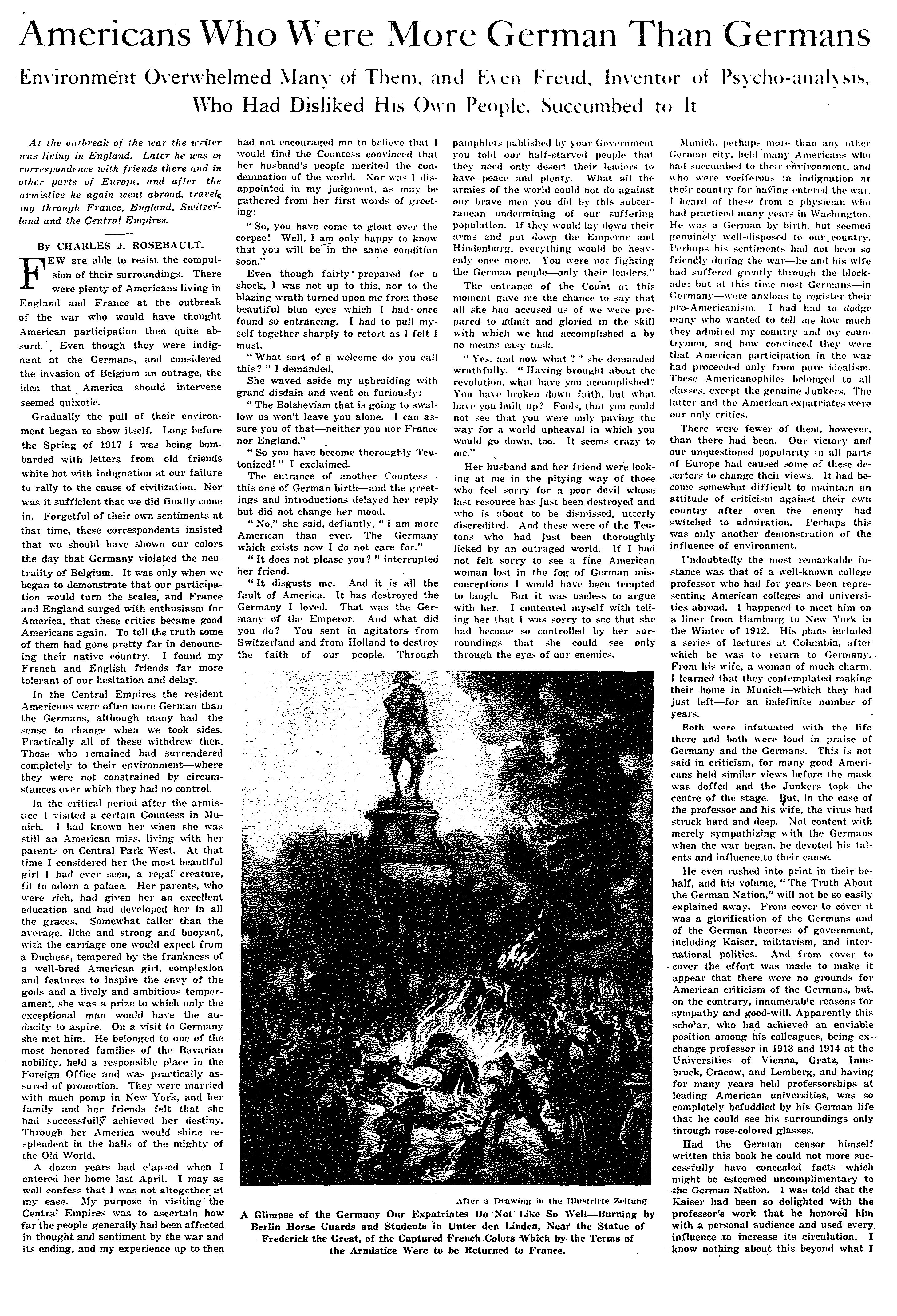
know nothing about this beyond what IA Glimpse of the Germany Our Expatriates Do Not Like So Well—Burning by
Berlin Horse Guards and Students in Unter den Linden, Near the Statue of
Frederick the Great, of the Captured French Colors Which by the Terms of
the Armistice Were to be Returned to France.```
S.
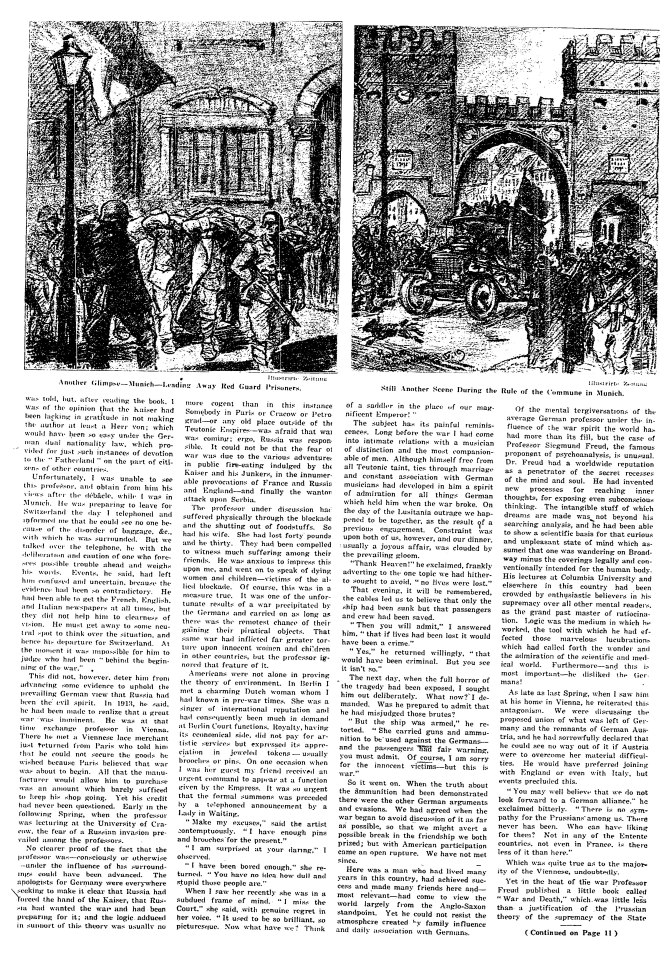
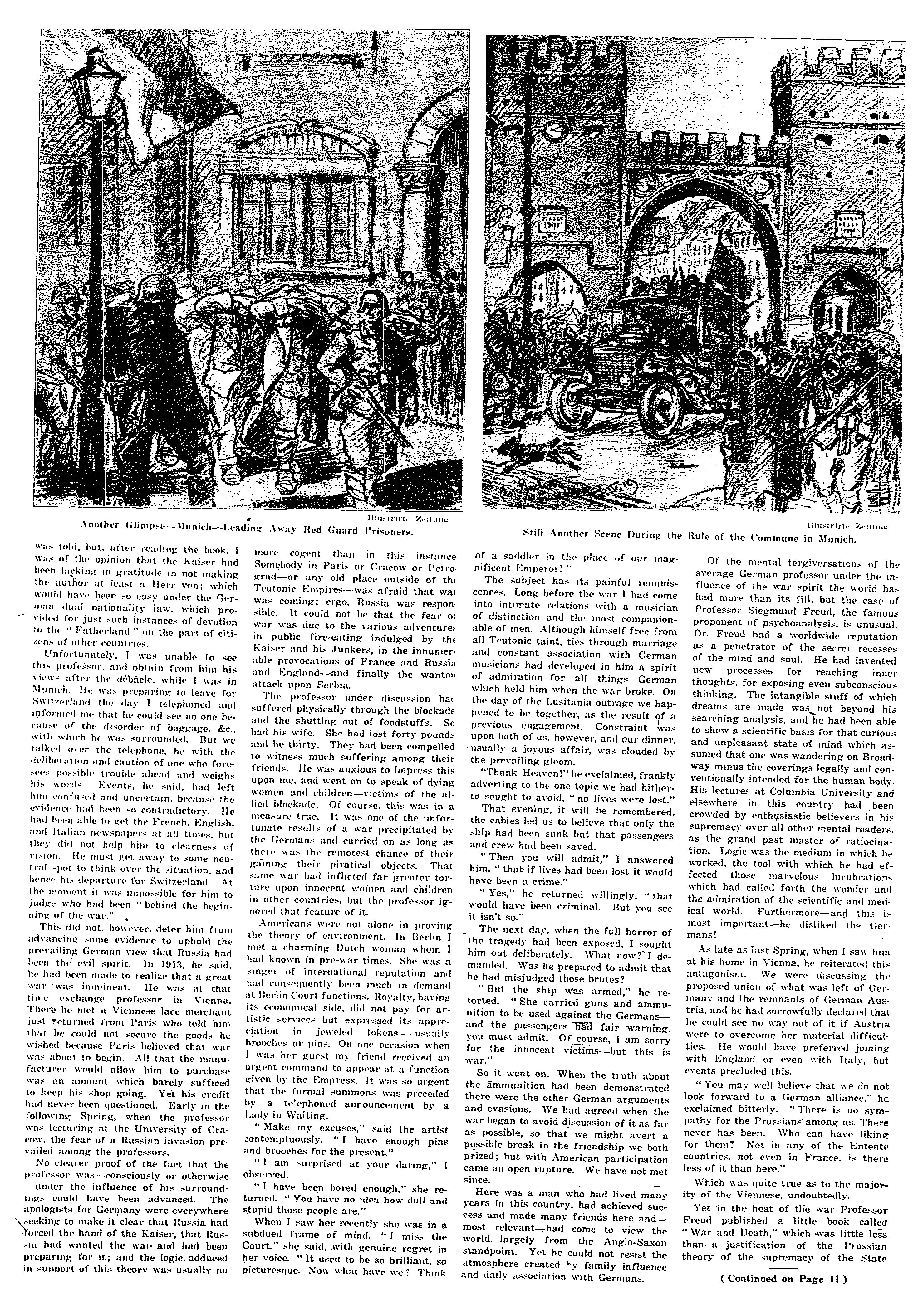
Illustrirte Zeitung
Another Glimpse—Munich—Leading Away Red Guard Prisoners.
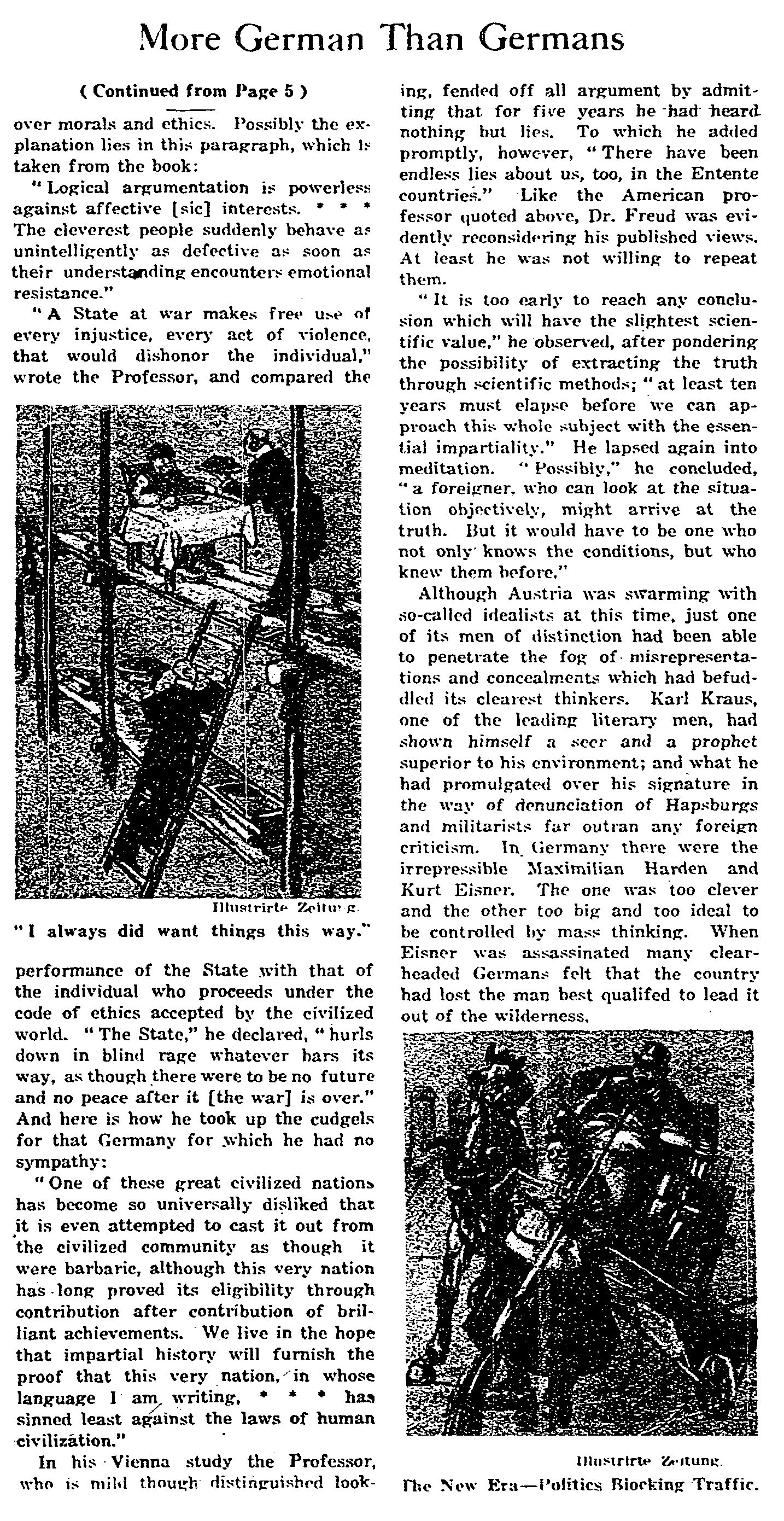
Illustrirte Zeitung
Still Another Scene During the Rule of the Commune in Munich.
was told, but, after reading the book, I
was of the opinion that the Kaiser had
been lacking in gratitude in not making
the author at least a Herr von; which
would have been so easy under the Ger-
man dual nationality law, which pro-
vided for just such instances of devotion
to the "Fatherland" on the part of citi-
zens of other countries.Unfortunately, I was unable to see
this professor, and obtain from him his
views after the debacle, while I was in
Munich. He was preparing to leave for
Switzerland the day I telephoned and
informed me that he could see no one be-
cause of the disorder of baggage, &c.,
with which he was surrounded. But we
talked over the telephone, he with the
deliberation and caution of one who fore-
sees possible trouble ahead and weighs
his words. Events, he said, had left
him confused and uncertain, because the
evidence had been so contradictory. He
had been able to get the French, English,
and Italian newspapers at all times, but
they did not help him to clearness of
vision. He must get away to some neu-
tral spot to think over the situation, and
hence his departure for Switzerland. At
the moment it was impossible for him to
judge who had been "behind the begin-
ning of the war."This did not, however, deter him from
advancing more evidence to uphold the
prevailing German view that Russia had
been the evil spirit. In 1913, he said,
he had been made to realize that a great
war was imminent. He was at that
time exchange professor in Vienna.
There he met a Viennese lace merchant
just returned from Paris who told him
that he could not secure the goods he
wished because Paris believed that war
was about to begin. All that the manu-
facturers would allow him to purchase
was an amount which barely sufficed
to keep his shop going. Yet his credit
had never been questioned. Early in the
following Spring, when the professor
was lecturing at the University of Cra-
cow, the fear of a Russian invasion pre-
vailed among the professors.No clearer proof of the fact that the
professor was—consciously or otherwise
—under the influence of his surround-
ings could have been advanced. The
apologists for Germany were everywhere
seeking to make it clear that Russia had
forced the hand of the Kaiser, that Rus-
sia had wanted the war and had been
preparing for it; and the logic adduced
in support of this theory was usually nomore cogent than in this instance.
Somebody in Paris or Cracow or Petro-
grad—or any old place outside of the
Teutonic Empire—was afraid that war
was coming; ergo, Russia was respon-
sible. It could not be that the fear of
war was due to the various adventures
in public fire-eating indulged by the
Kaiser and his Junkers, in the innumer-
able provocations of France and Russia
and England—and finally the wanton
attack upon Serbia.The professor under discussion has
suffered physically through the blockade
and the shutting out of foodstuffs. So
had his wife. She had lost forty pounds
and he thirty. They had been compelled
to witness much suffering among their
friends. He was anxious to impress this
upon me, and went on to speak of dying
women and children—victims of the al-
lied blockade. Of course, this was in a
measure true. It was one of the unfor-
tunate results of a war precipitated by
the Germans and carried on as long as
there was the remotest chance of their
gaining their piratical objects. That
same war had inflicted far greater tor-
ture upon innocent women and children
in other countries, but the professor ig-
nored that feature of it.Americans were not alone in proving
the theory of environment. In Berlin I
met a charming Dutch woman whom I
had known in pre-war times. She was a
singer of international reputation and
had consequently been much in demand
at Berlin Court functions. Royalty, having
its economical side, did not pay for ar-
tistic services but expressed its appre-
ciation in jeweled tokens usually
brooches or pins. On one occasion when
I was her guest my friend received an
urgent command to appear at a function
given by the Empress. It was so urgent
that the formal summons was preceded
by a telephoned announcement by a
Lady in Waiting."Make my excuses," said the artist
contemptuously. "I have enough pins
and brooches for the present.""I am surprised at your daring," I
observed."I have been bored enough," she re-
turned. "You have no idea how dull and
stupid these people are."When I saw her recently she was in a
subdued frame of mind. "I miss the
Court," she said, with genuine regret in
her voice. "It used to be so brilliant, so
picturesque. Now what have we? Thinkof a saddler in the place of our mag-
nificent Emperor!"The subject has its painful reminis-
cences. Long before the war I had come
into intimate relations with a musician
of distinction and the most companion-
able of men. Although himself free from
all Teutonic taint, ties through marriage
and constant association with German
musicians had developed in him a spirit
of admiration for all things German
which held him when the war broke. On
the day of the Lusitania outrage we hap-
pened to be together, as the result of a
previous engagement. Constraint was
upon both of us, however, and our dinner,
usually a joyous affair, was clouded by
the prevailing gloom."Thank Heaven!" he exclaimed, frankly
adverting to the one topic we had hither-
to sought to avoid, "no lives were lost."That evening, it will be remembered,
the cables led us to believe that only the
ship had been sunk but that passengers
and crew had been saved."Then you will admit," I answered
him, "that if lives had been lost it would
have been a crime.""Yes," he returned willingly, "that
would have been criminal. But you see
it isn't so."The next day, when the full horror of
the tragedy had been exposed, I sought
him out deliberately. What now? I de-
manded. Was he prepared to admit that
he had misjudged these brutes?"But the ship was armed," he re-
torted. "She carried guns and ammu-
nition to be used against the Germans—
and the passengers had fair warning,
you must admit. Of course, I am sorry
for the innocent victims—but this is
war."So it went on. When the truth about
the ammunition had been demonstrated
there were the other German arguments
and evasions. We had agreed when the
war began to avoid discussion of it as far
as possible, so that we might avert a
possible break in the friendship we both
prized; but with American participation
came an open rupture. We have not met
since.Here was a man who had lived many
years in this country, had achieved suc-
cess and made many friends here and—
most relevant—had come to view the
world largely from the Anglo-Saxon
standpoint. Yet he could not resist the
atmosphere created by family influence
and daily association with Germans.Of the mental tergiversations of the
average German professor under the in-
fluence of the war spirit the world has
had more than its fill, but the case of
Professor Sigmund Freud, the famous
proponent of psychoanalysis, is unusual.
Dr. Freud had a worldwide reputation
as a penetrator of the secret recesses
of the mind and soul. He had invented
new processes for reaching inner
thoughts, for exposing even subconscious
thinking. The intangible stuff of which
dreams are made was not beyond his
searching analysis, and he had been able
to show a scientific basis for that curious
and unpleasant state of mind which as-
sumed that one was wandering on Broad-
way minus the coverings legally and con-
ventionally intended for the human body.
His lectures at Columbia University and
elsewhere in this country had been
crowded by enthusiastic believers in his
supremacy over all other mental readers,
as the grand past master of ratiocina-
tion. Logic was the medium in which he
worked, the tool with which he had ef-
fected those marvelous lucubrations
which had rallied forth the wonder and
the admiration of the scientific and med-
ical world. Furthermore—and this is
most important—he disliked the Ger-
mans!As late as last Spring, when I saw him
at his home in Vienna, he reiterated this
antagonism. We were discussing the
proposed union of what was left of Ger-
many and the remnants of German Aus-
tria, and he had sorrowfully declared that
he could see no way out of it if Austria
were to overcome her material difficul-
ties. He would have preferred joining
with England or even with Italy, but
events precluded this."You may well believe that we do not
look forward to a German alliance," he
exclaimed bitterly. "There is no sym-
pathy for the Prussians among us. There
never has been. Who can have liking
for them? Not in any of the Entente
countries, not even in France, is there
less of it than here."Which was quite true as to the major-
ity of the Viennese, undoubtedly.Yet in the heat of the war Professor
Freud published a little book called
"War and Death," which was little less
than a justification of the Prussian
theory of the supremacy of the State.(Continued on Page 11)
S.
More German Than Germans
(Continued from Page 5)
over morals and ethics. Possibly the ex-
planation lies in this paragraph, which is
taken from the book:"Logical argumentation is powerless
against affective [sic] interests. * * *
The cleverest people suddenly behave as
unintelligently as defective as soon as
their understanding encounters emotional
resistance.""A State at war makes free use of
every injustice, every act of violence,
that would dishonor the individual,"
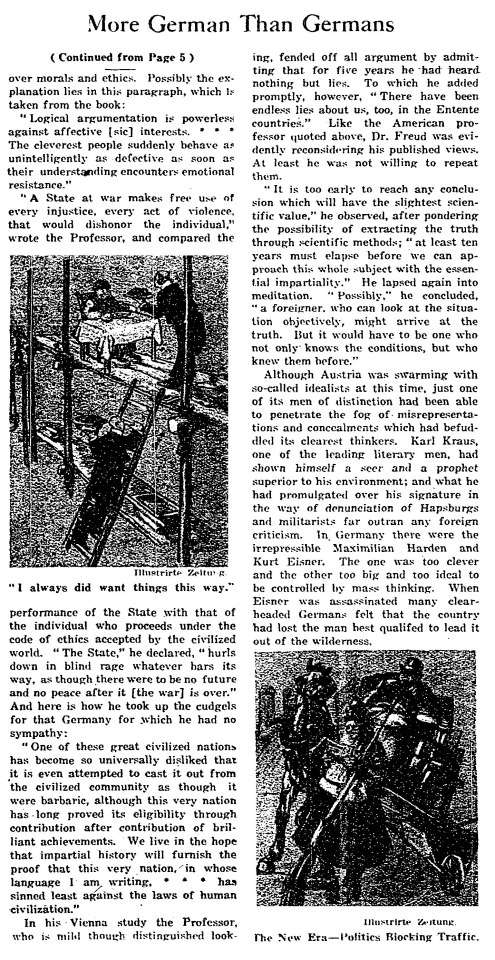
wrote the Professor, and compared theIllustrirte Zeitung.
"I always did want things this way."
performance of the State with that of
the individual who proceeds under the
code of ethics accepted by the civilized
world. "The State," he declared, "hurls
down in blind rage whatever bars its
way, as though there were to be no future
and no peace after it [the war] is over."
And here is how he took up the cudgels
for that Germany for which he had no
sympathy:"One of these great civilized nations
has become so universally disliked that
it is even attempted to cast it out from
the civilized community as though it
were barbaric, although this very nation
has long proved its eligibility through
contribution after contribution of bril-
liant achievements. We live in the hope
that impartial history will furnish the
proof that this very nation, in whose
language I am writing, * * * has
sinned least against the laws of human
civilization."In his Vienna study the Professor,
who is mild though distinguished look-ing, fended off all argument by admit-
ting that for five years he had heard
nothing but lies. To which he added
promptly, however, "There have been
endless lies about us, too, in the Entente
countries." Like the American pro-
fessor quoted above, Dr. Freud was evi-
dently reconsidering his published views.
At least he was not willing to repeat
them."It is too early to reach any conclu-
sion which will have the slightest scien-
tific value," he observed, after pondering
the possibility of extracting the truth
through scientific methods; "at least ten
years must elapse before we can ap-
proach this whole subject with the essen-
tial impartiality." He lapsed again into
meditation. "Possibly," he concluded,
"a foreigner, who can look at the situa-
tion objectively, might arrive at the
truth. But it would have to be one who
not only knows the conditions, but who
knew them before."Although Austria was swarming with
so-called idealists at this time, just one
of its men of distinction had been able
to penetrate the fog of misrepresenta-
tions and concealments which had befud-
dled its clearest thinkers. Karl Kraus,
one of the leading literary men, had
shown himself a seer and a prophet
superior to his environment; and what he
had promulgated over his signature in
the way of denunciation of Hapsburgs
and militarists far outran any foreign
criticism. In Germany there were the
irrepressible Maximilian Harden and
Kurt Eisner. The one was too clever
and the other too big and too ideal to
be controlled by mass thinking. When
Eisner was assassinated many clear-
headed Germans felt that the country
had lost the man best qualified to lead it
out of the wilderness.Illustrirte Zeitung.
The New Era—Politics Blocking Traffic.