S.
132
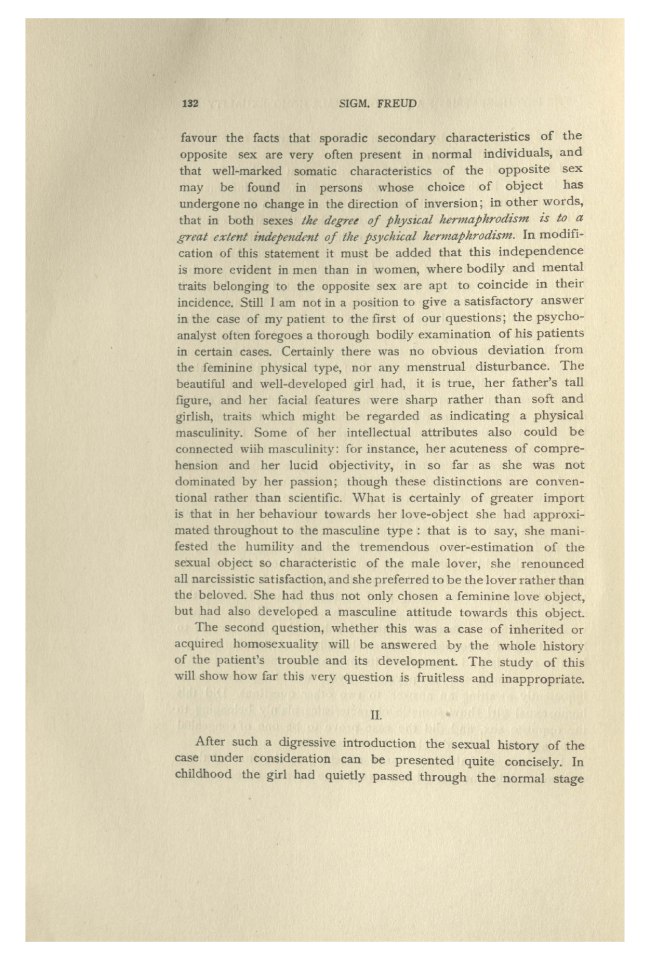
favour the facts that sporadic secondary characteristics of the
opposite sex are very often present in normal individuals, and
that well-marked somatic characteristics of the opposite sex
may be found in persons whose choice of object has
undergone no change in the direction of inversion; in other words,
that in both sexes the degree of physical hermaphrodism is to a
great extent independent of the psychical hermaphrodism. In modifi-
cation of this statement it must be added that this independence
is more evident in men than in women, where bodily and mental
traits belonging to the opposite sex are apt to coincide in their
incidence. Still I am not in a position to give a satisfactory answer
in the case of my patient to the first of our questions; the psycho-
analyst often foregoes a thorough bodily examination of his patients
in certain cases. Certainly there was no obvious deviation from
the feminine physical type, nor any menstrual disturbance. The
beautiful and well-developed girl had, it is true, her father’s tall
figure, and her facial features were sharp rather than soft and
girlish, traits which might be regarded as indicating a physical
masculinity. Some of her intellectual attributes also could be
connected with masculinity: for instance, her acuteness of compre-
hension and her lucid objectivity, in so far as she was not
dominated by her passion; though these distinctions are conven-
tional rather than scientific. What is certainly of greater import
is that in her behaviour towards her love-object she had approxi-
mated throughout to the masculine type: that is to say, she mani-
fested the humility and the tremendous over-estimation of the
sexual object so characteristic of the male lover, she renounced
all narcissistic satisfaction, and she preferred to be the lover rather than
the beloved. She had thus not only chosen a feminine love object,
but had also developed a masculine attitude towards this object.
The second question, whether this was a case of inherited or
acquired homosexuality will be answered by the whole history
of the patient’s trouble and its development. The study of this
will show how far this very question is fruitless and inappropriate.II.
After such a digressive introduction the sexual history of the
case under consideration can be presented quite concisely. In
childhood the girl had quietly passed through the normal stageS.
133
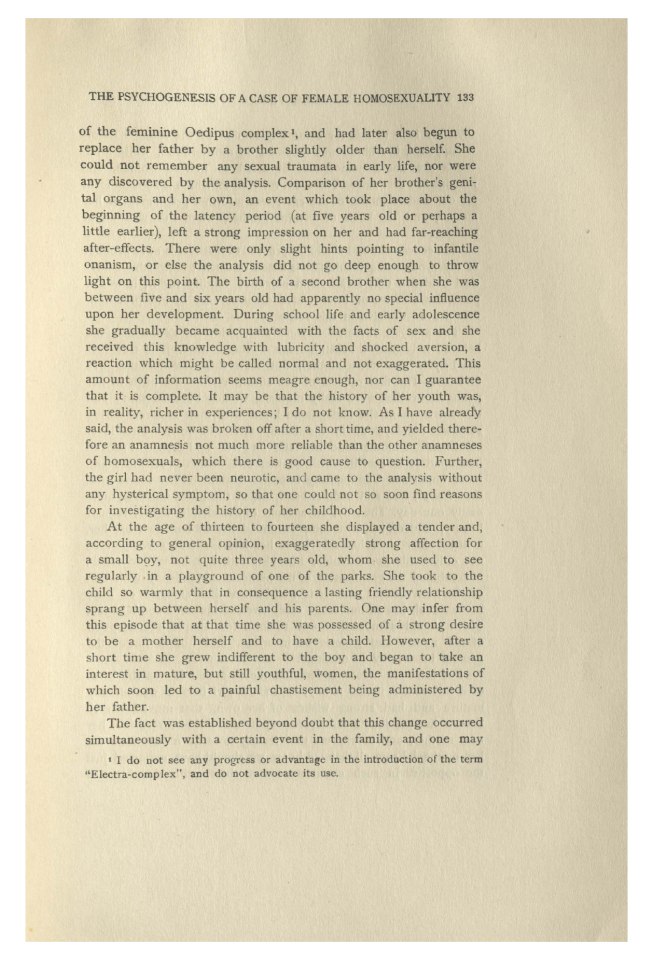
of the feminine Oedipus complex1, and had later also begun to
replace her father by a brother slightly older than herself. She
could not remember any sexual traumata in early life, nor were
any discovered by the analysis. Comparison of her brother’s geni-
tal organs and her own, an event which took place about the
beginning of the latency period (at five years old or perhaps a
little earlier), left a strong impression on her and had far-reaching
after-effects. There were only slight hints pointing to infantile
onanism, or else the analysis did not go deep enough to throw
light on this point. The birth of a second brother when she was
between five and six years old had apparently no special influence
upon her development. During school life and early adolescence
she gradually became acquainted with the facts of sex and she
received this knowledge with lubricity and shocked aversion, a
reaction which might be called normal and not exaggerated. This
amount of information seems meagre enough, nor can I guarantee
that it is complete. It may be that the history of her youth was,
in reality, richer in experiences; I do not know. As I have already
said, the analysis was broken off after a short time, and yielded there-
fore an anamnesis not much more reliable than the other anamneses
of homosexuals, which there is good cause to question. Further,
the girl had never been neurotic, and came to the analysis without
any hysterical symptom, so that one could not so soon find reasons
for investigating the history of her childhood.At the age of thirteen to fourteen she displayed a tender and,
according to general opinion, exaggeratedly strong affection for
a small boy, not quite three years old, whom she used to see
regularly in a playground of one of the parks. She took to the
child so warmly that in consequence a lasting friendly relationship
sprang up between herself and his parents. One may infer from
this episode that at that time she was possessed of a strong desire
to be a mother herself and to have a child. However, after a
short time she grew indifferent to the boy and began to take an
interest in mature, but still youthful, women, the manifestations of
which soon led to a painful chastisement being administered by
her father.The fact was established beyond doubt that this change occurred
simultaneously with a certain event in the family, and one may1I do not see any progress or advantage in the introduction of the term
„Electra-complex“, and do not advocate its use.S.
134
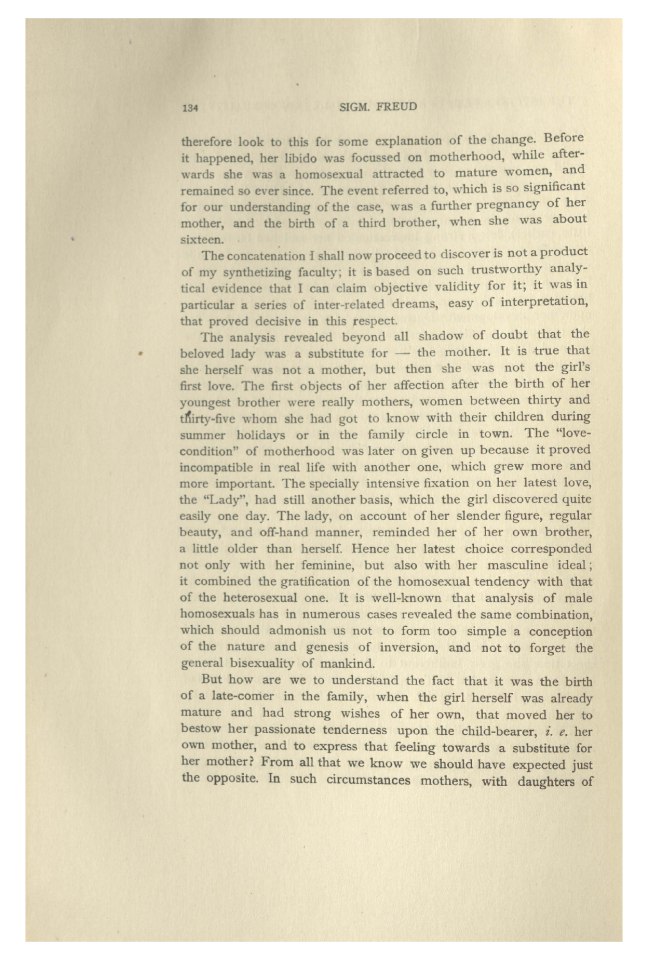
therefore look to this for some explanation of the change. Before
it happened, her libido was focussed on motherhood, while after-
wards she was a homosexual attracted to mature women, and
remained so ever since. The event referred to, which is so significant
for our understanding of the case, was a further pregnancy of her
mother and the birth of a third brother, when she was about
sixteen.The concatenation I shall now proceed to discover is not a product
of my synthetizing faculty; it is based on such trustworthy analy-
tical evidence that I can claim objective validity for it; it was in
particular a series of inter-related dreams, easy of interpretation,
that proved decisive in this respect.The analysis revealed beyond all shadow of doubt that the
beloved lady was a substitute for – the mother. It is true that
she herself was not a mother, but then she was not the girl’s
first love. The first objects of her affection after the birth of her
youngest brother were really mothers, women between thirty and
thirty-five whom she had got to know with their children during
summer holidays or in the family circle in town. The “love-
condition” of motherhood was later on given up because it proved
incompatible in real life with another one, which grew more and
more important. The specially intensive fixation on her latest love,
the “Lady”, had still another basis, which the girl discovered quite
easily one day. The lady, on account of her slender figure, regular
beauty, and off-hand manner, reminded her of her own brother,
a little older than herself. Hence her latest choice corresponded
not only with her feminine, but also with her masculine ideal;
it combined the gratification of the homosexual tendency with that
of the heterosexual one. It is well-known that analysis of male
homosexuals has in numerous cases revealed the same combination,
which should admonish us not to form too simple a conception
of the nature and genesis of inversion, and not to forget the
general bisexuality of mankind.But how are we to understand the fact that it was the birth
of a late-comer in the family, when the girl herself was already
mature and had strong wishes of her own, that moved her to
bestow her passionate tenderness upon the child-bearer, i. e. her
own mother, and to express that feeling towards a substitute for
her mother? From all that we know we should have expected just
the opposite. In such circumstances mothers, with daughters ofS.
135
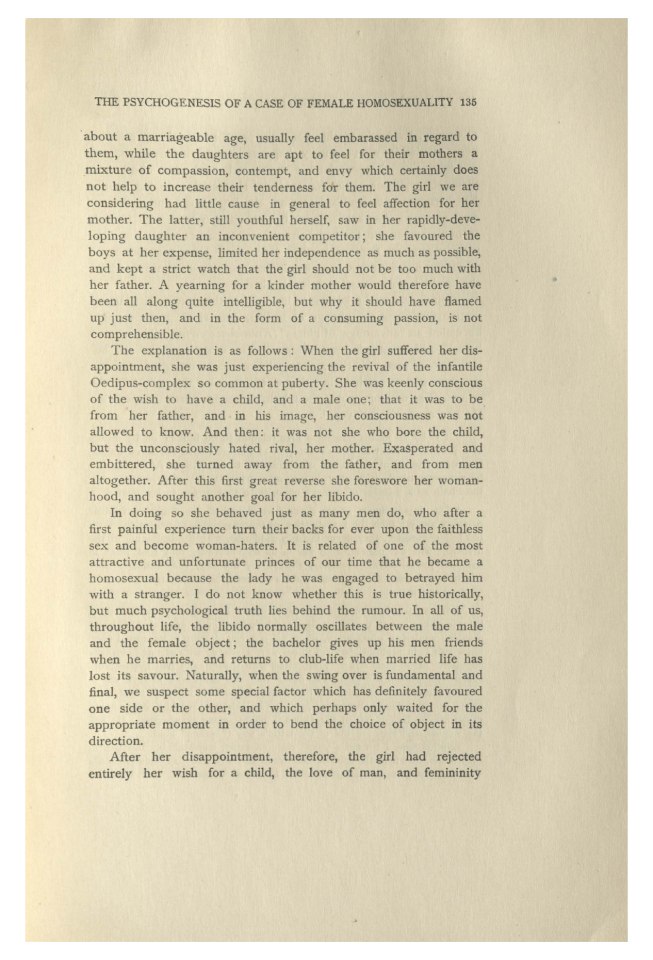
about a marriageable age, usually feel embarrassed in regard to
them, while the daughters are apt to feel for their mothers a
mixture of compassion, contempt, and envy which certainly does
not help to increase their tenderness for them. The girl we are
considering had little cause in general to feel affection for her
mother. The latter, still youthful herself, saw in her rapidly-
deve-
loping daughter an inconvenient competitor; she favoured the
boys at her expense, limited her independence as much as possible,
and kept a strict watch that the girl should not be too much with
her father. A yearning for a kinder mother would therefore have
been all along quite intelligible, but why it should have flamed
up just then, and in the form of a consuming passion, is not
comprehensible.The explanation is as follows: When the girl suffered her dis-
appointment, she was just experiencing the revival of the infantile
Oedipus-complex so common at puberty. She was keenly conscious
of the wish to have a child, and a male one; that it was to be
from her father, and in his image, her consciousness was not
allowed to know. And then: it was not she who bore the child,
but the unconsciously hated rival, her mother. Exasperated and
embittered, she turned away from the father, and from men
altogether. After this first great reverse she foreswore her woman-
hood, and sought another goal for her libido.In doing so she behaved just as many men do, who after a
first painful experience turn their backs for ever upon the faithless
sex and become woman-haters. It is related of one of the most
attractive and unfortunate princes of our time that he became a
homosexual because the lady he was engaged to betrayed him
with a stranger. I do not know whether this is true historically,
but much psychological truth lies behind the rumour. In all of us,
throughout life, the libido normally oscillates between the male
and the female object; the bachelor gives up his men friends
when he marries, and returns to club-life when married life has
lost its savour. Naturally, when the swing over is fundamental and
final, we suspect some special factor which has definitely favoured
one side or the other, and which perhaps only waited for the
appropriate moment in order to bend the choice of object in its
direction.After her disappointment, therefore, the girl had rejected
entirely her wish for a child, the love of man, and femininityS.
136
altogether. Evidently at this point the possible developments were
very manifold; what actually happened was the most extreme
possible. She changed into a man, and took her mother in
place of her father as her love-object1). Her relation to her mother
had certainly been ambivalent from the beginning, and it proved
easy to revive her earlier love for her mother and with its help
to over-
compensate for her current hostility. Since there was little
to be done with the real mother, there arose from the conversion
of feeling just described the search for a mother-
substitute to whom
she could become passionately attached2).From her actual relations to her mother there arose a practical
motive furthering the change of feeling, one which perhaps might
be called an “advantage of illness” (Krankheitsgewinn). The mother
herself still attached great value to the attentions and the ad-
miration of men. If, then, the girl became homosexual and left
the men to her mother (in other words “evaded the mother”), she
removed something which had hitherto been partly responsible
for her mother’s disfavour3).1)It is by no means rare for a love relation to be broken off by means
of a process of identification on the part of the lover with the loved object,
a process equivalent to a kind of regression to narcissism. After this has
been accomplished, it is easy in making a fresh choice of object to apply
the libido to a member of the sex opposite to that of the earlier choice.2)The displacements of the libido here described are doubtless familiar
to every analyst from the investigation of the anamneses of neurotics. With
the latter, however, they occur in early childhood, with the beginning of the
love-
life; with our patient, who was in no way neurotic, they took place in
the first years following puberty, though, by the way, they similarly were
wholly unconscious. Perhaps one day this temporal factor may turn out to be
of great import.3)As “evasion” has not previously been mentioned among the causes of
homosexuality, or in the mechanism of libido-
fixation in general, I will add
a similar analytical observation, which has a special feature of interest. I once
knew two twin brothers, both of whom were endowed with strong libidinous
impulses. One of them was very successful with women and had innumerable
affairs with women and girls. The other went the same way at first, but it
became unpleasant for him to be trespassing on his brother’s beat, and,
owing to the likeness between them, to be mistaken for him on intimate
occasions, so he got out of the difficulty by becoming homosexual. He left
the women, and thus got out of the latter’s way (“evaded” him).
Another time I treated a young man, an artist, unmistakably bisexual in
disposition, in whom the homosexual trend had won the day simultaneously
with a disturbance in his work. He fled from both women and work together.S.
137
The attitude of the libido thus adopted was greatly reinforced
as soon as the girl perceived how much it displeased the father.
Since she was first punished for an over-affectionate overture
made to a woman, she realized how she could hurt her father
and take revenge on him. Henceforth she remained homosexual
out of defiance against her father. Nor did she scruple to lie to
him and to deceive him in every way. Towards her mother, indeed,
she was only so far deceitful as was necessary to keep her father
in the dark. I had the impression that her behaviour followed the
principle of the satire: If you have betrayed me, you must put up
with my betraying you. Nor can I come to any other conclusion
about the striking lack of precaution displayed by this otherwise
ingenious and clever girl. She wanted her father to know
occasionally of her intercourse with the lady, otherwise it would
mean her missing the satisfaction of her keenest desire – namely,
revenge. So she saw to this by showing herself openly in the company
of her adored friend, by taking walks in the streets near her father’s
place of business, and the like. This maladroitness was by no means
unintentional. It was strange, by the way, that both parents behaved
as though they understood the secret psychology of their daughter.
The mother was tolerant, as though she appreciated as a kindness
her daughter’s withdrawal from the arena (“evasion”): the father
was furious, as though he realized the deliberate revenge directed
against himself.The girl’s inversion, however, received its final reinforcement
when she found in her “lady” an object which promised to satisfyThe analysis, which was able to bring him back to both, showed that the
fear of the father was the most powerful psychic motive; for both the di-
sturbances – which were, really, renunciations. In his imagination all women
belonged to the father, and he sought refuge in men from the impulse to
give way, so as to “evade” conflict with the father. Such motivation of the
homosexual object-choice must be by no means uncommon; in the primaeval
ages of race all women presumably belonged to the father and head of the
tribe.Among brothers and sisters who are not twins this “evasion” plays a
great part in other spheres as well as in that of the love-choice. For example,
the elder brother studies music and is admired for it; the younger, far more
gifted musically, soon gives up his own musical studies, in spite of his
longing, and cannot be persuaded to touch an instrument again. This is one
example of a very frequent occurrence, and the investigation of the motives
leading to “evasion” rather than to open rivalry discloses very complicated
psychical conditions.S.
138
not only her homosexual tendency, but also that part of her hetero-
sexual libido still attached to her brother.III.
Consecutive presentation is not a very adequate means of
describing complicated mental processes going on in different
layers of the mind. I am therefore obliged to pause in the dis-
cussion of the case and treat more fully and deeply some of the
points brought forward above.I mentioned the fact that the girl’s relation to her adored lady
resembled that characteristic of the masculine type of love. Her
humility and her tender lack of pretension “che poco spera e
nulla chiede”, her bliss when she was allowed to accompany the
lady a little way and to kiss her hand on parting, her joy when
she heard her praised as beautiful – anyone else’s recognition
of her own beauty meaning nothing at all to her –, her pilgrimages
to places once visited by the loved one, the oblivion of all more
sensual wishes: all these little traits in her resembled the first
enthusiastic passion of a youth for a celebrated actress whom he
regards as far above him, to whom he scarcely dares lift his
bashful eyes. The correspondence with the “type of masculine
object-choice” I have previously described1), held good even in the
details. It may seem remarkable that she was not in the least re-
pelled by the evil reputation of her beloved one, although her
own observations sufficiently confirmed the truth of such rumours.
She was after all a well brought-up and modest girl, who had
avoided sexual adventures herself, and who regarded coarsely
sensual gratification as unaesthetic. But already her first passions
had been for women who were not celebrated for specially strict
propriety. The first protest her father made against her love-choice
had been evoked by the pertinacity with which she sought the
company of a cinematograph actress at a summer resort. In all
these affairs it had never been a question of women who had
any reputation for homosexuality, and who might, therefore, have
offered her some prospect of homosexual gratification; on the
contrary, she illogically courted women who were coquettes in the1)Sammlung kl. Schriften zur Neurosenlehre, 4. Folge, 1918.
The Psychogenesis of a Case of Female Homosexuality1920-001/1920.en
1920-001/1920.en/2
