S.
144
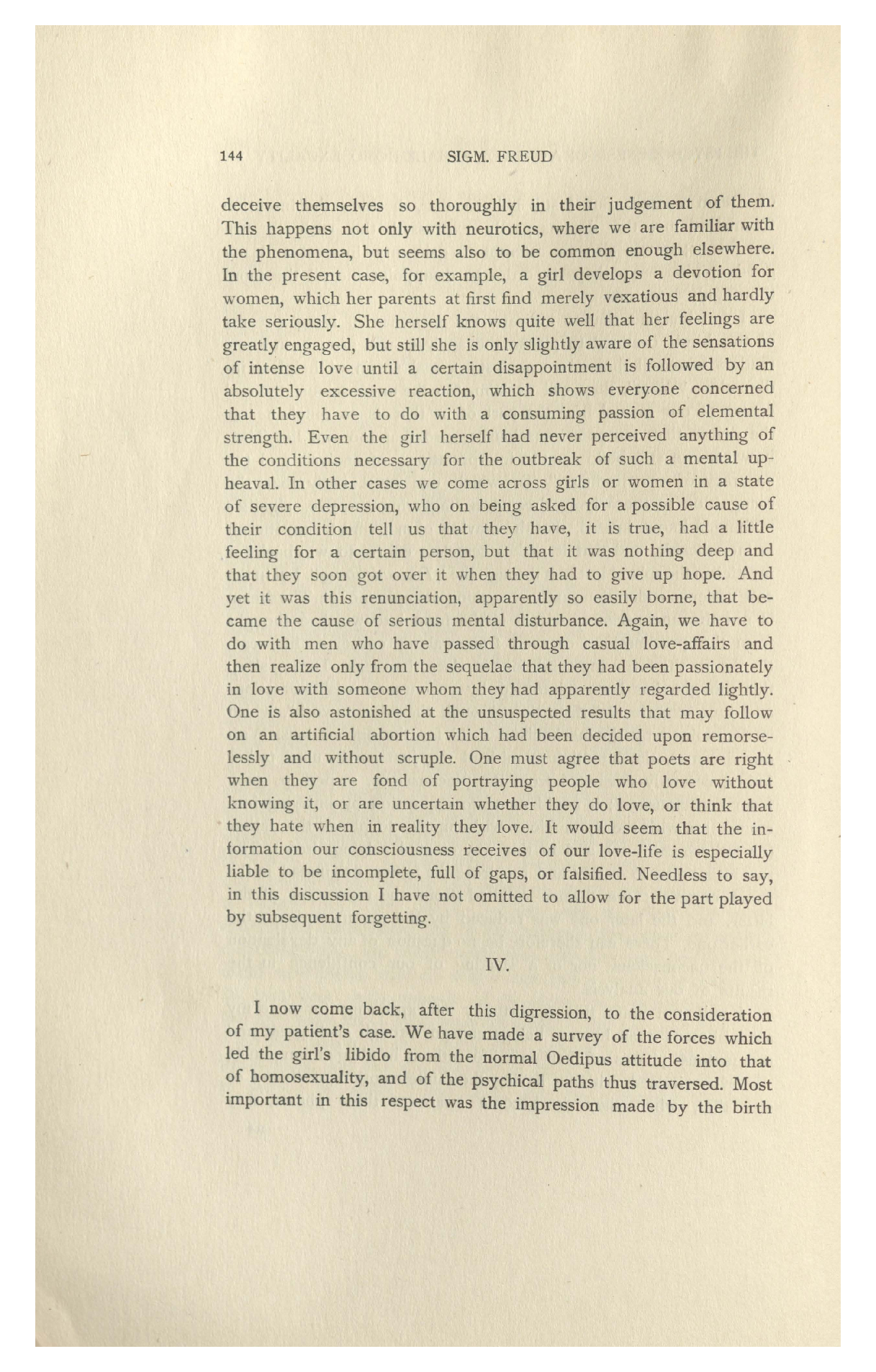
deceive themselves so thoroughly in their judgement of them.
This happens not only with neurotics, where we are familiar with
the phenomena, but seems also to be common enough elsewhere.
In the present case, for example, a girl develops a devotion for
women, which her parents at first find merely vexatious and hardly
take seriously. She herself knows quite well that her feelings are
greatly engaged, but still she is only slightly aware of the sensations
of intense love until a certain disappointment is followed by an
absolutely excessive reaction, which shows everyone concerned
that they have to do with a consuming passion of elemental
strength. Even the girl herself had never perceived anything of
the conditions necessary for the outbreak of such a mental up-
heaval. In other cases we come across girls or women in a state
of severe depression, who on being asked for a possible cause of
their condition tell us that they have, it is true, had a little
feeling for a certain person, but that it was nothing deep and
that they soon got over it when they had to give up hope. And
yet it was this renunciation, apparently so easily borne, that be-
came the cause of serious mental disturbance. Again, we have to
do with men who have passed through casual love-affairs and
then realize only from the sequelae that they had been passionately
in love with someone whom they had apparently regarded lightly.
One is also astonished at the unsuspected results that may follow
on an artificial abortion which had been decided upon remorse-
lessly and without scruple. One must agree that poets are right
when they are fond of portraying people who love without
knowing it, or are uncertain whether they do love, or think that
they hate when in reality they love. It would seem that the in-
formation our consciousness receives of our love-life is especially
incomplete, full of gaps, or falsified. Needless to say,
in this discussion I have not omitted to allow for the part played
by subsequent forgetting.IV.
I now come back, after this digression, to the consideration
of my patient’s case. We have made a survey of the forces which
led the girl’s libido from the normal Oedipus attitude into that
of homosexuality, and of the psychical paths thus traversed. Most
important in this respect was the impression made by the birthS.
145
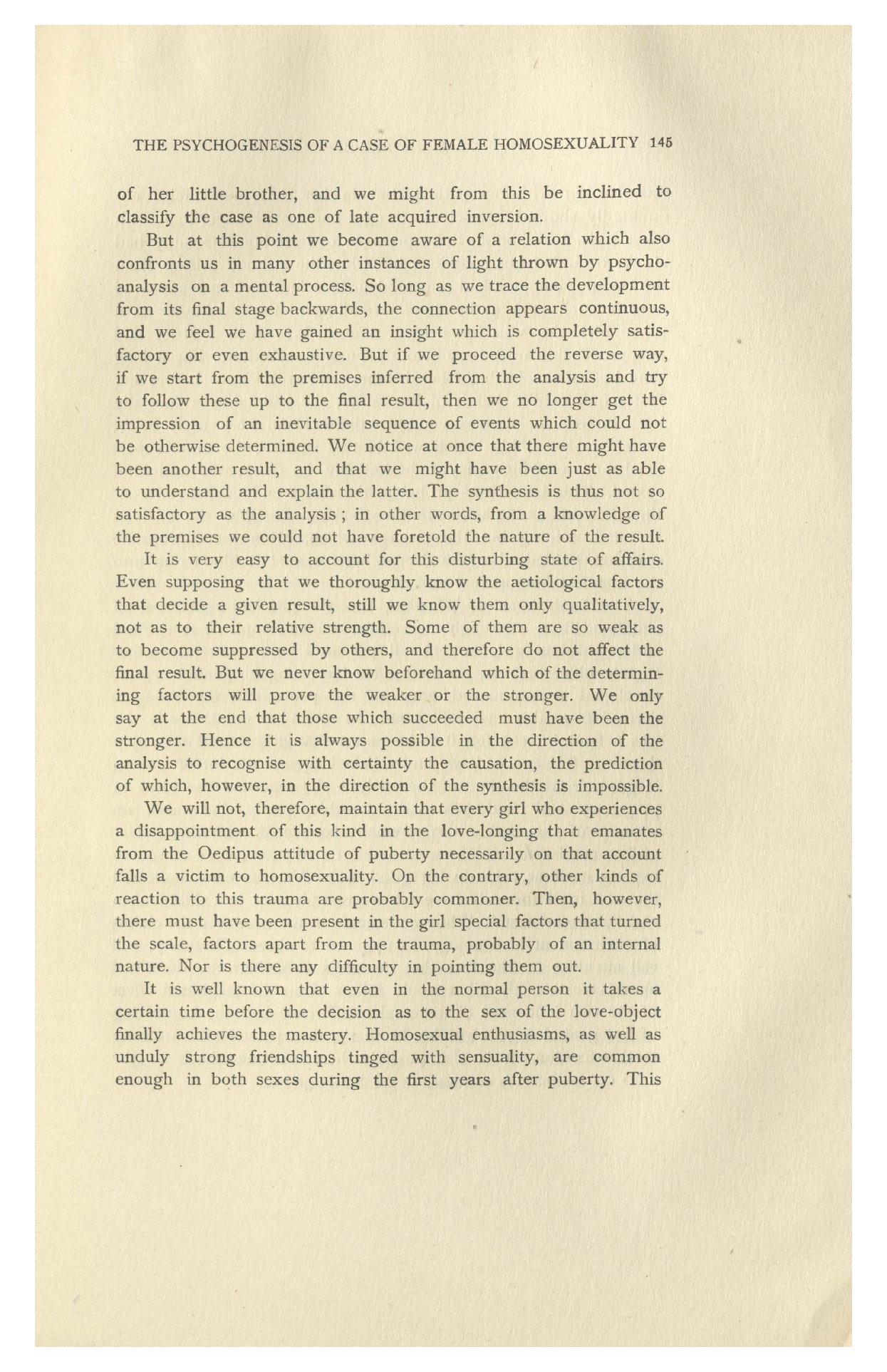
of her little brother, and we might from this be inclined to
classify the case as one of late acquired inversion.But at this point we become aware of a relation which also
confronts us in many other instances of light thrown by psycho-
analysis on a mental process. So long as we trace the development
from its final stage backwards, the connection appears continuous,
and we feel we have gained an insight which is completely satis-
factory or even exhaustive. But if we proceed the reverse way,
if we start from the premises inferred from the analysis and try
to follow these up to the final result, then we no longer get the
impression of an inevitable sequence of events which could not
be otherwise determined. We notice at once that there might have
been another result, and that we might have been just as able
to understand and explain the latter. The synthesis is thus not so
satisfactory as the analysis; in other words, from a knowledge of
the premises we could not have foretold the nature of the result.It is very easy to account for this disturbing state of affairs.
Even supposing that we thoroughly know the aetiological factors
that decide a given result, still we know them only qualitatively,
not as to their relative strength. Some of them are so weak as
to become suppressed by others, and therefore do not affect the
final result. But we never know beforehand which of the determin-
ing factors will prove the weaker or the stronger. We only
say at the end that those which succeeded must have been the
stronger. Hence it is always possible in the direction of the
analysis to recognise with certainty the causation, the prediction
of which, however, in the direction of the synthesis is impossible.We will not, therefore, maintain that every girl who experiences
a disappointment of this kind in the love-longing that emanates
from the Oedipus attitude of puberty necessarily on that account
falls a victim to homosexuality. On the contrary, other kinds of
reaction to this trauma are probably commoner. Then, however,
there must have been present in the girl special factors that turned
in the trauma, probably of an internal
nature. Nor is there any difficulty in pointing them out.It is well known that even in the normal person it takes a
certain time before the decision as to the sex of the love-object
finally achieves the mastery. Homosexual enthusiasms, as well as
unduly strong friendships tinged with sensuality, are common
enough in both sexes during the first years after puberty. ThisS.
146
was also so with our patient, but in in her these tendencies un-
doubtedly showed themselves stronger and lasted longer than with
other girls. In addition, these presages of later homosexuality had
always occupied her conscious life, while the attitude arising from
the Oedipus complex had remained unconscious and had appeared
only in such signs as her tender fondling of the little boy. As a
school-girl she was for a long time in love with a strict and
unapproachable mistress, obviously a mother-substitute. For a long
time before the birth of her brother and still longer before her
first rebuff at the hands of her father, she had taken a specially
keen interest in various young mothers. From very early years,
therefore, her libido had flowed in two streams, the more super-
ficial one of which may unhesitatingly be designated as homo-
sexual. This latter was probably the direct and unchanged con-
tinuation of an infantile mother-fixation. Possibly the analysis
revealed nothing but the process which, given the appropriate
occasion, guided also the deeper heterosexual libido-stream into
the manifest homosexual one.The analysis showed, further, that the girl had suffered from
childhood from a strongly-marked “masculine complex”. A spirited
and pugnacious girl, not at all prepared to be second to her
slightly older brother, she had, after inspecting his genital organs,
developed a pronounced envy of the penis, and the thoughts
derived from this envy still continued to fill her mind. Really she
was a feminist, she felt it to be unjust that girls should not enjoy
the same freedom as boys, and rebelled against the lot of woman
in general. At the time of the analysis she regarded the ideas of
pregnancy and child-birth as disagreeable, partly, I surmise, on
account of the bodily disfigurement connected with them. Her
girlish narcissism withdrew into this repudiation1, and ceased to
express itself as pride in her good looks. Various clues indicated
that she must formerly have taken great pleasure in exhibitionism
and “observationism”. Whoever is anxious not to curtail the claims
of environment in aetiology, as opposed to those of heredity, will
call attention to the fact that the girl’s behaviour, as described
above, was exactly what would follow from the combined effect
of the two influences of maternal indifference and the comparing
of her genital organs with her brother’s, in a person with a strong
mother-fixation. It is also possible here to trace back to the1 Cp. Kriemhilde’s confession in the Nibelungenlied.
S.
147
impression of an effective external influence in early life something
which one would have been ready to regard as a constitutional
peculiarity. A part of this acquired disposition, if it has really been
acquired, has to be ascribed to the inborn constitution. So we
see in practice a continual mingling and blending of what in
inherited and acquired factors.An earlier, tentative conclusion to the analysis might have led
to the view that this was a case of late-acquired homosexuality,
but the further investigation of the material impels us to conclude
that it is rather a case of inborn homosexuality which, as usual,
became fixed and unmistakably manifest only in the period
following puberty. Each of these classifications does justice to
only one part of the state of affairs ascertainable by observation,
but neglects the other. It would be best not to attach too much
value to this way of stating the problem.Publications on homosexuality usually do not distinguish
clearly enough between the questions of the choice of object, on
the one hand, and of the sexual characteristics and sexual attitude,
on the other, as though the answer to the former necessarily
involved the answer to the latter. Experience, however, proves
the contrary: a man with predominantly male characteristics and
also masculine in his love-life may still be inverted in respect to
his object, loving only men instead of women. A man in whose
character feminine attributes evidently predominate, who may,
indeed, behave in love as a woman, might be expected, from this
feminine attitude, to choose a man for his love-object; but he
may nevertheless be heterosexual, and show no more inversion
in respect of his object than an average normal man. The same
is true of women: here also psychical sexual character and object-
choice do not necessarily coincide. The mystery of homosexuality
is therefore by no means so simple as is commonly depicted in
popular expositions: a feminine personality, which therefore has
to love a man, unhappily attached to a male body; or a masculine
personality, irresistibly attracted by women, unfortunately cemented
to a female body. It is rather a question of three series of
characteristics, namely–
Somatic sexual characteristics – Psychical sexual characteristics
(physical hermaphrodism) –, (masculine, or feminine, attitude)
Kind of object-choice,S.
148
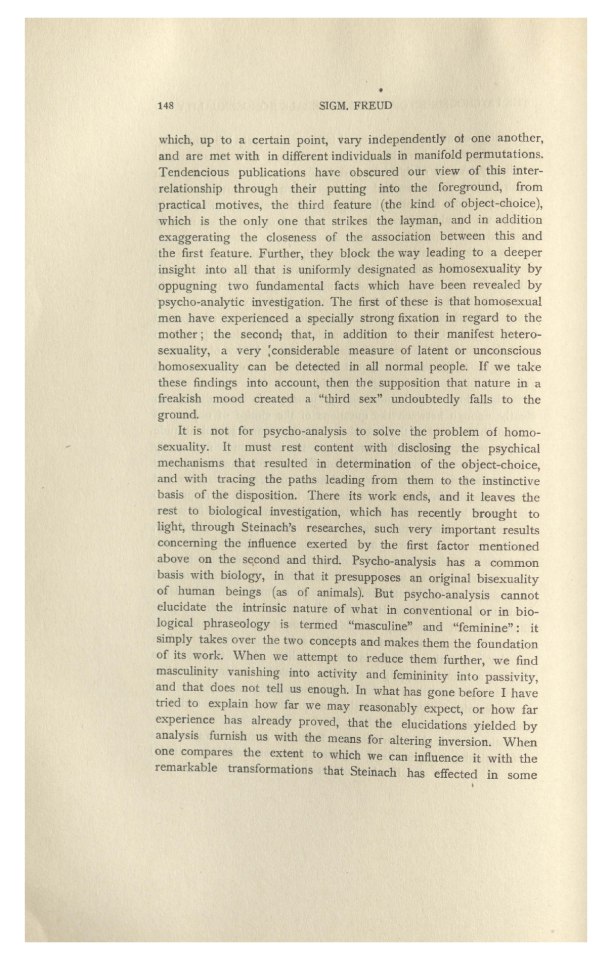
which, up to a certain point, vary independently of one another,
and are met with in different individuals in manifold permutations.
Tendencious publications have obscured our view of this inter-
relationship through their putting into the foreground, from
practical motives, the third feature (the kind of object-choice),
which is the only one that strikes the layman, and in addition
exaggerating the closeness of the association between this and
the first feature. Further, they block the way leading to a deeper
insight into all that is uniformly designated as homosexuality by
psycho-analytic investigation. The first of these is that homosexual
men have experienced a specially strong fixation in regard to the
mother; the second; that, in addition to their manifest hetero-
sexuality, a very ‘considerable measure of latent or unconscious
homosexuality can be detected in all normal people. If we take
these findings into account, then the supposition that nature in a
freakish mood created a “third sex” undoubtedly falls to the
ground.It is not for psycho-analysis to solve the problem of homo-
sexuality. It must rest content with disclosing the psychical
mechanisms that resulted in determination of the object-choice,
and with tracing the paths leading from them to the instinctive
basis of the disposition. There its work ends, and it leaves the
rest to biological investigation, which has recently brought to
light, through Steinach’s researches, such very important results
concerning the influence exerted by the first factor mentioned
above on the second and third. Psycho-analysis has a common
basis with biology, in that it presupposes an original bisexuality
of human beings (as of animals). But psycho-analysis cannot
elucidate the intrinsic nature of what in conventional or in bio-
logical phraseology is termed “masculine” and “feminine”: it
simply takes over the two concepts and makes them the foundation
of its work. When we attempt to reduce them further, we find
masculinity vanishing into activity and femininity into passivity,
and that does not tell us enough. In what has gone before I have
tried to explain how far we may reasonably expect, or how far
experience has already proved, that the elucidations yielded by
analysis furnish us with the means for altering inversion. When
one compares the extent to which we can influence it with the
remarkable transformations that Steinach has effected in someS.
149
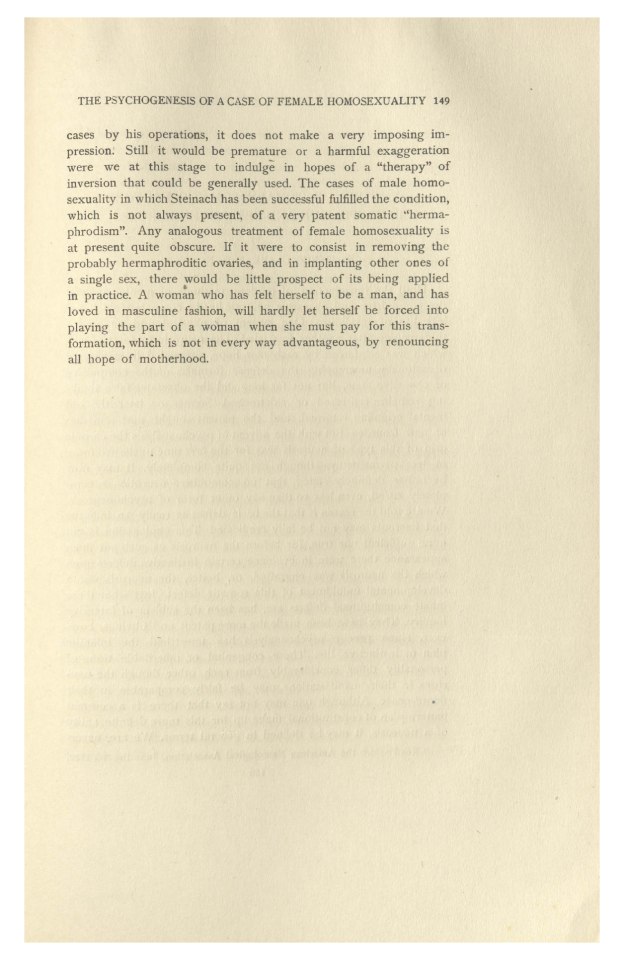
cases by his operations, it does not make a very imposing im-
pression. Still it would be premature or a harmful exaggeration
were we at this stage to indulge in hopes of a “therapy” of
inversion that could be generally used. The cases of male homo-
sexuality in which Steinach has been successful fulfilled the condition
which is not always present, of a very patent somatic “herma-
phrodism”. Any analogous treatment of female homosexuality is
at present quite obscure. If it were to consist in removing the
probably hermaphroditic ovaries, and in implanting other ones of
a single sex, there would be little prospect of its being applied
in practice. A woman who has felt herself to be a man, and has
loved in masculine fashion, will hardly let herself be forced into
playing the part of a woman when she must pay for this trans-
formation, which is not in every way advantageous, by renouncing
all hope of motherhood.
The Psychogenesis of a Case of Female Homosexuality1920-001/1920.en


1920-001/1920.en/4
