S.
31
CHAPTER III.
THE CASE OF MISS ELISABETH V. R.
In the fall of 1892 I was requested by a friendly colleague to
examine a young lady who had suffered from pains in her legs
for over two years and who walked badly. He also added that he
diagnosed the case as hysteria, though none of the usual symp-
toms of the neurosis could be found. He stated that he knew
something of the family and that the last few years had brought
them much misfortune and little pleasure. At first the father
of the patient died, then the mother underwent a serious operation
for the eyes, and soon thereafter a married sister succumbed to a
chronic cardiac affection after childbirth. Our patient had taken
an active part in all the afflictions and in all the nursings of the
sick. I made no further progress into the case after I had seen
the twenty-four-year-old patient for the first time. She seemed
intelligent and psychically normal and her affliction, which inter-
fered with her social relations and pleasure, she bore with a happy
mien, thus vividly recalling the “belle indifference” of hysterics.
She walked with the upper part of her body bent forward, but
without any support; her gait did not correspond to any known
pathological gait and it was in no way strikingly bad. She com-
plained of severe pains on walking, of early fatigue in walking
as well as standing, and after a brief period she would seek rest
in which the pains became diminished but they by no means
disappeared. The pain was of an indefinite nature–one could
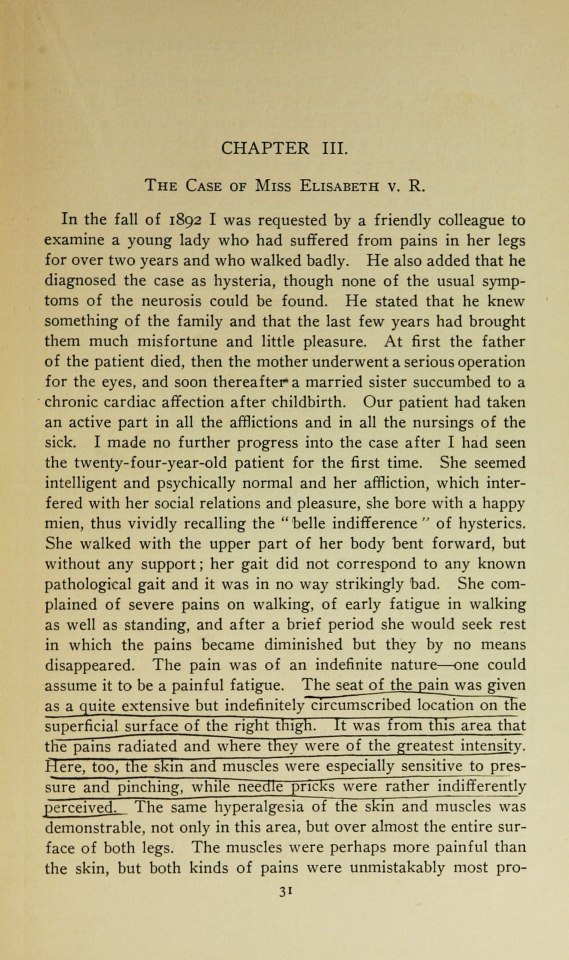
assume it to be a painful fatigue. The seat of the pain was given
as a quite extensive but indefinitely circumscribed location on the
superficial surface of the right thigh. It was from this area that
the pains radiated and where they were of the greatest intensity.
Here, too, the skin and muscles were especially sensitive to pres-
sure and pinching, while needle pricks were rather indifferently
perceived. The same hyperalgesia of the skin and muscles was
demonstrable, not only in this area, but over almost the entire sur-
face of both legs. The muscles were perhaps more painful than
the skin, but both kinds of pains were unmistakably most pro-S.
32
nounced over the thighs. The motor power of the legs was not
diminished, the reflexes were of average intensity and all other
symptoms were lacking, so that there was no basis for the as-
sumption of a serious organic affection. The disease developed
gradually during two years and changed considerably in its in-
tensity.I did not find it easy to determine the diagnosis, but for two
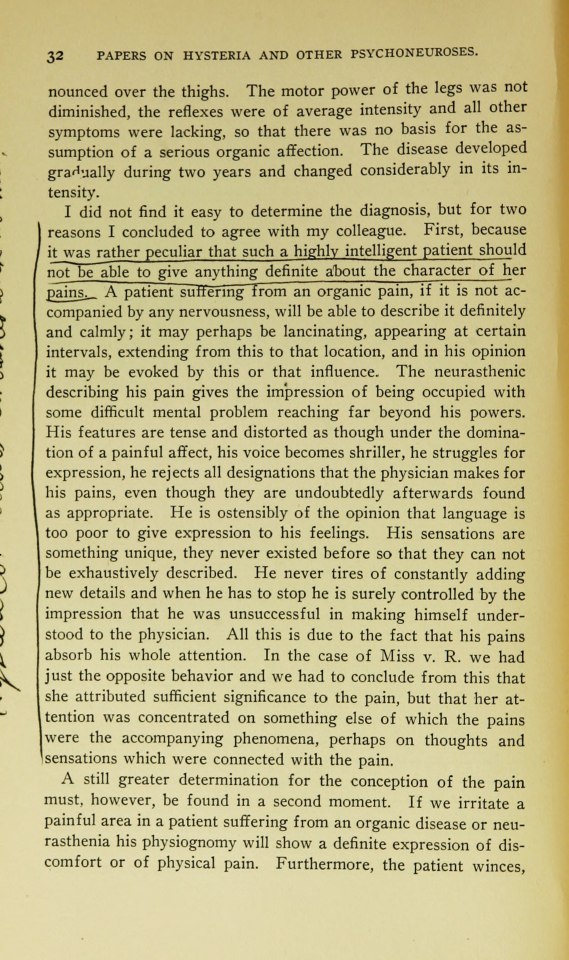
reasons I concluded to agree with my colleague. First, because
it was rather peculiar that such a highly intelligent patient should
not be able to give anything definite about the character of her
pains. A patient suffering from an organic pain, if it is not ac-
companied by any nervousness, will be able to describe it definitely
and calmly; it may perhaps be lancinating, appearing at certain
intervals, extending from this to that location, and in his opinion
it may be evoked by this or that influence. The neurasthenic
describing his pain gives the impression of being occupied with
some difficult mental problem reaching far beyond his powers.
His features are tense and distorted as though under the domina-
tion of a painful affect, his voice becomes shriller, he struggles for
expression, he rejects all designations that the physician makes for
his pains, even though they are undoubtedly afterwards found
as appropriate. He is ostensibly of the opinion that language is
too poor to give expression to his feelings. His sensations are
something unique, they never existed before so that they can not
be exhaustively described. He never tires of constantly adding
new details and when he has to stop he is surely controlled by the
impression that he was unsuccessful in making himself under
stood to the physician. All this is due to the fact that his pains
absorb his whole attention. In the case of Miss v. R. we had
just the opposite behavior and we had to conclude from this that
she attributed sufficient significance to the pain, but that her at-
tention was concentrated on something else of which the pains
were the accompanying phenomena, perhaps on thoughts and
sensations which were connected with the pain.A still greater determination for the conception of the pain
must, however, be found in a second moment. If we irritate a
painful area in a patient suffering from an organic disease or neu-
rasthenia his physiognomy will show a definite expression of dis-
comfort or of physical pain. Furthermore, the patient winces,S.
33.
refuses to be examined and assumes a defensive attitude. With
Miss v. R. when the hyperalgesic skin or muscles of her legs were
pinched or pressed her face assumed a peculiar expression ap-
proaching nearer pleasure than pain, she cried out and—I had to
think of a pleasurable tickling—her face reddened, she threw
her head backward, closed her eyes, and her body bent backward;
all this was not very distinct but sufficiently marked so that it
could only agree with the conception that her affliction was a hys-
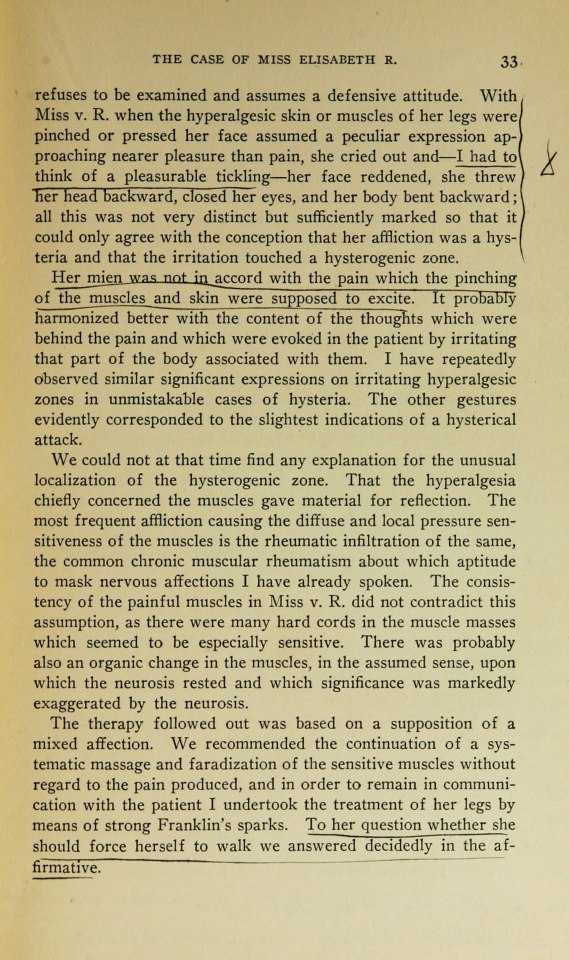
teria and that the irritation touched a hysterogenic zone.Her mien was not in accord with the pain which the pinching
of the muscles and skin were supposed to excite. It probably
harmonized better with the content of the thoughts which were
behind the pain and which were evoked in the patient by irritating
that part of the body associated with them. I have repeatedly
observed similar significant expressions on irritating hyperalgesic
zones in unmistakable cases of hysteria. The other gestures
evidently corresponded to the slightest indications of a hysterical
attack.We could not at that time find any explanation for the unusual
localization of the hysterogenic zone. That the hyperalgesia
chiefly concerned the muscles gave material for reflection. The
most frequent affliction causing the diffuse and local pressure sen-
sitiveness of the muscles is the rheumatic infiltration of the same,
the common chronic muscular rheumatism about which aptitude
to mask nervous affections I have already spoken. The consis-
tency of the painful muscles in Miss v. R. did not contradict this
assumption, as there were many hard cords in the muscle masses
which seemed to be especially sensitive. There was probably
also an organic change in the muscles, in the assumed sense, upon
which the neurosis rested and which significance was markedly
exaggerated by the neurosis.The therapy followed out was based on a supposition of a sys-
tematic massage and faradization of the sensitive muscles without
regard to the pain produced, and in order to remain in communi-
cation with the patient I undertook the treatment of her legs by
means of strong Franklin’s sparks. To her question whether she
should force herself to walk we answered decidedly in the af-
firmative.S.
34
We thus attained a slight improvement. She particularly liked
the painful shocks of the influence machine and the stronger they
were the more they seemed to suppress her pains. My colleague
meanwhile prepared the soil for the psychic treatment, and when
after four weeks of sham treatment I proposed the same and gave
the patient some explanations concerning the procedures and its
effects I found a ready understanding and only slight resistances.
The work which then began became eventually the most ardu-
ous that ever befell my lot, and the difficulty of giving an account
of this work ranks well with the obstacles that had to be over-
come. For a long time, too, I did not understand the connection
between the history of the disease and the affliction, a thing which
should really have been caused and determined by this row of
events.When one undertakes a cathartic treatment he at first asks him-
self whether the patient understands the origin and cause of her
suffering. If that is so one does not need any special technique
to cause her to reproduce the history of her ailment. The inter-
est shown in her, the understanding which we foreshadow, the
hope of recovery extended to her, all these will induce the pa-
tient to give up her secrets. With Miss Elisabeth it seemed
probable to me right from the very beginning that she was con-
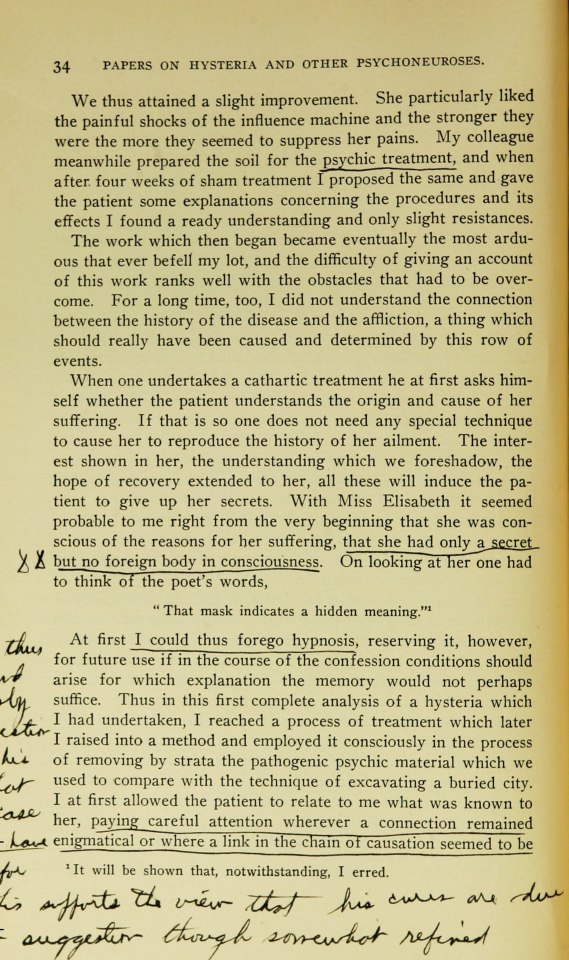
scious of the reasons for her suffering, that she had only a secret
but no foreign body in consciousness. On looking at her one had
to think of the poet’s words,“That mask indicates a hidden meaning.”1)
At first I could thus forego hypnosis, reserving it, however,
for future use if in the course of the confession conditions should
arise for which explanation the memory would not perhaps
suffice. Thus in this first complete analysis of a hysteria which
I had undertaken, I reached a process of treatment which later
I raised into a method and employed it consciously in the process
of removing by strata the pathogenic psychic material which we
used to compare with the technique of excavating a buried city.
I at first allowed the patient to relate to me what was known to
her, paying careful attention wherever a connection remained
enigmatical or where a link in the chain of causation seemed to be1)It will be shown that, notwithstanding, I erred.
S.
35
lacking. Later I penetrated into the deeper strata of memory by
using for those locations (hypnotic investigation) or a similar tech-
nique. The presupposition of the whole work was naturally the
expectation that a perfect and sufficient determination could be
demonstrated. The means of the deeper investigation will soon
be discussed.The history which Miss Elisabeth gave was very dull and was
woven of manifold painful experiences. During this recital she
was not in a hypnotic state; I merely asked her to lie down and
keep her eyes closed. I however made no objection if she from
time to time opened her eyes, changed her position or sat up.
Whenever she entered more deeply into a part of her history she
seemed to merge spontaneously into a condition resembling a
hypnotic state. She then remained motionless and kept her eyes
firmly closed.I shall now reproduce the results of the superficial strata of
her memory. As the youngest of three daughters she spent her
youth with her parents, to whom she was devotedly attached, on
their estate in Hungary. Her mother’s health was frequently
disturbed by an affliction of her eyes and also by nervous condi-
tions. It thus happened that she became especially and devotedly
attached to her jovial and broadminded father who was wont to
say that this daughter took the place of both a son and friend
with whom he could exchange his thoughts. As much as the
girl gained in mental stimulation in consequence of this inter-
course it did not escape the father that her psychic constitution
deviated from that ideal which one so much desires to see in a
girl. Jocosely he called her pert and disputatious. He warned
her against being too confident in her judgments, against her tend-
encies to tell the truth regardlessly to everybody and expressed
his opinion that she would find it difficult to get a husband. As
a matter of fact she was very discontented with her girlhood;
she was filled with ambitious plans, wishing to study or obtain a
musical education, and revolted at the thought of being forced
to give up her inclination to sacrifice her freedom of judgment
on account of marriage. Meanwhile she was proud of her father,
of the regard and social position of her family, and jealously
guarded everything connected with these matters. The indiffer-
ence with which she treated her mother and older sisters, as willS.
36
be shown, was considered by her parents to be due to the blunter
side of her character.
The age of the girls impelled the family to move into the
metropolis, where for a time Elisabeth enjoyed the richer and
gayer life. But then came the calamity which destroyed the
happiness of the home. The father either concealed or over-
looked a chronic cardiac affection, and one day he was brought
home in an unconscious state after the first attack of edema of the
lungs. This was followed by an illness of one and a half years,
during which Elisabeth took the most prominent part in nursing
him. She slept in her father’s room, awoke at night at his call,
watched over him faithfully during the day, and forced herself
to appear cheerful while he went through a hopeless condition
with amiable resignation. The beginning of her affection must
have been connected with this time of her nursing, for she could
recall that during the last half year of this care she had to remain
in bed on one occasion for a day and a half on account of severe
pain in the leg. She maintained, however, that these pains soon
passed away and excited neither worry nor attention. As a mat-
ter of fact it was two years after the death of her father that she
began to feel sick and became unable to walk on account of pain.
The gap which the father left in the life of this family consist-
ing of four women, the social solitude, the cessation of so many
relations which promised stimulation and pleasure, the increased
infirmity of the mother, all these clouded the mood of our patient,
but simultaneously stimulated a warm desire that the family might
soon find a substitute for the lost happiness and urged her to con-
centrate her entire devotion and care on the surviving mother.
At the end of the mourning year the eldest sister married a tal-
ented and ambitious man of notable position, who by his mental
capacity seemed to be destined for a great future, but who, how-
ever, very soon developed a morbid sensitiveness and egotistic
perseveration of moods, and dared to show his disregard for the
old lady in the family circle. That was more than Elisabeth
could endure. She felt herself called upon to take up the fight
against her brother-in-law whenever he gave occasion for it,
while the other women took lightly the outburst of his excited
temperament. To her it was a painful disillusionment to find that
the reconstruction of the old family happiness experienced such
[Studies in hysteria]1895-005/1912.en


1895-005/1912.en/3
