S.
639
II
THE TECHNIQUE OF WIT
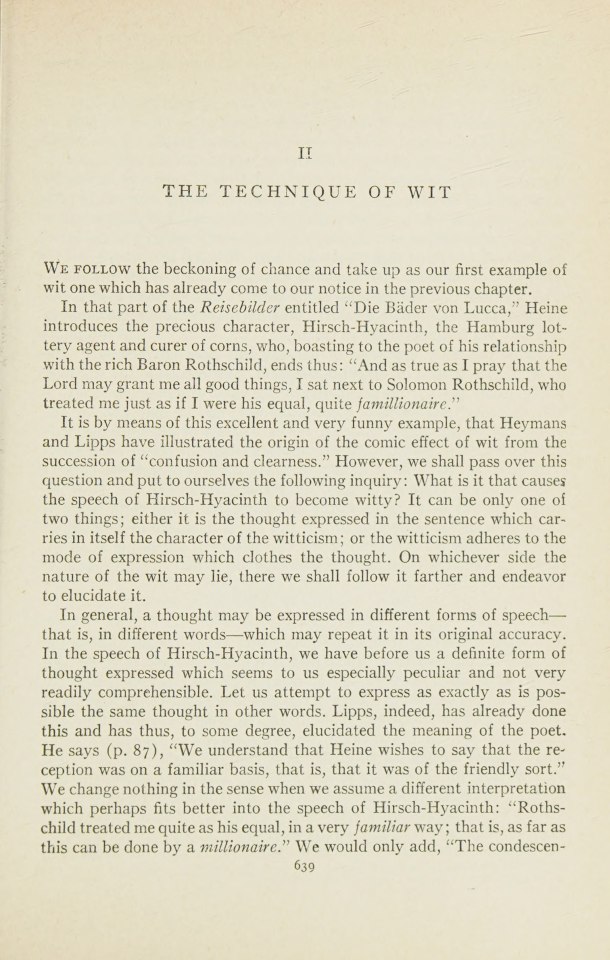
WE FOLLOW the beckoning of chance and take up as our first example of
wit one which has already come to our notice in the previous chapter.In that part of the Reisebil-
der entitled “Die Bäder von Lucca,” Heine
introduces the precious character, Hirsch-Hyacinth, the Hamburg lot-
tery agent and curer of corns, who, boasting to the poet of his relationship
with the rich Baron Rothschild, ends thus: “And as true as I pray that the
Lord may grant me all good things, I sat next to Solomon Rothschild, who
treated me just as if I were his equal, quite familion-
naire.”It is by means of this excellent and very funny example, that Heymans
and Lipps have illustrated the origin of the comic effect of wit from the
succession of “confusion and clearness.” However, we shall pass over this
question and put to ourselves the following inquiry: What is it that causes
the speech of Hirsch-Hyacinth to become witty? It can be only one of
two things; either it is the thought expressed in the sentence which car-
ries in itself the character of the witticism; or the witticism adheres to the
mode of expression which clothes the thought. On whichever side the
nature of the wit may lie, there we shall follow it farther and endeavor
to elucidate it.In general, a thought may be expressed in different forms of speech—
that is, in different words—which may repeat it in its original accuracy.
In the speech of Hirsch-Hyacinth, we have before us a definite form of
thought expressed which seems to us especially peculiar and not very
readily comprehen-
sible. Let us attempt to express as exactly as is pos-
sible the same thought in other words. Lipps, indeed, has already done
this and has thus, to some degree, elucidated the meaning of the poet.
He says (p. 87), “We understand that Heine wishes to say that the re-
ception was on a familiar basis, that is, that it was of the friendly sort.”
We change nothing in the sense when we assume a different inter-
pretation which perhaps fits better into the speech of Hirsch-Hyacinth: “Roths-
child treated me quite as his equal, in a very familiar way; that is, as far as
this can be done by a millionaire.” We would only add, “The condescen-
sionS.

640
WIT AND ITS RELATION TO THE UNCONSCIOUS
sion of a rich man always carries something embarrassing for the one
experiencing it.”1Whether we shall remain content with this or with another equiva
lent formulation of the thought, we can see that the question which we
have put to ourselves is already answered. The character of the wit in
this example does not adhere to the thought. It is a correct and ingenious
remark that Heine puts into the mouth of Hirsch-Hyacinth—a remark
of indubitable bitterness, as is easily understood in the case of the poor
man confronted with so much wealth; but we should not care to call it
witty. Now, if anyone who cannot forget the poet’s meaning in the inter
pretation should insist that the thought in itself is also witty, we can refer
him to the definite fact that the witty character is lost in the interpreta
tion. It is true that Hirsch-Hyacinth’s speech made us laugh loudly, but
though Lipps’s or our own accurate rendering may please us and cause us
to reflect, yet it cannot make us laugh.But if the witty character of our example does not belong to the
thought, then it must be sought in the form of expression in the wording.
We have only to study the peculiarity of this mode of expression to realize
what one may term word- or form-technique. Also we may discover the
things that are intimately related to the very nature of wit, since the char
acter as well as the effect of wit disappears when one set of expressions
is changed for others. At all events, we are in full accord with our authors
when we put so much value upon the verbal form of the wit. Thus, K.
Fischer (p. 72) says: “It is, in the first place, the naked form which is
responsible for the perception of wit, and one is reminded of a saying of
Jean Paul’s which affirms and proves this nature of wit in the same ex
pression. ‘Thus the mere position conquers, be it that of warriors or of
sentences.’ ”FORMATION OF MIXED WORDS
Now wherein lies the “technique” of this wit? What has occurred to the
thought, in our own conception, that it became changed into wit and
caused us to laugh heartily? The comparison of our conception with the
text of the poet teaches us that two processes took place. In the first place,
there occurred an important abbreviation. In order to express fully the
thought contained in the witticism, we had to append to the words “Roth
schild treated me just as an equal, on a familiar basis,” an additional
sentence which in its briefest form reads: i.e., so far as a millionaire can
do this. Even then, we feel the necessity of an additional explanatory sen
tence.2 The poet expresses it in terser terms as follows: “Rothschild1Since this joke will occupy us again and we do not wish to disturb the discussion
following here, we shall find occasion later to point out a correction in Lipps’s given
interpretation which follows our own.2The same holds true for Lipps’s interpretation.
S.
641
THE TECHNIQUE OF WIT
treated me just like an equal, quite “famillionaire.” The entire restriction,
which the second sentence imposes on the first, thus verifying the familiar
treatment, has been lost in the jest. But it has not been so entirely lost as
not to leave a substitute from which it can be reconstructed. A second
change has also taken place. The word “familiar” in the witless expres-
sion of the thought has been transformed into “famillionaire” in the text
of the wit, and there is no doubt that the witty character and ludicrous
effect of the joke depends directly upon this word-formation. The newly
formed word is identical in its first part with the word “familiar” of the
first sentence, and its terminal syllables correspond to the word “million-
aire” of the second sentence. In this manner, it puts us in a position to
conjecture the second sentence which was omitted in the text of the wit.
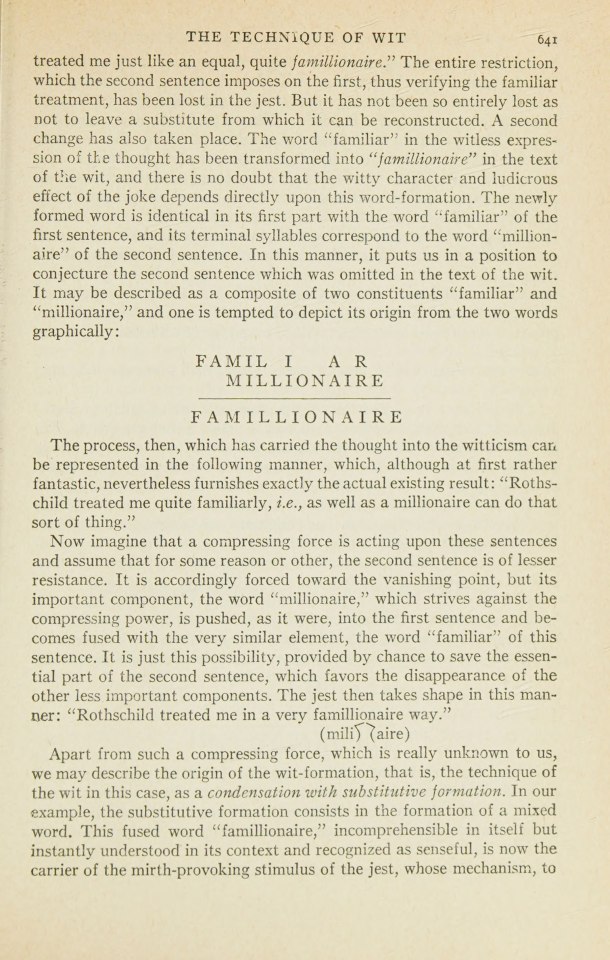
It may be described as a composite of two constituents “familiar” and
“millionaire,” and one is tempted to depict its origin from the two words
graphically:FAMILIAR
MILLIONAIRE
FAMILLIONAIRE
The process, then, which has carried the thought into the witticism can-
be represented in the following manner, which, although at first rather
fantastic, nevertheless furnishes exactly the actual existing result: “Roth-
schild treated me quite familiarly, i.e., as well as a millionaire can do that
sort of thing.”Now imagine that a compressing force is acting upon these sentences
and assume that for some reason or other the second sentence is of lesser
resistance. It is accordingly forced toward the vanishing point, but its
important component, the word “millionaire,” which strives against the
compressing power, is pushed, as it were, into the first sentence and be-
comes fused with the very similar element, the word “familiar” of this
sentence. It is just this possibility, provided by chance to save the essen-
tial part of the second sentence, which favors the disappearance of the
other less important components. The jest then takes shape in this man-
ner: “Rothschild treated me in a very famillionaire way.”(mili) (aire)
Apart from such a compressing force, which is really unknown to us,
we may describe the origin of the wit-formation, that is, the technique of
the wit in this case, as a condensation with substitutive formation. In our
example, the substitutive formation consists in the formation of a mixed
word. This fused word “famillionaire,” incomprehensible in itself but
instantly understood in its context and recognized as senseful, is now the
carrier of the mirth-provoking stimulus of the jest, whose mechanism, toS.
642
be sure, is in no way clearer to us through the discovery of the technique.
To what extent can a linguistic process of condensation with substitutive
formation produce pleasure through a fused word and force us to laugh?
We make note of the fact that this is a different problem, the treatment of
which we can postpone until we shall find access to it later. For the pres-
ent, we shall continue to busy ourselves with the technique of wit.Our expectation that the technique of wit cannot be considered an
indifferent factor in the examination of the nature of wit prompts us to
inquire next whether there are other examples of wit formed like Heine’s
“famillionaire.” Not many of these exist, but enough to constitute a small
group which may be characterized as the blend-word formations or fu-
sions. Heine himself produced a second witticism, as it were, when he
speaks of a “millionarr” (Ideen, Chap. XIV). This is a visible condensa-
tion of “millionaire” and “narr” (fool) and, like the first example, ex-
presses a suppressed by-thought. Other examples of a similar nature are
as follows:In an excellent chapter on this same theme, Brill gives the following
example.1“Disraeli once remarked that old persons are apt to fall into ‘anec-
dotage.’ ” The word anecdotage, though in itself incomprehensible, can
be readily analyzed to show its original full sense; and on analysis we
find that it is made up of two words, anecdote and dotage. That is, in
stead of saying that old persons are apt to fall into dotage and that old
persons are fond of telling anecdotes, Disraeli fuses the two words into
a neologism, anecdotage, and thus simultaneously expresses both ideas.
The technique, therefore, lies in the fusion of the two words. Such a fu-
sion of words is called condensation. Condensation is a substitutive for-
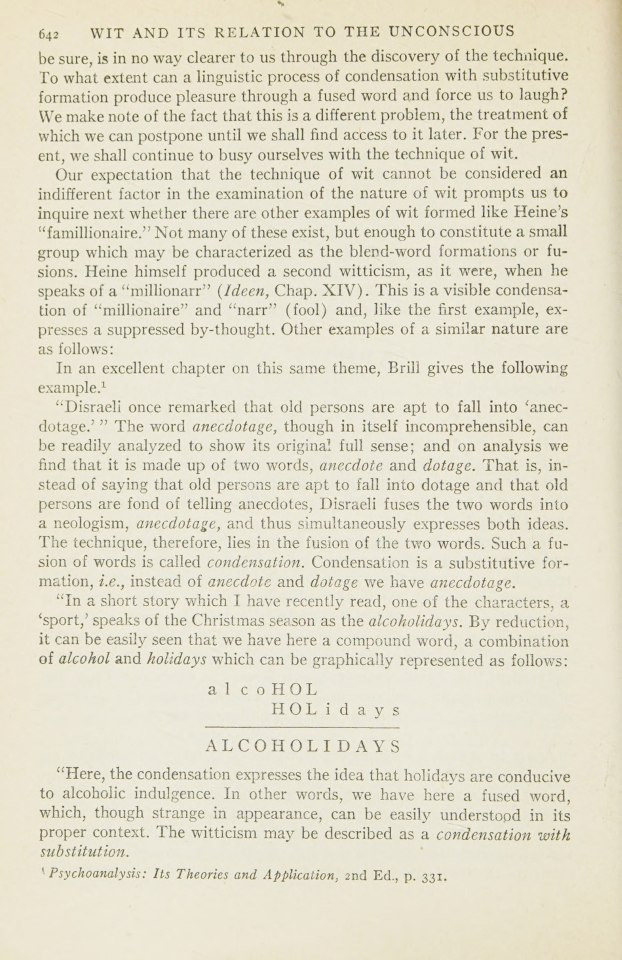
mation, i.e., instead of anecdote and dotage we have anecdotage.“In a short story which I have recently read, one of the characters, a
‘sport,’ speaks of the Christmas season as the alcoholidays. By reduction,
it can be easily seen that we have here a compound word, a combination
of alcohol and holidays which can be graphically represented as follows:a l c o H O L
H O L i d a y sA L C O H O L I D A Y S
“Here, the condensation expresses the idea that holidays are conducive
to alcoholic indulgence. In other words, we have here a fused word,
which, though strange in appearance, can be easily understood in its
proper context. The witticism may be described as a condensation with
substitution.1Psychoanalysis: Its Theories and Application, 2nd Ed., p. 331.
S.
643
THE TECHNIQUE OF WIT
“The same mechanism is found in the following: The famous dramatic
critic, Mr. George Jean Nathan, summarizing three paragraphs to the
effect that most plays then produced in New York City were violently
emotional and hysterical, remarked: ‘Thespis has taken up his home in
Dramatteawan.’ The last word is a condensation of drama and Mattea-
wan. The substitution not only expressed the critic’s idea that most of
the plays at that time produced in New York were violent, emotional and
hysterical, that is, insane, but it also contains a clever allusion to the
nature of the problem presented by most of these plays. Matteawan is a
state hospital for criminal insane. Most of the plays were not only insane,
but also criminal since they treated of murders, divorces, robberies, scan-
dals, etc.”During a conversation with a lady, I unintentionally furnished the ma-
terial for a jest. I spoke to her about the great merits of an investigator
whom I considered unjustly ignored. She remarked, “But the man really
deserves a monument.” “Perhaps he will get one some day,” I answered,
“but at the moment his success is very limited.” “Monument” and “mo-
ment” are contrasts. The lady then united these contrasts and said:
“Well, let us wish him a monumentary success.”If, at this stage, the reader should become displeased with a viewpoint
which threatens to destroy his pleasure in wit without explaining the
source of this pleasure, I must beg him to be patient for a while, because
we are now confronted with the technique of wit, the examination of
which promises many revelations if only we enter into it far enough.
Besides the analysis of the examples thus far cited, which show simply a
process of condensation, there are others in which the changed expres-
sions manifest themselves in other ways.CONDENSATION WITH MODIFICATION AND SUBSTITUTION
The following witticisms of Mr. N. will serve as illustrations.
“I was driving with him tête-à-bête.” Nothing is simpler than the re-
duction of this jest. Evidently, it can only mean: I was driving tête-à-tête
with Mr. X. and X. is a stupid ass (beast).Neither of these two sentences is witty nor is there any wit if one
combines them into this one: “I was out driving tête-à-tête” with that
stupid ass (beast).” The wit appears when the words “stupid ass” are
omitted and when, as a substitute for them, the first “t” of the second
“tête” is changed to “b.” This slight modification brings back to expres-
sion the suppressed “bête.” The technique of this group of witticisms may
be described as “condensation with a slight modification.” And it would
seem that the more insignificant the substitutive modification, the better
is the wit.Quite similar, although not without its complications, is the technique
S.
644
of another form of witticism. During a discussion about a person in whom
there was something to praise and much to criticise, N. remarked: “Yes,
vanity is one of his four heels of Achilles.”1 This modification consists in
the fact that instead of the one vulnerable heel which was attributed to
Achilles, we have here four heels. Four heels means four feet and that
number is only found on animals. The two thoughts condensed in the
witticism are as follows: Except for his vanity, he is an admirable fellow;
still I do not care for him, for he is more of an animal than a human
being.2A similar but simpler joke I heard statu nascendi in a family circle.
One of two brothers who were attending college was an excellent scholar,
while the other was only an average student. It so happened that the
model boy had a setback in school. The mother discussed this matter and
expressed her fear lest this event be the beginning of a lasting deteriora-
tion. The boy, who until then had been overshadowed by his brother,
gladly grasped this opportunity to remark: “Yes, Carl is going backward
on all fours.”Here, the modification consists in a small addition as an assurance that
in his judgment, his brother is going backward. The modification takes
the place of a passionate plea for his own cause which may be expressed
as follows: After all, you must not think that he is so much cleverer than
I am simply because he has more success in school. He is really a stupid
ass, i.e., much more stupid than I am.A good illustration of condensation with slight modification is fur-
nished by a well-known witty jest of Mr. N., who remarked about a char-
acter in public life that he had a “great future behind him.” The butt of
this joke was a young man, whose ancestry, rearing and personal qualities
seemed to have destined him for the leadership of a great party. But
times changed and the party became politically incompetent. It could
readily be foreseen that the man who was predestined to become its
leader would come to nothing. The briefest reduction of the meaning by
which one could replace this joke would be: The man has had a great
future before him, but that is now past. Instead of “has had” and the
appended afterthought, there is small change in the main sentence in
which “before” is replaced by its opposite “behind.”31) This same witticism was supposed to have been coined before by Heine concerning
Alfred de Musset.2) One of the complications involved in the technique of this example lies in the fact
that the modification through which the omitted abuse is substituted is to be taken
as an allusion to the latter, for it leads to it only through a process of deduction.
3) Another factor which I shall mention later on is also effective in the technique of
this witticism. It has to do with the inner character of the modification (representa-
tion through the opposite—contradiction). The technique of wit does not hesitate
to make use simultaneously of several means, with which, however, we can only be-
come acquainted in their sequential order.S.
645
THE TECHNIQUE OF WIT
Mr. N. made use of almost the same modification in the case of the
nobleman who was appointed minister of agriculture for no other reason
than that he was interested in agriculture. Public opinion had an oppor-
tunity to find out that he was the most incompetent man who had ever
been entrusted with this office. When, however, he had relinquished his
portfolio and had withdrawn to his agricultural pursuits, Mr. N. said of
him: “Like Cincinnatus of old he has returned to his place in front of the
plough.”That Roman, who was likewise called to his office from his farm, re-
turned to his place behind the plough. In those days, just as in the
present time, in front of the plough walked—the ox.We could easily increase these examples by many others, but I am of
the opinion that we are in need of no more cases in order to grasp this
second group—condensation with modification. If we now compare the
second group with the first, the technique of which consisted in condensa-
tion with a mixed word-
formation, we readily see that the differences are
not vital and that the lines of demarcation are indistinct. The mixed
word-
formation, like the modification, became subordinated to the idea
of substitutive formation, and if we desired, we could also describe the
mixed word-
formation as a modification of the parent word through the
second elements.We may make our first pause here and ask ourselves with what known
factor in the literature of wit our first result, either in whole or in part,
coincides. It obviously agrees with the factor of brevity which Shake-
speare calls the soul of wit. But brevity alone is not wit, else every la-
conism would be witty. The brevity of wit must be of a special kind. We
recall that Lipps has attempted to describe more fully the peculiarity of
the brevity of wit. Here, our investigation started and demonstrated that
the brevity of wit is often the result of a special process which has left a
second trace—substitutive formation—in the wording of the wit. By
applying the process of reduction, which aims to cause a regression
in the peculiar process of condensation, we find also that wit depends only
upon the verbal expression which was produced by the process of con-
densation. Naturally, our entire interest now centers upon this peculiar
and hitherto almost neglected mechanism. Furthermore, we cannot yet
comprehend how it gave origin to all that is valuable in wit; namely, the
resultant pleasure.CONDENSATION IN DREAMS
Have processes similar to those here described as the technique of wit
already been noted in another sphere of our psychic life? To be sure, in
one apparently remote sphere. In The Interpretation of Dreams, the at-
tempt to trace the dream to normal psychic operations is made. I contrastS.
646
there the manifest and often peculiar dream-
content with the latent but real thoughts of the dream from which it originated. I also investigated the
psychological forces which participated in this transposition. The sum
of the transforming processes I designated as the dream-work and, as a
part of this dream-work, I described the process of condensation. This
process has a striking similarity to the technique of wit and, like the latter,
it leads to abbreviations and brings about substitutive formations of like
character.From recollections of his own dreams, the reader will be familiar with
the compositions of persons and objects that appear in them; indeed, the
dream makes similar compositions of words which can be reduced by
analysis (e.g., Autodidasker-Autodidakt and Lasker).1 On other occa-
sions and even much more frequently, the condensation work of the
dream produces no compositions, but pictures which closely resemble an
object or person up to a certain addition or variation which comes from
another source, like the modifications in the witticisms of Mr. N. We
cannot doubt that in this case, as in the other, we deal with a similar
psychic process which is recognizable by identical results. Such a far-
reaching analogy between wit-technique and dream-work surely arouses
our interest in the former and stimulates our expectation of finding some
explanation of wit from a comparison with the dream. We hesitate, how-
ever, to enter into this work, bearing in mind that we have investigated
the technique of wit in only a very small number of witty jests. We shall
therefore postpone the comparison of wit with the dream and again take
up the technique of wit, leaving, however, at this place of our investigation
a visible thread, as it were, which we shall take up again later.WIT FORMED BY WORD-DIVISION
The next point to discuss is whether the process of condensation with
substitutive formation is demonstrable in all witticisms so that it may be
designated as a universal character of the technique of wit. I recall a joke
which has clung to my mind because of certain peculiar circumstances.
One of the great teachers of my youth, whom we considered unable to
appreciate a joke-he had never told us a single joke hitherto-came into
the Institute laughing. With an unwonted readiness, he explained the
cause of his good humor. “I have read an excellent joke,” he said. “A
young man who claimed to be a relative of the great J. J. Rousseau, and
who bore his name, was introduced into a Parisian drawing-room. It
should be added that he was decidedly red-headed. He behaved in such
an awkward manner that the hostess ventured this criticism to the gen-
tleman who had introduced him-‘Vous m’avez fait connaître un jeune
homme roux et sot, mais pas un Rousseau.’ ”1The Interpretation of Dreams, p. 332.
S.
647
At this point, our teacher started to laugh again. According to the
nomenclature of our authors, this is sound-wit and a poor kind at that,
since it plays with a proper name.But what is the technique of this wit? It is quite clear that the charac-
ter which we had perhaps hoped to demonstrate universally leaves us in
the lurch in the first new example. Here, there is no omission and scarcely
an abbreviation. In the witticism, the lady expresses almost everything
that we can ascribe to the thoughts. “You have made me look forward to
meeting a relative of J. J. Rousseau. I expected that he was perhaps even
mentally related to him. Imagine my surprise to find this red-haired
foolish boy, a roux et sot.” To be sure, I was able to add and insert some
thing, but this attempt at reduction does not annul the wit. It remains
fixed and attached to the sound similarity of Rousseau. This proves that
roux sot
condensation with substitution plays no part in the production of this
witticism.What else must we consider here? New attempts at reduction taught
me that the joke will persistently continue until the name Rousseau is
replaced by another. If, e.g., I substitute the name Racine for it, I find
that although the lady’s criticism is just as feasible as before, it imme-
diately loses every trace of wit. Now I know where I can look for the
technique of this joke although I still hesitate to formulate it. I shall make
the following attempt: The technique of the witticism lies in the fact
that one and the same word—the name—is used in a twofold application,
once as a whole and once divided into its syllables like a charade.I can mention a few examples of identical technique. A witticism of this
sort was utilized by an Italian lady to avenge a tactless remark made to
her by the first Napoleon. Pointing to her compatriots at a court ball, he
said: “Tutti gli Italiani danzano si male?” (All Italians dance so badly).
To which she quickly replied: “Non tutti, ma buona parte” (Not all, but
a great many)—Buona parte.1 Brill reports still another example in which
Buonaparte.
the wit depends on the twofold application of a name: “Hood once re-
marked that he had to be a lively Hood for a livelihood.”2MANIFOLD APPLICATION OF THE SAME MATERIAL
In these examples, which will suffice for this species of wit, the technique
is the same. A name is made use of twice; first, as a whole, and then di-
vided into its syllables—and in their divided state the syllables yield a
different meaning.3 The manifold application of the same word, once as1Cited by Brill: Psychoanalysis, p. 335.
2L. c., p. 334.
3The excellence of these jokes depends upon the fact that they, at the same time,
present another technical means of a much higher order.S.
648
a whole and then as the component syllables into which it divides itself,
was the first case that came to our attention in which technique deviated
from that of condensation. Upon brief reflection, however, we must divine
from the abundance of examples that come to us that the newly discovered
technique can hardly be limited to this single means. Obviously, there are
any number of hitherto unobserved possibilities wherein one can utilize
the same word or the same material of words in manifold application in
1
2
1
2
1
2
1
2
1
2
1
2
1
2
1
2
1
2
1
2
1
2
1
2
1
2
1
2
1
2
1
2
1
2
1
2
1
2
1
2
1
2
1
2
1
2
1
2
1
2
1
2
1
2
1
2
1
2
1
2
1
2
1
2
1
2
1
2
1
2
1
2
1
2
1
2
1
2
1
2
1
2
1
2
1
2
1
2
1
2
1
2
1
2
1
2
1
2
1
2
1
2
1
2
1
2
1
2
1
2
1
2
1
2
1
2
1
2
1
2
1
2
1
2
1
2
1
2
1
2
1
2
1
2
1
2
1
2
1
2
1
2
1
2
1
2
1
2
1
2
1
2
1
2
1
2
1
2
1
2
1
2
1
2
1
2
1
2
1
2
1
2
1
2
1
2
1
2
1
2
1
2
1
2
1
2
1
2
1
2
1
2
1
2
1
2
1
2
1
2
1
2
1
2
1
2
1
2
1
2
1
2
1
2
1
2
1
2
1
2
1
2
1
2
1
2
1
2
1
2
1
2
1
2
1
2
1
2
1
2
1
2
1
2
1
2
1
2
1
2
1
2
1
2
1
2
1
2
1
2
1
2
1
2
1
2
1
2
1
2
1
2
1
2
1
2
1
2
1
2
1
2
1
2
1
2
1
2
1
2
1
2
1
2
1
2
1
2
1
2
1
2
1
2
1
2
1
2
1
2
1
2
1
2
1
2
1
2
1
2
1
2
1
2
1
2
1
2
1
2
1
2
1
2
1
2
1
2
1
2
1
2
1
2
1
2
1
2
1
2
1
2
1
2
1
2
1
2
1
2
1
2
1
2
1
2
1
2
1
2
1
2
1
2
1
2
1
2
1
2
1
2
1
2
1
2
1
2
1
2
1
2
1
2
1
2
1
2
1
2
1
2
1
2
1
2
1
2
1
2
1
2
1
2
1
2
1
2
1
2
1
2
1
2
1
2
1
2
1
2
1
2
1
2
1
2
1
2
1
2
1
2
1
2
1
2
1
2
1
2
1
2
1
2
1
2
1
2
1
2
1
2
1
2
1
2
1
2
1
2S.
649
THE TECHNIQUE OF WIT
An excellent example of such wit modification is also the familiar ex-
clamation: “Traduttore-
Traditore.”1)The similarity between the two words, almost approaching identity,
results in a very impressive representation of the inevitability by which a
translator becomes a transgressor—in the eyes of the author.Words are plastic and may be moulded into almost any shape. There
are some words which have lost their true original meaning in certain
usages which they still enjoy in other applications. In one of Lichtenberg’s
jokes, precisely those conditions have been selected in which the blurred
words have regained their meaning.“How goes it?” asked the blind of the lame one. “As you see,” replied
the lame one to the blind.Language is replete with words which taken in one sense are full of
meaning and in another are colorless. There may be two different deriva-
tives from the same root, one of which may develop into a word with a
full meaning while the other may become a colorless suffix or prefix, and
yet both may have the same sound. The similarity of sound between a
word having full meaning and one whose meaning is colorless may also
be accidental. In both cases, the technique of wit can make use of such
a relationship of the speech material. The following examples illustrate
some of these points.“Do you call a man kind who remits nothing to his family while away?”
asked an actor. “Call that kindness?” “Yes, unremitting kindness,” was
the reply of Douglas Jerrold. The wit here depends on the first syllable un
of the word unremitting. Un is usually a prefix denoting “not,” but by
adding it to “remitting,” a new relationship is unexpectedly established
which changes the meaning of the context. “An undertaker is one who
always carries out what he undertakes.”2) The striking character upon
which the wit here depends is the manifold application of the words un-
dertaker and carry out. Undertaker commonly denotes one who manages
funerals. Only when taken in this sense and using the words carry out
literally is the sentence witty. The wit lies in the manifold application of
the same words.DOUBLE MEANING AND PLAY ON WORDS
If we delve more deeply into the variety of “manifold application” of the
same word, we suddenly notice that we are confronted with forms of
“double meaning” or “plays on words” which have been known a long
time and which are universally acknowledged as belonging to the tech-
nique of wit. Then, why have we bothered our brains about discovering1)Brill cites a very analogous modification wit: Amantes—Amentes (lovers—luna-
tics).2)Translator’s examples.
S.
650
WIT AND ITS RELATION TO THE UNCONSCIOUS
something new when we could just as well have gleaned it from the most
superficial treatise on wit? We can say in self-defense only that we are
presenting another side of the same phenomena of verbal expressions.
What the authors call the “playful” character of wit, we treat from the
point of view of “manifold application.”Further examples of manifold application which may also be desig-
nated under a new and third group, the class of double meaning, may be
divided into subdivisions. These, to be sure, are not essentially differen-
tiated from one another any more than the whole third group from the
second. In the first place, we have:(a) Cases of double meaning of a name and its verbal significance:
e.g., “Discharge thyself of our company, Pistol” (Henry IV, Act II).
“For Suffolk’s duke may he suffocate” (Henry IV, Act I). Heine says,
“Here in Hamburg rules not the rascally Macbeth, but Banko (Banquo).”(b) Cases where a double meaning is obtained by using a word which
has both a verbal and metaphoric sense, furnish an abundant source for
the technique of wit. A medical colleague, who was well known for his
wit, once said to Arthur Schnitzler, the writer: “I am not at all surprised
that you became a great poet. Your father had already held up the mirror
to his contemporaries.” The mirror used by the father of the writer, the
famous Dr. Schnitzler, was the laryngoscope. According to the well-
known quotation from Hamlet (Act III, Scene 2), the object of the play,
as well as the writer who creates it, is to “hold, as ’t were, the mirror up
to nature; to show virtue her own feature, scorn her own image, and the
very age and body of the time his form and pressure.”(c) Cases of actual double meaning or play on words—the ideal case,
as it were, of manifold application. Here, no violence is done to the word.
It is not torn into syllables. It need not undergo any modifications. It
need not exchange its own particular sphere, say as a proper name, for
another. Thanks to certain circumstances, it can express two meanings
just as it stands in the structure of the sentence. Many examples are at
our disposal.One of the first royal acts of the last Napoleon was, as is well known,
the confiscation of the estates belonging to the House of Orleans. “C’est
le premier vol de l’aigle” was an excellent play on words current at that
time. “Vol” means both flight and theft. Louis XV, wishing to test the
wit of one of his courtiers, of whose talent in that direction he had heard,
seized the first opportunity to command the cavalier to concoct a joke at
his (the king’s) expense. He wanted to be the “subject” of the witticism.
The courtier answered him with the clever bon mot, “Le roi n’est pas
sujet.” “Subject” also means “vassal.” (Taken from K. Fischer.)A physician, leaving the sick-bed of a wife, whose husband accom-
panied him, exclaimed doubtfully: “I do not like her looks.” “I have notS.
651
liked her looks for a long
time,” was the quick rejoinder of the husband. The physician, of course,
expressed his apprehension about the patient in such words as to afford
the husband the means of utilizing them to assert his conjugal aversion.
Concerning a satirical comedy Heine remarked: “This satire would not
have been so biting had the author of it had more to bite.” This jest is a
better example of metaphoric and common double meaning than of real
play upon words, but at present we are not concerned about such strict
lines of demarcation. Charles Matthews, the elder, one of England’s great-
est actors, was asked what he was going to do with his son (the young
man was destined for architecture). “Why,” answered the comedian, “he
is going to draw houses like his father.” Foote once asked a man why he
forever sang one tune. “Because it haunts me,” replied the man. “No
wonder,” said Foote, “you are continually murdering it.”A gentleman had shown much ingenuity in evading a notorious bor-
rower whom he had sent away many times with the request to call when
he was “in.” One day, however, the borrower eluded the servant at the
door and cornered his victim.“Ah,” said the host, seeing there was no way out of it, “at last I am in.”
“No,” returned the borrower in anticipation, “at last I am in and you
are out.”Heine said in the Harzreise: “I cannot recall at the moment the names
of all the students, and of the professors there are some who have no
name as yet.”Dr. Johnson said of the University of St. Andrews in Scotland, which
was poor in purse, but prolific in the distribution of its degrees: “Let it
persevere in its present plan and it may become rich by degrees.” Here,
the wit depends more on the manifold application than on the play on
words.The keen-witted writer, Horatio Winslow, sums up the only too-
familiar history of some American families as follows:A TALE OF TWO AMERICAN GENERATIONS
Gold Mine
Gold Spoon
Gold CureThe last couplet, gold cure, refers to the familiar cure for alcoholism.
This wit is an excellent example of unification—everything is, as it were,
of gold. The manifold meanings of the adjective, which do not very strik-
ingly contrast with one another, make possible this “manifold applica-
tion.”S.
652
AMBIGUITY
Another play on words will facilitate the transition to a new subdivision
of the technique of double meaning. The witty colleague who was respon-
sible for the joke mentioned earlier is likewise answerable for this joke,
current during the trial of Dreyfus:
1)“This girl reminds me of Dreyfus. The army does not believe in her
innocence.”The word innocence, whose double meaning furnishes the basis of the
witticism, has in one connection the customary meaning which is the
opposite of guilt or transgression, while in the other connection, it has a
sexual sense, the opposite of which is sexual experience. There are very
many such examples of double meaning and in each one, the point of the
joke refers especially to a sexual sense. The group could be designated as
“ambiguous.” A good example to illustrate this is the story told of a
wealthy but elderly gentleman who showed his devotion to a young actress
by many lavish gifts. Being a respectable girl, she took the first oppor-
tunity to discourage his attentions by telling him that her heart was al-
ready given to another man. “I never aspired as high as that,” was his
polite answer.If one compares this example of double-meaning-
with-ambiguity with
other examples, one cannot help noticing a difference which is not alto-
gether inconsequential to the technique. In the joke about “innocence”
one meaning of the word is just as good for our understanding of it as the
other. One can really not decide whether the sexual or non-sexual sig-
nificance of the word is more applicable and more familiar. But it is dif-
ferent with the other example mentioned. Here, the final sense of the
words, “I never aspired as high as that,” is by far more obtrusive and
covers and conceals, as it were, the sexual sense which could easily escape
the unsuspecting person. In sharp contrast to this, let us examine another
example of double meaning in which there is no attempt made to veil its
sexual significance-
e.g., Heine’s characterization of a complaisant lady:
“She could pass (ab-
schlagen) nothing except her water.” It sounds like
an obscene joke and the wit in it is scarcely noticed.1 But the peculiarity
that both senses of the double meaning are not equally manifested can
occur also in witticisms without sexual reference providing that one sense
is more common or that it is preferred on account of its connection with
the other parts of the sentence (e.g., c’est le premier vol de l’aigle). All
these examples I propose to call double meaning with allusion.1Compare here K. Fischer (p. 85), who applies the term “double meaning” to those
witticisms in which both meanings are not equally prominent, but where one over-
shadows the other. I have applied this term differently. Such a nomenclature is a
matter of choice. Usage of speech has rendered no definite decision about them.S.
653
different techniques of wit that I am afraid we may lose sight of them
Let us, therefore, attempt to make a summary.I. CONDENSATION
(a) With mixed word-formation.
(b) With modification.II. THE APPLICATION OF THE SAME MATERIAL
(c) The whole and the part.
(d) Change of order.
(e) Slight modification.
(f) The same words used in their full or colorless sense.III. DOUBLE MEANING
(g) Name and verbal significance.
(h) Metaphorical and verbal meaning.
(i) True double meaning (play on words).
(j) Ambiguous meaning.
(k) Double meaning with allusion.This variety causes confusion. It might vex us because we have devoted
so much time to the consideration of the technical means of wit, and the
stress laid on the forms might possibly arouse our suspicions that we are
overvaluing their importance so far as the knowledge of the nature of wit
is concerned. But this conjecture is met by the one irrefutable fact:
namely, that the wit invariably disappears when we remove the effect of
these techniques, in the expressions. We are thus directed to search for the
unity in this variety. It must be possible to bring all these techniques
under one head. As we have remarked before, it is not difficult to unite the
second and third groups, for the double meaning, the play on words, is
nothing but the ideal case of utilizing the same material. The latter is
here apparently the more comprehensive conception. The examples of
dividing, changing the order of the same material, manifold application
with slight modifications (c, d, e)—all these could, without difficulty, be
subordinated under the conception of double meaning. But what com-
munity exists between the technique of the first group—condensation
with substitutive formation—and the two other goups—manifold appli-
cation of the same material?THE TENDENCY TO ECONOMY
It seems to me that this agreement is very simple and clear. The applica-
tion of the same material is only a special case of condensation and the
play on words is nothing but a condensation without substitutive forma-
tion. Condensation thus remains as the chief category. A compressing or
—to be more exact—an economic tendency controls all these techniques.S.
654
As Prince Hamlet says: “Thrift, Horatio, thrift.” It seems to be all
matter of economy.Let us examine this economy in individual cases. “C’est le premier vo
de l’aigle.” That is, the first flight of the eagle. Certainly, but it is a depre-
dations flight. Luckily, for the gist of this joke “vol” signifies flight as
well as depredation. Has nothing been condensed and economized by this?
Certainly, the entire second thought, and, to be sure, it was dropped with-
out any substitution. The double sense of the word “vol” makes such sub-
stitution superfluous, or what is just as correct: the word “vol” contains
the substitution for the repressed thought without the necessity of sup-
plementing or varying the first sentence. Therein consists the benefit of
the double meaning.Another example: Gold mine—gold spoon, the enormous economy of
expression the single word “gold” produces. It really tells the history of
two generations in the life of some American families. The father made
his fortune through hard toiling in the gold fields during the early pio-
neer days. The son was born with a golden spoon in his mouth; having
been brought up as the son of a wealthy man, he becomes a chronic
alcoholic and has to take the gold cure.Thus, there is no doubt that the condensation in these examples pro-
duces economy and we shall demonstrate that the same is true in all cases.
Where is the economy in such jokes as “Rousseau—roux et sot,” in which
we first failed to find the prime factors in causing us to establish the
technique of the manifold application of the same material? In such cases,
condensation will naturally not cover the ground, but when we exchange
it for the broader conception of “economy” we find no difficulty. What we
save in such examples as those just given is quite obvious. We save our-
selves the trouble of making a criticism, of forming a judgment. Both are
contained in the names. The same is true in the “livelihood” example and
the others thus far analyzed. Where one does not save much is in the
example of “I am in and you are out,” at least the wording of a new an-
swer is saved. The wording of the address, “I am in,” serves also for the
answer. It is little, but in this little lies the wit. The manifold application
of the same words in addressing and answering surely comes under the
heading of economy. Note how Hamlet sums up the quick succession of
the death of his father and the marriage of his mother:“the funeral baked meats
Did coldly furnish forth the marriage tables.”But before we accept the “tendency to economize” as the universal
character of wit and ask whence it originates, what it signifies, and
how it gives origin to the resultant pleasure, we shall concede a doubt
which may justly be considered. It may be true that every techniqueS.
655
THE TECHNIQUE OF WIT
of wit shows the tendency to economize in expression, but the relationship
is not reversible. Not every economy in expression or every brevity
is witty on that account. We once raised the question when we still
hoped to demonstrate the condensation process in every witticism, and
at that we justly objected by remarking that a laconism is not neces-
sarily wit. Hence, it must be a peculiar form of brevity and economy upon
which the character of the wit depends, and just as long as we are ignorant
of this peculiarity, the discov-
ery of the common element in the tech-
nique
of wit will bring us nearer a solution. Besides, we have the courage to
acknow-
ledge that the econo-
mies caused by the tech-
nique of wit do not
impress us as very much. They remind one of the manner in which many
a house-
wife economizes when she spends time and money to reach a
dis-
tant market because the vegetables can there be had a cent cheaper.
What does wit save by means of its tech-
nique? Instead of putting together
a few new words, which, for the most part, could have been accom-
plished
without any effort, it goes to the trouble of searching for the word which
com-
prises both ideas. Indeed, it must often at first trans-
form the expres-
sion of one of the ideas into an unusual form until it furnishes an associa-
tive connection with the second thought. Would it not have been simpler,
easier, and really more econo-
mical to express both thoughts as they hap-
pen to come even if no agree-
ment in expression results? Is not the econ-
omy in verbal expression more than abro-
gated through the expendi-
ture
of intel-
lectual work? And who economized through it, whom does it
benefit? We can tempo-
rarily circum-
vent these doubts by leaving them
unsolved until later on. Are we really famil-
iar enough with all the forms
of tech-
niques of wit? It will surely be safer to gather new exam-
ples and
submit them to anal-
ysis.PUNS
Indeed, we have not yet given consideration to one of the largest groups
into which the tech-
niques of wit may be divi-
ded. In this we have perhaps
been influ-
enced by the low estimate in which this form of wit is held. It
em-
braces those jokes which are commonly called “puns.” These are gen-
erally counted as the lowest form of wit, perhaps because they are “cheap-
est” and can be formed with the least effort. They really make the least
demands on the tech-
nique of expres-
sion just as the actual play on words
makes the most. Whereas in the latter, both mean-
ings find expres-
sion in
the identical word, and hence usu-
ally in a word used only once, in the pun
it is enough if two words for both meanings resem-
ble each other through
some slight similarity in struc-
ture, in rhythmic conso-
nance, in the com-
munity of several vowels, or in some other similar manner. The following
exam-
ples illus-
trate these points:S.
656
“We are now fallen into that critical age wherein censures librorum
are become censures librorum: Lectores, Lictores.”Professor Cromwell says that Rome in exchanging her religion changed
Iupiter to Iew Peter.It is related that some students, wishing to play a trick on Agassiz, the
great naturalist, constructed an insect made up of parts taken from dif-
ferent bugs and sent it to him with the question, “What kind of a bug is
this?” His answer was “Humbug.”K. Fischer has given much attention to this form of wit and insists
upon making a sharp distinction between it and the “play on words” (p.
78). “A pun,” he says, “is a bad play on words, for it does not play with
the word as a word, but merely as a sound.” The play on words, however,
“transfers itself from the sound of the word into the word itself.” On the
other hand, he also classifies such jokes as “famillionaire,” etc., with
sound-wit. I see no necessity to follow him in this. In the plays on words
also, the word serves us only as a sound to which this or that meaning
attaches itself. Here, also, usage of language makes no distinction, and
when it treats “puns” with disdain but play on words with a certain re-
spect, it seems that these estimations are determined by others as tech-
nical viewpoints. One should bear in mind the forms of wit which are
referred to as puns. There are persons who have the ability, when they
are in a high-spirited mood, to reply with a pun for a long time to every
sentence addressed to them. Brill1) relates that at a gathering, someone
spoke disparagingly of a certain drama and wound up by saying, “It was
so poor that the first act had to be rewritten.” “And now it is rerotten,”
added the punster of the gathering.At all events, we can already infer from the controversies about the line
of demarcation between puns and play on words that the former cannot
aid us in finding an entirely new technique of wit. Even if no claims are
made for the pun that it utilizes the manifold application of the same
material, the accent, nevertheless, falls upon the rediscovering of the
familiar and upon the agreement between both words forming the pun.
Thus, the latter is only a sub-species of the group which reaches its height
in the real play on words.DISPLACEMENTS
There are some witticisms, however, whose techniques baffle almost every
attempt to classify them under any of the groups so far investigated. It is
related that while Heine and the poet Soulié were once chatting together
in a Parisian drawing-room, there entered one of those Parisians whom
one usually compared to Midas, but not alone on account of their money.
He was soon surrounded by a crowd which treated him with the greatest1)L. c., p. 339.
S.
657
THE TECHNIQUE OF WIT
deference. “Look over the
nineteenth century is worshipping the Golden Calf.” Heine cast one
glance upon the object of adoration and replied, as if correcting his
friend: “Oh, he must be older than that” (K. Fischer, p. 82).Wherein lies the technique of this excellent witticism? According to K.
Fischer, it lies in the play on words. Thus, for example, he says, “the
words ‘Golden Calf’ may signify Mammon as well as idol-worship—in
the first case, the gold is paramount; in the second case, it is the animal
picture. It may likewise serve to designate in a rather uncomplimentary
way one who has very much money and very little brains.” If we apply
the test and take away the expression “Golden Calf,” we naturally also
abrogate the wit. We then cause Soulié to say, “Just see how the people
are thronging about that blockhead only because he is rich.” To be sure,
this is no longer witty. Nor would Heine’s answer be possible under these
circumstances. But let us remember that it is not at all a matter of
Soulié’s witty comparison, but of Heine’s retort, which is surely much
more witty. We have then no right to disturb the phrase “the golden calf”
which remains as a basis for Heine’s words and the reduction can only
be applied to the latter. If we dilate upon the words, “Oh, he must be older
than that,” we can only proceed as follows:“Oh, he is no longer a calf; he is already a full-grown ox.” Heine’s wit
is, therefore, based on the fact that he no longer took the “golden calf”
metaphorically, but personally by referring it to the moneyed individual
himself. If this double meaning is not already contained in the opinion
of Soulié!Let us see. We believe that we can state that this reduction has not al-
together destroyed Heine’s joke, but, on the contrary, it has left its
essential element untouched. It reads as if Soulié were now saying, “Just
see how the nineteenth century is worshipping the golden calf,” and as if
Heine were retorting, “Oh, he is no longer a calf. He is already an ox.”
And even in this reduced form, it is still a witticism. However, another
reduction of Heine’s words is not possible.It is a pity that this excellent example contains such complicated tech-
nical conditions. And as it cannot aid us toward enlightenment, we shall
leave it to search for another in which we imagine we can perceive a rela-
tionship with the former one.It is a “bath” joke treating of the dread which some Jews are said to
have for bathing. We demand no patent of nobility for our examples, nor
do we make inquiries about their origin. The only qualifications we re-
quire are that they should make us laugh and serve our theoretical in-
terest. It is to be remarked that both these demands are satisfied best by
Jewish jokes.Two Jews meet near a bathing establishment. “Have you taken a
S.
658
bath?” asked one. “Is one missing?”
When one laughs very heartily about a joke, he is not in the best mood
to investigate its technique. It is for this reason that some difficulties are
experienced in delving into their analyses. “That is a comic misunder-
standing” is the thought that comes to us. Yes, but how about the tech-
nique of this joke? Obviously, the technique lies in the double meaning
of the word take. In the first case, the word is used in a colorless idiomatic
sense, while in the second, it is the verb in its full meaning. It is, there-
fore, a case where the same word is taken now in the “full” and now in
the “empty” sense (Group II. f.). And if we replace the expression “take
a bath” by the simpler equivalent “bathed,” the wit disappears. The
answer is no longer fitting. The joke, therefore, lies in the expression
“take a bath.”This is quite correct, yet it seems that in this case, also, the reduction
was applied in the wrong place, for the joke does not lie in the question,
but in the answer, or rather in the counter-question: “How is that? Is
there one missing?” Provided the same is not destroyed, the answer can
not be robbed of its wit by any dilation or variation. We also get the im-
pression that in the answer of the second Jew, the overlooking of the
bath is more significant than the misconception of the word “take.”
However, here, too, things do not look quite clear and we will, therefore,
look for a third example.Once more, we shall resort to a Jewish joke in which, however, the
Jewish element is incidental only. Its essence is universally human. It is
true that this example, too, contains undesirable complications, but
luckily they are not of the kind so far which have kept us from seeing
clearly.In his distress, a needy man borrowed twenty-five dollars from a
wealthy acquaintance. The same day, he was discovered by his creditor
in a restaurant eating a dish of salmon with mayonnaise. The creditor
reproached him in these words: “You borrow money from me and then
order salmon with mayonnaise. Is that what you needed the money for?”
“I don’t understand you,” responded the debtor, “when I have no money
I can’t eat salmon with mayonnaise. When I have money, I mustn’t eat
it. Well then, when shall I ever eat salmon with mayonnaise?”Here, we no longer discover any double meaning. Even the repetition
of the words “salmon with mayonnaise” cannot contain the technique of
the witticism, as it is not the “manifold application of the same mate-
rial,” but an actual, identical repetition required by the context. We may
be temporarily nonplussed in this analysis, and, as a pretext, we may wish
to dispute the character of the wit in the anecdote which causes us to
laugh. What else worthy of notice can be said about the answer of the
poor man? It may be supposed that the striking thing about it is itsS.
659
logical character, but, as a matter of fact, the answer is illogical. The
debtor endeavors to justify himself for spending the borrowed money on
luxuries and asks, with some semblance of right, when he is to be allowed
to eat salmon. But this is not at all the correct answer. The creditor does
not blame him for eating salmon on the day that he borrowed the money,
but reminds him that in his condition, he has no right to think of such
luxuries at all. The poor bon vivant disregards this only possible meaning
of the reproach, centers his answer on another point and acts as if he did
not understand the reproach.Is it possible that the technique of this joke lies in this deviation of the
answer from the sense of the reproach? A similar changing of the viewpoint—
displacement of the psychic accent—may perhaps also be demonstrated
in the two previous examples which we felt were related to this one. This
can be successfully shown and solves the technique of these examples.
Soulié calls Heine’s attention to the fact that society worships the “golden
calf” in the nineteenth century just as the Jewish nation once did in the
desert. To this, an answer from Heine like the following would seem fit:
“Yes, that is human nature. Centuries have changed nothing in it;” or he
might have remarked something equally apposite. But Heine deviates in
his manner from the instigated thought. Indeed, he does not answer at
all. He makes use of the double meaning found in the phrase “golden calf”
to go off on a tangent. He seizes upon one of the components of the
phrase, namely, “the calf,” and answers as if Soulié’s speech placed the
emphasis on it—“Oh, he is no longer a calf, etc.” 1The deviation is much more evident in the bath joke. This example
requires a graphic representation. The first Jew asks, “Have you taken a
bath?” The emphasis lies upon the bath element. The second answers as
if the query were: “Have you taken a bath?” The displacement would
have been impossible if the question had been: “Bathed?” “What do
you mean? I don’t know what that means.” However, the technique of
the wit lies in the displacement of the emphasis from “to bathe” to “to
take.”2Let us return to the example “salmon with mayonnaise,” which is the
purest of its kind. What is new in it will direct us into various paths. In
the first place, we have to give a name to the mechanism of this newly
discovered technique. I propose to designate it as displacement, for its
most essential element, the deviation of the trend of thought, consists in
displacement and an1Heine’s answer is a combination of two wit-
techniques—a displacement and an
allusion—for he does not say directly: “He is an ox.”2The word “take,” owing to its meanings, lends itself very well towards the forma-
tion of plays upon words, a pure example of which I wish to cite as a contrast to
the displacement mentioned above. While walking with his friend in front of a café,
a well-known stock-plunger and bank director made this proposal: “Let us go in and
take something.” His friend held him back and said: “My dear sir, remember there
are people in there.”S.
560
displacing the psychic accent to another than the original theme. It is
then incumbent upon us to find out the relationship of the technique of
displacement to the expression of the witticism. Our example (salmon
with mayonnaise) shows us that the displacement technique is absolutely
independent of the verbal expression. It does not depend upon words, but
upon the mental trend, and to abrogate it we are not helped by substitu-
tion so long as the sense of the answer is adhered to. The reduction is pos-
sible only when we change the mental trend and permit the gastronomist
to answer directly to the reproach which he eluded in the conception of
the joke. The reduced conception would then be: “What I like I cannot
deny myself, and it is all the same to me when I get the money for it.
Here you have my explanation as to why I happen to be eating salmon
with mayonnaise today just after you have loaned me some money.” But
that would not be a witticism but a cynicism. It will be instructive to
compare this joke with one which is closely allied to it in meaning.A man who was addicted to drink supported himself in a small city by
private teaching. His vice gradually became known and he lost most of
his pupils in consequence. A friend of his took it upon himself to ad-
monish him to reform. “Look here,” he said, “you could have the best
pupils in town if you would give up drinking. Why not do it?” “What are
you talking about?” was the indignant reply. “I am teaching in order to
be able to drink. Shall I give up drinking in order to get pupils?”This joke, too, carries the stamp of logic which we have noted in the
case of “salmon with mayonnaise,” but it is no longer displacement-wit.
The answer is a direct one. The cynicism, which is veiled there, is openly
admitted here, “For me drink is the most important thing.” The tech-
nique of this witticism is really very poor and cannot explain its effect. It
lies merely in the change in order of the same material, or to be more
exact, in the reversal of the means-and-end relationship between drink
and teaching or getting pupils. As I gave no greater emphasis in the re-
duction to this factor of the expression, the witticism is somewhat blurred;
it may be expressed as follows: “What a senseless demand to make. For
me, drink is the most important thing and not the pupils. Private teaching
is only a means to more drink.” The wit is really dependent upon the
expression.In the bath wit, the dependence of the witticism upon the wording
“have you taken a bath” is unmistakable and a change in the wording
nullifies the joke. The technique in this case is quite complicated. It is a
combination of double meaning (sub-group f) and displacement. The
wording of the question admits a double meaning. The joke arises from
the fact that the answer is given not in the sense expected by the ques-
tioner, but has a different subordinate sense. By making the displace-
ment retrogressive, we are accordingly in position to find a reductionS.
66
THE TECHNIQUE OF WIT
which leaves the double meaning in the expression and still does away
with the wit.“Have you taken a bath?” “Taken what? A bath? What is that?”
But that is no longer a witticism. It is simply either a spiteful or playful
exaggeration.In Heine’s joke about the “golden calf” the double meaning plays a
quite similar part. It makes it possible for the answer to deviate from the
instigated stream of thought—a thing which happens in the joke about
“salmon and mayonnaise”—without any such dependence upon the
wording. In the reduction, Soulié’s speech and Heine’s answer would be
as follows: “It reminds one very much of the worship of the golden calf
when one sees the people throng around that man simply because he is
rich.” Heine’s answer would be: “That he is made so much of on account
of his wealth is not the worst part. You do not emphasize enough the
fact that his ignorance is forgiven on account of his wealth.” Thus, while
the double meaning would be retained, the displacement-wit would be
eliminated.Here, we may be prepared for the objection which might be raised,
namely, that we are seeking to tear asunder these delicate differentiations
which really belong together. Does not every double meaning furnish oc-
casion for displacement and for a deviation of the stream of thought from
one sense to another? And shall we agree that a “double meaning” and
“displacement” should be designated as representatives of two entirely
different types of wit? It is true that a relation between double meaning
and displacement actually exists, but it has nothing to do with our dif-
ferentiation of the techniques of wit. In cases of double meaning the wit
contains nothing but a word capable of several interpretations which al-
lows the hearer to find the transition from one thought to another, and
which, with a little forcing, may be compared to a displacement. In the
cases of displacement-wit, however, the witticism itself contains a stream
of thought in which the displacement is brought about. Here the displace-
ment belongs to the work which is necessary for its understanding. Should
this differentiation not be clear to us, we can make use of the reduction
method, which is an unfailing way for tangible demonstration. We do not
deny, however, that there is something in this objection. It calls our
attention to the fact that we cannot confuse the psychic processes in the
formation of wit (the wit-work) with the psychic processes in the con-
ception of the wit (the understanding-work). The object of our present
investigation will be confined only to the former.11For the latter, see a later chapter. It will perhaps not be superfluous to add here
a few words for a better understanding. The displacement regularly occurs between
a statement and an answer, and turns the stream of thought to a direction different
from the one started in the statement. The justification for separating the displace-
ment from the double meaning is best seen in the examples where both are com-S.
632
Are there still other examples of the technique of displacement? They
are not easily found, but the following witticism is a very good specimen.
It also shows a lack of over-
emphasized logic found in our former ex-
amples.A horse-
dealer, in recommending a saddle horse to his client, said: “If
you mount this horse at four o’clock in the morning, you will be in Monti-
cello at six-
thirty in the morning.” “What will I do in Monticello at six-
thirty in the morning?” asked the client.Here, the displacement is very striking. The horse-
dealer mentions the
early arrival in the small city only with the obvious intention of proving
the efficiency of the horse. The client disregards the capacity of the ani-
mal, about which he evidently has no more doubts, and takes up only the
lata of the example selected for the test. The reduction of this joke is
comparatively simple.More difficulties are encountered by another example, the technique of
which is very obscure. It can be solved, however, through the application
of double meaning with displacement. The joke relates the subterfuge
employed by a “schadchen” (Jewish marriage broker). It belongs to a
class which will claim more of our attention later.The “schadchen” had assured the suitor that the father of the girl was
no longer living. After the engagement had been announced, the news
leaked out that the father was still living and serving a sentence in prison.
The suitor reproached the agent for deceiving him. “Well,” said the latter,
“what did I tell you? Do you call that living?”The double meaning lies in the word “living,” and the displacement
consists in the fact that the “schadchen” avoids the common meaning of
the word, which is a contrast to “death,” and uses it in the colloquial
sense: “You don’t call that living.” In doing this, he explains his former
utterance as a double meaning, although this manifold application is here
quite out of place. Thus far the technique resembles that of the “golden
calf” and the “bath” jokes. Here, however, another factor comes into con-
sideration which disturbs the understanding of the technique through its
obtrusiveness. One might say that this joke is a “characterization-
wit.” It
endeavors to illustrate by example the marriage agent’s characteristic
admixture of mendacious impudence and repartee. We shall learn that
this is only the “show-
side” of the façade of the witticism, that is, its
sense. Its object serves a different purpose. We shall also defer our at-
tempt at reduction.1After these complicated examples, which are not at all easy to analyze,
pined, that is, where the wording of the statement admits of a double meaning which
was not intended by the speaker, but which reveals in the answer the way to the dis-
placement (see examples).1See Chapter III.
S.
663
THE TECHNIQUE OF WIT
it will be gratifying to find a perfectly pure and transparent example of
“displacement-
wit.” A beggar implored the help of a wealthy baron for a
trip to Ostend, where he asserted the physicians had ordered him to take
sea baths for his health. “Very well, I shall assist you,” said the rich
baron, “but is it absolutely necessary for you to go to Ostend, which is
the most expensive of all watering-places?” “Sir,” was the reproving re-
ply, “nothing is too expensive for my health.” Certainly that is a proper
attitude, but hardly proper for the supplicant. The answer is given from
the viewpoint of a rich man. The beggar acts as if it were his own money
that he was willing to sacrifice for his health, as if money and health con-
cerned the same person.NONSENSE AS A TECHNICAL MEANS
Let us take up again in this connection the instructive example of “salmon
with mayonnaise.” It also presents to us a side in which we noticed a
striking display of logical work and we have learned from analyzing it
that this logic concealed an error of thought, namely, a displacement of
the stream of thought. Henceforth, even if only by way of contrast asso-
ciation, we shall be reminded of other jokes which, on the contrary, pre-
sent clearly something contradictory, something nonsensical, or foolish.
We shall be curious to discover wherein the technique of the witticism
lies. I shall first present the strongest and at the same time the purest ex-
ample of the entire group. Once more, it is a Jewish joke.
Ike was serving in the artillery corps. He was seemingly an intelligent
lad, but he was unwieldy and had no interest in the service. One of his
superiors, who was kindly disposed toward him, drew him aside and said
to him: “Ike, you are out of place among us. I would advise you to buy
a cannon and make yourself independent.”
The advice, which makes us laugh heartily, is obvious nonsense. There
are no cannons to be bought and an individual cannot possibly make him-
self independent, or establish himself as a fighting force, as it were. One
cannot remain one minute in doubt but this advice is not just nonsense;
it is witty nonsense and an excellent joke. By what means does the non-
sense become a witticism?
We need not meditate very long. From the discussions of the authors
in the Introduction, we can guess that sense lurks in such witty nonsense,
and that this sense in nonsense transforms nonsense into wit. In our ex- ample, the sense is easily found. The officer who gives the artilleryman,
Ike, the nonsensical advice pretends to be stupid in order to show Ike
how stupidly he is acting. He imitates Ike as if to say, “I will now give
you some advice which is exactly as stupid as you are.” He enters into
Ike’s stupidity and makes him conscious of it by making it the basis of a
proposition which must meet with Ike’s wishes, for if Ike owned a cannonS.
664
and took up the art of warfare on his own account, of what advantage
would his intelligence and ambition be to him? How would he take care
of the cannon and acquaint himself with its mechanism in order to meet
the competition of other possessors of cannon?I am breaking off the analysis of this example to show the same sense
in nonsense in a shorter and simpler, though less glaring case of nonsense-
wit.“Never to be born would be best for mortal man.” “But,” added the
sages of the Fliegende Blätter, “hardly one man in a hundred thousand
has this luck.”The modern appendix to the ancient philosophical saying is pure non-
sense, and becomes still more stupid through the addition of the seem-
ingly careful “hardly.” But this appendix, in attaching itself to the first
sentence, incontestably and correctly limits it. It can thus open our eyes
to the fact that that piece of wisdom so reverently scanned, is neither
more nor less than sheer nonsense. He who is not born of woman is not
mortal; for him there exists no “good” and no “best.” The nonsense of
the joke, therefore, serves here to expose and present another bit of non-
sense as in the case of the artilleryman. Here, I can add a third example
which, owing to its context, scarcely deserves a detailed description. It
serves, however, to illustrate the use of nonsense in wit in order to repre-
sent another element of nonsense.A man about to go upon a journey entrusted his daughter to his friend,
begging him to watch over her chastity during his absence. When he re-
turned some months later, he found that she was pregnant. Naturally, he
reproached his friend. The latter alleged that he could not explain this
unfortunate occurrence. “Where has she been sleeping?” the father
finally asked. “In the same room with my son,” replied the friend. “How
is it that you allowed her to sleep in the same room with your son after I
had begged you so earnestly to take good care of her?” remonstrated the
father. “Well,” explained the friend, “there was a screen between them.
There was your daughter’s bed, and over there was my son’s bed and be-
tween them stood the screen.” “And suppose he went behind the screen?
What then?” asked the parent. “Well, in that case,” rejoined the friend
thought-
fully, “it might be possible.”In this joke—aside from the other qualities of this poor witticism—we
can easily get the reduction. Obviously, it would read like this: “You have
no right to reproach me. How could you be so foolish as to leave your
daughter in a house where she must live in the constant companionship
of a young man? As if it were possible for a stranger to be responsible for
the chastity of a maiden under such circumstances!” The seeming stupid-
ity of the friend here also serves as a reflection of the stupidity of the
father. By means of the reduction, we have eliminated the nonsense con-
S.
665
tained in the witticism as well as the witticism itself. We have not gotten
rid of the “nonsense” element itself, as it finds another place in the con-
text of the sentence after it has been reduced to its true meaning.We can now also attempt the reduction of the joke about the cannon.
The officer might have said: “I know, Ike, that you are an intelligent
business man, but I must tell you that you are very stupid if you do not
realize that one cannot act in the army as one does in business, where each
one is out for himself and competes with the other. Military service de-
mands subordination and co-operation.”The technique of the nonsense witticisms hitherto discussed really con-
sists in advancing something apparently absurd or nonsensical which,
however, discloses sense that serves to illustrate and represent some
other actual absurdity and nonsense.Has the employment of contradiction in the technique of wit always
this meaning? Here is another example which answers this affirmatively.
On an occasion when Phocion’s speech was applauded, he turned to his
friends and asked: “Did I say something foolish?”This question seems paradoxical, but we immediately comprehend its
meaning. “What have I said that has pleased this stupid crowd? I ought
really to be ashamed of the applause, for if it appealed to these fools, it
could not have been very clever after all.”Other examples teach us that absurdity is used very often in the tech-
nique of wit without serving at all the purpose of uncovering another
piece of nonsense.A well-known university teacher who was wont to spice richly with
jokes his rather dry specialty, was once congratulated upon the birth of
his youngest son, who was bestowed upon him at a rather advanced age.
“Yes,” said he to the well-wishers, “it is remarkable what mortal hands
can accomplish.” This reply seems especially senseless and out of place,
for children are called the blessings of God in contrast to creations of
mortal hands. But it soon dawns upon us that this answer has a sense and
an obscene one at that. The point in question is not that the happy father
wishes to appear stupid in order to make something else or some other
persons appear stupid. The seemingly senseless answer causes us astonish-
ment. It puzzles us, as the authors would have it. We have seen that the
authors deduce the entire mechanism of such jokes from the change of
the succession of “clearness and confusion.” We shall try to form an
opinion about this later. Here we content ourselves by remarking that
the technique of this witticism consists in advancing such confusing and
senseless elements.The following joke of Lichtenberg’s has an especially peculiar place in
nonsense jokes.“He was surprised that the two holes were cut in the pelts of cats just
S.
666
WIT AND ITS RELATION TO THE UNCONSCIOUS
where their eyes were located.” It is certainly foolish to be surprised about
something that is obvious in itself, something which is really the explana-
tion of an identity. It reminds one of a seriously intended utterance of
Michelet ( The Woman) which, as I remember it, runs as follows: “How
beautifully everything is arranged by nature. As soon as the child comes
into the world, it finds a mother who is ready to care for it.” This utter-
ance of Michelet’s is really silly, but the one of Lichtenberg is a witticism,
which makes use of the absurdity for some purpose. There is something
behind it. What? At present, that is something we cannot discuss.SOPHISTIC FAULTY THINKING
We have learned from two groups of examples that the wit-work makes
use of deviations from normal thought, namely, displacement and ab-
surdity, as technical means of presenting witty expressions. It is only just
to expect that other faulty thinking may find a similar application. In-
deed, a few examples of this sort can be cited.A gentleman entered a shop and ordered a fancy cake, which, however,
he soon returned, asking for some liqueur in its stead. He drank the
liqueur, and was about to leave without paying for it. The shopkeeper
held him back. “What do you want of me?” he asked. “Please pay for the
liqueur,” said the shopkeeper. “But I have given you the fancy cake for
it.” “Yes, but you have not paid for that either?” “Well, neither have I
eaten it.”This little story also bears the semblance of logic which we already
know as the suitable façade for faulty thinking. The error, obviously, lies
in the fact that the cunning customer establishes a connection between
the return of the fancy cake and its exchange for the liqueur, a connection
which really does not exist. The state of affairs may be divided into two
processes which, as far as the shopkeeper is concerned, are independent of
each other. He first took the fancy cake and returned it, so that he owes
nothing for it. He then took the liqueur, for which he owes money. One
might say that the customer uses the relation “for it” in a double sense,
or, to speak more correctly, by means of a double sense, he forms a rela-
tion which does not hold in reality.1The opportunity now presents itself for making a not unimportant
confession. We are here busying ourselves with an investigation of tech-
nique of wit by means of examples, and we ought to be sure that the ex-
amples which we have selected are really true witticisms. The facts are,
however, that in a series of cases, we fall into doubt as to whether or not
the example in question may be called a joke. We have no criterion at our
disposal which seems to be removed through the special conditions of its content. A joke of
this sort is related by J. Falke (l. c.): “Is this the place where the Duke of Wellington
spoke these words?” “Yes, this is the place; but he never spoke these words.”1A similar nonsense technique results when the joke aims to maintain a connection
which seems to be removed through the special conditions of its content. A joke of
this sort is related by J. Falke (l. c.): “Is this the place where the Duke of Wellington
spoke these words?” “Yes, this is the place; but he never spoke these words.”S.
667
disposal before investigation itself furnishes one. Usage of language is
unreliable and is itself in need of examination for its authority. To decide
the question, we can rely on nothing else but a certain “feeling,” which
we may interpret by saying that in our judgment, the decision follows
certain criteria which are not yet accessible to our knowledge. We shall
naturally not appeal to this “feeling” for substantial proof. In the case of
the last-
mentioned example, we cannot help doubting whether we may
present it as a witticism, as a sophistical witticism, or merely as a
sophism. The fact is that we do not yet know wherein the character of
wit lies.On the other hand, the following example, which evinces, as it were, the
complementary faulty thinking, is a witticism without any doubt. Again,
it is a story of a marriage agent. The agent is defending the girl he has
proposed against the attacks of her prospective fiancé. “The mother-in-
law does not suit me,” the latter remarks. “She is a crabbed, foolish per-
son.” “That’s true,” replies the agent, “but you are not going to marry
the mother-in-law, but the daughter.” “Yes, but she is no longer young,
and she is not pretty, either.” “That’s nothing: if she is not young or
pretty, you can trust her all the more.” “But she hasn’t much money.”
“Why talk of money? Are you going to marry money? You want a wife,
don’t you?” “But she is a hunchback.” “Well, what of that? Do you ex-
pect her to have no blemishes at all?”It is really a question of an ugly girl who is no longer young, who has
a paltry dowry and a repulsive mother, and who is besides equipped with
a pretty bad deformity, qualities which are not at all inviting to matri-
mony. The marriage agent knows how to present each individual fault in
a manner to cause one to become reconciled to it, and then takes up the
unpardonable hunchback as the one fault which can be excused in any-
one. Here again, there is the semblance of logic which is characteristic of
sophisms, and which serves to conceal the faulty thinking. It is apparent
that the girl possesses nothing but faults, many of which can be over-
looked, but one that cannot be passed by. The chances for the marriage
become very slim. The agent acts as if he removed each individual fault
by his evasions, forgetting that each leaves behind some depreciation
which is added to the next one. He insists upon dealing with each factor
individually, and refuses to combine them into a sum-
total.A similar omission forms the nucleus of another sophism which causes
much laughter, though one can well question its right to be called a joke.
A. had borrowed a copper kettle from B., and upon returning it, was
sued by B. because it had a large hole which rendered it unserviceable.
His defense was this: “In the first place, I never borrowed any kettle from
B., secondly, the kettle had a hole in it when I received it from B., thirdly,
the kettle was in perfect condition when I returned it.” Each separateS.
668
WIT AND ITS RELATION TO THE UNCONSCIOUS
protest is good by itself, but taken together, they exclude each other. A.
treats individually what must be taken as a whole, just as the marriage
agent when he deals with the imperfections of the bride. One can also say
that A. uses “and” where only an “either-
or” is possible.
Another sophism greets us in the following marriage agent story. The
suitor objects because the bride has a short leg and therefore limps. The
agent contradicts him. “You are wrong,” he says. “Suppose you marry a
woman whose legs are sound and straight. What do you gain by it? You
are not sure from day to day that she will not fall down, break a leg, and
then be lame for the rest of her life. Just consider the pain, the excite-
ment, and the doctor’s bill. But if you marry this one, nothing can happen.
Here you have a finished job.”
Here the semblance of logic is very shallow, for no one will admit that
a “finished misfortune” is to be preferred to a mere possibility of such.
The error in the stream of thought will be seen more easily in a second
example.
In the temple of Cracow, sat the great Rabbi N. praying with his disci-
ples. Suddenly, he emitted a cry, and in response to his troubled disciples
said: “The great Rabbi L. died just now in Lemberg.” The congregation
thereupon went into mourning for the deceased. In the course of the next
day, travellers from Lemberg were asked how the rabbi had died, and
what had caused his death. They knew nothing about the event, however,
as, they said, they had left him in the best of health. Finally, it was def-
initely ascertained that the Rabbi of Lemberg had not died at the hour
on which Rabbi N. had felt his death telepathically, and that he was still
living. A stranger seized the opportunity to banter a pupil of the Cracow
rabbi about the episode. “That was a glorious exhibition that your rabbi
made of himself when he saw the Rabbi of Lemberg die,” he said. “Why,
the man is still living!” “No matter,” replied the pupil. “To look from
Cracow to Lemberg was wonderful anyhow.”
Here the faulty thinking common to both of the last examples is openly
shown. The value of fanciful ideas is unfairly matched against reality;
possibility is made equivalent to actuality. To look from Cracow to Lem-
berg despite the miles between would have been an imposing telepathic
feat, had it resulted in some truth, but the disciple gives no heed to that.
It might have been possible that the Rabbi of Lemberg had died at the
moment when the Rabbi of Cracow had proclaimed his death, but the
pupil displaces the accent from the condition under which the teacher’s
act would be remarkable to the unconditional admiration of this act.
“In magnis rebus voluisse sat est” is a similar point of view. Just as in this
example, reality is sacrificed in favor of possibility, so in the foregoing
example, the marriage agent suggests to the suitor that the possibility of
the woman’s becoming lame through an accident is a far more importantS.
669
THE TECHNIQUE OF WIT
consideration to be taken into account; whereas the question as to
whether or not she is lame is put altogether into the background.AUTOMATIC ERRORS OF THOUGHT
Another interesting group falls in with this one of sophistical faulty
thinking, in which the faulty thinking may be designated as automatic.
It is perhaps only a stroke of fate that all the examples which I shall cite
for this new group are again stories referring to marriage agents.The agent brought along an assistant to a conference about a bride.
This assistant was to confirm his assertions. “She is as well built as a pine
tree,” said the agent. “Like a pine tree,” repeated the echo. “She has eyes
which one must appreciate.” “Wonderful eyes,” confirmed the echo. “She
is cultured beyond words. She possesses extraordinary culture.” “Wonder-
fully cultured,” repeated the assistant. “However, one thing is true,”
confessed the agent. “She has a slight hunch on her back.” “And what a
hunch!” confirmed the echo.The other stories are quite analogous to this one, but they are cleverer.
On being introduced to his prospective bride, the suitor was rather un-
pleasantly surprised, and drawing aside the marriage agent, he reproach-
fully whispered to him: “Why have you brought me here? She is ugly
and old. She squints, has bad teeth and bleary eyes.” “You can talk
louder,” interrupted the agent. “She is deaf, too.”A prospective bridegroom made his first call on his future bride in com-
pany with the agent, and while in the parlor waiting for the appearance
of the family, the agent drew the young man’s attention to a glass closet
containing a handsome silver set. “Just look at these things,” he said.
“You can see how wealthy these people are.” “But is it not possible that
these articles were just borrowed for the occasion,” inquired the sus-
picious young man, “so as to give the appearance of wealth?” “What an
idea,” answered the agent protestingly. “Who in the world would lend
them anything?”In all three cases, one finds the same thing. A person who reacts sev-
eral times in succession in the same manner, continues in the same man-
ner on the next occasion where it is inappropriate, and runs contrary to his
intentions. Falling into the automatism of habit, he fails to adapt himself
to the demands of the situation. Thus, in the first story, the assistant
forgot that he was taken along in order to influence the suitor in favor of
the proposed bride, and as he had thus far accomplished his task by
emphasizing through repetition the excellencies attributed to the lady,
he now emphasizes also her timidly conceded hunchback which he should
have belittled.The marriage agent in the second story is so fascinated by the failings
and infirmities of the bride that he completes the list from his own knowl-S.
670
edge, which it was certainly neither his business nor his intention to do.
Finally, in the third story, he is so carried away by his zeal to convince
the young man of the family’s wealth, that in order to corroborate his
proofs, he blurts out something which must upset all his efforts. Every-
where, the automatism triumphs over the appropriate variation of thought
and expression.That is all quite easy to understand, although it must cause confusion
when it is called to our attention that these three stories could just as
well be termed “comical” as “witty.” Like every act of unmasking and
self-betrayal, the discovery of the psychic automatism also belongs to
technique of the comic. We suddenly see ourselves here confronted with
the problem of the relationship of wit to the comic element—a subject
which we endeavored to avoid (see the Introduction). Are these stories
only “comical” and not “witty” also? Does the comic element employ
here the same technical means as wit? And again, of what does the
peculiar character of wit consist?We must bear in mind that the technique of the group of witticisms
examined last consists of nothing else but illustrations of “faulty think-
ing.” We are forced to admit, however, that so far, the investigation has
led us into more obscurity than enlightenment. Nevertheless, we do not
abandon the hope of arriving at a result by means of a more thorough
knowledge of the technique of wit, which may become the starting-point
for further understanding.UNIFICATION
The next examples of wit with which we wish to continue our investiga-
tion do not give us as much work. Their technique reminds us very
much of what we already know. Here is one of Lichtenberg’s jokes. “Janu-
ary,” he says, “is the month in which one extends good wishes to his
friends, and the rest are months in which the good wishes are not ful-
filled.”As these witticisms may be called clever rather than strong, and are
effected by less forceful means, we shall reinforce the impression gained
from them by further study.“Human life is divided into two halves; during the first, one looks for-
ward to the second, and during the second, one looks backward to the
first.”“Experience consists in experiencing what one does not care to experi-
ence.” (The last two examples were cited by K. Fischer.)One cannot help being reminded by these examples of a group, treated
of before, which is characterized by the “manifold application of the same
material.” The last example especially will cause us to ask why we have
not inserted it there instead of presenting it here in a new connection.S.
671
“Experience” is described through its own terms, just as in some of the
examples cited above. Neither would I be against this correction. How-
ever, I am of the opinion that the other two cases, which are surely simi-
lar in character, contain a different factor which is more striking and
more important than the manifold application of the same words, which
shows nothing here verging on double meaning. And what is more, I wish
to emphasize that new and unexpected identities are here formed which
show themselves in relations of ideas to one another, in relations of defini-
tions to each other, or to a common third. I would call this process unifi-
cation. Obviously, it is analogous to condensation by compression into
similar words. Thus, the two halves of human life are described by the in-
ter-relationship discovered between them: during the first part, one longs
for the second, and in the second, one longs for the first. To speak more
precisely, there were two relationships very similar to each other which
were selected for description. This similarity of the relationship which
corresponds to the similarity of the words that, just for this reason,
might recall the manifold application of the same material—(looks for-
ward) (looks backward).In Lichtenberg’s joke, January and the months contrasted with it are
characterized again by a modified relationship to a third factor: these are
good wishes which one receives in the first month, but are not fulfilled
during the other months. The differentiation from the manifold appli-
cation of the same material which is really related to double meaning is
here quite clear.A good example of unification-wit needing no explanation is the fol-
lowing:J. B. Rousseau, the French poet, wrote an ode to posterity (à la pos-
térité). Voltaire, thinking that the poor quality of the poem in no way
justified its reaching posterity, wittily remarked, “This poem will not
reach its destination.” (K. Fischer)The last example may remind us of the fact that it is essentially unifi-
cation which forms the basis of the so-called repartee in wit. For ready
repartee consists in using the defense for aggression and in “turning the
tables” or in “paying with the same coin.” That is, repartee consists in
establishing an unexpected identity between attack and counter-attack.For example, a baker said to a tavern keeper, one of whose fingers was
festering: “I guess your finger got into your beer.” The tavern keeper re-
plied: “You are wrong. One of your rolls got under my finger nail”
(Ueberhorst: Das Komische, II, 1900).While Augustus was travelling through his domains, he noticed a
man in the crowds who bore a striking resemblance to himself. He
beckoned to him to come over and asked: “Was your mother ever em-
ployed in my home?” “No, sire,” replied the man, “but my father was.”S.
672
While Duke Karl of Württemberg was riding horseback, he met a dyer
working at his trade. “Can you color my white horse blue?” “Yes, sire,”
was the rejoinder, “if the animal can stand the boiling.”In this excellent repartee, which answers a foolish question with a con-
dition that is equally impossible, there occurs another technical factor
which would have been omitted if the dyer’s reply had been: “No, sire, I
am afraid that the horse could not stand being boiled.”Another peculiarly interesting technical means at the disposal of unifi-
cation, is the addition of the conjunction “and.” Such correlation signifies
a connection which could not be understood otherwise. When Heine
(Harzreise) says of the city of Göttingen, “In general, the inhabitants of
Göttingen are divided into students, professors, Philistines and cattle,” we
understand this combination exactly in the sense which he furthermore
emphasized by adding: “These four social groups are distinguished little
less than sharply.” Again, when he speaks about the school where he had
to submit “to so much Latin, drubbing and geography,” he wants to con-
vey by this combination, which is made very conspicuous by placing the
drubbing between the two studies, that the schoolboy’s conception unmis-
takably described by the drubbing should be extended also to Latin and
geography.In Lipps’s book, we find, among the examples of “witty enumeration”
(Koordination) the following verse, which stands nearest to Heine’s
“students, professors, Philistines and cattle,”“With a fork and with much effort, his mother pulled him from a
mess.”“As if effort were an instrument like the fork,” adds Lipps by way of
explanation. But we get the impression that there is nothing witty in this
sentence. To be sure, it is very comical, whereas Heine’s co-ordination is
undoubtedly witty. We shall, perhaps, recall these examples later when
we shall no longer be forced to evade the problem of the relationship be-
tween wit and the comic.REPRESENTATION THROUGH THE
OPPOSITEWe have remarked in the example of the Duke and the dyer that it would
still have been a joke by means of unification had the dyer replied, “No,
I fear that the horse could not stand being boiled.” But his answer read:
“Yes, if the horse could stand boiling.” In substituting a “yes” for the
“no” which rightly belonged there, we meet a new technical means of wit,
the application of which we shall study in other examples.This joke, which resembles the one we have just cited from K. Fischer,
is somewhat simpler. “Frederick the Great heard of a Silesian clergyman
who had the reputation of communicating with spirits. He sent for himS.
673
and received him with the following question: ‘Can you call up ghosts?’
‘At your pleasure, Your Majesty,’ replied the clergyman, ‘but they won’t
come.’ ” Here, it is perfectly obvious that the wit lies in the substitution
of its opposite for the only possible answer, “No.” To complete this sub-
stitution “but” had to be added to “yes,” so that “yes” plus “but” gives
the equivalent for “no.”This “representation through the opposite,” as we choose to call it,
serves the mechanism of wit in several ways. In the following cases, it
appears almost in its pure form:“This woman resembles the Venus de Milo in many points. Like her,
she is extraordinarily old, has no teeth, and has white spots on the yellow
surface of her body” (Heine).Here, ugliness is depicted by making it agree with the most beautiful.
Of course, these agreements consist of attributes expressed in double
meaning or of matters of slight importance. The latter applies to the sec-
ond example.“The attributes of the greatest men were all united in himself. Like
Alexander, his head was tilted to one side; like Caesar, he always had
something in his hair. He could drink coffee like Leibniz, and once settled
in his armchair, he forgot eating and drinking like Newton, and like him,
had to be awakened. He wore a wig like Dr. Johnson, and like Cervantes,
the fly of his trousers was always open” (Lichtenberg: The Great Mind).J. V. Falke’s Lebenserinnerungen an eine Reise nach Irland (page
271) furnishes an exceptionally good example of “representation through
the opposite” in which the use of words of a double meaning plays abso-
lutely no part. The scene is laid in a wax figure museum, like Mme. Tus-
saud’s. A lecturer discourses on one figure after another to his audience,
which is composed of old and young people. “This is the Duke of Welling-
ton and his horse,” he says. Whereupon a young girl remarks, “Which is
the duke and which is the horse?” “Just as you like, my pretty child,” is
the reply. “You pay your money and you take your choice.”The reduction of this Irish joke would be: “It is gross impudence on
the part of the museum’s management to offer such an exhibition to the
public. It is impossible to distinguish between the horse and the rider
(playful exaggeration), and it is for this exhibit that one pays one’s hard-
earned money!” The indignant expression is now dramatized and applied
to a trivial occurrence. In the place of the entire audience, there appears
one woman and the riding figure becomes individually determined. It is
necessarily the Duke of Wellington, who is so very popular in Ireland.
But the insolence of the museum proprietor or lecturer who takes money
from the public and offers nothing in return, is represented by the oppo-
site, through a speech, in which he extols himself as a conscientious busi-
ness man, whose fondest desire is to respect the rights to which the publicS.
674
is entitled through the admission fee. One then realizes that the technique
of this joke is not very simple. In so far as a way is found to allow the
swindler to assert his scrupulosity, it may be said that the joke is a case
of “representation through the opposite.” The fact, however, that he does
it on an occasion where something different is demanded of him, and the
fact that he replies in terms of commercial integrity when he is expected
to discuss the similarity of the figures, shows that it is a case of displace-
ment. The technique of the joke lies in the combination of both technical
means.OUTDOING-WIT
This example is closely allied to another small group which might be
called “outdoing-wit.” Here, “yes,” which would be proper in the reduc-
tion, is replaced by “no,” which, owing to its context, is equivalent to a
still stronger “yes.” The same mechanism holds true when the case is
reversed. The contradiction takes the place of an exaggerated confirma-
tion. An example of this nature is seen in the following epigram from
Lessing.1“The good Galatea! ’Tis said that she dyes her hair black, yet it was
black when she bought it.”Lichtenberg’s make-
believe mocking defense of philosophy is another
example.“There are more things in heaven and earth than are dreamt of in your
philosophy,” Prince Hamlet had disdainfully declared. Lichtenberg well
knew that this condemnation was by no means severe enough, in that it
does not take into account all that can be said against philosophy. He
therefore added the following: “But there is also much in philosophy
which is found neither in heaven nor on earth.” To be sure, his assertion
supplements what was lacking in Hamlet’s philosophical utterance, but
in doing this, he adds another and still greater reproach.More transparent still, because they show no trace of displacement,
are two Jewish jokes, which are, however, of the coarse kind.Two Jews were conversing about bathing. “I take a bath once a year,”
said one, “whether I need one or not.”It is clear that this boastful assurance of his cleanliness only betrays
his state of uncleanliness.A Jew noticed remnants of food on the beard of another. “I can tell
you what you ate yesterday,” he remarked. “Well, let’s hear it,” said the
other. “Beans,” said the first one. “You are wrong,” responded the other.
“I had beans the day before yesterday.”The following example is an excellent “outdoing” witticism which can
be traced easily to representation through the opposite.1)Following an example of the Greek Anthology.
S.
675
The king condescended to pay a visit at a surgical clinic, and found the
professor of surgery engaged in amputating a leg. He watched the various
steps of the operation with interest and expressed his royal approval with
these loud utterances: “Bravo, bravo, Professor.” When the operation was
over, the professor approached the king, bowed low and asked: “Does
your majesty also command the amputation of the other leg?”Whatever the professor may have thought during this royal applause
surely could not have been expressed unchanged. His real thoughts were:
“Judging by this applause, he must be under the impression that I am
amputating the poor devil’s diseased leg by order of the king and for his
pleasure. To be sure, I have other reasons for performing this operation.”
But instead of expressing these thoughts, he goes to the king and says:
“I have no other reasons but your majesty’s order for performing this
operation. The applause you accorded me has inspired me so much that I
am only awaiting your majesty’s command to amputate the other leg
also.” He thus succeeded in making himself understood by expressing
the opposite of what he really thought but which he had to keep to him-
self. Such an expression of the opposite represents an incredible exaggera-
tion or outdoing.As we gather from these examples, representation through the oppo-
site is a means frequently and effectively used in the technique of wit.
We need not overlook, however, something else, namely, that this tech-
nique is by no means confined only to wit. When Marc Antony, after his
long speech in the Forum had changed the mood of the mob listening to
Caesar’s obsequies, at last repeats the words,“For Brutus was an honorable man,”
he well knows that the mob will scream the true meaning of his words
at him, namely,“They are traitors: nice honorable men!”
Or when someone transcribes a collection of unheard-
of brutalities and cynicisms as expressions of “people with tempera-
ments,” this, too, is a representation through the opposite. However,
this is no longer designated as wit, but as “irony.” Indeed, the only
technique that is characteristic of irony is representation through the
opposite. Besides, one reads and hears about “ironical wit.” Hence,
there is no longer any doubt that technique alone is not capable of
characterizing wit. There must be something else which we have not
yet discovered. On the other hand, the fact that the reduction of the
technique destroys the wit still remains uncontradicted. For the
present, it may be difficult for us to unite for the expla-
nation of wit the two strong points which we have already gained.S.
676
INDIRECT EXPRESSION
Since representation through the opposite belongs to the technical means
of wit, we may also expect that wit could make use of its reverse, namely,
the representation through the similar and cognate. Indeed, when we con-
tinue our investigation, we find that this forms the technique of a new
and especially extensive group of thought-witticisms. We can describe
the peculiarity of this technique much better if, instead of representation
through the “cognate,” we use the expression representation through
“relationships and associations.” We shall start with the last character-
istic and illustrate it by an example.INDIRECT EXPRESSION WITH
ALLUSIONIt is an American anecdote and runs as follows: By undertaking a series
of risky schemes, two not very scrupulous business men had succeeded in
amassing an enormous fortune and were now intent on forcing their way
into good society. Among other things, they thought it advisable to have
their portraits painted by the most prominent and most expensive paint-
ers in the city, men whose works were considered masterpieces. The costly
pictures were exhibited for the first time at a great evening gathering, and
the hosts themselves led the most prominent connoisseur and art critic to
the wall of the salon on which both portraits were hanging side by side, in
order to elicit from him a favorable criticism. He examined the portraits
for a long time, then shook his head as if he were missing something. At
length, he pointed to the bare space between the pictures, and asked:
“And where is the Savior?”The meaning of this expression is clear. It is again the expression of
something which cannot be represented directly. In what way does this
“indirect expression” come about? By a series of very obvious associ-
ations and conclusions, let us work backwards from the verbal setting.The query, “where is the Savior?” or “where is the picture of the
Savior?” arouses the conjecture that the two pictures have reminded the
speaker of a similar arrangement familiar to him as it is familiar to us.
This arrangement, of which one element is here missing, shows the figure
of the Savior between two other figures. There is only one such case:
Christ hanging between the two thieves. The missing element is empha-
sized by the witticism, and the similarity rests in the figures at the right
and left of the Savior, which are not mentioned in the jest. It can only
mean that the pictures hanging in the drawing-room are likewise those of
thieves. This is what the critic wished to, but could not say, “You are a
pair of scoundrels,” or more in detail, “What do I care about your por-
traits? You are a pair of scoundrels, that I know.” And by means of a fewS.
677
associations and conclusions, he has said it in a manner which
we designate as “allusion.”We are immediately reminded that we have encountered the process
of allusion before. Namely, in double meaning, when one of the two
meanings expressed by the same word stands out very prominently be-
cause being used much oftener and more commonly, our attention is di-
rected to it first, whereas the other meaning remains in the background be-
cause it is more remote—such cases we wished to describe as double
meaning with allusion. In an entire series of examples which we have
hitherto examined, we have remarked that their technique is not simple
and we realized that the process of allusion was the factor that compli-
cated it. For example, see the contradiction-witticism in which the con-
gratulations on the birth of the youngest child are acknowledged by the
remark that it is remarkable what human hands can accomplish.In the American anecdote, we have the process of allusion without the
double meaning, and we find that the character of this process consists
in completing the picture through mental association. It is not difficult to
guess that the utilized association can be of more than one kind. So as
not to be confused by large numbers, we shall discuss only the most pro-
nounced variations, and shall give only a few examples.For example, Lichtenberg coined the saying: “New baths heal well,”
which immediately reminds one of the proverb, “New brooms clean well,”
whose first and last words, as well as whose whole sentence structure, is
the same as in the first saying. It has undoubtedly arisen in the witty
thinker’s mind as an imitation of the familiar proverb. Thus Lichtenberg’s
saying is an allusion to the latter. By means of this allusion, something
is suggested that cannot be frankly said, namely, that the efficacy of the
baths taken as cures is due to other things beside the thermal springs
whose attributes are the same everywhere.The solution of the technique of another one of Lichtenberg’s jokes is
similar: “The girl barely twelve modes old.” That sounds something like
the chronological term “twelve moons” (i.e., months), and may originally
have been a mistake in writing, a permissible poetical expression. But
there is a good deal of sense in designating the age of a feminine creature
by the changing modes instead of by the changing of moons.The connection of similarity may even consist of a single slight modifi-
cation. This technique again runs parallel with a word-technique. Both
kinds of witticisms create almost the identical impression, but they are
more easily distinguishable by the processes of the wit-work.The following is an example of such a word-witticism or pun. The
great singer, Mary Wilt, who was famous not merely on account of the
magnitude of her voice, suffered the mortification of having a title of a
play, dramatized from the well-known novel of Jules Verne, serve as anS.
78
allusion to her corpulency. “Around the Wilt (world)
in Eighty Days.”
Or: “Every fathom a queen,” which is a modification of the familiar
Shakespearean quotation, “Every inch a king,” and served as an allusion
to a prominent woman who was unusually big physically. There would
really be no serious objection if one should prefer to classify this witticism
as a substitution for condensation with modification (cf. tête-à-bête).Discussing the hardships of the medical profession, namely, that phy-
sicians are obliged to read and study constantly because remedies and
drugs once considered efficacious are later rejected as useless, and that
despite the physician’s best efforts, the patient often refuses to pay for
the treatment, one of the doctors present remarked, “Yes, every drug has
its day,” to which another added, “But not every Doc gets his pay.” These
two witty remarks are both modifications with allusion of the well-known
saying, “Every dog has his day.” But here, too, the technique could be
described as fusion with modification.If the modification contents itself with a change in letters, allusions
through modifications are barely distinguishable from condensation with
substitutive formation, as shown in this example: “Mellingitis,” the allu-
sion to the dangerous disease meningitis, refers to the danger which the
conservative members of a provincial borough in England thought im-
pended if the socialist candidate Mellon were elected.The negative particles make very good allusions at the cost of very
little changing. Heine referred to Spinoza as:
“My fellow unbeliever Spinoza.”
“We, by the Ungrace of God, Laborers, Bondsmen, Negroes, Serfs,”
etc., is a manifesto (which Lichtenberg quotes no further) of these un-
fortunates who probably have more right to that title than kings and
dukes have to the unmodified “by the Grace of God.”OMISSION
Finally omission, which is comparable to condensation without substitu-
tive formation, is also a form of allusion. For in every allusion there is
really something omitted, namely, the trend of thought that leads to the
allusion. It is only a question of whether the gap, or the substitute in
the wording of the allusion, which partly fills in the gap, is the more
obvious element. Thus we come back through a series of examples from
the very clear cases of omission to those of actual allusion.Omission without substitution is found in the following example.
There lived in Vienna a clever and bellicose writer whose sharp invec-
tives had repeatedly brought him bodily assault from the hands of the
persons he assailed. During a conversation about a new misdeed by one
of his habitual opponents, someone said, “When X. hears this, he will re-
ceive another box on the ear.” The technique of this wit shows in the firstS.
675
THE TECHNIQUE OF WIT
place the confusion about the apparent contradiction, for it is by no
means clear to us why a box on one’s ear should be the direct result of
having heard something. The contradiction disappears if one fills in the
gap by adding to the remark: “then he will write such a caustic article
against that person that, etc.” Allusions through omission and contradic-
tion are thus the technical means of this witticism.Heine remarked about someone: “He praises himself so much that
pastils for fumigation are advancing in price.” The omission can easily
be filled in. What has been omitted is replaced by an inference which then
strikes back as an allusion to the same. For self-praise has always car-
ried an evil odor with it.Once more we encounter the two Jews in front of the bathing estab-
lishment. “Another year has passed by already,” says one with a sigh.
These examples leave no doubt that the omission is meant as an allu-
sion.A still more obvious omission is contained in the next example, which
is really a genuine and correct allusion-witticism. Subsequent to an art-
ists’ banquet, a joke book was given out in which, among others, the fol-
lowing most remarkable proverb could be read:“A wife is like an umbrella, at worst one may also take a cab.”
An umbrella does not afford enough protection from rain. The words
“at worst” can mean only: when it is raining hard. A cab is a public con-
veyance. As we have to deal here with the figure of comparison, we shall
put off the detailed investigation of this witticism until later on.Heine’s “Bäder von Lucca” contains a veritable wasps’ nest of sting-
ing allusions which make the most artistic use of this form of wit as
polemics against the Count of Platen. Long before the reader can suspect
this application, a certain theme, which hardly lends itself to direct repre-
sentation, is preluded by allusions of the most varied material possible;
e.g., in Hirsch-Hyacinth’s twisting of words: “You are too corpulent and
I am too lean; you have too much imagination and I have much more busi-
ness acumen; I am a practicus and you are a diarrheticus in fine, ‘You
are altogether my Antipodex’—‘Venus Urinia,’ etc.” Then the occurrences
of which the poet speaks take a turn in which it first merely seems to show
the impolite sportiveness of the poet, but soon it discloses the symbolic
relation to the polemical intention, and in this way it also reveals itself as
allusion. At last, the attack against Platen bursts forth, and now the
allusions to the subject of the Count’s love for men seethe and gush from
each one of the sentences which Heine directs against the talent and the
character of his opponent, e.g.:“Even the Muses are not well disposed to him, he has at least the
genius of speech in his power, or rather he knows how to violate him; for
he lacks the free love of this genius, besides he must perseveringly runS.
680
after this youth, and he knows only how to grasp the outer forms which,
in spite of their beautiful rotundity, never express themselves nobly.”“He has the same experience as the ostrich, which considers itself suffi-
ciently hidden when it sticks its head into the sand so that only its back-
side is visible. Our illustrious bird would have done better if he had stuck
his backside into the sand, and had shown us his head.”Allusion is perhaps the commonest and most easily employed means
of wit, and is at the basis of most of the short-lived witty productions
which we are wont to weave into our conversation. They cannot bear
being separated from their native soil nor can they exist independently.
Once more, we are reminded by the process of allusion of that relation-
ship which has already begun to confuse our estimation of the technique
of wit. The process of allusion is not witty in itself; there are perfectly
formed allusions which have no claims to this character. Only those allu-
sions which show a “witty” element are witty, hence the characteristics
of wit, which we have followed even into its technique, again escape us.I have sometimes designated allusion as “indirect expression,” and now
recognize that the different kinds of allusion with representation through
the opposite, as well as the techniques still to be mentioned, can be united
into a single large group for which “indirect expression” would be the
comprehensive name. Errors of thought—unification—indirect represent-
ation—are therefore designations for those viewpoints under which we
can group the techniques of thought-wit with which we became familiar.REPRESENTATION THROUGH THE MINUTE OR THE
MINUTEST ELEMENTOn continuing the investigation of our material, we think that we recog-
nize a new sub-group of indirect representation, which though sharply
defined, can be illustrated only by few examples. It is that of representa-
tion through a minute or minutest element, and solves the problem by
bringing the entire character to full expression through a minute detail.
Correlation of this group with the mechanism of allusion is made possible
when we consider that this triviality is connected with the thing to be pre-
sented and is really derived from it. For example:A Jew who was riding in a train had made himself very comfortable; he
had unbuttoned his coat, and had put his feet on the seat, when a fashion-
ably dressed gentleman came in. The Jew immediately put on his best
behavior and assumed a modest position. The stranger turned over the
pages of a book, did some calculation, and pondered a moment and sud-
denly addressed the Jew: “I beg your pardon, how soon will we have
Yom Kippur?” (Day of Atonement). “Oh, oh!” said the Jew, and put his
feet back on the seat before he answered.It cannot be denied that this representation through something minute
S.
681
is allied to the tendency of economy which we found to be the final com-
mon element in the investigation of the technique of word-wit.The following example is much similar.
The doctor who had been summoned to help the baroness in her con-
finement declared that the critical moment had not yet arrived, and pro-
posed to the baron that they play a game of cards in the adjoining room
in the meantime. After a while, the doleful cry of the baroness reached the
ears of the men. “Ah, mon Dieu, que je souffre!” The husband jumped
up, but the physician stopped him saying, “That’s nothing; let us play
on.” A little while later, the woman in labor was heard again: “My God,
my God, what pains!” “Don’t you want to go in, Doctor?” asked the
baron. “By no means, it is not yet time,” answered the doctor. At last,
there rang from the adjacent room the unmistakable cry, “A-a-a-ai-e-e-e-
e-e-e-E-E-E!” The physician quickly threw down the cards and said,
“Now it’s time.”How the pain causes the original nature to break through all the strata
of education, and how an important decision is rightly made dependent
upon a seemingly inconsequential utterance—both are shown in this good
joke by the successive changes in the cries of this child-
bearing lady of
quality.COMPARISON
Another kind of indirect expression of which wit makes use is comparison,
which we have not discussed so far because an examination of comparison
touches upon new difficulties, or rather it reveals difficulties which have
made their appearance on other occasions. We have already admitted
that in many of the examples examined, we could not banish all doubts
as to whether they should really be counted as witty, and have recog-
nized in this uncertainty a serious shock to the principles of our investi-
gation. But in no other material do I feel this uncertainty greater and
nowhere does it occur more frequently than in the case of comparison-
wit. The feeling which usually tells me—and I dare say a great many
others under the same conditions—this is a joke, this may be written
down as witty before even the hidden and essential character of the wit
has been uncovered—this feeling I lack most in witty comparisons. If I
first have no hesitation in declaring the comparison as witty, then the
next instant I seem to think that the pleasure I thus found was of a differ-
ent quality than that which I am accustomed to ascribe to a joke. More-
over, the fact that witty comparisons but seldom evoke the explosive va-
riety of laughter by which a good joke proves itself, makes it impossible
for me to cast aside the existing doubts, even when I limit myself to the
best and most effective examples.That there are some especially good and effective examples of com-
parison-S.
682
parison, which in no way give the impression of wit, can be easily shown.
A beautiful example of this kind which I have not yet tired of admiring,
and the impression of which still clings to me, I shall not deny myself the
pleasure of citing. It is a comparison with which Ferd. Lassalle concluded
one of his famous pleas (Die Wissenschaft und die Arbeiter): “A man
like myself who, as I explained to you, had devoted his whole life to the
motto ‘Die Wissenschaft und die Arbeiter’ (Science and the Working-
man), would receive the same impression from a condemnation which in
the course of events confronts him as would the chemist, absorbed in
his scientific experiments, from the cracking of a retort. With a slight
knitting of his brow at the resistance of the material, he would, as soon
as the disturbance was quieted, calmly continue his labor and investiga-
tions.”One finds a rich assortment of pertinent and witty comparisons in the
writings of Lichtenberg (Vol. II of the Göttingen edition, 1853). I shall
take the material for our investigation from that source.
“It is almost impossible to carry the torch of truth through a crowd
without singeing somebody’s beard.” This may seem witty, but on closer
examination, one notices that the witty effect does not come from the
comparison itself but from a secondary attribute of the same. For the ex-
pression “the torch of truth” is no new comparison, but one which has
been used for a long time and which has degenerated into a fixed phrase,
as always happens when a comparison has the luck to be absorbed into
the common usage of speech. But whereas we hardly notice the compari-
son in the saying, “the torch of truth,” its original full force is restored
to it by Lichtenberg, since by building further on the comparison it re-
sults in a deduction. But the taking of blurred expressions in their full
sense is already known to us as a technique of wit; it finds a place in the
Manifold Applications of the Same Material. It may well be that the witty
impression created by Lichtenberg’s sentence is due only to its relation
to this technique of wit.The same explanation will undoubtedly hold good for another witty
comparison by the same author.
“The man was not exactly a shining light, but a great illuminator. . . .
He was a professor of philosophy.”To call a scholar a shining light, a “lumen mundi,” has long ceased
to be an effective comparison, whether it be originally qualified as a wit-
ticism or not. But here the comparison was freshened up and its full force
was restored to it by deducting a modification from it, and in this way
setting up a second, new comparison. The way in which the second com-
parison came into existence seems to contain the condition of the wit-
ticism, and not the two comparisons themselves. This is a case of the same
technique of wit as in the example of the torch.S.
683
The following comparison seems witty for another, though similarly
classified reason: “I look upon reviews as a kind of children’s disease
which more or less attacks new-born books. There are cases on record
where the healthiest succumbed to them, and the puniest have often sur-
vived them. Many never get this disease. Attempts have frequently been
made to prevent the disease by means of amulets of prefaces and dedica-
tions, or by coloring them up with pronunciamentos; but it does not al-
ways help.”The comparison of reviews with children’s diseases is based in the first
place upon their susceptibility to attack shortly after they have seen
the light of the world. Whether this makes it witty I do not trust myself
to decide. But when the comparison is continued, it is found that the later
fates of the new books may be represented within the scope of the same
or by means of similar comparisons. Such a continuation of a compari-
son is undoubtedly witty, but we know already to what technique it
owes its witty flavor; it is a case of unification or the establishment of an
unexpected association. The character of the unification, however, is not
changed by the fact that it consists here in a relationship with the first
comparison.DOUBT IN WITTY COMPARISONS
In a series of other comparisons, one is tempted to ascribe an indispu-
tably existing witty impression to another factor which again in itself has
nothing to do with the nature of the comparison. These are comparisons
which are strikingly grouped, often contain a combination that sounds
absurd, or comes into being as a result of such combinations. Most of
Lichtenberg’s examples belong to this group.“It is a pity that one cannot see the learned bowels of the writers, in
order to find out what they have eaten.” “The learned bowels” is a con-
fusing, really absurd attribute which is made clear only by the compari-
son. How would it be if the witty impression of this comparison should
be referred entirely and fully to the puzzling character of their compo-
sition? This would correspond to one of the means of wit well known to
us, namely, representation through absurdity.Lichtenberg has produced another witticism by comparing imbibing of
reading and educational material with imbibing of physical nourishment.
“He thought highly of studying in his room and was heartily in favor
of learned stable fodder.”The same absurd or at least conspicuous attributes, which, as we are
beginning to notice, are the real carriers of the wit, mark other compari-
sons of the same author.
“This is the weatherside of my moral constitution, here I can stand al-
most anything.”S.
584
“Every person has also his moral backside which he does not show ex-
cept under the stress of necessity and which he covers as long as possible
with the pants of good breeding.”The “moral backside” is the striking attribute which exists here as a
result of a comparison. But this is followed by a continuation of the com-
parison with a regular play on words (“necessity”) and a second, still
more unusual combination (“the pants of good breeding”), which is pos-
sibly witty in itself; for the pants become witty, as it were, because they
are the pants of good breeding. We may, therefore, be surprised if the
whole thing gives us the impression of a very witty comparison and we
are beginning to notice that we are generally inclined in our estimation
to extend a quality to the whole thing when it clings only to one part of it.
Besides, the “pants of good breeding” remind us of a similar confusing
verse of Heine:“Until, at last, the buttons tore from the pants of my patience.”
It is obvious that both of the last comparisons possess a character
which one cannot find in all good, i.e., fitting comparisons. One might
say that they are in a large manner “debasing,” for they place a thing
of high category, an abstraction (good breeding, patience), side by side
with a thing of a very concrete nature of a very low kind (pants). Whether
this peculiarity has something to do with wit we shall have to consider
in another connection. Let us attempt to analyze another example in
which the degrading character is exceptionally well defined. In Nestroy’s
farce “Einen Jux will er sich machen,” the clerk, Weinberl, who resolves
in his imagination how he will ponder over his youth when he has some
day become a well-established merchant, says: “When in the course of
confidential conversation, the ice is chopped up before the warehouse of
memory, when the portal of the storehouse of antiquity is unlocked
again, and when the mattings of phantasy are stocked full with wares of
yore.” These are certainly comparisons of abstractions with very com-
mon, concrete things, but the witticism depends—exclusively or only par-
tially—upon the circumstance that a clerk makes use of these compari-
sons which are taken from the sphere of his daily occupation. But to bring
the abstract in relation to the commonplace with which he is otherwise
filled, is an act of unifica-
tion. Let us revert to Lichtenberg’s comparisons.PECULIAR ATTRIBUTIONS
“The motives for our actions may be arranged like the thirty-two winds,
and their names may be classified in a similar way, e.g., Bread-bread-
glory or Glory-glory-bread.”As so often happens in Lichtenberg’s witticisms, in this case, too, the
impression of appropriateness, cleverness and ingenuity is so marked that
our judgment of the character of the witty element is thereby misled. IfS.
688
something witty is intermingled in such an utterance with excellent sense.
we probably are deluded into declaring the whole thing as an exceptional
joke. Moreover, I dare say that everything that is really witty about it
results from the strangeness of the peculiar combination bread-
glory. Thus, as far as wit is concerned, it is representation through ab-
surdity.The peculiar combination or absurd attribution can alone be repre-
sented as a product of a comparison.Lichtenberg says: “A twice-sleepy woman—a once-sleepy church pew.”
Behind each one there is a comparison with a bed; in both cases, there is
besides the comparison also the technical factor of allusion. Once it is an
allusion to the soporific effect of sermons, and the second time to the in-
exhaustible theme of sex.Having found hitherto that a comparison as often as it appears witty
owes this impression to its connection with one of the techniques of wit
known to us, there are nevertheless some other examples which seem to
point to the fact that a comparison as such can also be witty.This is Lichtenberg’s characteristic remark about certain odes. “They
are in poetry what Jacob Böhm’s immortal writings are in prose—they
are a kind of picnic in which the author supplies the words and the read-
ers the meaning.”“When he philosophizes, he generally sheds an agreeable moonlight
over his topics, which is in the main quite pleasant, but which does not
show any one subject clearly.”Again, Heine’s description: “Her face resembled a kodex palimpsestus,
where under the new block-lettered text of a church father peek forth the
half-obliterated verses of an ancient Hellenic erotic poet.”Or, the continued comparison with a very depreciating tendency, from
the “Bäder von Lucca:”“The Catholic priest is more like a clerk who is employed in a big
business; the church, the big house at the head of which is the Pope, gives
him a set salary. He works lazily like one who is not working for himself;
he has many colleagues, and thus easily remains unnoticed in this big
business enterprise. He is concerned only in the credit of the house and
still more in its preservation, since he would be deprived of his livelihood
if it went into bankruptcy. The Protestant clergyman, on the other hand,
is his own boss and carries on the religious businesses on his own respon-
sibility. He has no wholesale trade like his Catholic brother-tradesman,
but deals merely at retail; and since he himself must understand it, he
cannot afford to be lazy. He must praise his articles of faith to the people
and must disparage the articles of his competitors. Like a true small
tradesman, he stands in his retail store, full of envy of the industry of all
large houses, particularly the large house in Rome which has so many”S.
686
thousand bookkeepers and packers on its payroll, and which owns fac-
tories in all four corners of the world.”In the face of this, as in many other examples, we can no longer dis-
pute the fact that a comparison may in itself be witty, and that the witty-
impression need not necessarily depend on one of the known techniques
of wit. But we are entirely in the dark as to what determines the witty-
character of the comparison, since it certainly does not cling to the simi-
larity as a form of expression of the thought, or to the operation of the
comparison. We can do no better than include comparison among the dif-
ferent forms of “indirect representation” which are at the disposal of the
technique of wit, but the problem, which confronted us more distinctly in
the mechanism of comparison, than in the means of wit hitherto treated,
must remain unsolved. There must surely be a special reason why the de-
cision as to whether something is a witticism or not, presents more dif-
ficulties in cases of comparison than in other forms of expression.This gap in our understanding, however, offers no ground for complaint
that our first investigation has been unsuccessful. Considering the inti-
mate connection which we had to be prepared to ascribe to the different
qualities of wit, it would have been imprudent to expect, that we could
fully explain one aspect of the problem before we had cast a glance over
the others. We shall have to take up this problem at another place.REVIEW OF THE TECHNIQUES OF WIT
Are we sure that none of the possible techniques of wit has escaped our
investigation? Not exactly; but by a continued examination of new ma-
terial, we can convince ourselves that we have become acquainted with
the most numerous and most important technical means of wit-work—at
least with as much as is necessary for formulating a judgment about the
nature of this psychic process. At present no such judgment exists; on
the other hand, we have come into possession of important indications,
from the direction of which we may expect a further explanation of the
problem. The interesting processes of condensation with substitutive for-
mation, which we have recognized as the nucleus of the technique of
‘word-wit’, directed our attention to the dream-formation in whose mecha-
nism the identical psychic processes were discovered. Thither also we are
directed by the technique of the thought-wit, namely displacement, faulty
thinking, absurdity, indirect expression and representation through the
opposite—each and all are also found in the technique of dreams. The
dream is indebted to displacement for its strange appearance, which
hinders us from recognizing in it the continuation of our waking thoughts;
the dream’s use of absurdity and contradiction has cost it the dignity of
a psychic product, and has misled the authors to assume that the deter-
minants of dream-formation are: collapse of mental activity, cessation ofS.
687
criticism, morality and logic. Representation through the opposite is so
common in dreams that even the popular, but entirely misleading, books
on dream interpretation usually put it to good account. Indirect expres-
sion, the substitution for the dream-thought by an allusion, by a trifle or
by a symbolism analogous to comparison, is just exactly what distin-
guishes the manner of expression of the dream from our waking thoughts.1)
Such a far-reaching agreement as found between the means of wit-work
and those of dream-work can scarcely be accidental. To show those agree-
ments in detail and to trace their motivations will be one of our future
tasks.1)Cf. my Interpretation of Dreams, Chap. VI, The Dream-Work.
A. Analysis1905-003/1938.en/M1


1905-003/1938.en/2
