S.
380
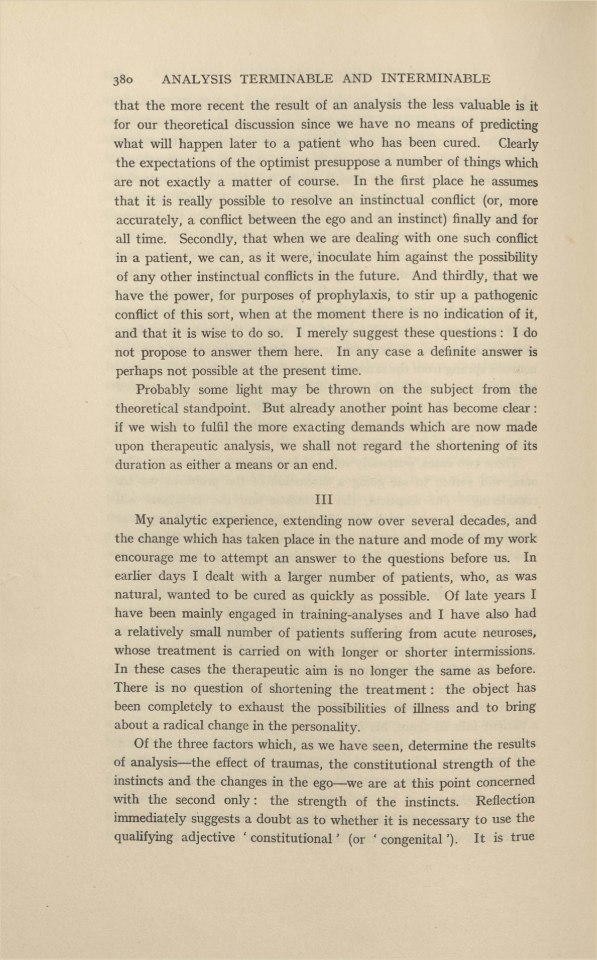
that the more recent the result of an analysis the less valuable is it
for our theoretical discussion since we have no means of predicting
what will happen later to a patient who has been cured. Clearly
the expectations of the optimist presuppose a number of things which
are not exactly a matter of course. In the first place he assumes
that it is really possible to resolve an instinctual conflict (or, more
accurately, a conflict between the ego and an instinct) finally and for
all time. Secondly, that when we are dealing with one such conflict
in a patient, we can, as it were, inoculate him against the possibility
of any other instinctual conflicts in the future. And thirdly, that we
have the power, for purposes of prophylaxis, to stir up a pathogenic
conflict of this sort, when at the moment there is no indication of it,
and that it is wise to do so. I merely suggest these questions: I do
not propose to answer them here. In any case a definite answer is
perhaps not possible at the present time.Probably some light may be thrown on the subject from the
theoretical standpoint. But already another point has become clear:
if we wish to fulfil the more exacting demands which are now made
upon therapeutic analysis, we shall not regard the shortening of its
duration as either a means or an end.III
My analytic experience, extending now over several decades, and
the change which has taken place in the nature and mode of my work
encourage me to attempt an answer to the questions before us. In
earlier days I dealt with a larger number of patients, who, as was
natural, wanted to be cured as quickly as possible. Of late years I
have been mainly engaged in training-analyses and I have also had
a relatively small number of patients suffering from acute neuroses,
whose treatment is carried on with longer or shorter intermissions.
In these cases the therapeutic aim is no longer the same as before.
There is no question of shortening the treatment: the object has
been completely to exhaust the possibilities of illness and to bring
about a radical change in the personality.Of the three factors which, as we have seen, determine the results
of analysis—the effect of traumas, the constitutional strength of the
instincts and the changes in the ego—we are at this point concerned
with the second only: the strength of the instincts. Reflection
immediately suggests a doubt as to whether it is necessary to use the
qualifying adjective ‘constitutional’ (or ‘congenital’). It is trueS.

381
that from the very beginning the constitutional factor is of crucial
importance, but it is yet conceivable that the same effects might
ensue from a reinforcement of instinctual energy at some later period
in life. If this were so, we should have to modify our formula and
say ‘the strength of the instincts at a given moment’ rather than
‘the constitutional strength of the instincts’. Now the first of our
questions was this: is it possible for analysis permanently and defini-
tively to resolve a conflict between instinct and ego or to settle a
pathogenic instinctual claim upon the ego? To avoid misunder-
standing we must perhaps define more exactly what we mean by the
phrase: ‘a permanent settlement of an instinctual claim’. We
certainly do not mean that we cause the claim to die away, so that
it never makes itself felt again. As a rule this is impossible and not
even desirable. No, we mean something else, something which may
be roughly described as the ‘restraining’ of the instinct. That is to
say, it is brought into harmony with the ego and becomes accessible
to the influence of the other ego-tendencies, no longer seeking for
independent gratification. If we are asked how and by what means
this result is achieved, we do not find it easy to answer. We say to
ourselves, ‘We must use a bit of magic’ 2): the ‘magic’ of metapsycho-
logy in fact. Without metapsychological speculation and theorizing–I
had almost said ‘phantasy’–we shall not get a step further. Un-
fortunately, here as elsewhere, what our magic reveals is neither very
clear nor very exact. We have only one single clue to follow–but a
clue the value of which cannot be exaggerated–namely, the antithesis
between the primary and the secondary processes, and to this I must
refer here.Reverting to our first question, we find that our new approach to
the problem makes a particular conclusion inevitable. The question
was as follows: is it possible permanently and definitively to resolve
an instinctual conflict? that is to say, to ‘restrain’ the instinctual
claim in the way I have described. Formulated thus, the question
contains no mention of the strength of the instinct, but it is precisely
this which determines the issue. Let us be quite clear that what
analysis achieves for neurotics is just what normal people accomplish
for themselves without its help. But everyday experience teaches us
that in a normal person any solution of an instinctual conflict holds
good only so long as the instinct is of a particular degree of strength,
2)‘So muss denn doch die Hexe dran’.
S.
382
ANALYSIS TERMINABLE AND INTERMINABLE
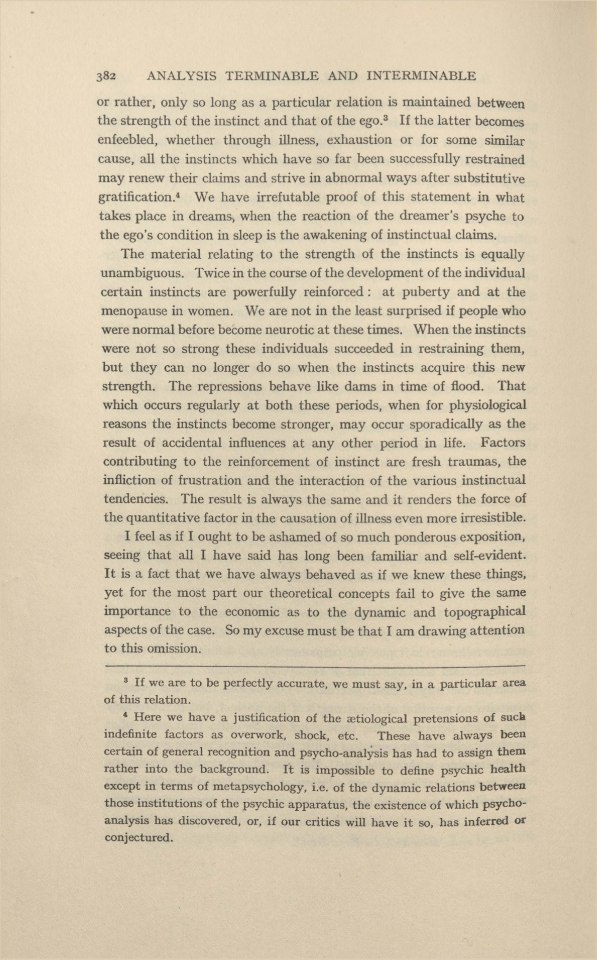
or rather, only so long as a particular relation is maintained between
the strength of the instinct and that of the ego.3 If the latter becomes
enfeebled, whether through illness, exhaustion or for some similar
cause, all the instincts which have so far been successfully restrained
may renew their claims and strive in abnormal ways after substitutive
gratification.4 We have irrefutable proof of this statement in what
takes place in dreams, when the reaction of the dreamer’s psyche to
the ego’s condition in sleep is the awakening of instinctual claims.The material relating to the strength of the instincts is equally
unambiguous. Twice in the course of the development of the individual
certain instincts are powerfully reinforced: at puberty and at the
menopause in women. We are not in the least surprised if people who
were normal before become neurotic at these times. When the instincts
were not so strong these individuals succeeded in restraining them,
but they can no longer do so when the instincts acquire this new
strength. The repressions behave like dams in time of flood. That
which occurs regularly at both these periods, when for physiological
reasons the instincts become stronger, may occur sporadically as the
result of accidental influences at any other period in life. Factors
contributing to the reinforcement of instinct are fresh traumas, the
infliction of frustration and the interaction of the various instinctual
tendencies. The result is always the same and it renders the force of
the quantitative factor in the causation of illness even more irresistible.I feel as if I ought to be ashamed of so much ponderous exposition,
seeing that all I have said has long been familiar and self-evident.
It is a fact that we have always behaved as if we knew these things,
yet for the most part our theoretical concepts fail to give the same
importance to the economic as to the dynamic and topographical
aspects of the case. So my excuse must be that I am drawing attention
to this omission.
3 If we are to be perfectly accurate, we must say, in a particular area
of this relation.4 Here we have a justification of the ætiological pretensions of such
indefinite factors as overwork, shock, etc. These have always been
certain of general recognition and psycho-analysis has had to assign them
rather into the background. It is impossible to define psychic health
except in terms of metapsychology, i.e. of the dynamic relations between
those institutions of the psychic apparatus, the existence of which psycho-
analysis has discovered, or, if our critics will have it so, has inferred or
conjectured.S.
383
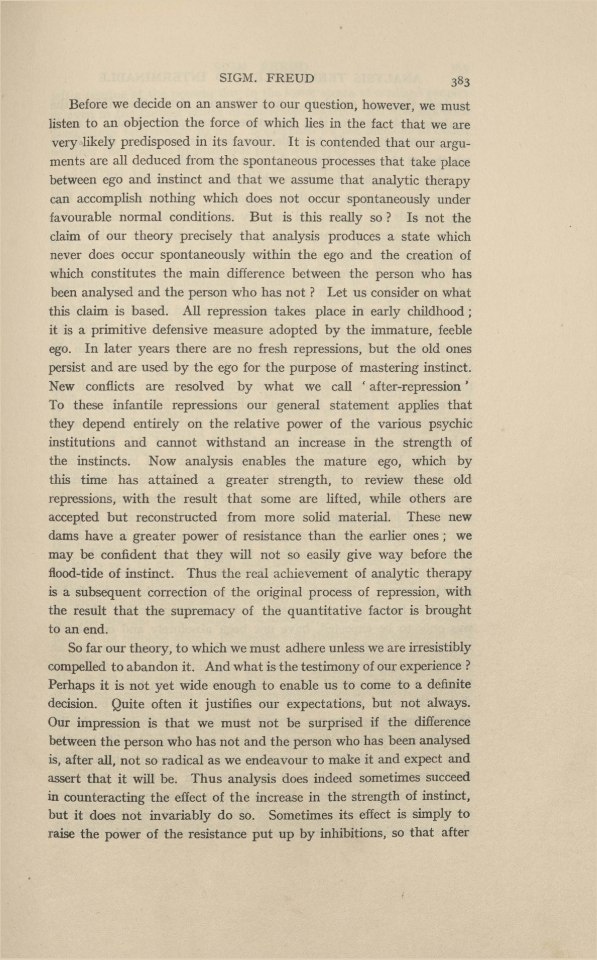
Before we decide on an answer to our question, however, we must
listen to an objection the force of which lies in the fact that we are
very likely predisposed in its favour. It is contended that our argu-
ments are all deduced from the spontaneous processes that take place
between ego and instinct and that we assume that analytic therapy
can accomplish nothing which does not occur spontaneously under
favourable normal conditions. But is this really so? Is not the
claim of our theory precisely that analysis produces a state which
never does occur spontaneously within the ego and the creation of
which constitutes the main difference between the person who has
been analysed and the person who has not? Let us consider on what
this claim is based. All repression takes place in early childhood;
it is a primitive defensive measure adopted by the immature, feeble
ego. In later years there are no fresh repressions, but the old ones
persist and are used by the ego for the purpose of mastering instinct.
New conflicts are resolved by what we call ‘after-repression’.
To these infantile repressions our general statement applies that
they depend entirely on the relative power of the various psychic
institutions and cannot withstand an increase in the strength of
the instincts. Now analysis enables the mature ego, which by
this time has attained a greater strength, to review these old
repressions with the result that some are lifted, while others are
accepted but reconstructed from more solid material. These new
dams have a greater power of resistance than the earlier ones; we
may be confident that they will not so easily give way before the
flood-tide of instinct. Thus the real achievement of analytic therapy
is a subsequent correction of the original process of repression, with
the result that the supremacy of the quantitative factor is brought
to an end.So far our theory, to which we must adhere unless we are irresistibly
compelled to abandon it. And what is the testimony of our experience?
Perhaps it is not yet wide enough to enable us to come to a definite
decision. Quite often it justifies our expectations, but not always.
Our impression is that we must not be surprised if the difference
between the person who has not and the person who has been analysed
is, after all, not so radical as we endeavour to make it and expect and
assert that it will be. Thus analysis does indeed sometimes succeed
in counteracting the effect of the increase in the strength of instinct,
but it does not invariably do so. Sometimes its effect is simply to
raise the power of the resistance put up by inhibitions, so that afterS.
384
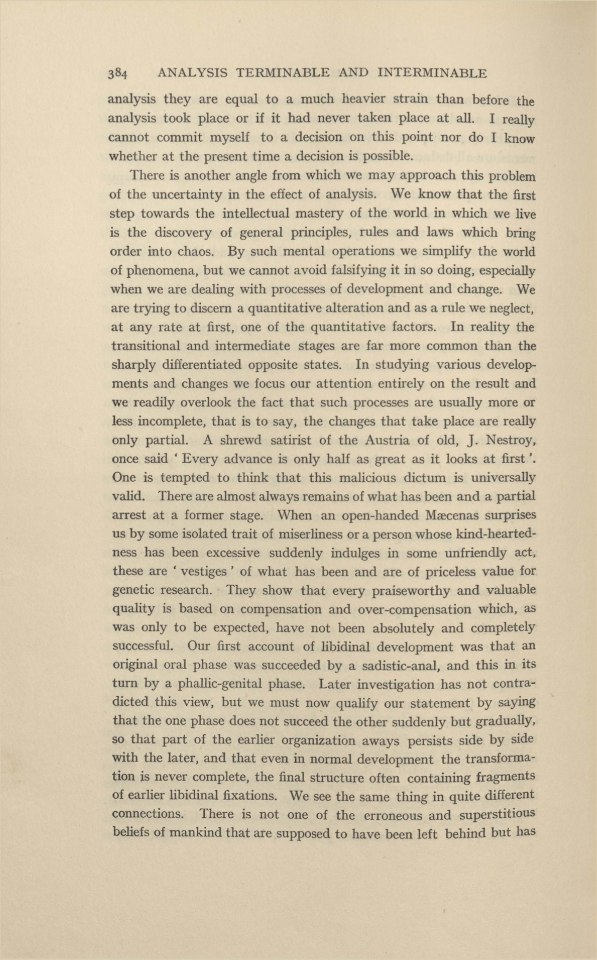
analysis they are equal to a much heavier strain than before the
analysis took place or if it had never taken place at all. I really
cannot commit myself to a decision on this point nor do I know
whether at the present time a decision is possible.
There is another angle from which we may approach this problem
of the uncertainty in the effect of analysis. We know that the first
step towards the intellectual mastery of the world in which we live
is the discovery of general principles, rules and laws which bring
order into chaos. By such mental operations we simplify the world
of phenomena, but we cannot avoid falsifying it in so doing, especially
when we are dealing with processes of development and change. We
are trying to discern a quantitative alteration and as a rule we neglect,
at any rate at first, one of the quantitative factors. In reality the
transitional and intermediate stages are far more common than the
sharply differentiated opposite states. In studying various develop-
ments and changes we focus our attention entirely on the result and
we readily overlook the fact that such processes are usually more or
less incomplete, that is to say, the changes that take place are really
only partial. A shrewd satirist of the Austria of old, J. Nestroy,
once said ‘Every advance is only half as great as it looks at first’.
One is tempted to think that this malicious dictum is universally
valid. There are almost always remains of what has been and a partial
arrest at a former stage. When an open-handed Mæcenas surprises
us by some isolated trait of miserliness or a person whose kind-
heartedness has been excessive suddenly indulges in some unfriendly act,
these are ‘vestiges’ of what has been and are of priceless value for
genetic research. They show that every praiseworthy and valuable
quality is based on compensation and over-compensation which, as
was only to be expected, have not been absolutely and completely
successful. Our first account of libidinal development was that an
original oral phase was succeeded by a sadistic-anal, and this in its
turn by a phallic-
genital phase. Later investigation has not contra-
dicted this view, but we must now qualify our statement by saying
that the one phase does not succeed the other suddenly but gradually,
so that part of the earlier organization aways persists side by side
with the later, and that even in normal development the transforma-
tion is never complete, the final structure often containing fragments
of earlier libidinal fixations. We see the same thing in quite different
connections. There is not one of the erroneous and superstitious
beliefs of mankind that are supposed to have been left behind but hasS.
385
left a residue at the present day in the lower strata of civilized peoples
or even in the highest strata of cultivated society. All that has once
lived clings tenaciously to life. Sometimes we are inclined to doubt
whether the dragons of primæval times are really extinct.Applying these remarks to our particular problem, I would say
that the answer to the question how we explain the uncertain results
of our analytic therapy might well be that our success in replacing
insecure repressions by the mastery of instinct in ways that are reliable
and ego-syntonic is not always complete, i.e. is not radical enough.
A change does occur but it is often only partial : parts of the old
mechanisms remain untouched by analysis. It is difficult to prove
that this is really so. We can only judge by the result which it seems
to explain. But the impressions we receive during our analytic work
do not contradict this hypothesis–rather, they confirm it. We have
to be careful not to imagine that the clarity of our own insight is a
measure of the conviction we produce in the mind of the analysand.
This conviction may lack ‘depth’, so to speak ; the point in question
is always that quantitative factor which is so easily overlooked. If
we now have the correct answer to our question, we may say that
analysis is always right in theory in its claim to cure neurosis by
ensuring the mastery of instinct but that in practice its claim is not
always justified. This is because it does not always succeed in laying
sufficiently firm foundations for the mastery of instinct. The reason
for this partial failure is easy to discover. The quantitative factor–
the strength of the instincts–in the past opposed the efforts of the
patient’s ego to defend itself, and now that analysis is called in to
help, that same factor limits the efficacy of this new attempt. If the
instincts are excessively strong the ego fails in its task, although it is
now mature and has the support of analysis, just as it failed in earlier
days in its helpless state ; its mastery of instinct is greater but not
complete, because the change in the defence-mechanism is only partial.
This is not surprising, for the power of analysis is not infinite ; it
is limited, and the final result always depends on the relative strength
of the conflicting psychic institutions.No doubt it is desirable to shorten analytic treatment, but we
shall achieve our therapeutic purpose only when we can give a greater
measure of help to the patient’s ego. At one time it seemed that
hypnotic influence was a splendid way of achieving our end ; the
reasons why we had to abandon this method are well known. Hitherto
no substitute for hypnosis has been discovered, but we realize that itS.
386
was with this aim that such a master of analysis as Ferenczi devoted
his last years to therapeutic experiments which were, alas ! in vain.IV
The two related questions: whether, when dealing with one
instinctual conflict, we can guard a patient against such conflicts in
the future and whether it is practicable and advisable for purposes of
prophylaxis to stir up a conflict which is not at the moment manifest
must be treated together. Obviously the first task can be accom-
plished only if one performs the second, i.e. if one turns a possible
future conflict into a present one and then brings analytic influence
to bear upon it. This new problem is really only an extension of the
earlier one. In the first instance we were considering how to guard
against the return of the same conflict; now we are considering the
possible substitution of a second conflict for the first. This sounds a
very ambitious proposal but we are really only trying to make clear
what limits are set to the efficacy of analytic therapy.Tempting as it may be to our therapeutic ambition to propose such
tasks for itself, experience bids us refuse them out of hand. If an in-
stinctual conflict is not a present one and does not manifest itself in any
way, it cannot be influenced by analysis. The warning that we should
‘let sleeping dogs lie’—as we are so often told in connection with our
investigation of the psychic underworld—is peculiarly inapposite when
applied to the relations existing in psychic life. For, if the instincts are
causing disturbances it is a proof that the dogs are not sleeping and if it
is evident that they really are sleeping, we have not the power to wake
them. This last statement, however, does not seem entirely accurate and
we must consider it in greater detail. Let us consider the means we have
at our disposal for transforming a latent into a present instinctual con-
flict. Clearly there are only two things we can do: either we can
bring about situations in which the conflict becomes actual or we can
content ourselves with discussing it in analysis and pointing out that
it may possibly arise. The first of these two alternatives can be
accomplished in two different ways, either in reality, or in the trans-
ference. In either case we expose the patient to a measure of real
suffering through frustration and the damming-up of libido. Now it
is true that in ordinary analytic practice we do make use of this
technique. Otherwise, what would be the meaning of the rule that
analysis must be carried through ‘in a state of abstinence’? But we
use it when we are dealing with a conflict which is already present.
Analysis terminable and interminable1937-001/1937.en
1937-001/1937.en/3
