S.
403
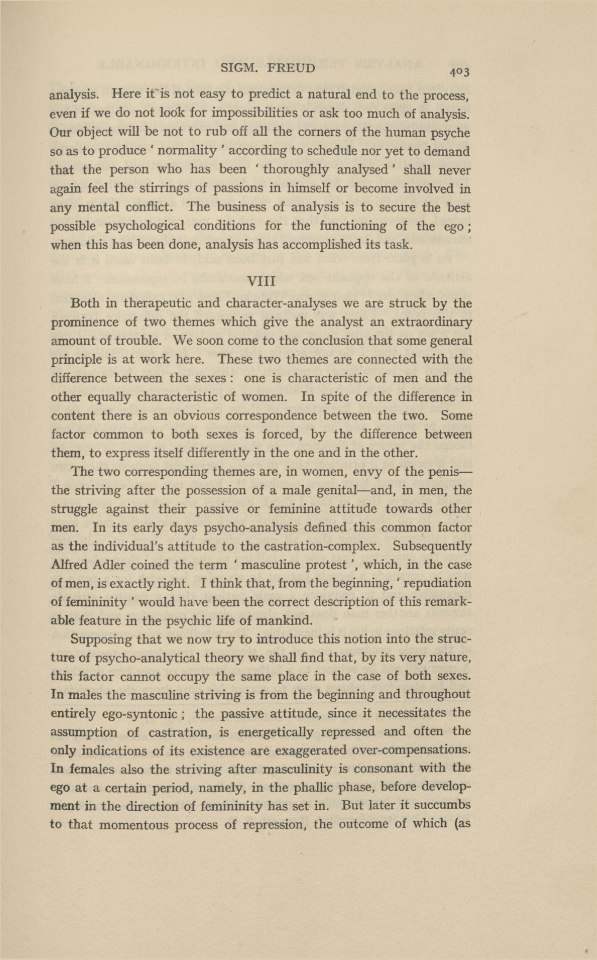
analysis. Here it is not easy to predict a natural end to the process,
even if we do not look for impossibilities or ask too much of analysis.
Our object will be not to rub off all the corners of the human psyche
so as to produce ‘normality’ according to schedule nor yet to demand
that the person who has been ‘thoroughly analysed’ shall never
again feel the stirrings of passions in himself or become involved in
any mental conflict. The business of analysis is to secure the best
possible psychological conditions for the functioning of the ego;
when this has been done, analysis has accomplished its task.VIII
Both in therapeutic and character-
analyses we are struck by the
prominence of two themes which give the analyst an extraordinary
amount of trouble. We soon come to the conclusion that some general
principle is at work here. These two themes are connected with the
difference between the sexes: one is characteristic of men and the
other equally characteristic of women. In spite of the difference in
content there is an obvious correspondence between the two. Some
factor common to both sexes is forced, by the difference between
them, to express itself differently in the one and in the other.The two corresponding themes are, in women, envy of the penis-
the striving after the possession of a male genital–and, in men, the
struggle against their passive or feminine attitude towards other
men. In its early days psycho-
analysis defined this common factor
as the individual’s attitude to the castration-
complex. Subsequently
Alfred Adler coined the term ‘masculine protest’, which, in the case
of men, is exactly right. I think that, from the beginning, ‘repudiation
of femininity’ would have been the correct description of this remark-
able feature in the psychic life of mankind.Supposing that we now try to introduce this notion into the struc-
ture of psycho-
analytical theory we shall find that, by its very nature,
this factor cannot occupy the same place in the case of both sexes.
In males the masculine striving is from the beginning and throughout
entirely ego-
syntonic; the passive attitude, since it necessitates the
assumption of castration, is energetically repressed and often the
only indications of its existence are exaggerated over-
compensations.
In females also the striving after masculinity is consonant with the
ego at a certain period, namely, in the phallic phase, before develop-
ment in the direction of femininity has set in. But later it succumbs
to that momentous process of repression, the outcome of which (asS.
404
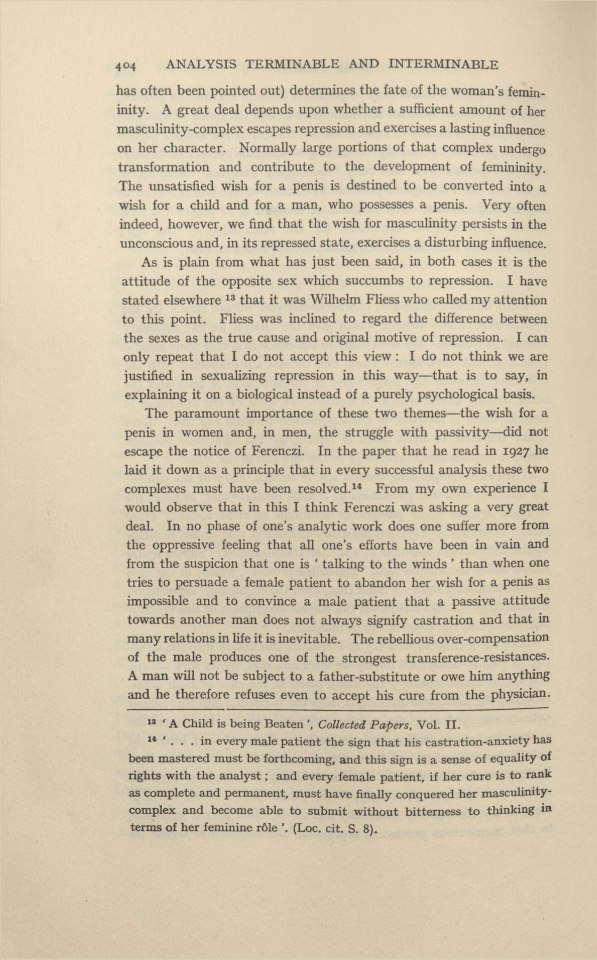
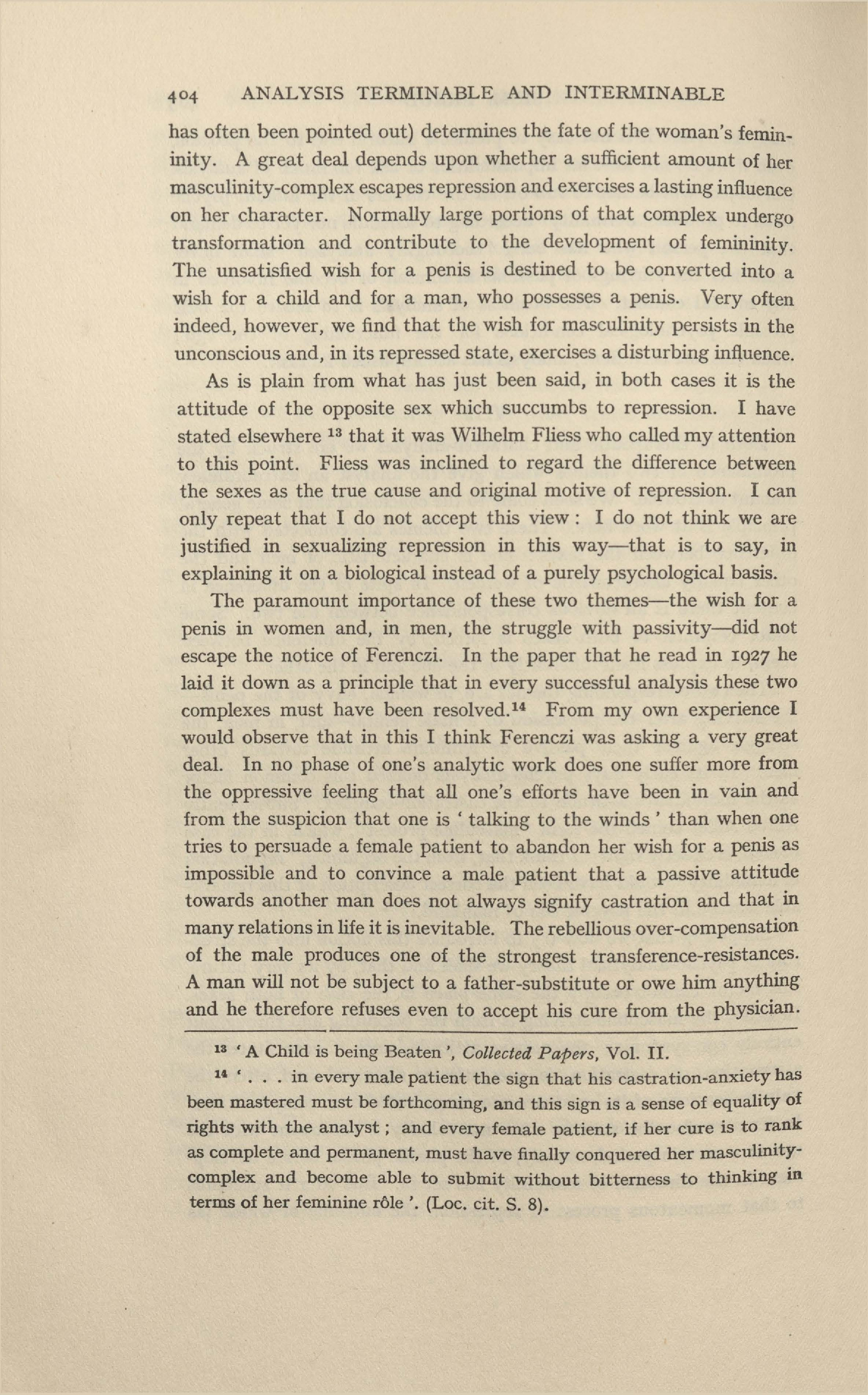
has often been pointed out) determines the fate of the woman’s femin-
inity. A great deal depends upon whether a sufficient amount of her
masculinity-complex escapes repression and exercises a lasting influence
on her character. Normally large portions of that complex undergo
transformation and contribute to the development of femininity.
The unsatisfied wish for a penis is destined to be converted into a
wish for a child and for a man, who possesses a penis. Very often
indeed, however, we find that the wish for masculinity persists in the
unconscious and, in its repressed state, exercises a disturbing influence.As is plain from what has just been said, in both cases it is the
attitude of the opposite sex which succumbs to repression. I have
stated elsewhere 13) that it was Wilhelm Fliess who called my attention
to this point. Fliess was inclined to regard the difference between
the sexes as the true cause and original motive of repression. I can
only repeat that I do not accept this view: I do not think we are
justified in sexualizing repression in this way—that is to say, in
explaining it on a biological instead of a purely psychological basis.The paramount importance of these two themes—the wish for a
penis in women and, in men, the struggle with passivity—did not
escape the notice of Ferenczi. In the paper that he read in 1927 he
laid it down as a principle that in every successful analysis these two
complexes must have been resolved.14) From my own experience I
would observe that in this I think Ferenczi was asking a very great
deal. In no phase of one’s analytic work does one suffer more from
the oppressive feeling that all one’s efforts have been in vain and
from the suspicion that one is ‘talking to the winds’ than when one
tries to persuade a female patient to abandon her wish for a penis as
impossible and to convince a male patient that a passive attitude
towards another man does not always signify castration and that in
many relations in life it is inevitable. The rebellious over-compensation
of the male produces one of the strongest transference-resistances.
A man will not be subject to a father-substitute or owe him anything
and he therefore refuses even to accept his cure from the physician.
13)‘A Child is being Beaten’, Collected Papers, Vol. II.
14)‘… in every male patient the sign that his castration-anxiety has
been mastered must be forthcoming, and this sign is a sense of equality of
rights with the analyst; and every female patient, if her cure is to rank
as complete and permanent, must have finally conquered her masculinity-
complex and become able to submit without bitterness to thinking in
terms of her feminine rôle’. (Loc. cit. S. 8).S.

405
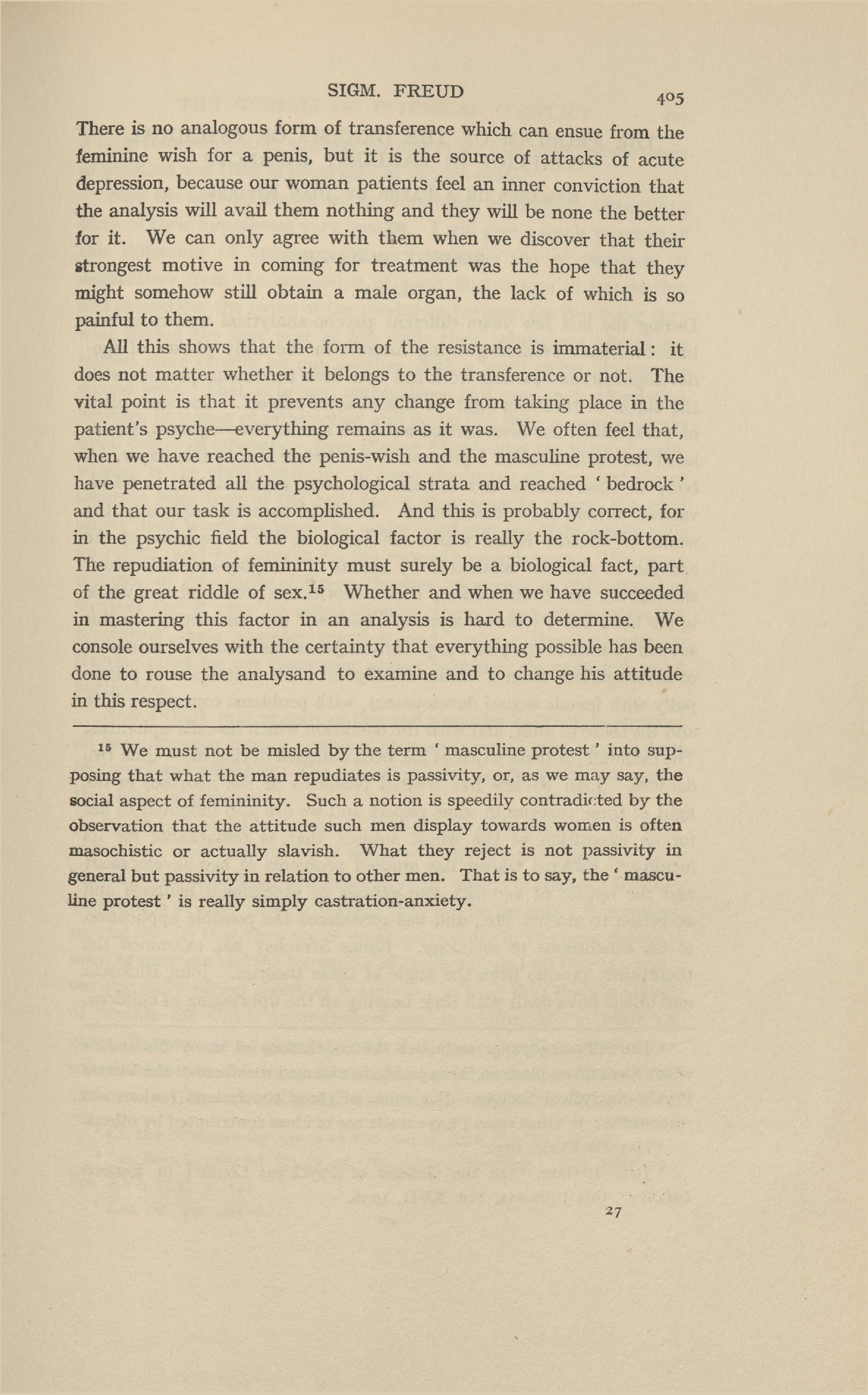
There is no analogous form of transference which can ensue from the
feminine wish for a penis, but it is the source of attacks of acute
depression, because our woman patients feel an inner conviction that
the analysis will avail them nothing and they will be none the better
for it. We can only agree with them when we discover that their
strongest motive in coming for treatment was the hope that they
might somehow still obtain a male organ, the lack of which is so
painful to them.All this shows that the form of the resistance is immaterial: it
does not matter whether it belongs to the transference or not. The
vital point is that it prevents any change from taking place in the
patient’s psyche–everything remains as it was. We often feel that,
when we have reached the penis-wish and the masculine protest, we
have penetrated all the psychological strata and reached ‘bedrock’
and that our task is accomplished. And this is probably correct, for
in the psychic field the biological factor is really the rock-bottom.
The repudiation of femininity must surely be a biological fact, part
of the great riddle of sex.15 Whether and when we have succeeded
in mastering this factor in an analysis is hard to determine. We
console ourselves with the certainty that everything possible has been
done to rouse the analysand to examine and to change his attitude
in this respect.15We must not be misled by the term ‘masculine protest’ into sup-
posing that what the man repudiates is passivity, or, as we may say, the
social aspect of femininity. Such a notion is speedily contradicted by the
observation that the attitude such men display towards women is often
masochistic or actually slavish. What they reject is not passivity in
general but passivity in relation to other men. That is to say, the ‘mascu-
line protest’ is really simply castration-anxiety.
Analysis terminable and interminable1937-001/1937.en

1937-001/1937.en/8
