S.
SIGMUND FREUD
S.

S.
23
Vienna, September, 1932.
Dear Professor Einstein,
WHEN I learnt of your intention to
invite me to a mutual exchange of
views upon a subject which not only
interested you personally but seemed
deserving, too, of public interest, I cor-
dially assented. I expected you to
choose a problem lying on the borderland
of the knowable, as it stands to-day, a
theme which each of us, physicist and
psychologist, might approach from his
own angle, to meet at last on commonS.
24
ground, though setting out from different
premises. Thus the question which you
put me–what is to be done to rid man-
ind of the war-menace ?–took me by
surprise. And, next, I was dumbfounded
by the throught of my (of our, I almost
wrote) incompetence ; for this struck me
as being a matter of practical politics,
the statesman’s proper study. But then
I realised that you did not raise the ques-
tion in your capacity of scientist or phys-
icist, but as a lover of his fellow men,
who responded to the call of the League
of Nations much as Fridtjof Nansen, the
Polar explorer, took on himself the task of
succouring homeless and starving victims
of the World War. And, next, I remind-
ed myself that I was not being called on
to formulate practical proposals, but,
rather, to explain how this question ofS.
25
SIGMUND FREUD
preventing wars strikes a psychologist.
But here, too, you have stated the gist
of the matter in your letter–and taken
the wind out of my sails! Still, I will
gladly follow in your wake and content
myself with endorsing your conclusions,
which, however, I propose to amplify
to the best of my knowledge or surmise.You begin with the relations between
Might and Right, and this is assuredly
the proper starting-point for our enquiry.
But, for the term “might”, I would
substitute a tougher and more telling
word: “violence”. In right and violence
we have to-day an obvious antinomy.
It is easy to prove that one has evolved
from the other and, when we go back to
origins and examine primitive conditions,
the solution of the problem follows easily
enough. I must crave your indulgence ifS.
26
WHY WAR ?
in what follows I speak of well-known,
admitted facts as though they were
new data ; the context necessitates this
method.Conflicts of interest between man and
man are resolved, in principle, by the
recourse to violence. It is the same in
the animal kingdom, from which man
cannot claim exclusion ; nevertheless men
are also prone to conflicts of opinion,
touching, on occasion, the loftiest peaks
of abstract thought, which seem to call
for settlement by quite another method.
This refinement is, however, a late devel-
opment. To start with, brute force was
the factor which, in small communities,
decided points of ownership and the
question which man's will was to prevail.
Very soon physical force was implemented,
then replaced, by the use of variousS.
27
SIGMUND FREUD
adjuncts ; he proved the victor whose
weapon was the better, or handled the
more skilfully. Now, for the first time,
with the coming of weapons, superior
brains began to oust brute force, but the
object of the conflict remained the same :
one party was to be constrained, by the
injury done him or impairment of his
strength, to retract a claim or a refusal.
This end is most effectively gained when
the opponent is definitively put out of
action–in other words, is killed. This
procedure has two advantages ; the enemy
cannot renew hostilities, and, secondly,
his fate deters others from following his
example. Moreover, the slaughter of a
foe gratifies an instinctive craving–a
point to which we shall revert hereafter.
However, another consideration may be
set off against this will to kill : the possi-
S.

28
WHY WAR ?
bility of using an enemy for servile tasks
if his spirit be broken and his life spared.
Here violence finds an outlet not in
slaughter but in subjugation. Hence
springs the practice of giving quarter ;
but the victor, having from now on to
reckon with the craving for revenge that
rankles in his victim, forfeits to some
extent his personal security.Thus, under primitive conditions, it is
superior force–brute violence, or vio-
lence backed by arms–that lords it every-
where. We know that in the course of
evolution this state of things was modified,
a path was traced that led away from
violence to law. But what was this
path ? Surely it issued from a single
verity; that the superiority of one strong
man can be overborne by an alliance of
many weaklings, that l'union fait la force.S.
SIGMUND FREUD
Brute force is overcome by union, the
allied might of scattered units makes good
its right against the isolated giant. Thus
we may define “right” (i.e. law) as the
might of a community. Yet it, too, is
nothing else than violence, quick to
attack whatever individual stands in its
path, and it employs the selfsame me-
thods, follows like ends, with but one
difference; it is the communal, not indiv-
idual, violence that has its way. But, for
the transition from crude violence to the
reign of law, a certain psychological con-
dition must first obtain. The union of
the majority must be stable and enduring.
If its sole raison d'être be the discom-
fiture of some overweening individual
and, after his downfall, it be dissolved,
it leads to nothing. Some other man,
trusting to his superior power, will seek— 29 —
S.
30
to reinstate the rule of violence and the
cycle will repeat itself unendingly. Thus
the union of the people must be perma
nent and well organised ; it must enact
rules to meet the risk of possible revolts ;
must set up machinery ensuring that its
rules–the laws–are observed and that
such acts of violence as the laws demand
are duly carried out. This recognition
of a community of interests engenders
among the members of the group a senti
ment of unity and fraternal solidarity
which constitutes its real strength.So far I have set out what seems to me
the kernel of the matter : the suppression
of brute force by the transfer of power to
a larger combination, founded on the
community of sentiments linking up its
members. All the rest is mere tautology
and glosses. Now the position is simpleS.
31
enough so long as the community consists
of a number of equipollent individuals.
The laws of such a group can determine
to what extent the individual must forfeit
his personal freedom, the right of using per-
sonal force as an instrument of violence,
to ensure the safety of the group. But
such a combination is only theoretically
possible; in practice the situation is
always complicated by the fact that, from
the outset, the group includes elements
of unequal power, men and women, elders
and children, and, very soon, as a result
of war and conquest, victors and the
vanquished–i.e. masters and slaves–
as well. From this time on the common
law takes notice of these inequalities of
power, laws are made by and for the
rulers, giving the servile classes fewer
rights. Thenceforward there exist withinS.
32
the state two factors making for legal
instability, but legislative evolution, too :
first, the attempts by members of the
ruling class to set themselves above the
law's restrictions and, secondly, the cons-
tant struggle of the ruled to extend their
rights and see each gain embodied in the
code, replacing legal disabilities by equal
laws for all. The second of these ten-
dencies will be particularly marked when
there takes place a positive mutation of the
balance of power within the community,
the frequent outcome of certain historical
conditions. In such cases the laws may
gradually be adjusted to the changed
conditions or (as more usually ensues) the
ruling class is loath to reckon with the
new developments, the result being insur-
rections and civil wars, a period when
law is in abeyance and force once moreS.
3
SIGMUND FREUD
the arbiter, followed by a new regime of
law. There is another factor of constitut-
ional change, which operates in a wholly
pacific manner, viz : the cultural evolut-
ion of the mass of the community ; this
factor, however, is of a different order
and can only be dealt with later.Thus we see that, even within the
group itself, the exercise of violence can-
not be avoided when conflicting interests
are at stake. But the common needs
and habits of men who live in fellowship
under the same sky favour a speedy
issue of such conflicts and, this being so,
the possibilities of peaceful solutions make
steady progress. Yet the most casual
glance at world-history will show an
unending series of conflicts between one
community and another or a group of
others, between large and smaller units,— 33 —
S.
34
WHY WAR ?
between cities, countries, races, tribes
and kingdoms, almost all of which were
settled by the ordeal of war. Such wars
end either in pillage or in conquest and
its fruits, the downfall of the loser. No
single all-embracing judgment can be
passed on these wars of aggrandisement.
Some, like the war between the Mongols
and the Turks, have led to unmitigated
misery ; others, however, have furthered
the transition from violence to law, since
they brought larger units into being,
within whose limits a recourse to violence
was banned and a new régime determined
all disputes. Thus the Roman conquests
brought that boon, the pax romana, to
the Mediterranean lands. The French
kings’ lust for aggrandisement created a
new France, flourishing in peace and
unity. Paradoxical as it sounds, weS.
35
must admit that warfare well might serve
to pave the way to that unbroken peace
we so desire, for it is war that brings
vast empires into being, within whose
frontiers all warfare is proscribed by a
strong central power. In practice, how-
ever, this end is not attained, for as a
rule the fruits of victory are but short-
lived, the new-created unit falls asunder
once again, generally because there can
be no true cohesion between the parts
that violence has welded. Hitherto, more-
over, such conquests have only led to
aggregations which, for all their magni-
tude, had limits, and disputes between
these units could be resolved only by
recourse to arms. For humanity at large
the sole result of all these military enter-
prises was that, instead of frequent not to
say incessant little wars, they had now toS.
36
WHY WAR ?
face great wars which, for all they came
less often, were so much the more des-
tructive.Regarding the world of to-day the
same conclusion holds good, and you, too,
have reached it, though by a shorter path.
There is but one sure way of ending war
and that is the establishment, by com-
mon consent, of a central control which
shall have the last word in every conflict
of interests. For this, two things are
needed : first, the creation of such a
supreme court of judicature ; secondly,
its investment with adequate executive
force. Unless this second requirement
be fulfilled, the first is unavailing. Ob-
viously the League of Nations, acting
as a Supreme Court, fulfils the first con-
dition ; it does not fulfil the second. It
has no force at its disposal and can onlyS.
37
get it if the members of the new body, its
constituent nations, furnish it. And, as
things are, this is a forlorn hope. Still we
should be taking a very short-sighted
view of the League of Nations were we to
ignore the fact that here is an experiment
the like of which has rarely–never before,
perhaps, on such a scale–been attempted
in the course of history. It is an attempt
to acquire the authority (in other words,
coercive influence), which hitherto reposed
exclusively on the possession of power,
by calling into play certain idealistic
attitudes of mind. We have seen that
there are two factors of cohesion in a
community : violent compulsion and ties
of sentiment (“identifications”, in techni-
cal parlance) between the members of the
group. If one of these factors becomes
inoperative, the other may still sufficeS.
38
to hold the group together. Obviously
such notions as these can only be signi-
ficant when they are the expression of a
deeply rooted sense of unity, shared by
all. It is necessary, therefore, to gauge
the efficacy of such sentiments. History
tells us that, on occasion, they have been
effective. For example, the Panhellenic
conception, the Greeks’ awareness of
superiority over their barbarian neigh-
bours, which found expression in the
Amphictyonies, the Oracles and Games,
was strong enough to humanise the me-
thods of warfare as between Greeks,
though inevitably it failed to prevent
conflicts between different elements of the
Hellenic race or even to deter a city or
group of cities from joining forces with
their racial foe, the Persians, for the
discomfiture of a rival. The solidarity ofS.

39
Christendom in the Renaissance age was
no more effective, despite its vast author-
ity, in hindering Christian nations, large
and small alike, from calling in the Sul-
tan to their aid. And, in our times, we
look in vain for some such unifying notion
whose authority would be unquestioned.
It is all too clear that the nationalistic
ideas, paramount to-day in every country.
operate in quite a contrary direction.
Some there are who hold that the Bolshe-
vist conceptions may make an end of war,
but, as things are, that goal lies very far
away and, perhaps, could only be attained
after a spell of brutal internecine warfare.
Thus it would seem that any effort to
replace brute force by the might of an
ideal is, under present conditions, doomed
to fail. Our logic is at fault if we ignore
the fact that right is founded on bruteS.
40
force and even to-day needs violence to
maintain it.I now can comment on another of your
statements. You are amazed that it is
so easy to infect men with the war-fever,
and you surmise that man has in him
an active instinct for hatred and des-
truction, amenable to such stimulations.
I entirely agree with you. I believe in
the existence of this instinct and have
been recently at pains to study its mani-
festations. In this connexion may I set
out a fragment of that knowledge of the
instincts, which we psychoanalysts, after
so many tentative essays and gropings in
the dark, have compassed ? We assume
that human instincts are of two kinds :
those that conserve and unify, which we
call “erotic” (in the meaning Plato gives
to Eros in his Symposium), or elseS.
41
SIGMUND FREUD
“sexual” (explicitly extending the popular
connotation of “sex”) ; and, secondly, the
instincts to destroy and kill, which we
assimilate as the aggressive or destructive
instincts. These are, as you perceive,
the well-known opposites, Love and Hate,
transformed into theoretical entities ;
they are, perhaps, another aspect of those
eternal polarities, attraction and repul-
sion, which fall within your province.But we must be chary of passing over-
hastily to the notions of good and evil.Each of these instincts is every whit as
indispensable as its opposite and all the
phenomena of life derive from their acti-
vity, whether they work in concert or in
opposition. It seems that an instinct of
either category can operate but rarely in
isolation ; it is always blended (“alloyed”,
as we say) with a certain dosage of itsS.
42
WHY WAR ?
opposite, which modifies its aim or even,
in certain circumstances, is a prime condit-
ion of its attainment. Thus the instinct
of self-preservation is certainly of an erotic
nature, but to gain its ends this very
instinct necessitates aggressive action.
In the same way the love-instinct, when
directed to a specific object, calls for an
admixture of the acquisitive instinct if
it is to enter into effective possession of
that object. It is the difficulty of isolat-
ing the two kinds of instinct in their
manifestations that has so long prevented
us from recognising them.If you will travel with me a little fur-
ther on this road, you will find that
human affairs are complicated in yet
another way. Only exceptionally does
an action follow on the stimulus of a
single instinct, which is per se a blend ofS.

43
Eros and destructiveness. As a rule
several motives of similar composition
concur to bring about the act. This fact
was duly noted by a colleague of yours,
Professor G. C. Lichtenberg, sometime
Professor of Physics at Göttingen; he
was perhaps even more eminent as a
psychologist than as a physical scientist.
He evolved the notion of a “Compass-
card of Motives” and wrote: “The effic-
ient motives impelling man to act can
be classified like the 32 Winds, and
described in the same manner; e.g. Food-
Food-Fame or Fame-Fame-Food.” Thus,
when a nation is summoned to engage in
war, a whole gamut of human motives
may respond to this appeal; high and
low motives, some openly avowed, others
slurred over. The lust for aggression
and destruction is certainly included; theS.
44
WHY WAR ?
innumerable cruelties of history and man’s
daily life confirm its prevalence and-
strength. The stimulation of these des-
tructive impulses by appeals to idealism
and the erotic instinct naturally facilitates
their release. Musing on the atrocities
recorded on history’s page, we feel that
the ideal motive has often served as a
camouflage for the lust of destruction;
sometimes, as with the cruelties of the
Inquisition, it seems that, while the ideal
motives occupied the foreground of cons-
ciousness, they drew their strength from
the destructive instincts submerged in
the unconscious. Both interpretations
are feasible.You are interested, I know, in the
prevention of war, not in our theories,
and I keep this fact in mind. Yet I would
like to dwell a little longer on this des-
S.
45
tructive instinct which is seldom given
the attention that its importance war-
rants. With the least of speculative
efforts we are led to conclude that this
instinct functions in every living being,
striving to work its ruin and reduce life
to its primal state of inert matter. Indeed
it might well be called the “death-ins-
tinct”; whereas the erotic instincts vouch
for the struggle to live on. The death
instinct becomes an impulse to destruc-
tion when, with the aid of certain organs,
it directs its action outwards, against
external objects. The living being, that
is to say, defends its own existence by
destroying foreign bodies. But, in one
of its activities, the death instinct is
operative within the living being and we
have sought to trace back a number of
normal and pathological phenomena toS.
46
WHY WAR ?
this introversion of the destructive ins-
tinct. We have even committed the her-
esy of explaining the origin of human
conscience by some such “turning inward”
of the aggressive impulse. Obviously
when this internal tendency operates on
too large a scale, it is no trivial matter,
rather a positively morbid state of things;
whereas the diversion of the destructive
impulse towards the external world must
have beneficial effects. Here is then the
biological justification for all those vile,
pernicious propensities which we now
are combating. We can but own that
they are really more akin to nature than
this our stand against them, which, in
fact, remains to be accounted for.All this may give you the impression
that our theories amount to a species of
mythology and a gloomy one at that!S.
47
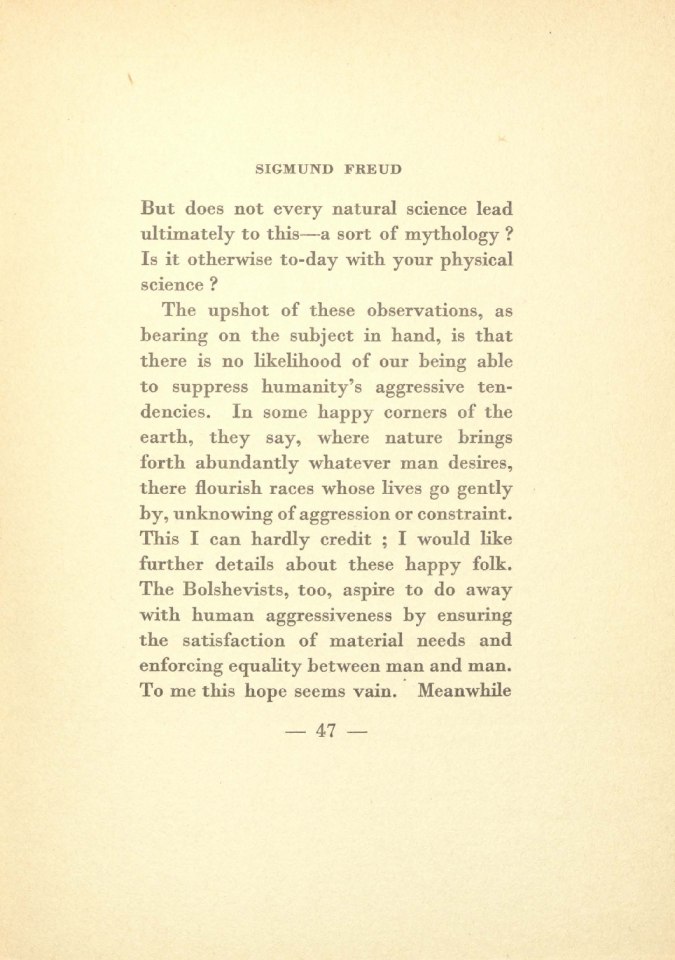
But does not every natural science lead
ultimately to this–a sort of mythology ?
Is it otherwise to-day with your physical
science ?The upshot of these observations, as
bearing on the subject in hand, is that
there is no likelihood of our being able
to suppress humanity's aggressive ten-
dencies. In some happy corners of the
earth, they say, where nature brings
forth abundantly whatever man desires,
there flourish races whose lives go gently
by, unknowing of aggression or constraint.
This I can hardly credit ; I would like
further details about these happy folk.
The Bolshevists, too, aspire to do away
with human aggressiveness by ensuring
the satisfaction of material needs and
enforcing equality between man and man.
To me this hope seems vain. MeanwhileS.
48
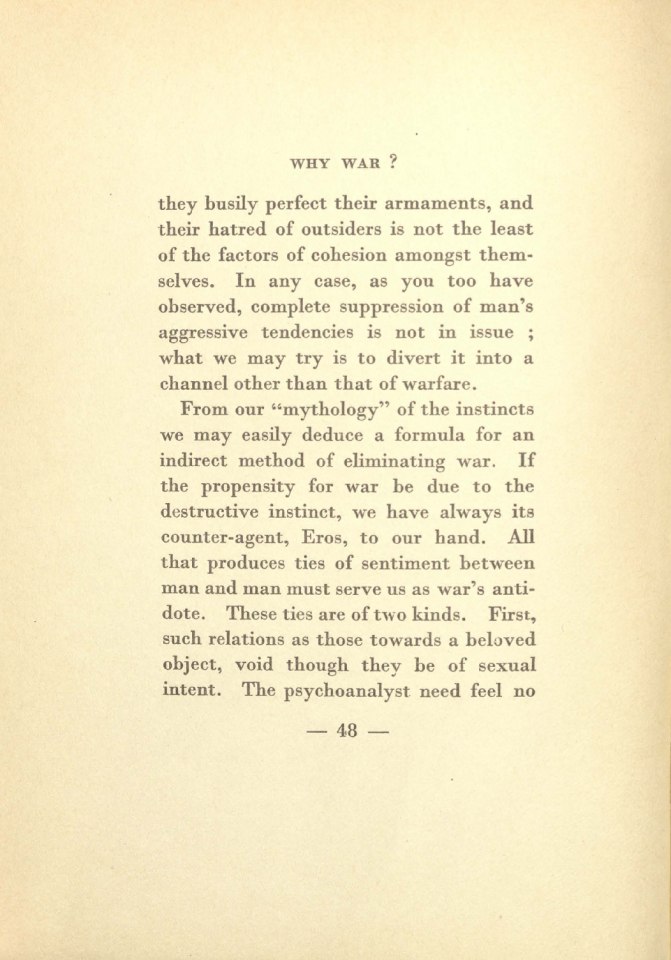
WHY WAR ?
they busily perfect their armaments, and
their hatred of outsiders is not the least
of the factors of cohesion amongst them-
selves. In any case, as you too have
observed, complete suppression of man’s
aggressive tendencies is not in issue ;
what we may try is to divert it into a
channel other than that of warfare.From our “mythology” of the instincts
we may easily deduce a formula for an
indirect method of eliminating war. If
the propensity for war be due to the
destructive instinct, we have always its
counter-agent, Eros, to our hand. All
that produces ties of sentiment between
man and man must serve us as war’s anti-
dote. These ties are of two kinds. First,
such relations as those towards a beloved
object, void though they be of sexual
intent. The psychoanalyst need feel noS.
49
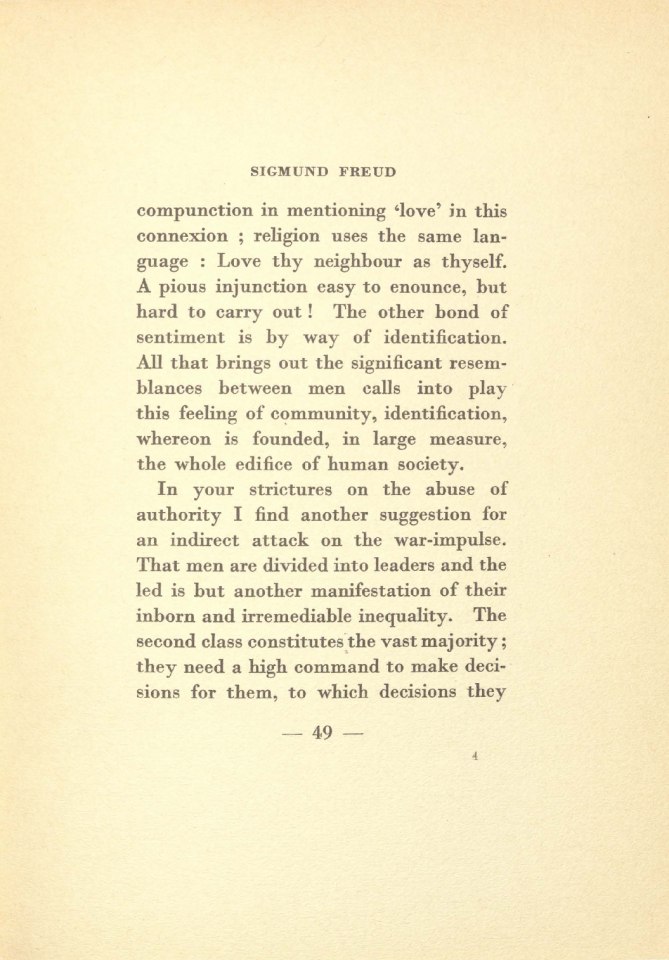
compunction in mentioning ‘love’ in this
connexion ; religion uses the same lan-
guage : Love thy neighbour as thyself.
A pious injunction easy to enounce, but
hard to carry out ! The other bond of
sentiment is by way of identification.
All that brings out the significant resem-
blances between men calls into play
this feeling of community, identification,
whereon is founded, in large measure,
the whole edifice of human society.In your strictures on the abuse of
authority I find another suggestion for
an indirect attack on the war-impulse.
That men are divided into leaders and the
led is but another manifestation of their
inborn and irremediable inequality. The
second class constitutes the vast majority ;
they need a high command to make deci-
sions for them, to which decisions theyS.
50
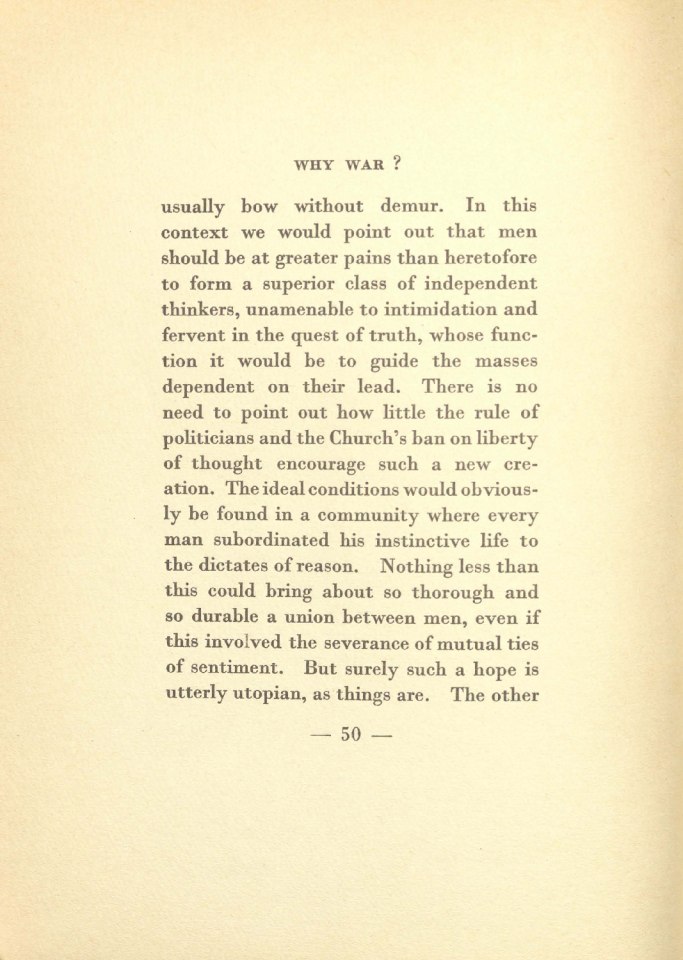
usually bow without demur. In this
context we would point out that men
should be at greater pains than heretofore
to form a superior class of independent
thinkers, unamenable to intimidation and
fervent in the quest of truth, whose func-
tion it would be to guide the masses
dependent on their lead. There is no
need to point out how little the rule of
politicians and the Church’s ban on liberty
of thought encourage such a new cre-
ation. The ideal conditions would obvious-
ly be found in a community where every
man subordinated his instinctive life to
the dictates of reason. Nothing less than
this could bring about so thorough and
so durable a union between men, even if
this involved the severance of mutual ties
of sentiment. But surely such a hope is
utterly utopian, as things are. The otherS.
51
indirect methods of preventing war are
certainly more feasible, but entail no
quick results. They conjure up an ugly
picture of mills that grind so slowly that,
before the flour is ready, men are dead of
hunger.As you see, little good comes of consult-
ing a theoretician, aloof from worldly
contacts, on practical and urgent pro-
blems! Better it were to tackle each
successive crisis with means that we have
ready to our hands. However, I would
like to deal with a question which, though
it is not mooted in your letter, interests
me greatly. Why do we, you and I and
many an other, protest so vehemently
against war, instead of just accepting it
as another of life's odious importunities?
For it seems a natural thing enough,
biologically sound and practically un-
S.
52
WHY WAR ?
avoidable. I trust you will not be shocked
by my raising such a question. For
the better conduct of an inquiry it may
be well to don a mask of feigned aloofness.
The answer to my query may run as
follows : Because every man has a right
over his own life and war destroys lives
that were full of promise ; it forces the
individual into situations that shame his
manhood, obliging him to murder fellow
men, against his will ; it ravages material
amenities, the fruits of human toil, and
much besides. Moreover wars, as now
conducted, afford no scope for acts of
heroism according to the old ideals and,
given the high perfection of modern arms,
war to-day would mean the sheer exter-
mination of one of the combatants, if not
of both. This is so true, so obvious, that
we can but wonder why the conduct ofS.
53
war is not banned by general consent.
Doubtless either of the points I have just
made is open to debate. It may be asked
if the community, in its turn, cannot
claim a right over the individual lives of
its members. Moreover, all forms of war
cannot be indiscriminately condemned ;
so long as there are nations and empires,
each prepared callously to exterminate
its rival, all alike must be equipped for
war. But we will not dwell on any of
these problems ; they lie outside the
debate to which you have invited me.
I pass on to another point, the basis, as it
strikes me, of our common hatred of war.
It is this : we cannot do otherwise than
hate it. Pacifists we are, since our organ-
ic nature wills us thus to be. Hence it
comes easy to us to find arguments that
justify our standpoint.S.
54
WHY WAR ?
This point, however, calls for elucida-
tion. Here is the way in which I see it.
The cultural development of mankind
(some, I know, prefer to call it civilisa-
tion) has been in progress since immemor-
ial antiquity. To this processus we owe
all that is best in our composition, but also
much that makes for human suffering.
Its origins and causes are obscure, its
issue is uncertain, but some of its charac-
teristics are easy to perceive. It well
may lead to the extinction of mankind,
for it impairs the sexual function in more
than one respect, and even to-day the
uncivilised races and the backward clas-
ses of all nations are multiplying more
rapidly than the cultured elements. This
process may, perhaps, be likened to the
effects of domestication on certain ani-
mals–it clearly involves physical changesS.
55
of structure–but the view that cultural
development is an organic process of this
order has not yet become generally fami-
liar. The psychic changes which accom-
pany this process of cultural change are
striking, and not to be gainsaid. They
consist in the progressive rejection of
instinctive ends and a scaling down of
instinctive reactions. Sensations which
delighted our forefathers have become
neutral or unbearable to us; and, if our
ethical and æsthetic ideals have under-
gone a change, the causes of this are
ultimately organic. On the psychologi-
cal side two of the most important phe-
nomena of culture are, firstly, a strength-
ening of the intellect, which tends to
master our instinctive life, and, secondly,
an introversion of the aggressive impulse,
with all its consequent benefits and perils.S.
WHY WAR ?
Now war runs most emphatically counter
to the psychic disposition imposed on us
by the growth of culture ; we are there-
fore bound to resent war, to find it
utterly intolerable. With pacifists like
us it is not merely an intellectual and
affective repulsion, but a constitutional
intolerance, an idiosyncrasy in its most
drastic form. And it would seem that
the æsthetic ignominies of warfare play
almost as large a part in this repugnance
as war’s atrocities.How long have we to wait before the
rest of men turn pacifist ? Impossible
to say, and yet perhaps our hope that
these two factors—man’s cultural dispo-
sition and a well-founded dread of the
form that future wars will take—may
serve to put an end to war in the near
future, is not chimerical. But by whatS.
SIGMUND FREUD
ways or by-ways this will come about,
we cannot guess. Meanwhile we may
rest on the assurance that whatever makes
for cultural development is working also
against war.With kindest regards and, should this
exposé prove a disappointment to you,
my sincere regrets,Yours,
Sigmund FREUD.
S.

Why War?1933-071/1933.en