-
S.
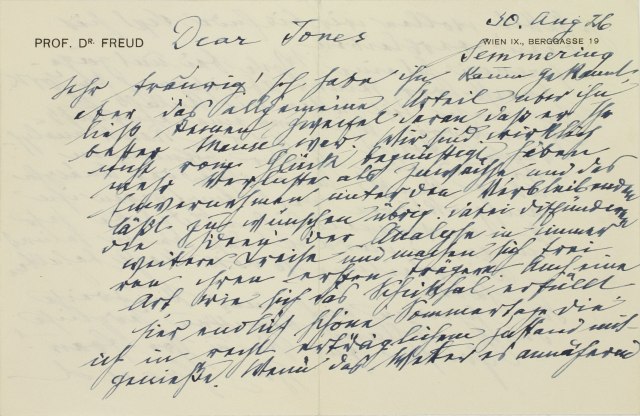
PROF. DR. FREUD
WIEN IX., BERGGASSE 19Semmering
30. Aug 26
Dear Jones
Sehr traurig! Ich habe ihn kaum gekannt,
aber das allgemeine Urteil über ihn
ließ keinen Zweifel daran, dass er Ihr
bester Mann war. Wir sind wirklich
nicht vom Glück begünstigt, haben
mehr Verluste als Zuwächse, und das
Einvernehmen unter den Verbleibenden
läßt zu wünschen übrig. Dabei diffundiren
die Ideen der Analyse in immer
weitere Kreise und machen sich frei
von ihren ersten Trägern. Auch eine
Art, wie sich das Schicksal erfüllt.Hier endlich schöne Sommertage, die
ich in recht erträglichem Zustand mit-
genieße. Wenn das Wetter es annähernd -
S.
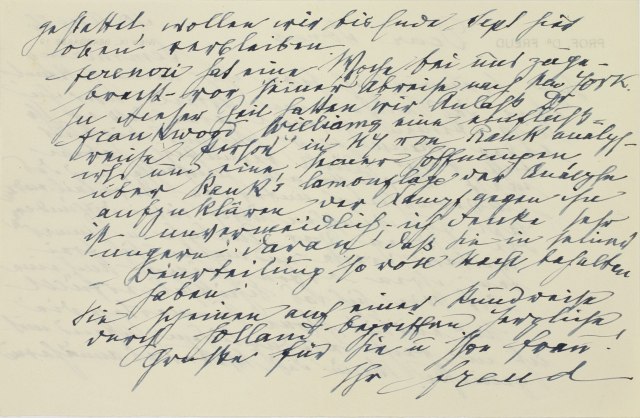
gestattet, wollen wir bis Ende Sept hier
oben verbleiben.Ferenczi hat eine Woche bei uns zuge-
bracht – vor seiner Abreise nach New York.
In dieser Zeit hatten wir Anlaß, Dr
Frankwood Williams, eine einfluß-
reiche Person in NY von Rank analys-
irt und eine seiner Hoffnungen,
über Rank’s Camouflage der Analyse
aufzuklären. Der Kampf gegen ihn
ist unvermeidlich; ich denke sehr
ungern daran, dass Sie in seiner
– Beurteilung so voll Recht behalten
haben.Sie scheinen auf einer Rundreise
durch Holland begriffen. Herzliche
Grüße für Sie u Ihre Frau!
Ihr
FreudIch habe ihn kaum gekannt] James Glover starb am 25. 8. 1926.
Frankwood Williams
1925 Psychoanalyse bei Otto Rank in Wien.
"Frankwood E. Williams (18 May 1883 – 24 September 1936) was an American psychiatrist[1] concerned with the science of human nature. He worked with the National Committee for Mental Hygiene to elevate the science of psychiatry with the goal of lowering the number of mental illness cases through prevention. He also shared the committee's second major goal of helping those patients who were already institutionalized. His life's work included a study of New York county prisons that indicated high rates of mental illness in the inmate populations, as well as showing that the childhood period was a critical time of life for mental health formation. He was influenced by the 1929 stock market crash, and the Soviet Union's structure and politics.[2] Williams was the author of several books: Russia, Youth and the Present Day World (Farrar and Rinehart, Inc. 1934) Social Aspects of Mental Hygiene (Yale University Press, 1925) and the booklet, Reading with a Purpose No.16 Mental Hygiene (Chicago American Library Association, 1929)." (Quelle: https://en.wikipedia.org/wiki/Frankwood_Williams [2025-12-04])


Ein Projekt der Wiener Psychoanalytische Vereinigung
in Kooperation mit: Wiener Psychoanalytische Akademie (2014-), International Psychoanalytic University Berlin (2015-),
Sigmund Freud Museum (2017-)
© 2026 Alle Rechte vorbehalten.
Gefördert von
